My bus to Villahermosa was leaving at ten and rain was pounding in the street. It was a good thing I’d grabbed an umbrella at the bus station in Campeche a few days earlier. After checking out of my room, I stood there and waited in the lobby for the rain to abate. It was full of people who’d been caught by surprise and had ducked in to try to stay dry. When it seemed like it might be tapering off, I headed out and flagged down a taxi. There were not many people at the station.
The transportation ended up being a van that said AIRPORT. It was just two hours to Villahermosa. The rain fell off and on. There were wet cows grazing by the road and white egrets perched at the edge of the jungle. Once we got into Villahermosa, the entire highway was undergoing major construction. From the window I saw the park of Olmec artifacts, the Museo La Venta, that I wanted to visit, and then my hotel, the Real del Lago. The bus kept going for another mile before pulling over at the terminal. I hoped I would be able to make my way back on foot.
Before setting out for my hotel, I went and booked a bus to Oaxaca. The only service they had was on an all-night bus that left at 6:30. That would mean killing a lot of time the next day, but also that the bus would arrive in the morning as opposed to the middle of the night. I set out to find the hotel, just relying on memory to guide me there as I hadn’t had phone service the entire trip. The construction they were doing made an obstacle course out of what should have been a simple walk. At one point I had to get around two blocks of mud and then walk right through a construction camp, carrying my suitcase with two hands.
The hotel billed itself as an executive suite, but one that didn’t accept credit cards. That was telling. The air conditioner sounded like a cowbell when I turned it on. A more urgent concern was getting to the park before the rain started pouring again. I took my umbrella under my arm and hurried out the door.
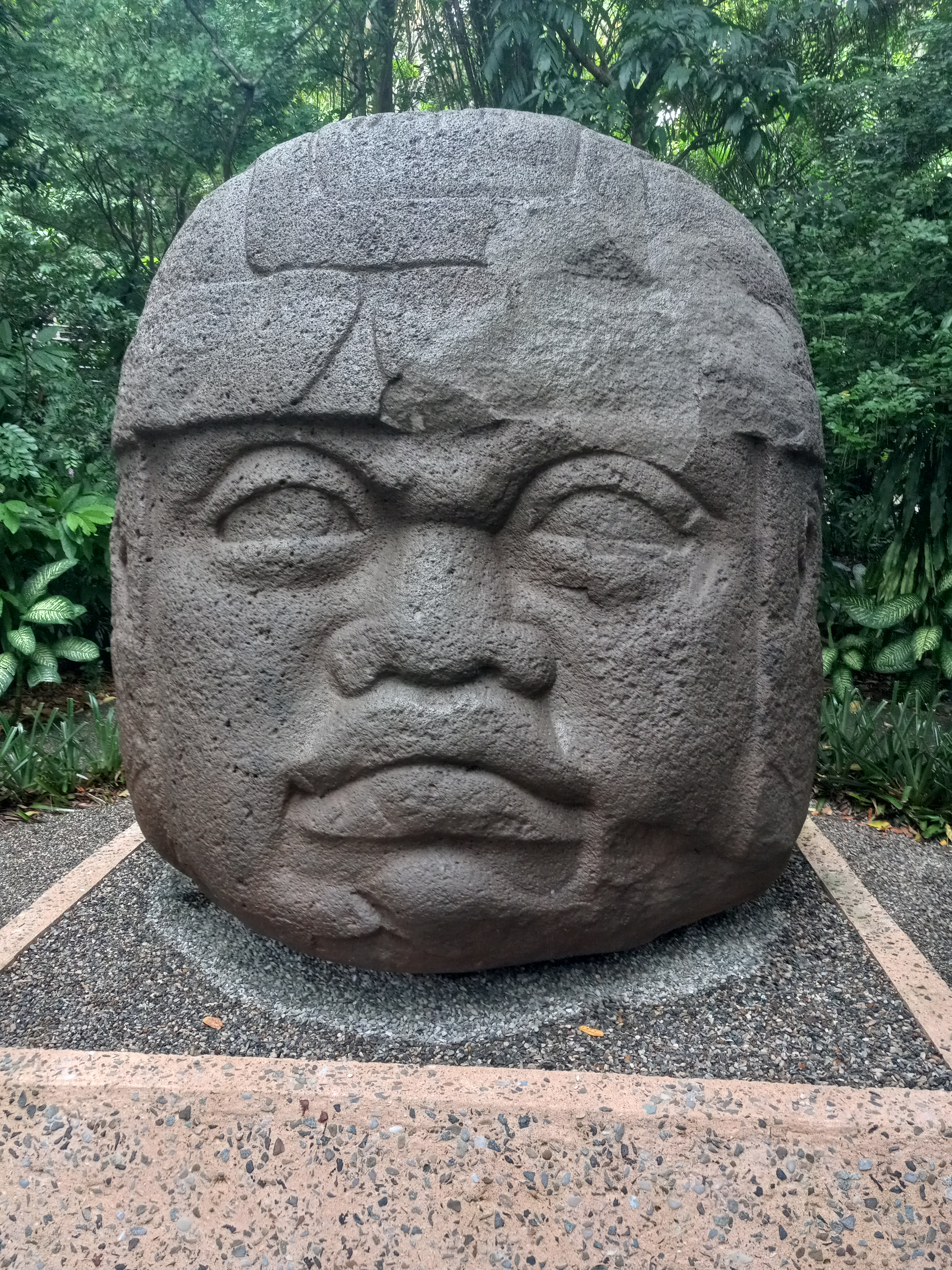
The Olmecs were the earliest known Mesoamerican civilization, and lived in the area of Veracruz and Tabasco. They thrived before the time of Christ and are most well-known for their colossal heads, giant stone heads, with broad faces, that were carved from boulders. I’d seen them on display but had never made a point to specifically visit Villahermosa. The park I was about to visit is a combination zoo and outdoor museum, with statues and altars from the Olmec era. To get there I crossed Laguna de las Ilusiones, or the Lake of Illusions.
Fortunately, the rain held off for my entire visit. The rune I had drawn to bring along and photograph was Wunjo, or the rune of happy endings. It did turn out to be a peaceful afternoon and a memorable walk, with few visitors to crowd the path. After passing one of the great stone heads at the entrance, I walked first through the zoo. There were a number of animals endemic to the rainforest; monkeys, turtles, both a spotted and black jaguar, crocodiles, parrots, snakes.
I then walked through the forested trail, past stelas, and figures, with names like the Walker, the Young Goddess, the Bearded Man, the Young Warrior, the Split Head, the Triumphal Altar, the Stela of the King, the Altar of Dialogue, and of course, the Colossal Head. There I stopped to take a picture of Wunjo, the rune of happy endings and serenity. It was hard to know how the trip would end, but it had been on track so far, not thrilling but productive, both interesting and informative.
 Haunted Rock