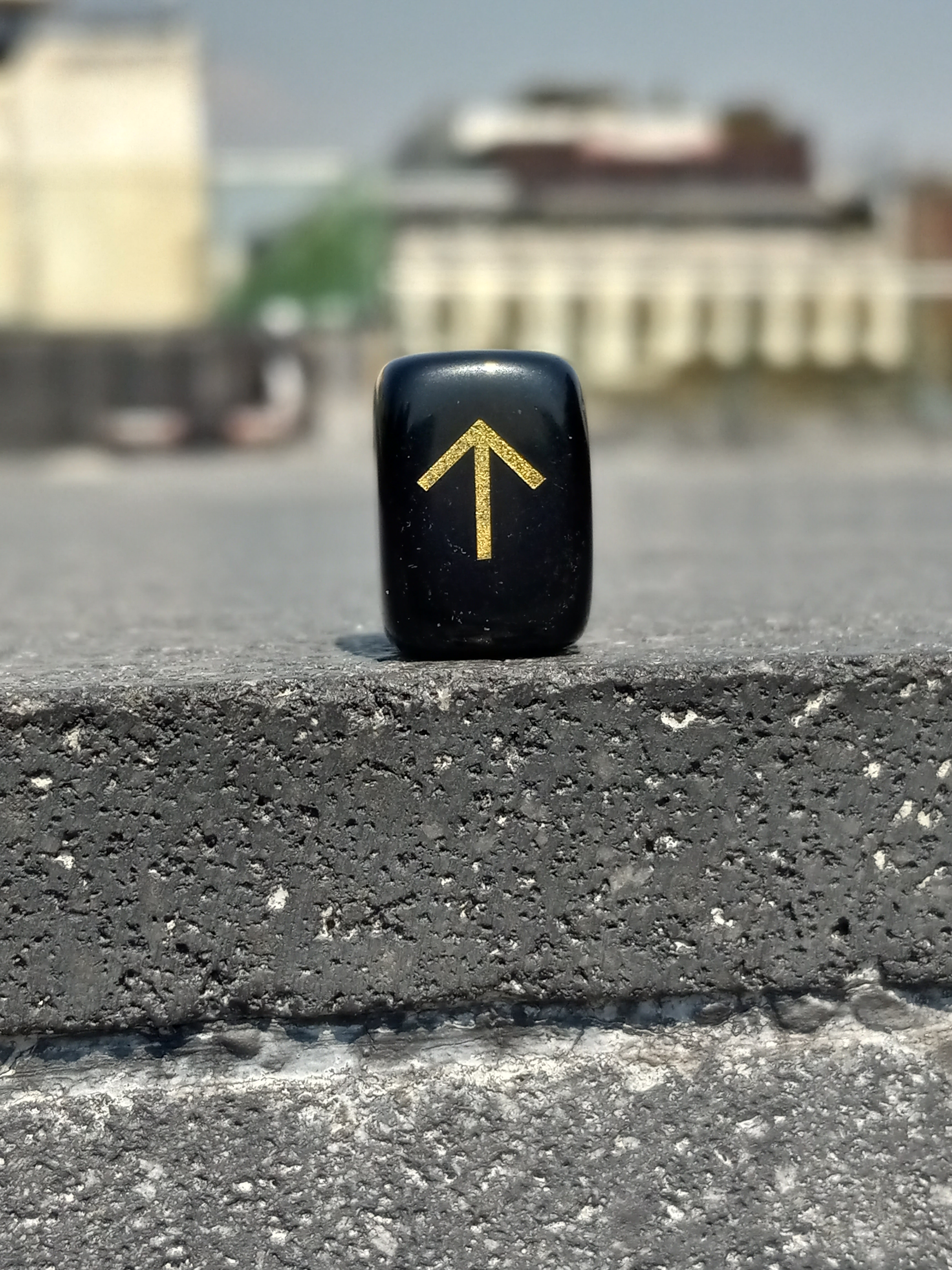
The rune that I had drawn that morning had been Tiwaz, or the rune that symbolizes commitment. I’d wanted to get an interesting picture of it, so had carried it to the Zocalo with me. After strolling through the ofrendas in the plaza and passing the Cuanderos once again, I headed over to the Templo Mayor, all that remains of the Great Temple of Tenochtitlan. The museum was closed but the ruins outside were free to explore. I set the rune of a stone wall and took its picture in the bright sunlight.
Tiwaz looks like an arrow pointing up and is related to the Norse god of war and the North Star. It represents a fight that needs to be fought, one that is just and necessary. It is a rune of promises and vows that are not to be taken lightly, a bond that cannot be easily broken. To draw this stone means commitment to a cause that you believe in. If you believe in it enough you will find the strength to carry on. Your chances at success correlate to the conviction you hold. Fight because you must.
When it comes to the healing interpretation, Tiwaz represents courage. What is courage? Not the absence of fear. No. It is moving on in the face of it, taking a leap into the great unknown when necessary. There is sometimes only a very thin line between courage and foolishness. I’d crossed it so many times it was hard to know which was which.
On this day, the rune spoke to me, embarking on a new project, willing to learn something new. If adventures came easy, everyone would have them. The fight to make art had given meaning to my life. Did it matter if it was giants or just windmills that I’d been battling? Perhaps, not. Call the adversary what you will, the war had been real. The damage couldn’t be just wished away, but neither could the insight.
On my first trip to Mexico City, many years ago, I’d spent my first night next to Garibaldi Square, the place where all the mariachis meet up to perform. I’d already drank two 40 ouncers when I ran into some young guys with a bottle of brandy and cigars. We’d gone staggering through the streets together, and one of the last things I remember is falling into some garbage cans, before waking up on the bathroom floor of the hotel with the worst hangover of my life.
Now I wanted to revisit Garibaldi, just to track down the musicians, not repeat my performance. It was just three metro stops away. I needed to take the blue line to the green line and transfer at Bella Artes. The underground Metro was a museum, both of ancient stone figures and modern street art. A group of pointed-head warriors, with bonnets and spears, stood in a line along one wall. A great mechanical god, born of pistons, stared out of another.
There was a mural of Juan Diego, the peasant who’d been instructed by the Virgin Mary in 1531 to build a temple for her. Gathering roses in winter to prove the miraculous nature of his claim, and then carrying them in his shirt, once he dropped the roses, the imprint of Mary remained. This image became known as the Virgin of Guadalupe and is worshipped to this day.
As I exited the subway, I passed a montage celebrating Mexican boxing, and then stood there blinking in the sunlight. Garibaldi Square was still five blocks away. It was a quiet day. Only one group was out, dressed resplendently in their three-piece suits and polished boots, despite the fact that they were only playing to a small group of homeless drunks that sat clustered around a bench. It must’ve been a charitable act that they were doing, playing for the bums, and when I passed by, I got cat-called by a man so wasted he could barely see straight. I walked over and paid for the next two songs and that changed his tone. He suddenly recognized me as a long-lost brother. My feet were already numb with pain.
There was a mariachi school and statues of some of the famous performers; Pedro Infante, Jorge Negrete, Jose Alfredo Jiminez, and others. Walking past the Museum of Tequila, I happened across a scuffle. A homeless man got into it with a teenaged boy, and then a man and woman ran out and attacked the homeless man. The three of them got the better of the vagabond, and when he was down on the street the other man kicked him three or four times in the side with his boots. Not something you see every day in Mexico City, but violence does happen.
When I got back to the hotel, I looked at a newspaper I’d picked up in the Metro. The first three or four pages were full of bloody corpses, those who had been executed in drug warfare or run down on the road. A famous actor had just been shot in the head by the police. A dead man was lying next to his bicycle, his entrails spilling on the ground. A mariachi lay dazed on the ground after a robbery attempt, red blood soaking his white tuxedo. Four bodies had been found, naked and tortured. Then I turned to a centerfold section where a blonde woman was showing her ass. Just like Day of the Dead, here was something to celebrate in the midst of all the carnage.
 Haunted Rock