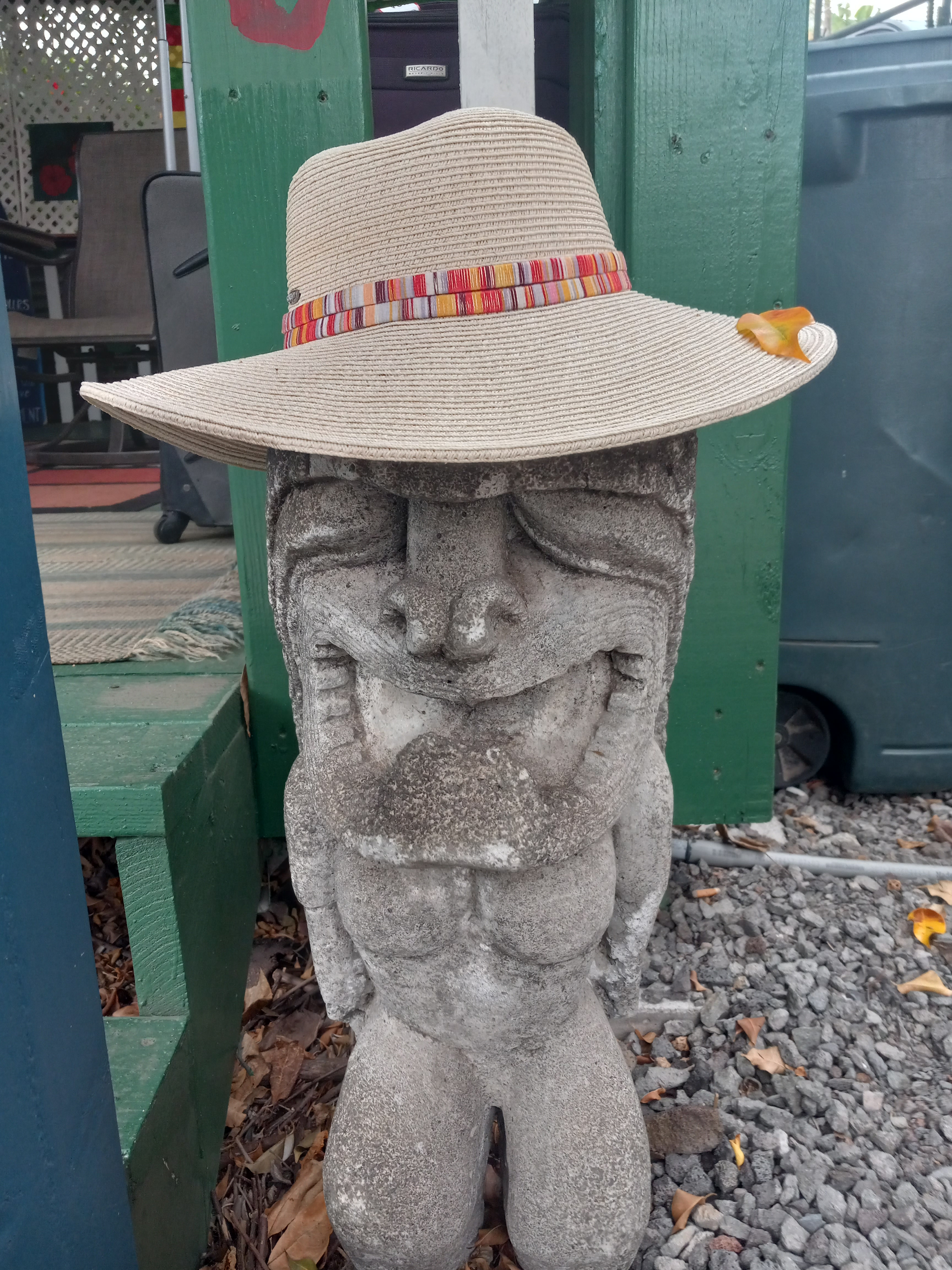
When my family was living in Palolo, the backyard opened up to jungle growing on the side of a mountain. There were a few trails through the trees. Walking through one of them my brother and I discovered a cave that was in the shape of a human skull. What intrigued us about it, was that someone was keeping it clean, sweeping the floor and piling stones at the entrance. One day when we walked up to visit it, we saw a vine swinging back and forth. We figured it was menehune, the invisible little people of Hawaii, who were taking care of the cave and swinging on the vine.
The mu and the menehune are the little people of Hawaii, similar, perhaps to dwarves and elves. The mu were hairy people, with bushes hair, beards and eyebrows, and round stomachs. They fed on plant life and bananas and would steal food from campfires by piercing it with a stick. The menehune were smooth people, about two feet tall, who also fed on plants and lived in caves. It may be that the stories about them derive from a time when the generations were shorter and stockier. They may also represent nature spirits, inhabiting the wao, or spiritual side of the mountain.
The menehune are credited with creating the fishponds and many of the early temples, especially the ones in hard-to-reach spaces. It is possible that the temples, or heiaus were constructed by workers passing the stones along hand to hand. It could also have been the mythical menehune working by night.
At one point the menehune began to intermarry with too many Hawaiians and were forced to migrate to preserve their blood line. None of the expert craftsmen were allowed to stay behind. Offerings are still made on some of the trails they are reported to have traveled on. Certain rocks are thought to be petrified members of the party and they are considered to have magical powers.
It was another weird night. I could only wish I was a kid again in the Palolo Valley, sleeping with my back to the mountain so the menehune couldn’t trouble my dreams. By now I was a middle-aged man, lost in the world, sleeping in a dorm room on the Big Island, filled mostly with German women and one other dislocated crank who suddenly shouted out in agony when someone started snoring. I’d seen the guy earlier, about my age, wearing Tevas and a floppy little beach hat, a loner among loners. Left to my own devices, I could pass myself off as another traveler. Two of us old guys in the same room made a crowd, however. I wished he would move on.
It had been my idea at one point to visit all of the major islands of Hawaii, but prices were at an all-time high and I wasn’t enjoying myself. All of my history was on Oahu and the Big Island, and if I decided to live in Hawaii, it would probably be on one of those islands. My exploration was drawing to a close and things didn’t look good. I had a little over a week until my flight back to Los Angeles. Unless something improved dramatically, I would probably fly straight to Central America and hunker down there while I looked for my next job. In the meantime, I booked a flight back to Oahu and another week at the Waikiki Beach Club, the first two nights in an expensive single, just because that’s all they had available.
I was comfortable in Kapiolani Park in Waikiki, and fit right in in Hilo, but Kona was too touristy, too many cruise ships and package tours going on. The closest match for me was as one of the homeless residents. I was just as dislocated, but not sleeping on the street. Two more days seemed like a long time to kill.
That afternoon I walked up to Honi’s Beach, where the boogie board was invented. On one day in the 1971, Tom Morey cut a nine-foot piece of foam in half, shaped it, and a new sport was born. By now it was clear I was staying out of the water and wasn’t sure why. I was just sticking to the ukelele, sitting by the ocean’s edge, trying to exorcise anxiety and gather some peaceful mana vibes.
 Haunted Rock