Although cannibalism was practiced in Polynesia at one point in time, it was largely as a revenge in war, or to take on the energy of dead relatives. Largely, it was outlawed. Although it wasn’t a part of early Hawaiian culture, there are some tales of famous Man Eaters, usually outsiders who migrated to the islands. In one such account a chief, Lo the Man Eater, arrives on Kauai with his people. They are darker than the Hawaiians and have no tapu laws. It is said that human flesh was devoured at their religious feasts.
Tattooed Lo has a beautiful daughter with hair down to her feet and sparkling teeth. She gets married to a chief of Kauai and is later put to death for breaking one of the tapus. In retaliation, the tribe of Lo have a cannibal feast and then flee to Hawaii. They base themselves in the mountains of Haupu where the chief’s servant builds a house on a high cliff. From this vantage point it is easy to throw travelers over the edge.
The wife of the chief witnesses her own brothers eaten by Lo, but the younger one escapes. He learns wrestling and returns to fight the servant. Both of them fall to their deaths and Lo and his people are forced to relocate once again.
There was nothing left to do in Kona but walk around some more. This time I walked south until I came to a bridge where a few locals were surfing in a channel. I sat and dangled my legs over the edge, absorbing the energy they put into what was once called wave sliding. It was forbidden for anyone but the royal family to surf back in the early days. To break this tapu was punishable by death.
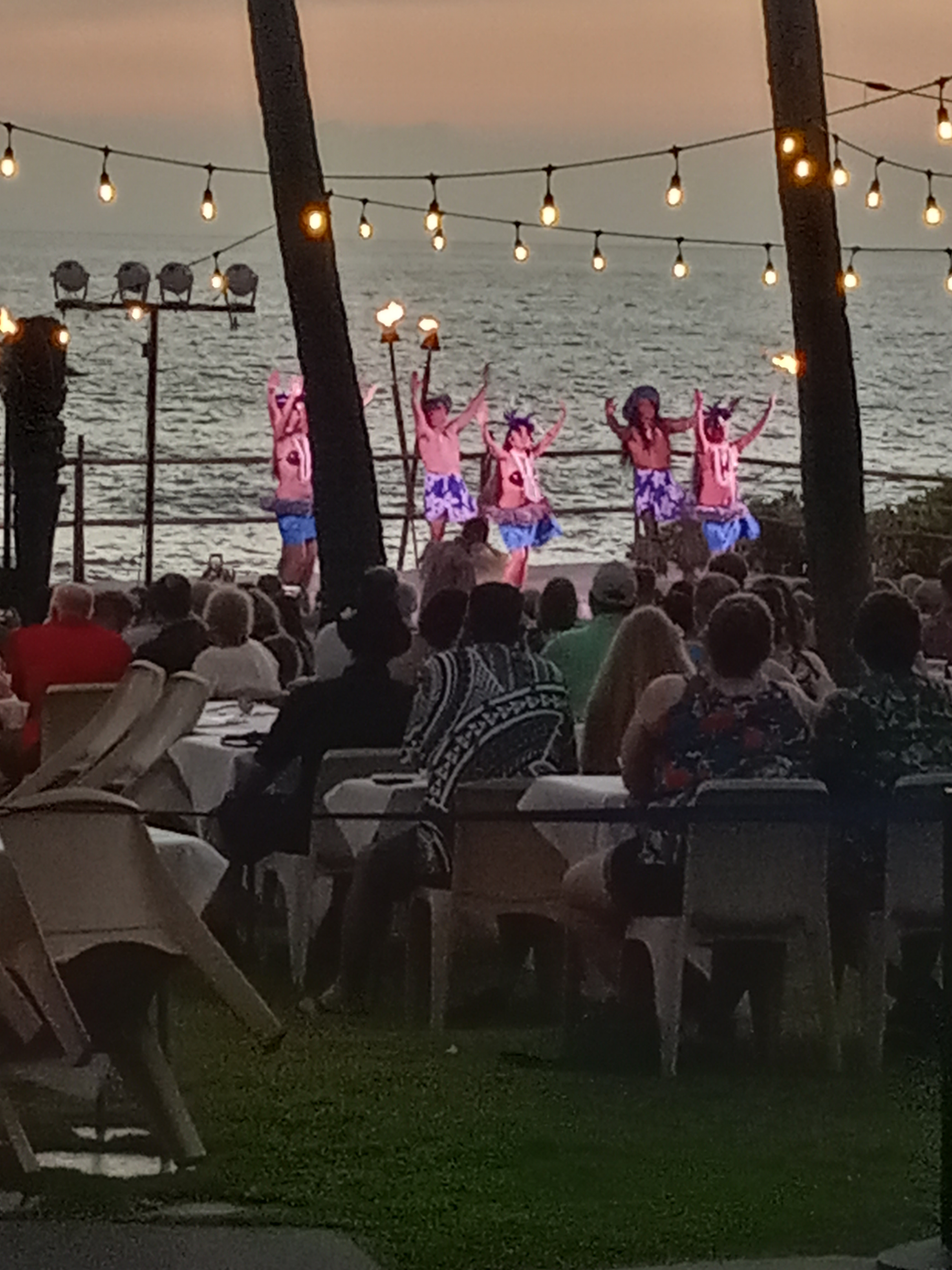
I returned to Honi Park for the sundown then started walking towards some music that was coming from the Royal Kona Resort. They were in the midst of having a luau. A luau is a Hawaiian tradition that goes back hundreds of years. It is a feast meant to commemorate either a special occasion or one of the gods. Women weren’t allowed to eat with the men until 1819, when Kamehameha II invited them to join. A luau is traditionally eaten sitting on mats or leaves. Often the food was eaten with the hands.
What I was witnessing was a version of a luau, the occasion being just another night at the Royal Kona. Tourists sat in plastic chairs at plastic tables and ate from a buffet. A dance troupe performed for them, doing the hula in the stage lights, later dimming the lights to dance with fire. I had neither the budget nor inclination to join. Instead, I walked over to an ABC store across the street and got a spam musubi and fruit drink.
That night I went and laid down as soon as it got dark. I was flying to Honolulu in the morning and glad to be getting away. There was a new guy in the bed above me who was drinking from a six pack. An hour later the old crank, with his Tevas and floppy hat, entered the room and got into bed. Almost as soon as he laid down the guy above me began to snore and the crank began to curse. Here we go again, I thought. By now I just wanted to get to Central America. My only plan was to go where I could get the cheapest ticket, possibly Guatemala. I wanted to get my own room and just stay inside it for a month.
An older woman came in during the night with a dozen plastic shopping bags. When I talked to her in the morning, I learned that she was hoping to relocate to Kona from California. She’d spent some good years in Hawaii in her early twenties and was hoping to recreate them. If the shopping bags were full of money, she’d might’ve stood a chance. If not, I didn’t know what to tell her.
 Haunted Rock