The next day I set out on the bus to Sandy Beach. It left from the corner of Kapahulu and Kalakaua. A couple were hoping it would take them to Hanauma Bay, but since I’d just researched it the day before, could assure them that it wouldn’t. The bus traveled up to Diamond Head and passed the Kahala Mall, places I’d recently revisited on the trip. It took the 72 to Hawaii Kai and then made a long circuitous route through a series of housing tracts, past the neighborhood where I’d stayed with my parents on our last trip to Hawaii together. It dropped me off down the road from Sandy Beach, and I walked the rest of the way.
Sandy Beach, with its pounding shore break, is one of the of most dangerous beaches in Hawaii. It is also known as Broke Neck Beach, as many people have been paralyzed and drowned while bodysurfing there. Although my father never learned to surf, he did go bodysurfing at Sandy Beach when I was a kid. One time I got pulled out by the current and he ran and snatched me out of the water. I probably would have drowned.
Later, I pulled a little kid out of the water when our class was on a field trip to Waikiki. It doesn’t take a hero to pull someone out of the sea. It’s just what we do. Let them die slowly on a sidewalk, however, and that’s a different matter.
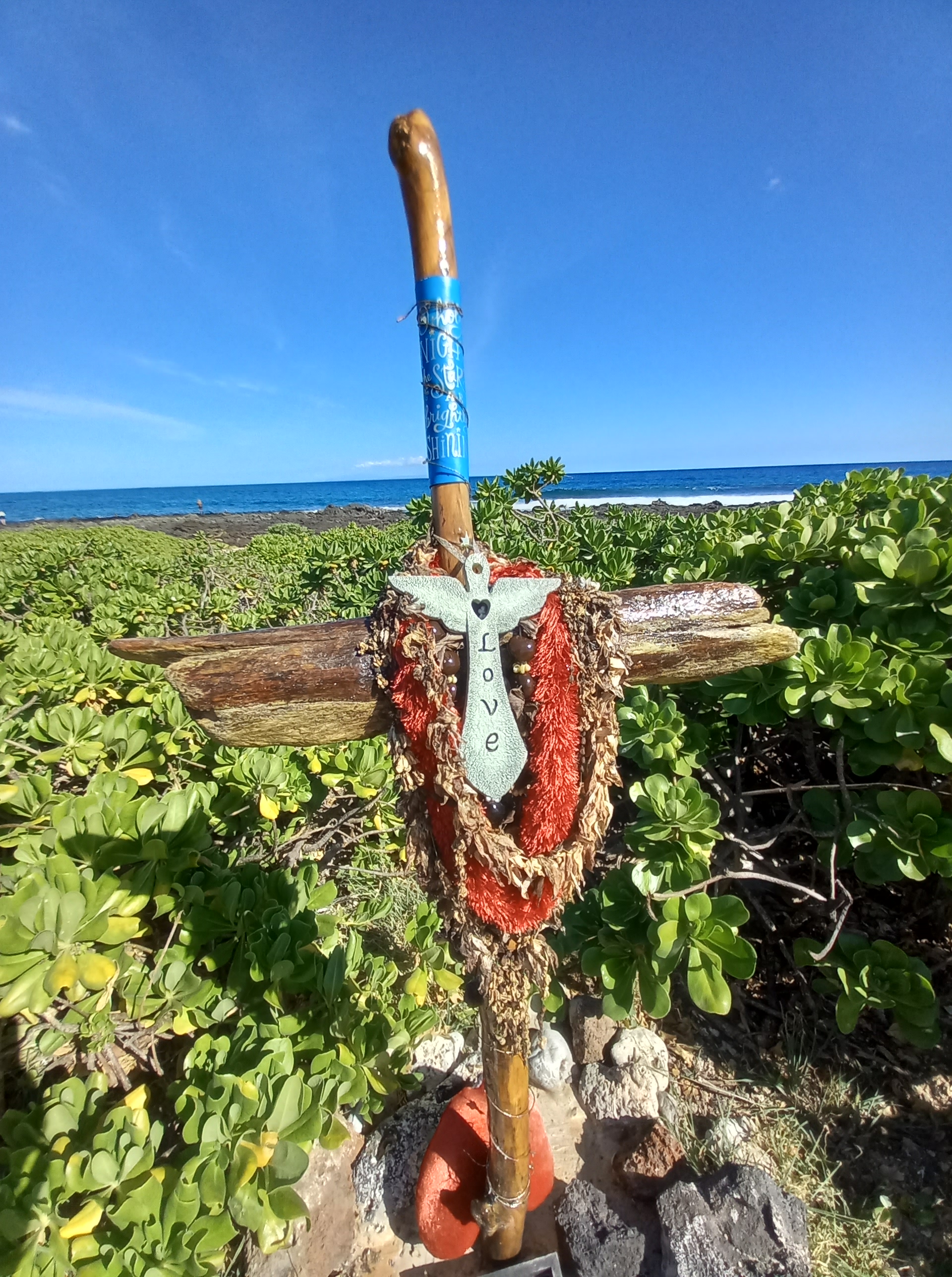
There were bright murals on the restrooms at Sandy Beach, a local in a red shirt and hat against a backdrop of fish, a woman with long flowing black hair and a flower tucked behind her ear, Ernie Cruz, playing his Aloha guitar, Duke with a pair of shades on, three tikis behind him, dolphins, a whale, and a sea turtle, all swimming out to sea. There was a cross on the shore that said love. I found a bench to sit and play my ukelele on.
Later, I started walking up towards the Halona Blowhole Lookout. The blowhole was probably my greatest single memory of our early years living in Hawaii. When the tide is high, the ocean breeze sends the waves through rock tunnels. One of them acts like a geyser, shooting a stream of water thirty feet into the air. We used to wait for it when we were children, never failing to get excited when it finally blew. I was still excited to see it blow. Someone had balanced rocks on top of each other, down by the water’s edge.
Then I remembered Umi Mamori Jizo, the Japanese shrine to drowned fisherman, a little way up the highway. It was still there, honoring Boddhisatva Jizo, the patron saint of children, women, and travelers. Someone had placed an offering of two oranges and some flowers in front of it. I was walking a lot and not drinking much water. I’d also been taking antidepressants like tic-tacs, popping a few here and there when my mood got too low to stand. Now I was dizzy, and the world was careening at my feet. I decided to call my mother, just to let her know that my trip hadn’t really worked out and I was on my way to Guatemala.
Just when she answered, however, I was momentarily distracted by another blowhole, off on the horizon, then a second and a third. It was humpback whales, migrating along the coast, just in time for me to tell my mother all about it. Now my disappointing trip suddenly seemed like a rare and exciting adventure. The presence of whales always has a way of dramatically altering any story line.
In Hawaiian mythology whales represent Kanaloa, the god of the sea, and are also seen as aumakua, or guardian spirits. It was the right time for them to make their presence known. Consider how much time a whale spends below the surface of the sea. Eventually, it needs to surface to breathe again and go on living. I’d been down a long time, but change was always around the bend.
My mother didn’t need to hear about my struggles and depression, not when there were whales breaching right beneath me. It was a good way to close out the trip. It left me believing that good things might happen in their time.
 Haunted Rock