If you look up the major tiki gods of Hawaii, you will find that the big four are Ku, the god of war, Lono, the god of peace and fertility, Kane, the god of life and light, and Kanaloa, the god of the sea. I looked up some of the carvings to see if I could identify which god was which. All four had similar squat bodies and scowls. Ku has a headdress that extends to his feet. Lono has a narrower headdress that rises to three points. Kane is a broader, more aggressive version of Lono. Kanaloa has more of a human, or octopus face, with a rectangular headpiece.
I’d brought along Hawaiian Mythology by Martha Beckwith, and she had written a chapter on each of the gods. I started with Ku, the male ancestral god who is married to Hina. He represents the sunrise and rising up in the East, while she represents the sunset, or leaning down in the West. Between them they represent the whole earth and all the generations of mankind. Ku reigns over all of the male spirits and Hina presides over the female ones.
There are many subordinate gods, such as Ku-mauna or Ku of the mountain, or Ku-kaili-moku, Ku snatcher of land. Similarly, Hina-ulu-ohia, would be Hina of the growing ohia tree. Every situation and form in the natural world is assigned either a male or female form of divinity.
When James Cook arrived on the islands in 1778, he found that the priests assigned to the worship of Ku were responsible for deciding where the heiaus, or altars to the god, should be built. They were in charge of both the sacred locations, and also knowing if an altar needed to be replaced or just repaired. A typical offering to Ku might be pigs, coconuts, red fish, white cloth, and quite often a human. Ceremonies might last up to ten days.
My goal for the day was to climb to the top of Diamond Head. I knew it got hot in the crater in the afternoon, so set out while the day was still early. It was two and a half miles to get to the trail head and there was an electronic ticketing booth that only accepted credit cards to get in. I learned this the hard way a few days earlier, after showing up with only money and getting turned away at the gate. The world was changing every day, rarely for the better.
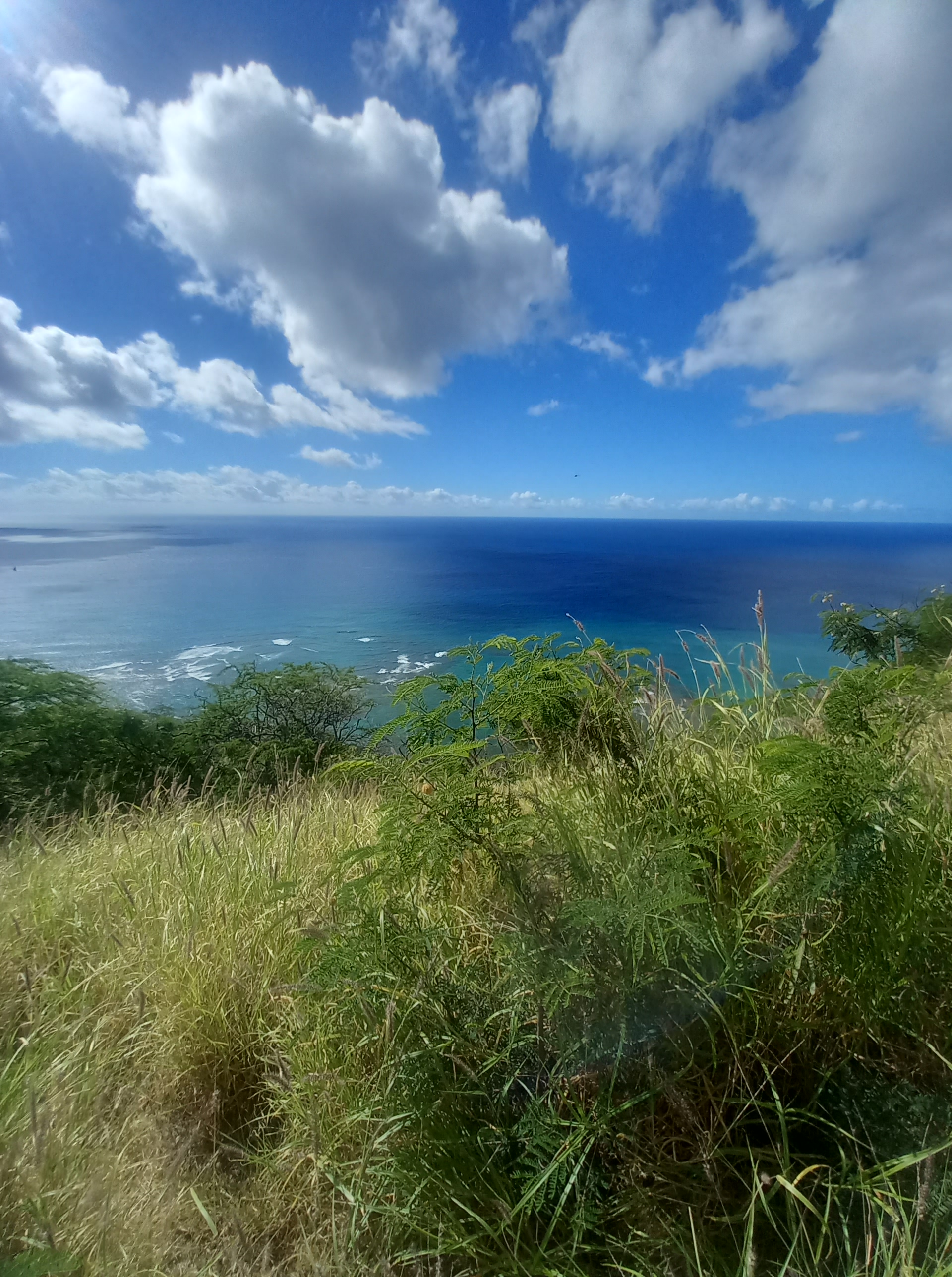
The hike to the summit of Diamond Head is nearly a mile and ascends 560 feet, up a steep flight of stairs and through a dark tunnel. There were many tourists out hiking that day. A strong breeze was tugging at the tall grass beside the trail and white clouds, like the sails of ships unfurled across the sky. My legs started to get wobbly near the top. I climbed into one of the bunkers carved inside of the mountain, and sweat began to pour.
Pushing my way to the overlook at the very top I saw the guy from the hostel with the 12 pack of PBR in his locker, now taking pictures with a giant zoom lens. They might have been worth something. The view was amazing, all shifting green grass, blue sea, blue sky, the clouds contracting and rearranging, like the thought patterns of some great ancestor.
On my way back from Diamond Head, I decided to stop by the zoo. It remained a favorite memory from childhood, seeing the flamingos, monkeys, and elephants, afterwards getting a shave ice with ice cream. Now I was returning as a borderline homeless man, his shirt soaked in sweat, hoping there was still some innocent enjoyment left in the world. The flamingos were still there. The elephants were still there. I tracked down an orangutang who sat beating the ground with a spoon. On this day I passed on the shave ice, having already spent twenty dollars just to get in.
Some folks complain about how animals are treated in a zoo, but people often get treated worse. At least animals in a zoo don’t need to worry about where their next meal is coming from. Back out on Kalakaua Avenue I saw a guy digging through the trash, looking for something to eat. With kind of freedom is that?
 Haunted Rock