In the morning, I lay in bed later than usual. I felt the bed shaking and knew that Jerry was climbing down from his perch. There was a couple that were just moving into the room. It was their first time in Hawaii, and they were on their way to pick up a rental car. Jerry started giving them advice on places to visit, and soon I heard him volunteering to come with them and drive the car for them, since he knew his way around Oahu. This led to an incredibly long pause and then a series of stammering thank yous and apologies, as they struggled to come up with excuses for why that wouldn’t work.
My plan was to visit the Bishop Museum, but first I needed to read another chapter about Hawaiian mythology. No one was using the hammocks in the kitchen, so I sat down and got busy. When American missionaries first came to Hawaii in 1820, they found that Kane, the god of procreation and the ancestor of the chiefs, was the leading god. He, in conjunction with Ku and Lono, founded the three worlds, the upper heaven of the gods, the lower heaven of earth, and then earth itself, as a garden for men.
The story of creation is very similar to the one in the Bible, probably due to the influence of the missionaries over time. First, there is only darkness, no heaven or earth. Then the three gods create light and fashion the earth and everything in it. Next, they create man and woman. Finally, man breaks the law. Kane goes to heaven alone and people stay on the earth.
An altar to Kane is usually a single conical stone, often in the shape of a phallus. It may be one to eight feet high and is usually surrounded by ti plants. Here families came to pray to their aumakua, or family god, praying for forgiveness and protection. The stone would often be covered with a bark cloth and sprinkled with coconut oil.
Prayers were offered as chants. A scaffolding and three stages were erected at the temple, or heiau. The three stages were meant to represent the earth, the heavens, and some far-off place. Only the high priest and chief had access to this highest of stages. The whole structure was covered with a white cloth and prayers were offered at each step going up.
Like Ku, there are a host of lesser gods that share the name of Kane. Kane-i-ke-ao would be Kane of the dawn. Kane-i-ka-ua would be Kane of the rain. There is Kane of the whirlwind, Kane of the rainbow, Kane of the cloud above, Kane of the heavenly star, different Kanes for different clouds, different stars, different elements, and situations. God was in everything to the Hawaiian people.
The Bishop Museum was founded in 1889 and has the largest collection of Polynesian artifacts in the world. To get there, I first went to the ABC store and bought a five-dollar bus pass. Then I walked up to Kuhio Avenue and took the number 2 bus, across the Ala Wai Canal and over to downtown, turning left on King Street. We passed Iolani Palace and the Hawaii State Capitol, then voyaged through China Town. From Liliha Street we took a left on North School Street, and soon after arrived at the museum.
Although there is also a Science Center and a Planetarium on the grounds, my interest was mostly in mythology and history, so I headed for the Hawaiian Hall. The three floors here are divided in a similar way to native cosmology, with the first floor, Kai Akea, representing Hawaiian gods, legends, and beliefs, the second, Woa Kanaka, being the realm where people live and work, and the third, Wao Lani, reserved for history.
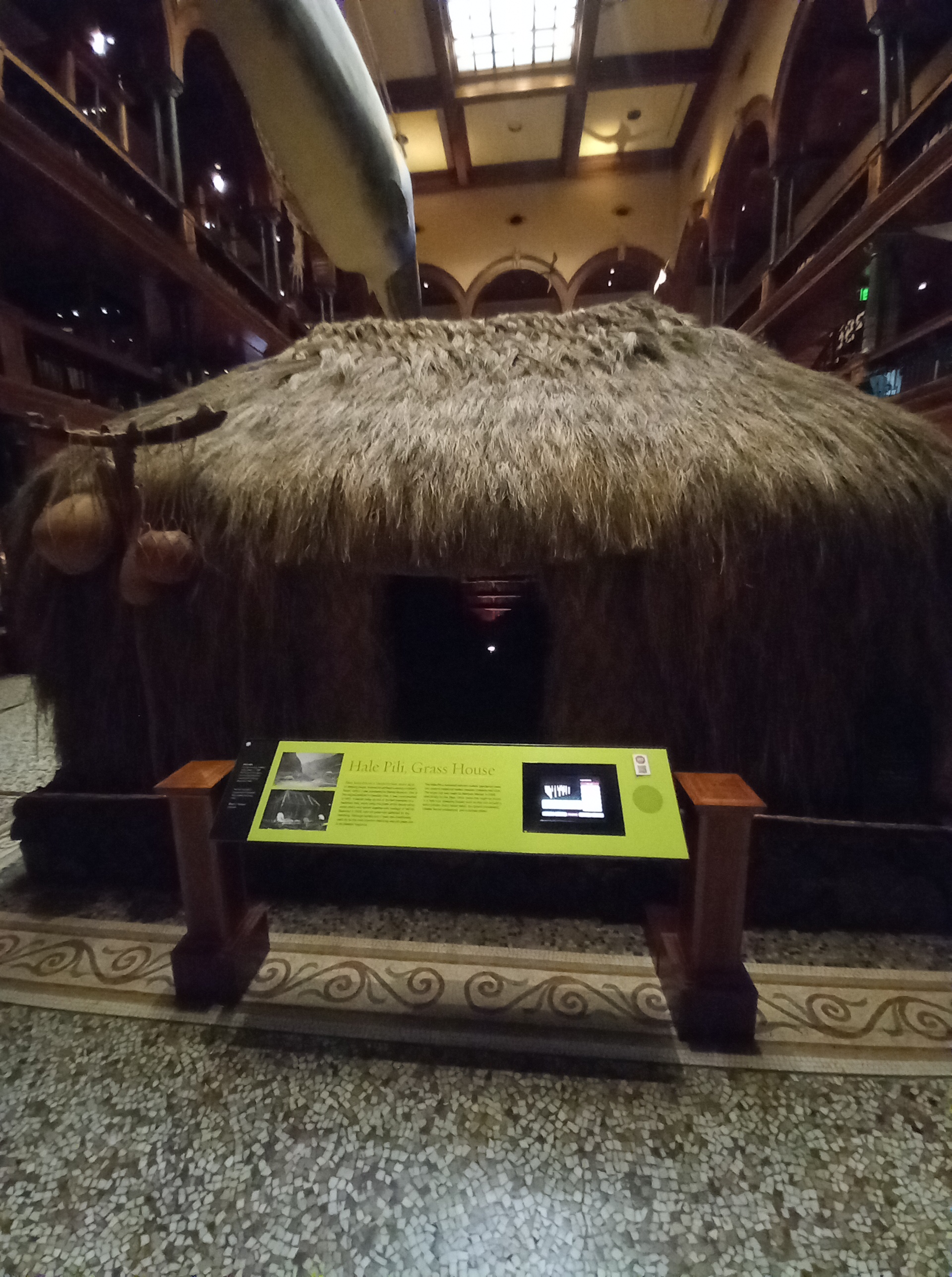
I went around to the exhibits and read up on Kane, the life giver, Ku, the protector, Lono, the people’s god, and Kanaloa, the god of the sea. The representations of the gods went beyond the typical tikis. There were black dolls with wide-eyes in loin cloths, stone heads like those of Easter Island, erect phalluses, rough wooden masks, long poles, intricate carvings of family guardians, goddesses with pointed breasts. In the center of the room was a grass house with gourds out front. There was a model of a temple and a large great white shark, suspended by strings.
On the next floors were exhibits on folk healing, hula, and melee, or songs. There was a guitar that had belonged to Liliuokalani, the last Hawaiian monarch and composer of Aloha Oe. There were also the red and yellow feathered cloaks and hats that had been worn by royalty, and in the Kahili Room, the feather staffs of the royal family accompanied by oil paintings of the nobles in the Kamehameha family tree.
To be a Hawaiian back in the day, meant knowing what class you were assigned to and what was expected of you. It was a far cry from my situation, not knowing where I belonged or what to do next. On the bus on the way back to the hostel, I was behind some old drifter, who sat with his head collapsed in his hands as we whisked past chain-link fences and trash.
Outside of a gas station, beneath two coconut trees, was an enormous homeless residence, a plastic structure stretched over an abandoned mattress, two shopping carts and a baby stroller, loaded with junk outside. On the corner was another makeshift structure, cardboard, and tarp, one shopping cart, two bicycles locked to a fence. A woman lay on a cardboard box. A man sat hunched over at the bus stop, with a jacket over his head and his belonging sprawled on the sidewalk in front of him.
 Haunted Rock