In addition to the four primary gods; Ku, Lono, Kane, and Kanaloa, the Hawaiians believed in whole pantheons of lesser gods. There were the four gods, the four thousand gods, the forty thousand gods, and so on, and so on. Martha Beckwith makes an analogy to a tree, the trunk of the tree, the branches, the twigs, the leaves, the cells within the leaves. There were the primary gods that made the heavens and earth, and then a numberless body of spirits, the spirits of the air, or uhane lewa, and the spirits of the dead, which have become aumakua, or guardian spirits, for their relatives on earth.
Every physical form on the planet is seen as a manifestation of spiritual forces. Since every object has a spirit that may either do harm or be of help, every object is to be worshipped. Each object or animal has a guardian spirit, which is something of an archetype for that variety of being. The rocks are gods, the birds are gods, the rainbows are gods, every natural force and phenomenon contains some trace of divinity. In short, all creation is sacred.
There is a diving tower on Coconut Island that was built for sailors to practice their dives. One of the launching pads is from ten feet and the other is from twenty. On this blustery day, I climbed to the top and sat dangling my legs over the edge, playing my ukelele songs to the sea, to the banyan trees, to the dark clouds, to the flowers, to fish, to the stone lanterns in the Japanese garden, until a family of tourists showed up who weren’t there to hear a concert. They were there to visit the tower.
It was too stormy for anyone to jump in the water or swim around the island, but I knew the kids wouldn’t be satisfied if they didn’t get a chance to scramble up, so I ceded my position and began walking back towards Hilo. On the way I stopped for a plate lunch at a fish market, and as soon as I sat down to eat my loco moco, it started to rain, as hard as it is capable of raining, anywhere, at any time. I continued to have small luck, luck that I didn’t get poured on, luck that I got the lower bunk at the hostel, luck that I should be in Hawaii at all, not big luck, like having enough money or getting someone to cover my songs.
As soon as I finished eating, it stopped raining. I walked across the highway to the park at Waiakea Pond. The buildings and houses that had once been built on the land had been wiped out by a tsunami in 1960, so they’d created the park, with a few whimsical rolling bridges. As hard as it had been raining, it was now that calm. I walked over one bridge, like I was moving through a dream land, and saw the heavy blue and grey clouds reflected in the green water.
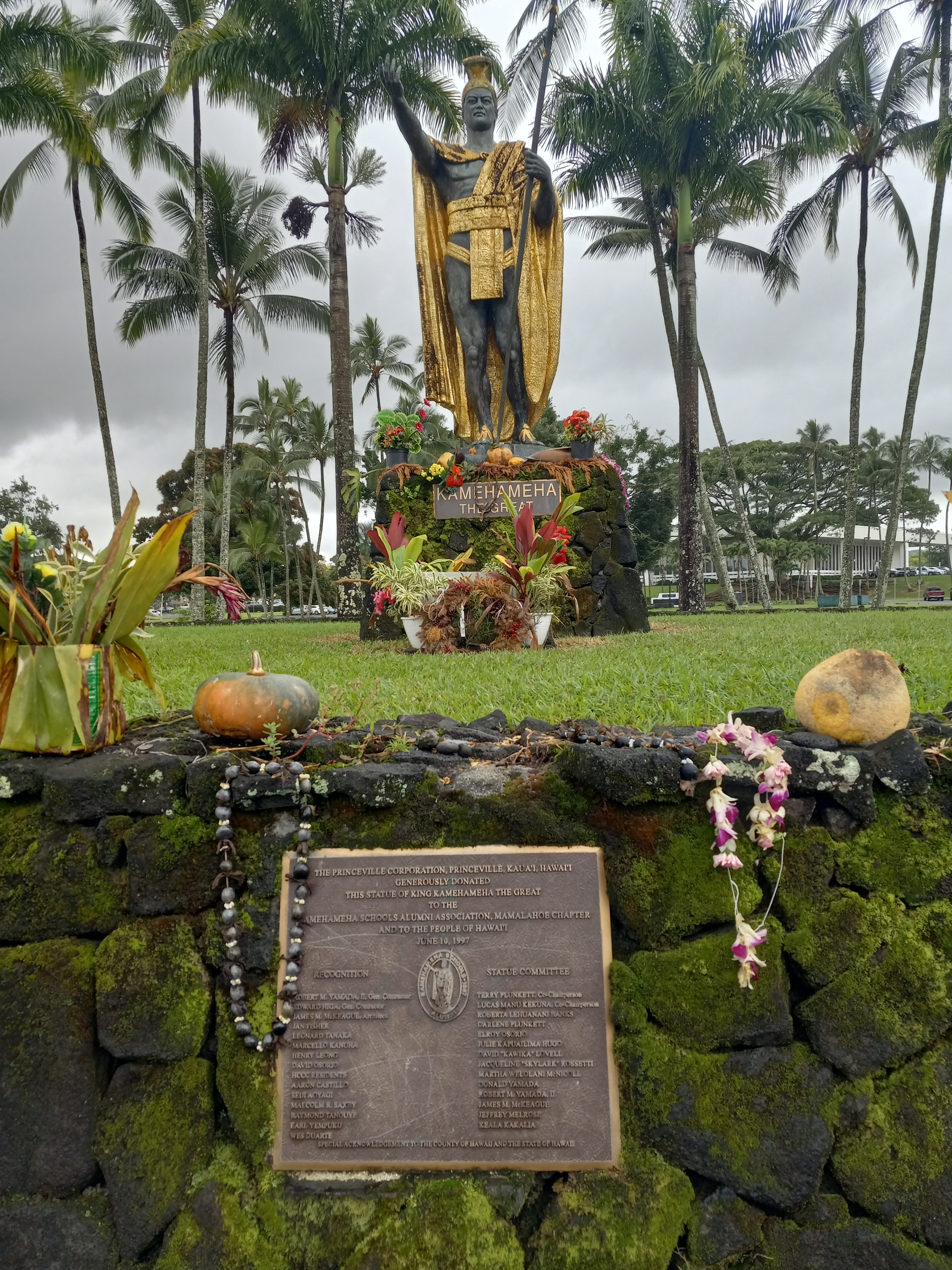
It was not far from there to the statue of King Kamehameha, the first conqueror and ruler of the Kingdom of Hawaii. Hilo had been an important place to him, his first official capitol after unifying the Hawaiian Islands and also where he built his fleet of war canoes. The statue is fourteen feet tall. Kamehameha wears a gold helmet and robe and clutches a spear in his left hand. His right hand is reaching out in front of him. There were offerings in front of him, leis, shells, gourds, flowers in vases.
Walking back along the beach I came across a homeless encampment, where someone had pushed a shopping cart out onto the black sand. They’d cleared a space to sleep in, in a confinement as narrow as a coffin, and had a tarp to pull over them. It was only early afternoon and the black clouds were rolling in again. I hurried back to the park close to the hostel where I’d started from.
There I noticed I sign warning that a shark had recently been spotted in the water. It also said no camping. It was hard to call what the people on the beach were doing camping. The danger they were in didn’t come from any shark.
 Haunted Rock