With the addresses for all the places we’d lived at in Hawaii, the one I wouldn’t be able to track down was the one in Kona, since all I had for it was a rural route number. Although it was a long time ago, I still had many memories of the commune called the House of David. There were a lot of spaced-out hippies living in that house. Not all of them knew how to deal with children.
I remember driving into town and waiting outside of the post-office in the car one day and seeing a guy coming down the street towards me, so bald and strange, with a big, hoop earring, that he seemed to be an alien. Now a sight like that wouldn’t even phase me, not like looking into a mirror, which would shake me to my core.
We could fit a lot of people into one house back in the day, but nothing like what the Kona Beach Huts hostel was squeezing into one room. I was glad that Kamapua’a, the Hog Man, had moved on, but another strange old guy had just moved into a bunk across the way. There were four German women taking up most of the other beds.
One of them told how it was very strange. In Europe if you stayed in a hostel. it was mostly young travelers. In Hawaii, half the bunks would be taken up by old guys lying in bed. I wasn’t sure if she was confiding in me or complaining about me. The truth hurts and I was one of them. What I wanted more than anything is to have my own room for a few days so I could shut the door and just stay inside.
That morning I went out with my ukelele and tried to meditate on a sea wall close to the hostel. A guy was trying to snare a crab. I took a deep breath and felt the mana of the sea fill my lungs. For two and a half weeks I’d managed to play ukelele at least six hours a day and I wasn’t improving at all, just playing the same rhythm over and over, tinkering with a song I’d started on one of the first days. There was a sound I could hear in my head, a dark, frightening, urban hula, a paradise gone to seed, the good vibes of the innocent days capsized by cruel invaders.
Instead of sitting in the sun, swimming in the sea, taking long nature hikes, I was experiencing the seedy, gritty side of the islands. Not even knowing what to do with myself, I walked towards the old airport where there was supposed to be a beach park. I wasn’t even wearing flip-flops. Sweat was filling both my shoes. When I got out there, I went to sit down by a baseball field. As soon as I started playing my ukelele, a hobo crawled out of the dugout and asked me for a smoke. Then I looked on the backside of the hill behind me and there was a whole tent-city of displaced people. One of them rode towards me on a bike with a Hawaiian flag streaming behind him.
That afternoon I got out my book and read about the great flood. There are many stories from Hawaiian mythology that resemble myths from other countries and cultures, but this particular one, about a man named Nu’u who builds a large boat with a house on top of it to survive a flood, made me think that someone must’ve gotten a hold of a Bible at some point. In this version, however, Kane, Lono, and Ku send him outside after the rain has stopped, and he finds himself on the summit of Maunakea. He begins to worship the moon until Kane stops him and informs him who is really due the praise. He goes on to have three sons and repopulate the land.
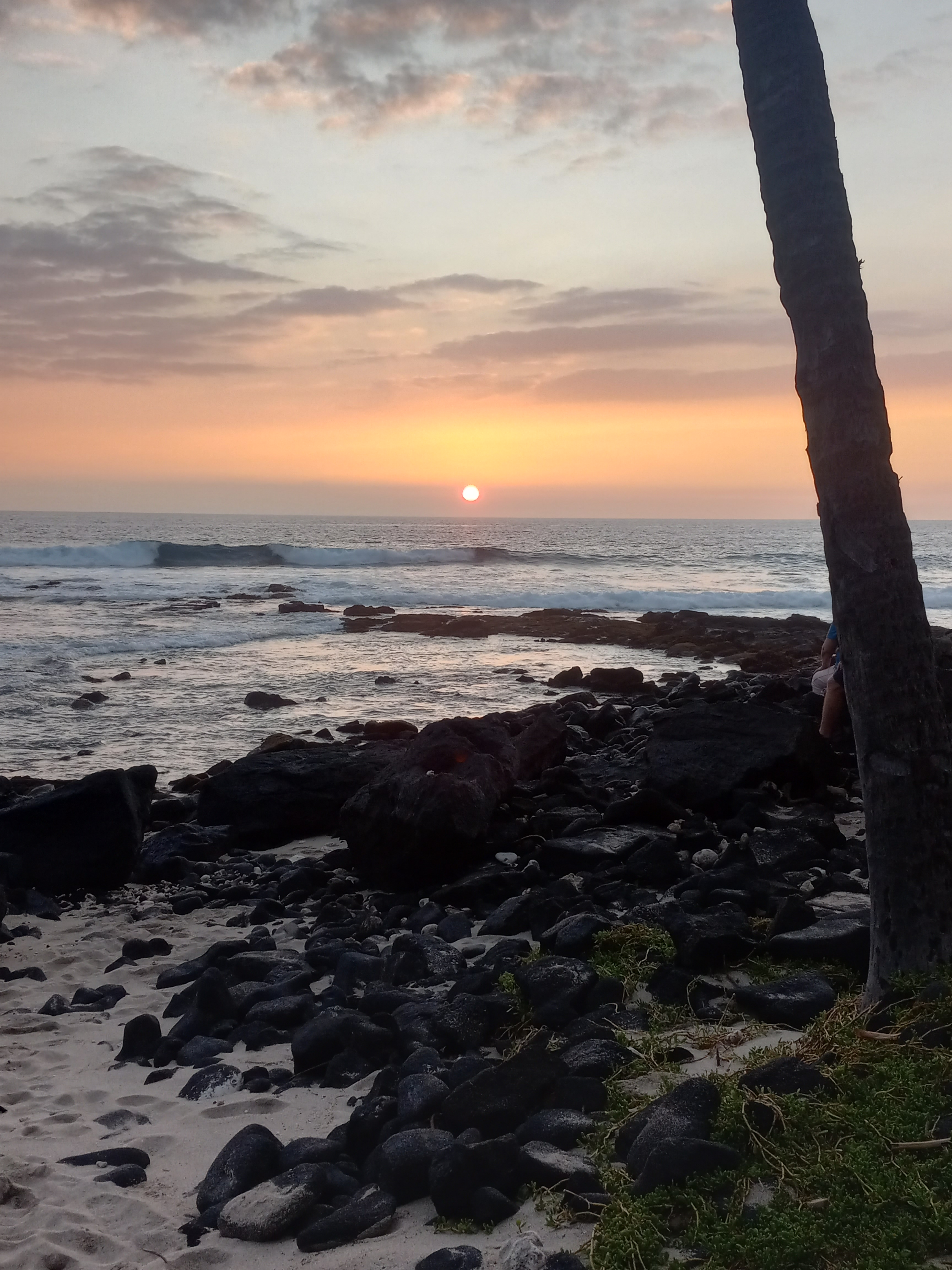
Towards sunset, I walked down to the beach, away from the crowds who began to line up on the main strip a half hour beforehand. The beauty of Hawaii defies imagination. On this night the sky was purple and pink, and the surf was turquoise with pink highlights. Pay what you like, you couldn’t witness a finer sunset. I sat on a chunk of black lava and watched the pinpoint of light that was the sun sink down into the sea.
 Haunted Rock