That night when I got back to the hostel there was an old man lying in the rollaway bed next to me, looking like a mummy that had been unwrapped from his bandages. There were snores pouring out of his mouth like ancient curses. At the same time, some local street buskers had set up shop right beneath the window and were making as much commotion as the Bremen Musicians, that odd assembly of a donkey, dog, rooster, and cat, who struck out to make it as musicians and had frightened a houseful of robbers, leaving them with a fortune in gold to divide between them.
The musicians beneath our window may have divided a fortune of meth, what with all the caterwauling, but nothing more than that. My hope was that at least they’d wake up the old man, but he kept right on accompanying them on his buzzsaw.
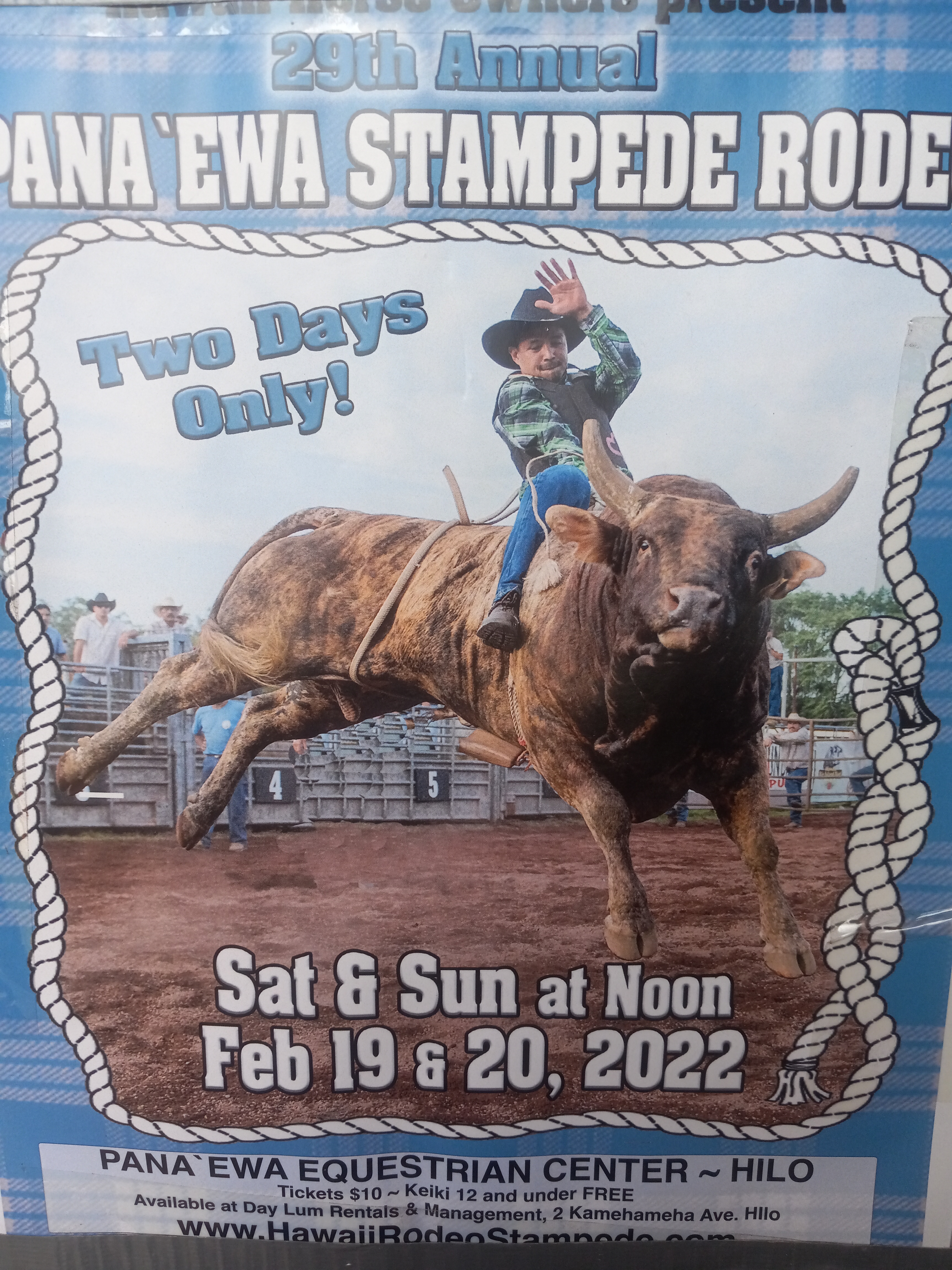
That was a bad day to wind up so tired because there was a rodeo that I was planning on attending, the Panawea Stampede. The first vaqueros, or cowboys, were brought from Mexico to the Big Island in 1823. They were called Espanoles, from Spanish, which later became paniolos, or Hawaiian cowboys. Earlier, an English officer had gifted King Kamehameha with six cows and a bull, and over time their descendants ran amok, destroying crops and damaging villages. The cowboys were brought over to bring the population of wild cattle under control and help usher in the beef industry.
Paniolos developed their own unique heritage, a mixture of Hawaiian, European, Latin American, and Asian cultures. In 1908, three paniolos competed in the American rodeo championships in Wyoming, and one of them, Ikua Purdy, became the champion steer roper of the world. Paniolos were also responsible for the slack-key guitar style, coming up with different tunings on the guitars that were brought over by the vaqueros, and embellishing on falsetto voicings to create something uniquely Hawaiian.
When I announced my intention to walk to the rodeo that day Joe and Seth were impressed by my resolve, seeing that it was over six miles one way. Both of them had been in Hilo for years and hadn’t made it there yet. The old man, Ryan, was sitting there with orange juice and donuts. He hadn’t been to the rodeo either but he had been in the Armed Forces. He started talking nonstop, just like he’d been snoring that night, but then he flashed me a toothless smile and I saw that he was kind. Later, I learned his wife was in the hospital and grew to like him.
To get to the rodeo, I took Kilauea Avenue past the pond and the university, past the golf course, and finally onto the 11, where I walked beside the freeway another mile. Another half mile and I came to cars and trucks parked beside the road and people walking to the rodeo grounds. It was ten dollars to get in and they were requiring COVID masks. I put one on, like a black bandana, and went to sit down on a grassy mound where a group of keikis, or kids, in cowboy hats were making their own tug of war contest with a rope.
There were bleacher seats that were mostly full, so after resting up a bit, I got to my feet and walked around. They had some kids come out and do some dummy roping, and then there was barrel racing. After that was an event unique to the Hawaiian rodeo, double mugging, where one cowboy on a horse ropes a steer, and another on foot wrestles it to the ground and ties its legs. A few times the roper missed and they ended up chasing it clear to the other end of the arena. By that time the runner would be all tired out and have difficulty lifting the cow off its feet.
It would’ve been a perfect day to be with some family or friends. Watching the children running around cavorting in their cowboy hats made me realize how much I’d missed out in life, chasing a dream that really hadn’t come true. The days had all been long, but the years had gone by fast. They called for an hour intermission, but while I was standing in line for a chili bowl, I saw that black clouds were welling up on the horizon. If I left early, I’d miss the bull riding, but if I stayed, I risked getting stranded and soaked. In the end, I started walking again, just because I was so lonely.
By now, my feet were killing me. After following the 11 Highway back to Kilauea, I had to be careful because it was a narrow, one-way road for a short stretch and the cars wouldn’t be expecting a pedestrian. By the time I made it back to town, I was limping like I’d been bucked off by one of the bulls, when all I’d really done is walked thirteen miles. They say growing old isn’t for the faint of heart. Not like that it isn’t. Not like that.
 Haunted Rock