Maui is one of the most popular characters to come out of Hawaiian folklore, a trickster and hero, rather than a god, who accomplishes great feats that serve to better the condition of humankind. Some of his exploits are similar to those of Prometheus, Atlas, and Hercules, in Greek mythology. He is born after the goddess Hina goes searching for seaweed and finds a loincloth that she puts on. After falling asleep in it she becomes pregnant. When Maui is born, her husband, Akalana, recognizes the divinity of the child.
These are some of Maui’s most famous deeds. First, he gets fire for man from the mud hens. They are roasting bananas, but every time he gets close to them, they put out the fire. They try to trick him when he demands that they show him the source of fire, but finally show him the right sticks to rub together. Before leaving them, he smears red on their heads for trying to get the best of him.
Next, he is able to stop the sun from moving so fast across the sky. He does this by sitting by a tree trunk and lassoing the sun’s rays. The sun begs him to let it go, and in return makes a bargain to travel slower during the summer, thus insuring longer days. He also pushes the heavens up from the earth for a woman in exchange for a drink from her gourd.
Once when he is fishing with his brothers, he throws out his magic fish hook and catches a giant ulua fish. They fight for two days to bring it to the surface, but look back at the last minute and the line breaks. Instead of one big fish, they wind up with a string of smaller ones. That’s how the Hawaiian Islands were created.
As far as I was concerned, my ukelele was my magic hook, but I was far from accomplishing great deeds with it. Mostly I’d spent the trip isolating, facing the waves, facing the jungle, trying to escape from others, escape from myself. What is the worth of a song if no one hears it? I’d spent my whole life trying to answer that question. Does art have any value if there is no one to receive it? I grabbed my ukelele and trudged down to the shore.
On this trip I suspected that I might be in trouble, so I’d brought along a bottle of anti-depressants that had only kept me up for nights on end a few months earlier. I couldn’t afford to go down the tubes right now and lose all confidence. I still had a week and a half to try to figure out some way to stay in Hawaii. It wouldn’t work to run around frowning and scowling, but that’s where I was at.
A few nights earlier I’d started taking the pills, but now, walking down Ali’I Drive with my ukelele, I suddenly got so dizzy I thought I was going to pass out. I stopped at a park and lay on my back on the grass, staring up at the coconut trees swaying above me. It was like a death scene in a movie, seen through the eyes of the victim. I was ready to let go and go floating up into the clouds, but it wasn’t my time yet. Life had more torture in store for me.
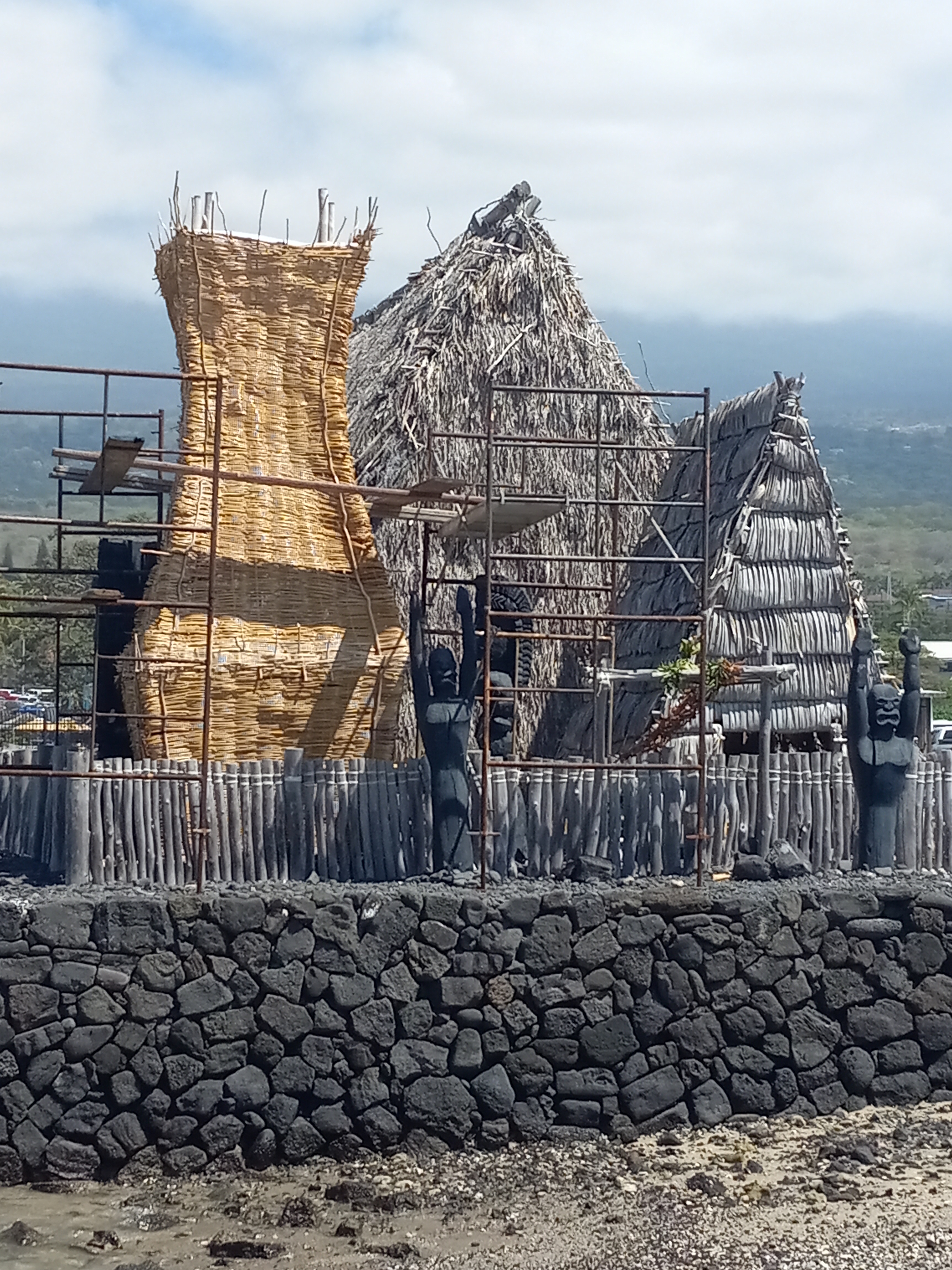
Eventually, I struggled to my feet and continued down to the Kailua Pier, where the first missionaries arrived in 1820. There, across from the King Kamehameha’s Kona Beach Hotel, was the Ahuena Heiau, a recreation of a temple dedicated to Lono by the king himself. It was similar to a temple that I’d wanted to revisit at the City of Refuge, but without a car had been unable to. The temple was closed to foreigners, so I had to stand and look at it from the shore.
On a stone platform are three structures. The Hale Mana is where the king met with his advisors. The Hale Pahu housed the ceremonial drum. The white tower, ‘A’nu’u was where the priests prayed and received answers from the gods. There are various tikis outside of the building, the tallest being the god of healing.
In their early years in Hawaii, my parents worshipped like natives, in that they were moved enough by the spirit to dance and let it all hang out. They spoke in tongues, cast out demons, prayed for healing, believed in visions. Then something changed. Life happened. The whole tribe had to grow up and get jobs. We moved back to the mainland, started wearing shoes, enrolled in sports, registered to vote. After a few years we were just another working-class family, living in the Midwest, barely standing out.
Hawaii had changed as well. I watched another cruise ship, backing up into the bay.
 Haunted Rock