All posts by Haunted Rock

These are songs, poems and images from a life on the road. Enjoy your stay and safe travels.

pages fly away 5

The land that makes up California existed long before the Gold Rush, but it is that galvanizing event of 1848 that made the state the myth, destination, and eventual republic that it would become.  After gold was discovered at Sutter’s Mill, north of Sacramento, more than 300,000 prospectors, or 49ers, swarmed in from all over the world to seek their fortunes and stake their claims.  That’s back when you could just show up and take whatever you found, never mind the fact that someone might already be living there.  The most conniving and ruthless of the invaders became kings.

All night long there’d been a lightshow on the wall of my tent, trees blowing in the breeze, thunder clouds, backlit by flashes of lightning, to a soundtrack of constant drizzle.  As soon as the first dim light of morning moved in, I jumped up, ready to roll.  The ground outside was wet, and the tent was splashed with mud.  I took it down, folded it, and put in in the trunk, still dripping.  No one had come around to collect money yet.  I looked for anyone on my way out, but it was still dark.

There were some low dark clouds and occasional flashes of lightning, as I headed into the foothills of the Sierras.  Having braced myself for a heat wave, the rain came as a pleasant surprise.  Grass Valley was my first stop.  I filled up on gas and got some coffee and a muffin, then parked in visitor parking and took a walk down the boardwalk, remembering weekends feeling like a cowboy, drinking in the saloons, eyeing the banks.  I walked up to the Holbrooke Hotel, established during the Gold Rush and in continual operation since.  It once hosted US presidents, Jack London, Mark Twain, even the notorious outlaw Black Bart. 

Nevada City was next.  Here it was a simpler walk, starting at the Methodist Church and strolling down Broad Street past the various bars and small businesses.  I stopped outside the Mine Shaft Saloon and looked at a mannequin of a prospector in a shop window, rain clouds welling up in the reflections around his head, the trappings of the modern world, traffic jams and ATM machines, unable to touch him.  It made me nostalgic for a simpler time.

Then it was on to Washington, a secret little town that someone needs to tell you about to find.  What used to be the Indiana mining camp on the South Yuba River is still largely off the grid, with only a few hundred residents.  It’s about seven miles off Highway 20, all downhill, through thick pine forest.  I parked outside the Washington Hotel, a favorite haunt from the past.  It was all locked up.  There was no one around outside of an old miner type, with a white beard to his waist, walking his dog beside the road.

My idea was to sit and meditate beside the river, so I figured I’d get that taken care of first.  I drove a few miles down to the bridge and found a delivery truck parked in the only parking spot, so continued toward a campground I knew about on the other side.  The road was closed due to the wildfires, so I went back to the bridge and parked on the side of the road. 

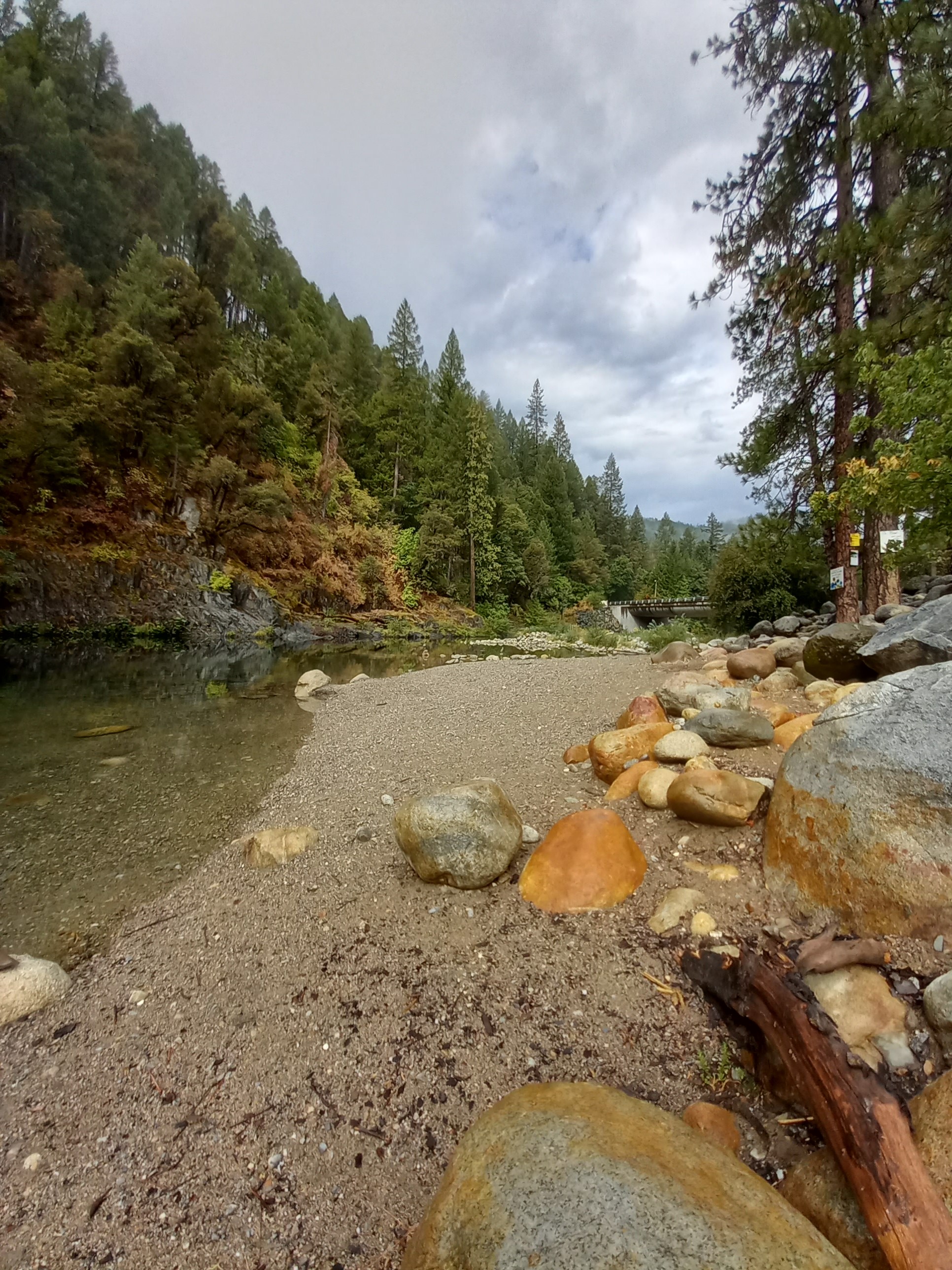
Twelve years earlier I’d been out half-heartedly promoting a record and had stumbled across a few gypsies beneath the bridge, having a jam session with a guitar and bongo.  My harmonica had been the special sauce back then.  Now I was alone, waiting for the rain to stop.  In a few minutes it did.  I got out and walked down to the river.  There I came upon a scene, serene beyond compare.  The shallow river reflected the green pines.  The sky above, temporarily all cried out, swirled like a blue and grey river above.  Someone had balanced rocks in the water like a Zen Garden.  Stray drops of rain plopped into the river like temple bells.

I sat down on a wet stone and gathered my legs beneath me.  A few birds were chirping.  A crow was cawing.  Outside of that there were only the few drops of rain that still fell.  If I was going to have a breakthrough, this was the place to do it.  Rain falling into a river.  Wasn’t that eternity in a nutshell?  Whatever was behind me was behind me now.  Where I’d sleep that night, I couldn’t know.  Until I arrived, nothing was real. 

Still, I struggled to make it through my breath cycle.  All I wanted was to drive.  As soon as I’d let out the last breath, I clasped my hands in a show of gratitude, then staggered towards the car, throwing the door open and leaping in, like the law was on my trail. 

In town, I passed the old miner and his dog.  They were almost in the same place I’d left them.  The town itself had almost escaped time.  That wasn’t happening to me.  Surging back uphill, the rain clouds parted.  Highway 20 came up fast.  I turned right and sped back towards the valley, the road ahead of me as wide open as the range in a cowboy song.
pages fly away 6

Rough and Ready is named for the 12th president of the United States, Zachary Taylor.  Established as a mining camp by a group from Wisconsin, they seceded from the Union in 1851 to avoid paying taxes.  That didn’t last long.  Driving through on my way back to Yuba City, I discovered that pioneer town, with a blacksmith shop, saloon, and post office.  On the other side of the road was a facsimile of the mine, complete with railroad tracks, a few carts, and a dummy standing behind the gate.  A wagon next to it advertised cemetery rides for only a dollar each way.

Arriving in Yuba City brought me right back to the here and now.  Fast food restaurants as far as the eye could see.  I stopped at Burger King for lunch and drove past the parking lot where I’d been tested for my class A license twenty-five years earlier.  I went looking for the plant where I’d worked.  It was now a Walmart.  The farmhouse across from it where we’d bunked had been razed.  Even the country music bar at the end of Harter Road, where the band had included a pedal steel player was gone, now a barber shop.

Most everything had changed except for the Sutter Buttes.  The Sutter Buttes, just outside of Yuba City, are sometimes called the smallest mountain range in the world.  The Native Americans had known them as the Middle, or Spirit Mountains.  With red radio towers blinking atop of them, at night you can see them from miles, in every direction.  Although they’re private property, I used to park my truck at the base during a night shift and stumble to the top, just for the thrill of feeling alive.  Now, in broad daylight, they resembled little more than yellow mounds.

Williams was the place I’d first been stationed when I got hired to drive trucks.  At the time it was designed to be the biggest tomato processing plant in the world.  Without all the kinks out of the system, they’d brought in a hundred of us drivers, only to hurry up and wait.  We were housed in trailers and ready to work, but the conveyors weren’t synching up right.  Since all we were getting was commission on the loads we hauled in, they had to promise us a stipend to get us to stay.  In the meantime, we hit up all the bars in town, and spent long afternoons throwing rocks at beer cans floating in an irrigation canal.

Those three years driving a tomato truck had been OK.  At the end of the season, we got laid off, so were able to qualify for unemployment.  There’d been a lot of time to sit out in a field beneath the stars and write songs.  After the second year, I’d saved up enough to make my first record.  It wasn’t something you wanted to do for the rest of your life, but at the time it had served a purpose.

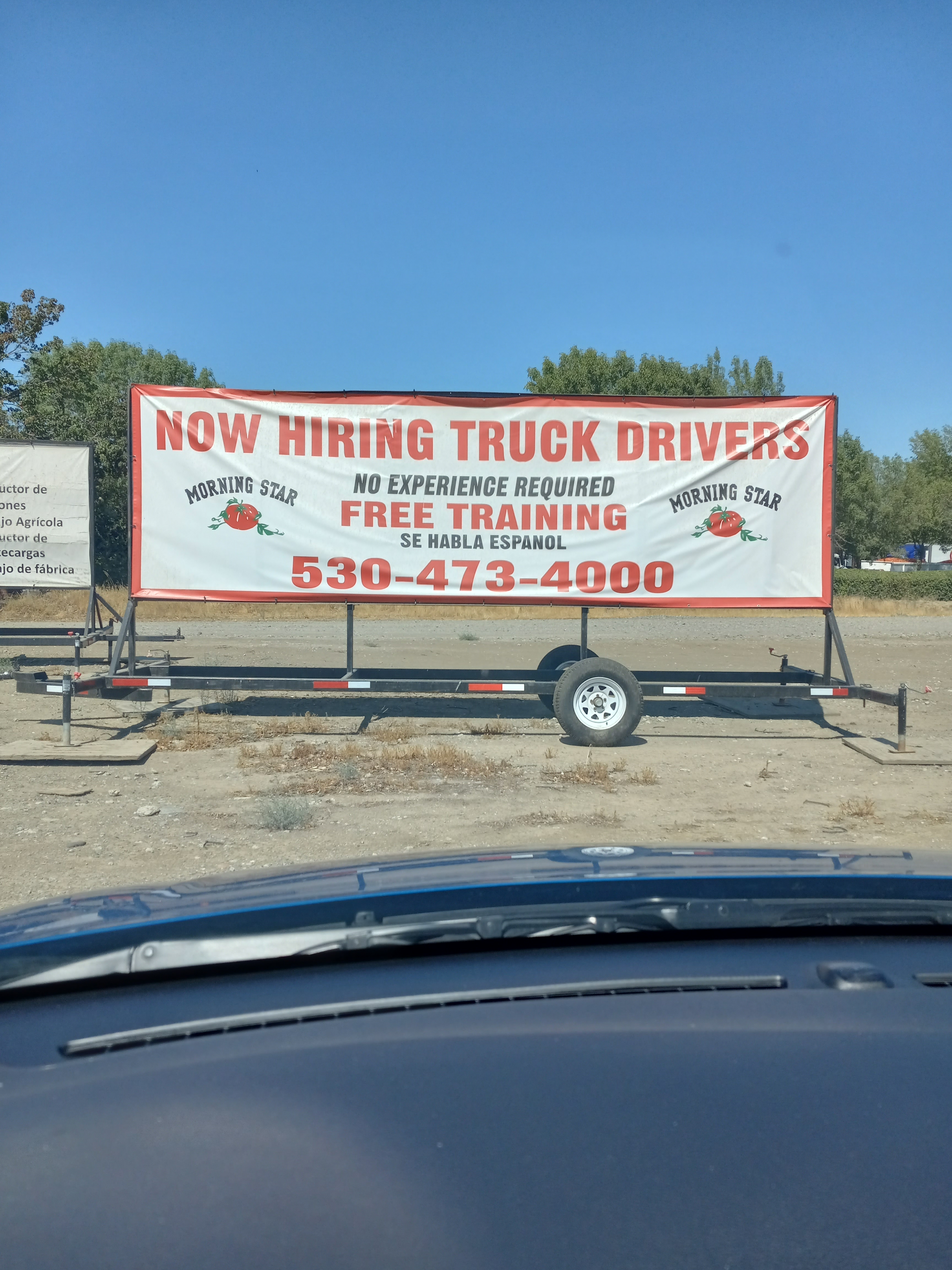
Pulling up in front of the Morning Star plant, I was surprised to see that the season was still going on.  Trucks were lined up at the scales outside, the drivers anxious to drop their loads and get out into the fields for more.  I saw that they were still hiring.  It had just been a lucky break that had brought me there years ago, meeting a driver in Guatemala, who’d claimed to have saved ten grand in the course of one summer.  I’d returned to California with his name and that of the company written on the back of a notebook.  One mention of his name, and I was in, although I never did work with him.

Those had been impossibly long, dreary, dreamy shifts.  Getting in a truck at six at night and finishing at ten in the morning.  I saw every sunset during those years, every phase of the moon, every formation of the summer stars.  There were times on a long run down to the Delta where I’d almost fall asleep at three in the morning and have to pull over.  A state of lucid dreaming would fall over the world.  In the morning, white cranes would rise up out of wetlands.  The sun would begin infiltrating the earth again.  In a few hours it would be as dry and dusty as an atomic blast site. 

Now I sat and watched the young drivers waiting their turns.  A white crane stood beside an irrigation ditch, staring me down.  I briefly thought about taking down their number and giving them a call.  After all these years, I was unemployed once more.  I no longer had my commercial license, however, and it wouldn’t be the same, even if I did.  The fact is that most of the job had been an excruciating drag, and all it would take to remember that is to climb back into a cab. 

All the promise of that situation had been extracted years earlier, just as most of the gold had been tapped from the mines.  The only option was move forward, even if that meant no longer knowing where to go.  So that’s what I did.

pages fly away 7

Clear Lake is the largest lake in California and one of the oldest lakes in North America.  I’d been there a handful of times in my life, once on a fishing trip with my father.  Another time I’d been given a three hour wait time while driving truck and had dropped my trailers in a field and set off for Clear Lake in the middle of the night driving bobtail.  It had been an impulsive gesture, one that I began to regret the further I got from Williams. 

All in all, it was an eighty-mile roundtrip drive, and if someone would’ve known that the truck was AWOL, losing my job would have been the least of my worries.  By the time I reached the lake I was panicking, and just hightailed it straight back to the field, not even bragging to my closest friends about my midnight run.

Now I was back on the road to Clear Lake again, but this time in the middle of a beautiful sunny day, driving a zippy blue Kia that I’d dubbed the Mountain Bluebird.  For a day that had started out cloudy and rainy, things had cleared up dramatically.  The sun was shining through the windshield, like a white hole, cut out of blue sky, and little wisps of cloud drifted over the hills. 

When I got to the town of Clearlake, it was different than what I remembered.  I searched for a campsite on Google Maps and just followed where the woman led me, not beginning to question her directions until I’d already traveled ten miles along the southern shore.  At that point I needed to double check to make sure I wasn’t being led on a wild goose chase.  The lake was way larger than I’d imagined.

At Clear Lake State Park there were four campgrounds to choose from.  Thank God, I didn’t need to have reservations to camp there.  The woman at the booth told me to drive in and pick out a site, then return to let her know what I’d chosen.  All the spots were taken at the Upper Bay Campground, which came as little surprise since they were perched on a steep cliff, and the view of the lake rivaled one of the Mediterranean Sea.  I drove through the Lower Bay Campground and most of the good sites were taken there as well. 

Finally, I came to the Kelsey Creek Campground, and that was nice too, within walking distance of the lake.  I drove back and told the attendant the site I’d chosen, number 46, and she gave me a receipt to clip to the post.

I’d just set up camp and was getting ready to drive down to the beach, when the attendant came rushing up in a white truck with a hesitant look on her face.  The site I’d paid for had already been reserved by someone else.  Would I mind terribly?  No.  That was OK.  I’d given up on the tent pegs, relying solely on the sleeping gear inside it to weigh the tent down.  It was a simple matter to pick it up and carry it over to an adjacent site.  Within a few minutes, I’d made the transfer.

It was a sunny day, warm and without a breeze, but I had no idea what to expect from the lake.  It turned out the water was lukewarm, but I needed to wade out far from the shore, through gooey black mud, to arrive at any depth.  The swimming area was sectioned off with a rope.  The only thing swimming in it was a few ducks.  A guy in an inflatable kayak was fishing just beyond it. 

To get to the deep water I needed to go past the rope.  When it was finally overhead, I thrust upwards with my arms to propel my feet to the bottom.  The same black mud was now cooler and squished between my toes.  I did somersaults underwater and watched the light in front of my closed eyes go from yellow to green to black. 

When I got out, I dried off and changed and then took my ukelele to a picnic table.  There were two teenage Asian girls at another picnic table, busy on their phones.   I’d come up with a song idea driving through the Sequoia Park, meant to be a theme song for the trip.  It was called The Ballad of the Mountain Bluebird.  Just as the Lone Ranger had Silver, and Zorro had Tornado, I’d found a true ally and friend in the blue Kia, one I would’ve been unable to embark on my journey without.

The next morning, I got up and followed a nature trail down to the same beach.  A turkey vulture sat in one tree.  Two great egrets were in another.  There was a fallen log on the shore that I sat down on.  The sky was already clear and blue.  There were a few fishing boats off in the distance.  From somewhere I could hear the honking of geese.  I closed my eyes and took a few deep breaths.  What I’d been doing wasn’t meditation as much as fighting to just sit still.  Still, I’d taken a vow to make time for it at least once every day that I was off on this unchartered driving trip.

The sound of a plane occupied most of the space in my head, and then gradually faded to a hum.  The excited voices of children came from the camp.  Songbirds were singing.  A gray squirrel scampered through the branches of a tree.  The lake splashed softly on the shore.

Three loud women came down the trail, walking their dogs.  One pointed out a few pelicans I hadn’t noticed.  She told the others how the lake had been flooded only a few years earlier.  It had been affected by drought since then and had badly receded.  A friend of theirs was moving in with her boyfriend after five years.  They all had their opinions about him.  Right behind them came two old guys who didn’t like the San Franciso Giants’ new uniforms.  According to one of them, they looked like they’d been spray-painted on.

My mind wasn’t clearing.  I was just listening and thinking.  Now I remembered fishing at the lake with my father years earlier.  I believe he’d driven me up to Williams to drop me off at my truck driving job.  Clear Lake was like the Midwest lakes we were accustomed to, with the same kind of fish: bass, bluegills, crappies, bullheads, carp.  Renting the poles had been my father’s idea.  We’d gotten a bucket of minnows and a carton of worms.  Fishing was something we’d always bonded over.  It was easier than talking.  We just fished from the shore and never caught anything.  The wind and waves had picked up and it was hard to really say what was happening with the bobbers.  It wasn’t the nibbling of fish that was causing them to sink.

A man came up behind me with a pug dog.  He threw a stick for it to fetch, and the little dog went wheezing after it.  I was wrapping up my breathing cycle, eleven sets of eleven deep breaths, and had gotten to my closing prayers.  A loud honking came from directly overhead and some shadows fell over the earth.  It was a flock of Canadian geese, flying in formation, heading out over the lake.  A minute later, here came another flock, in a tight V, following their leader. 

A woman came down to join the man with the pug dog.  All she noticed was the stink.  The lake was too smelly, she said.  It smelled like a cesspool.  True, but there was more to it than just that.  Two boats were drifting off on the horizon.  It was time to head back to camp and hit the road.

pages fly away 8

From Clear Lake State Park, I took Soda Lake Road to the 29 and then followed that north until it met up with the 20.  Just past Blue Lakes, beyond a bison ranch, with a small herd of buffalo grazing out front, it turned into the 101.  In Willits, I stopped at a Dinosaur gas station and filled the tank with gas, and also got a turkey sandwich and large coffee.  The Mountain Bluebird had been getting great mileage so far, and even filling three quarters of a tank only set me back thirty dollars.  I was getting into Redwood country.

Just outside on Laytonville I came upon the first of many unusual attractions that line the Redwood Highway.  It was called Area 101, and I wasn’t sure what it was supposed to be, perhaps a New Age amusement park or marijuana dispensary.  The sign showed a spaceship beaming down hearts.  There were statues of Buddha, Jesus, Mother Mary, Saint Jude, Ganesh, and an Eastern Island head, or Moai.  Paintings depicted multi-limb goddesses, mountains and streams, penetrating eyes, all that hippy-dippy stuff I know so well, being something of a latter-day hippy.

Next up were some more conventional curiosities; redwood carvings of loggers and bears, an eagle, and Indian chief, a tree house built out of the stump of an old redwood.  Then it was Confusion Hill.  Signs start appearing miles before you reach it.  Mystery.  Fun.  Is Seeing Believing?  The Mountain Train Ride.  The Gravity House.  I stopped and took a picture of the world’s largest redwood sculpture carved from a chain saw, bears standing back-to-back, six of them in total, three stories high.  Then I got a drumstick from the snack bar and went to see the Shoe House.

Just south of Garberville was another attraction, opposite the south fork of the Eel River.  This was the Legend of Big Foot.  The first footprints of Big Foot, the elusive ape-like creature reported to stalk the deep forests of North America, were captured in plaster casts in Humbolt by a logger in 1958 and measured sixteen inches long.  From there, the stories spread.  At the Legend of Bigfoot, the depictions of Bigfoot, or the Sasquatch, ranged from those of an upright ape to something that resembled a hostile, bushy-eyebrowed caveman.

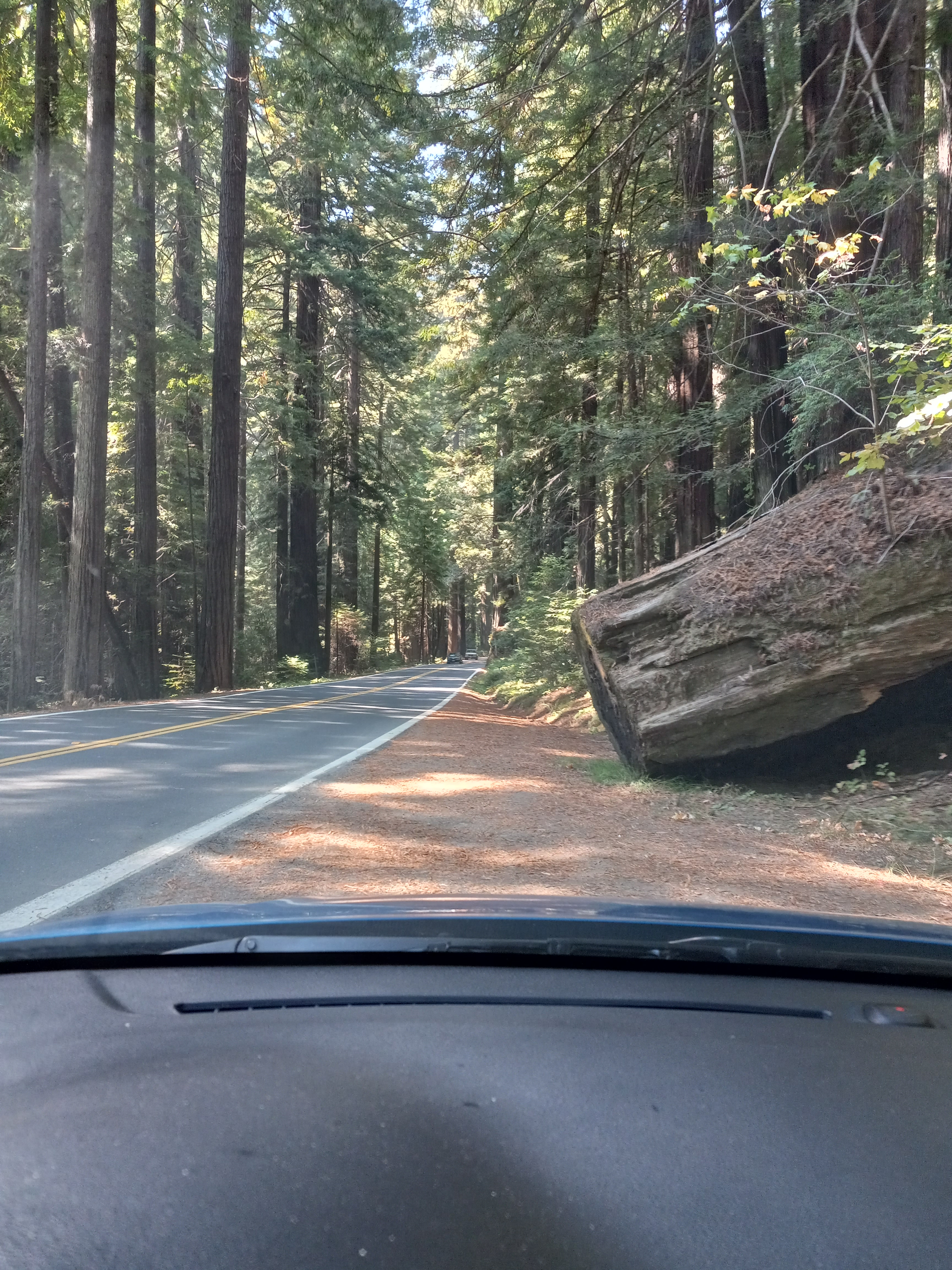
A few miles down the road, right around Phillipsville, I got on State Route 254, or the Avenue of Giants.  Redwoods are the tallest trees in the world, sometimes reaching up to four hundred feet.  They have less girth than their cousins, the Sequoias, and slightly shorter life spans.  The Avenue of the Giants runs through the Humboldt Redwood State Park, a small road that winds like a river through a tunnel of these ancient trees. 

The sun was high above as I went snaking through the forest.  Sometimes it got tangled up and lost in the branches.  Then there’d be a gap, and light would come streaming through, like a rogue beam reaching the bottom of the ocean.  At one straightaway, I happened upon the Immortal Tree.  It’s a thousand years old, had once been three hundred feet tall, and had survived floods, forest fires, a lightning strike, and the loggers’ axe. 

It was scenes like the ones I was seeing that had inspired me to move up to Humboldt County in my late twenties, not knowing a soul.  There was a fantasy I was chasing about getting back to the land, finding a hippy girlfriend, starting a band.  I’d driven up to Arcata and camped on Clam Beach for a week before finding a cheap apartment on the grounds of the university.  I’d signed up for a few classes, prerequisites for a teaching degree, and then went on to endure one of the rainiest, coldest, most depressing seasons of my life.  It had felt like I was a sea captain at a school for cadets.  I’d wandered through the redwoods alone and only managed to score a few gigs, before moving on.

Before reaching Arcata, I had to pass through Eureka.  A port city and lumber town, the many Victorian mansions still standing bear witness to a time of great prosperity.  Driving through on the 101, however, you get the impression of a town with a rough edge, fast food restaurants, rampant homeless, and an underlying drug crisis that gives off a sinister vibe.  It was the same thing I’d discovered living in the region years earlier, freedom turned to anarchy, recreational drug use yielding to psychosis.  A shirtless man was lying beside the road, face down.

At Arcata, I pulled off at Humboldt University and went looking for my old apartment, in the dungeon, or basement side of campus apartments, not far from the library.  I’d drank a lot and suffered from loneliness during those rainy months.  There was the apartment now, just one room, a sliding glass door, and a bathroom.  The sites where hard times went down are sometimes the best to revisit.   Don’t say I didn’t pay my dues, you get to say.

In the town plaza I found the same assortment of freedom fighters and lunatics, still holding their ground, sitting in a big circle, banging on drums.  Half of them were students from affluent suburbs, diving deep into alternative living, letting their freak flags fly.  The others were the resident aliens, those who’d gone so far into the lifestyle that they couldn’t return from it, many of them homeless, camping in the area, getting a buzz on while the sun was shining.  They traded stories for hits from a pipe, credibility for shots from a bottle.  I was just like them, a grizzled old-timer, banged up badly by life, needing just one bright moment a day, someone to listen to my story, to keep me afloat.

I walked around, looking into the bars, the Alibi Room, Everett’s, the Jambalaya, where I’d finally worked my way up to hosting an open mic, before leaving town to drive a truck and raise money for my first record.  That day I’d played my new song, Ghost on the Roam, and the room had gotten silent, maybe for the first time ever.  A breakthrough had occurred in the form of a break down, but when it was all over, what were left were memories and songs, like jewels in the bag of life.

pages fly away 9

North of Arcata is a beach called Clam Beach where camping is allowed.  I’d camped there years earlier, and hoped they’d have a space for my tent.  To get there I got back on the 101 and crossed the Mad River.  There were a few sites around the parking lot and one of them was open.  I was three for three on the camping so far, and that had to happen if I was going to continue.  The fee was twenty dollars, which I could accept, being able to set up somewhere without the risk of being hassled.  What I couldn’t accept was paying a hundred dollars for a hotel, or sleeping in the car, not unless I really needed to.

After setting up the tent, I walked on wooden planks, through wetlands, to get to the beach.  There was still a quarter mile of packed, black sand to cross to reach the ocean.  The wind was blowing from the north, savagely and without reason.  Someone had balanced stones on top of each other that somehow hadn’t been toppled yet.  A young yoga warrior was sitting cross-legged on a dune, demonstrating his commitment.  Screw that.  The wind was out of control.  I’d brought along my ukelele but didn’t even consider getting it out.  Loose grains of sand were stinging my face.

That night some girls who were camped right next to me had a few cases of PBR and partied all night long.  They had a friend, Charlie, who joined them after getting off his shift at a bar.  They were loud but not obnoxious.  I couldn’t fault them for having their fun, but it was like trying to fall asleep in the middle of a party, right on the floor.  I’d done that many times, but not tonight.  One of the girls was complaining about her new roommate.  He’d offered to help with everything, but hadn’t, and then had eaten all her bananas without contributing one dime. 

Before six o’clock I was up, packing the car.  An older couple on the opposite side were breaking down their camp at the same time.  I wondered if they’d gotten any sleep.  It was only ten minutes to Trinidad, a fishing village on a bluff that I wanted to revisit.  There’s a lighthouse there that I thought might be a good place to meditate at, looking down on the harbor.  When I got there, it was gone, however, perhaps undergoing reconstruction, but the memorial to those who’d lost their lives at sea was still there.

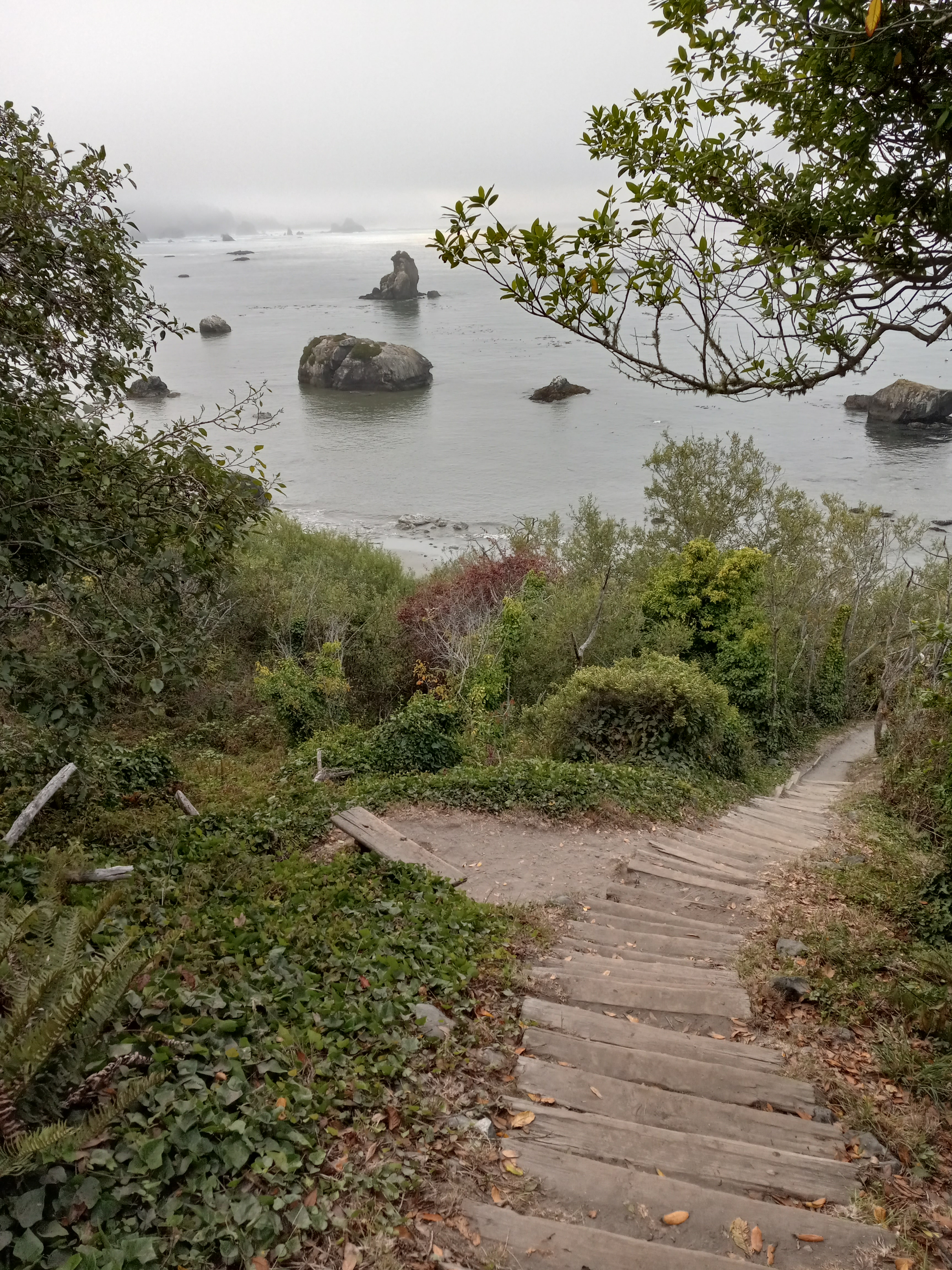
There were steps leading down to the sea and I decided to make a walking meditation out of it.  I’d spent time in a Buddhist monastery in Thailand and walking meditation is a recognized form of the practice.  Since I was nearly jumping out of my skin to hit the road, I decided then to implement it from time to time, if the conditions allowed for it.

I started to descend the stairs, step after deliberate step, measuring my breaths, making sure to draw each breath down to my navel.  A bell on a buoy was clanging out on the water.  Large, black rocks protruded from the water.  On a few of them, different seabirds sat huddled together, screeching at the waves.  There were a dozen boats anchored in the bay, a few miles from shore.  A crow started cawing.  There was the piping of some songbirds.

A cool breeze greeted me when I got closer to the water.  Thick bushes, looking like blackberry bushes without the berries, crowded both sides of the trail.  There was a bench I briefly sat on, thinking about my thinking, wondering where it was coming from.  Then I got up and started down the stairs again.  The closer I got to the ocean, the louder the waves crashed on the shore.  Small stones were tumbling in the surf.  The larger ones stayed resolute, like ancestors from a prehistoric age.  The beach was strewn with seaweed and footprints.  Driftwood lay cast around in various stages of decomposition.

I thought about those who had lost their lives at sea.  Then I thought about all of us, if not losing it at sea, losing it none the less, too often in far less dramatic settings, leaving this world unheralded.  If I’d ever made my peace with death, I wouldn’t be who I was.  Everything in my being recoiled at the thought of just vanishing one day, never to return, sinking into the black water, so far down, beyond hope of recovery.  I’d been constructing my own memorial my whole life, casting my lantern on the sea.  How would that work out in the end?  I couldn’t begin to know.

pages fly away 10

A tall tale is a story, perhaps once grounded in fact, that has been exaggerated beyond believability.  Famous characters from American folklore include Paul Bunyan, Pecos Bill, John Henry, and Davy Crocket.  They may have been real people at one point, but the stories that have sprung up around them and their adventures have made them larger than life, figures of myth and fiction.

On my road trip I’d already encountered one monument to Paul Bunyan in Three Rivers and was now on my way to reacquaint myself with Paul and his Blue Ox, Babe, at the Trees of Mystery, in Klamath, just forty-five minutes from Trinidad.  Along the way I stopped at Elk Country, but the usual herd of Roosevelt Elks was absent, leaving just a red barn and redwood sculptures of a cowboy, unsmiling Indian, and a totem pole to take pictures of.

Trees of Mystery, like Confusion Hill, is what people sometimes call a tourist trap.  It is interesting enough to justify a few hours there, however, with unusual trees like the Cathedral, the Candelabra, and the Elephant Tree, along with a canopy walking trail and gondola ride.  They also house a large collection of Native American artifacts, which was my primary reason for stopping by.  That, and to see Paul and Babe.

From the road the first sign of the Trees of Mystery, is the statue of the Indian, come to the end of the Trail of Tears, his head drooping, atop his hunched horse, his spear tucked under his arm, pointed at the ground in defeat.  Next to that is an American flag, which on this day was hanging lifeless from the pole.  I pulled into the parking lot and there were not more a dozen cars there.  A good day to just drop by. 

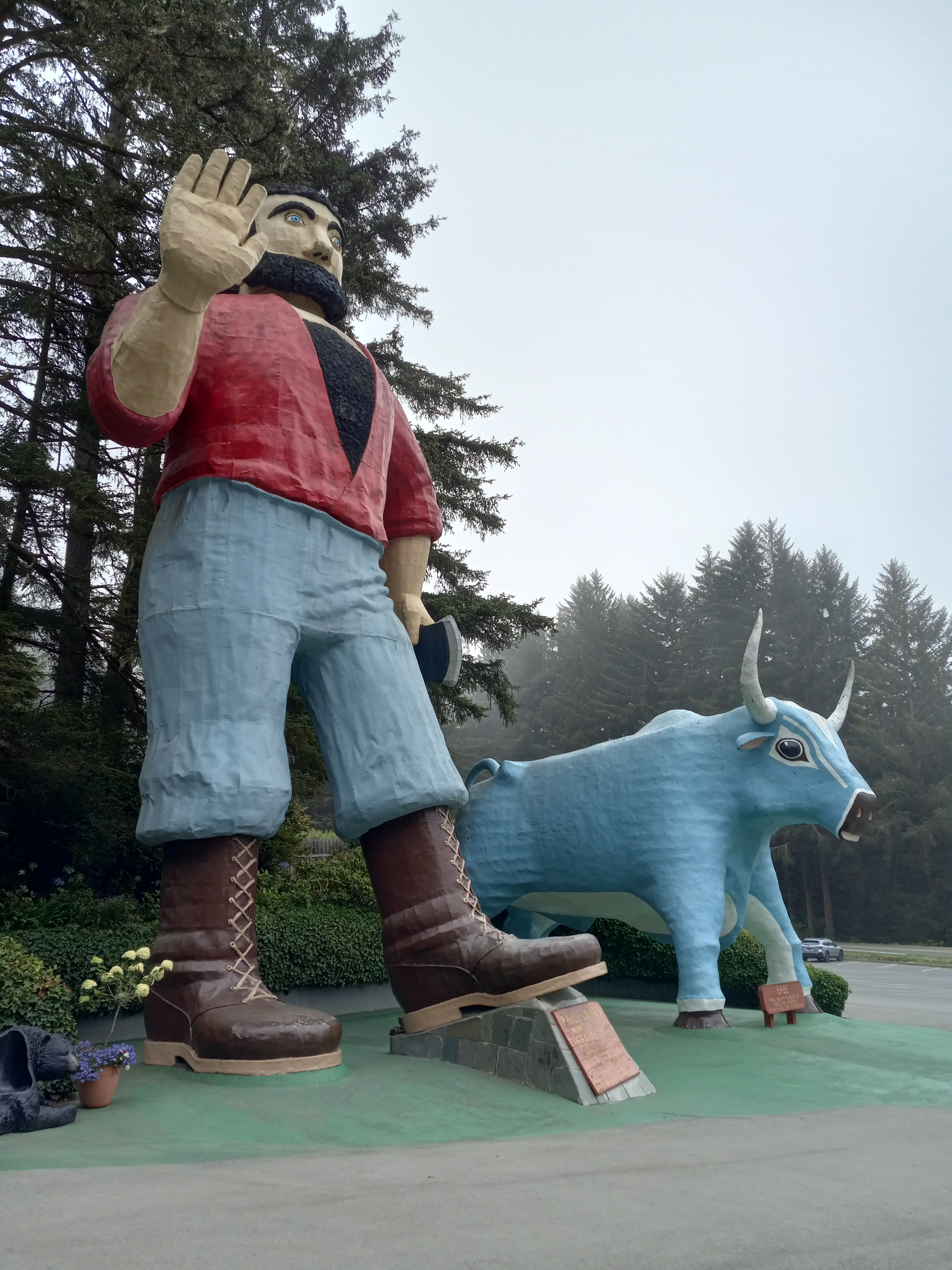
Paul stood there, fifty feet tall, black hair and beard, dressed in a red shirt over a black T-shirt, his jeans tucked into his logging boots.  Babe was right behind him at thirty-five feet, light blue and with great white horns.  Although capable of speaking and waving his right hand, Paul did neither, at least not to me.  Would I be able to separate it from just a delusion if he had?  I was riding high, not on anything but pure adrenaline.  Dreams, memories, and fantastic new realities were getting mixed up all over the place.

I went to use the bathroom, then entered the gift-shop and headed straight for the Native American museum.  One of the goals of the trip was to drive through as many reservations as possible, not to study them in depth, but at least learn a little about different tribes and where they’re located. 

Up until now when I thought about Indians what came to mind was the Hollywood stereotype, largely based on the Sioux and other Plains tribes, with the tipis, the feathered headdresses, the war paint, the peace pipes, the bows and arrows, the horses, and buffalo hunts.  I knew this was an incomplete picture but only had a small idea about the distribution of other tribes and nations, and what set them apart. 

There is a map on the wall of the museum with the traditional names and geographic locations of the tribes.  I bought a smaller version of, to act as some kind of guide.  The collection houses artifacts, largely from the western Regions of the US.  There were ivory fishhooks and totemic raven masks from the Northwest.  A wolf skin was mounted to the wall.  In one case there were black and white photos of Plains Indians, a warrior on horseback, a medicine man lifting his hands to the sky, a maiden by a stream, exposing one of her buttocks. 

There were many cases of Kachina dolls from the Southwest, representing spirits of the Hopi, wildly fantastic beings, a bear, a crow mother, a butterfly, a corn maiden, a striped clown, a buffalo warrior.  I looked at woven baskets, wooden flutes, a buckskin shirt with elaborate beadwork.  It got me all pumped up.  I was ready to explode.

Leaving the Trees of Mystery, I jumped into the Mountain Bluebird with no idea where I was heading.  North.  That was it.  Just north.  Would I continue up the coast?  I didn’t even know until I reached the 199 and veered off towards Grant’s Pass.  What was I doing now?  I was heading in the direction of Crater Lake.  There were some reservations north of that I could begin to visit.  I thought about heading back south as far as Mount Shasta, a sacred destination, in its own right, but perhaps that was too far. 

I just drove and kept driving on the Redwood Highway, jumping out to look down on the Smith River, deep blue and green, reflecting the pines, yet at the same time nearly transparent.  Someone had left a little birdhouse beside the road.

Driving through the Cascade-Siskiyou National Forest, I almost had the highway to myself.  I was flying through the mountains, leaning hard into the curves.  Outside of that one spot of rain in Yuba City, the weather had been perfect so far.  At Grants Pass, I got on the 5, heading towards Mount Shasta, but just past Ashland, got on the 56 and headed towards Klamath Falls instead. 

It occurred to me that might be a good place to stop and set up camp, but when I arrived in Klamath Falls it was still too early in the day.  I had to use the bathroom so pulled into Moore Park besides the Upper Klamath Lake, and right up in front of a porta-potty, just as a homeless woman was stepping out.  Inside it resembled a crime scene.

Wanting to get closer to Crater Lake, I searched for a campground on Google Maps, and let the woman, the voice that I was becoming familiar with and beginning to trust, lead me onto the 97 in the direction of the Happy Trails Cowboy Campground, only thirty miles away.  As I was driving north, however, I saw an enormous amount of fire damage.  The earth had been scorched black in some areas and the campground was subsequently closed.  Continuing on, I passed another one, but it was only for campers and mobile homes.

It was late afternoon by now, and I was starting to get a bit worried, knowing that without a reservation, I wouldn’t be able to camp at Crater Lake National Park.  Maybe I could’ve figured it out on my phone, but resented what they were doing, adding a surcharge on top of a charge, making something very simple into something enormously complicated and expensive. 

Outside of Fort Klamath, I passed a campground that looked like it might just be for RVs but decided to ask anyway.  They did have a few tent sites, but each cost fifty dollars.  It was the first big money hit of the trip, but I decided to deal with it.  It was a beautiful campground, built around a shallow, gurgling stream, and the site I paid for was beneath a tree on an enormous bed of green grass.

After I set up the tent and laid down my bedding, I went and walked beside the stream, which was reflecting every color in nature, the most perfect meditation spot, but not tonight.  My mind was jumping.  There was a store inside where I bought a few hardboiled eggs and a Slim Jim.  The guy working the counter was a college student who was supposed to be studying in Australia until the pandemic messed it all up.  He’d taken a philosophic approach to the whole ordeal and was easy to talk to.

It got cold that night.  I got under the sleeping bag and both my blankets, but my mind kept jumping.  I could see the road ahead.  The way that the trip was already unfolding, told me it was going to be epic.  I’d barely scratched the surface.  Awake, but content, I lay there and schemed, right up until I fell asleep and started to dream.

pages fly away 11

Crater Lake is a volcanic lake, and at nearly two thousand feet, the deepest one in America.  The Klamath tribe believed that a battle between the Sky God and the Lord of the Underworld led to the collapse of Mount Mazama and the formation of the lake.  It is considered to be the adobe of the Great Spirit and is a prime destination for those embarking on a vision quest, full of danger and great beauty, capable of shocking one into awareness.

The park was open when I arrived at the crack of dawn.  I may have been the first visitor of the day.  I parked outside Rim Village, hoping to get a cup of coffee, but the store was still closed.  I drove over to the side of the lake and got out of the car.  The sun was just beginning to rise over the rim of the crater.  It was cold enough to keep my hood up and my hands inside my pockets.

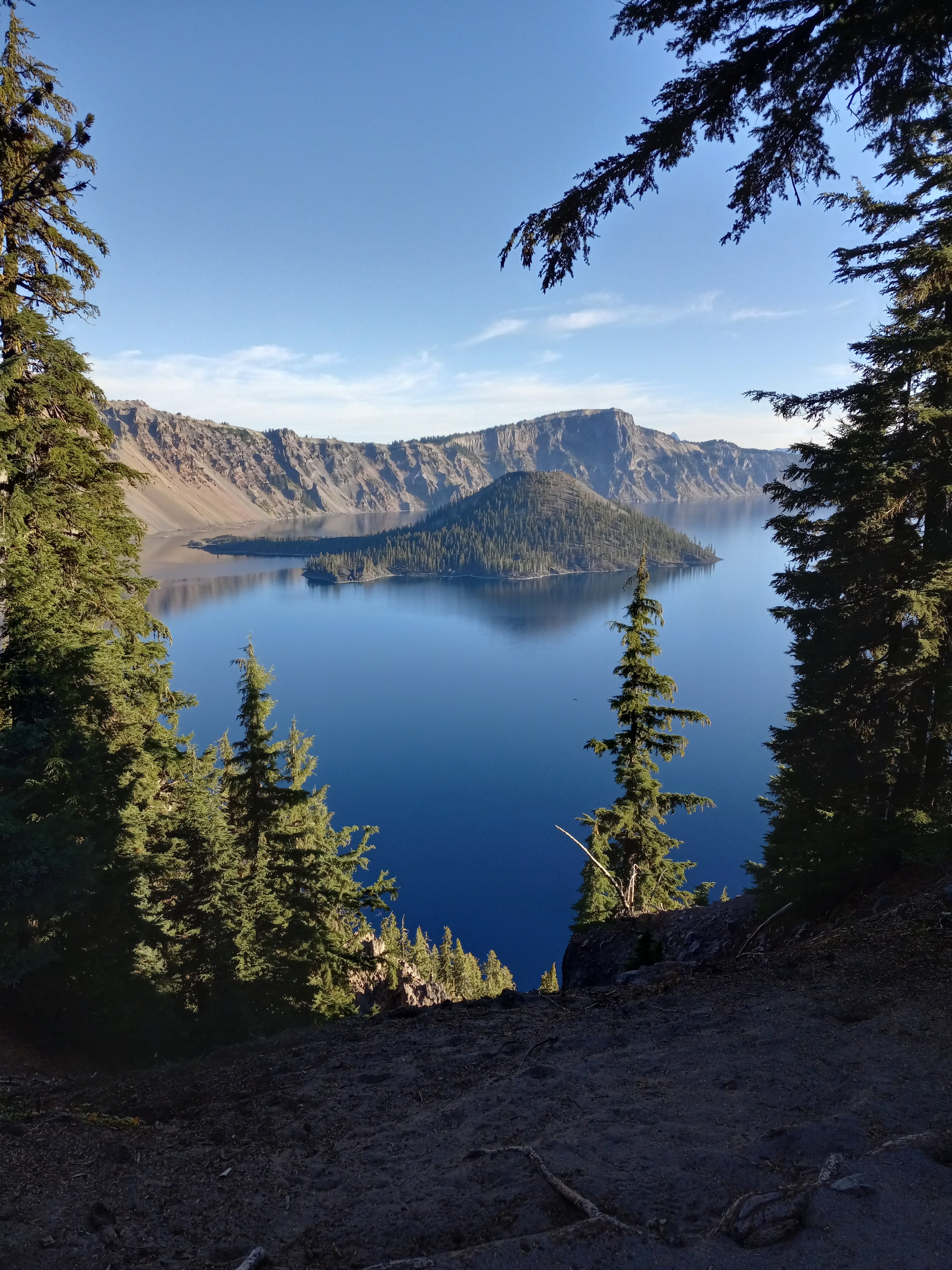
The water in Crater Lake is known to be bluer than blue, like the blue Kia, the Mountain Bluebird, that I’d rented for the journey.  The sky was blue.  The lake was blue.  The day was already a triumph of blue.  Below I could see the cinder cone, known as Wizard Island.  There were pine branches overhead, and pine trees beneath me.  The white all-seeing eye of the sun continued its ascent.  I sat on a stump and tried to meditate, or at least just stay in the moment.

There was hardly a sound.  A few birds.  My fingers and toes were numb with cold.  Before long, they begin to warm.  The sun was growing larger, starting to radiate and expand.  A drowsy fly came to life and began to buzz around my face.  Is that one of the constants of meditation?  That a fly has to buzz around your face and try to get up your nose?  I heard the swish of car tires behind me.  Then another and another.  I was no longer alone in the park, nor was I alone in my mind.  I resented the car full of tourists who parked nearby and got out with noisy voices.  Were they trying to ruin my good thing?  If not for them, and the fly, and all of my thoughts, I could probably get into the zone.  This was definitely the place to do it.

Though I was mediating, I didn’t want to broadcast that fact, like the guy at Clam Beach, by wrangling my limbs into a cross-legged lotus, nor would I pinch my thumbs and forefingers together and rest them on my knees in a receptive mudra position.  If anything, I wanted to make it look like I was just sitting there resting, possibly thinking, because that’s about all I was doing, sitting there thinking, about the fly and the voices I could hear, where’d I’d drive to next, where I’d stop for the night.  What could I see that afternoon?  No.  No.  I had to pull myself back and begin to count all over.  Wasn’t just being there better than anything?

After getting back on the road, I stopped at a few viewpoints, most notably The Watchman, which provided a different view of the lake.   There were many tourists in the parking lot, all strangers in real life, humbled by the power of nature, observing a temporary cease-fire, interacting with courtesy and respect, as long as the moment lasted. 

I got back in the car and got on the 97, racing north towards the Warm Springs Indian Reservation, which looked to be three hours away, passing through La Pine and Bend along the way.  At Madras, I got onto the 26.  It was just fifteen miles from there.

My greatest fear was that a majority, or even some of the reservations, would be closed to outsiders because of the pandemic.  The worst of it may have passed, but many places were still being extra careful.  I had a mask in my pocket and sometimes put it on, depending on where I was at.  It would’ve sucked, but not surprised me at all, if I’d pulled up at Warm Springs and couldn’t get in. 

Instead, the only thing impeding my progress was a major construction job on the road leading into the agency, where cars were lined up in each direction, waiting for a pickup truck to guide them through.  That I could deal with.  At least they were still letting people in.