All posts by Haunted Rock

These are songs, poems and images from a life on the road. Enjoy your stay and safe travels.

pages fly away 33

Among the legends of America, the Mississippi River is one of the greatest and most enduring.  It is the second largest river in North America, running from Northern Minnesota to the Gulf of Mexico, and for many years served as a natural boundary for the frontier and great wide-open West.  If I’d driven so hard the day before, it’s because I’d wanted to get close to the source of the Mississippi, Lake Itasca.  There it begins as a small stream, leaving a glacial lake.  I knew about it because I’d been there once before, floating down it naked to celebrate a record I’d just made called Deep River in my Heart.  The plan for today was a more conservative one, simply to revisit the stream and walk beside it.

It was only a half hour from the Hungry Man Forest Campground, where I’d arrived late the night before, in a dark spell of exhaustion and mania, stumbling to set up my tent like a disoriented child in a Grimm Brothers Fairy Tale.  Now in the daylight, the forest and roads were easy to navigate.  How could I have gotten so lost?  The world is not such a frightening place, not all of the time.

There were only a few cars in the parking lot of the Mississippi Headwaters Center.  An arrow pointed out that the headwaters were only eight hundred feet away.  There were a number of exhibits about the history of the river and flora and fauna of the region.  I made my way to a signpost, stating that the Mississippi starts right there, at 1475 feet above sea level, and flows 2,552 miles to the Gulf of Mexico.  My idea had been to sit right at that spot and meditate.  Instead, I found a woman had shown up first and snaked my idea, so I had to turn it into a walking meditation in an attempt to walk off my annoyance.

A trail ran beside the stream, back in the direction of the Visitor Center.  I stuck to that and counted my breaths, only managing to draw them to the middle of my chest.  There was a small bridge that crossed the stream.  I walked out and stood in the middle of it, looking down on it, only fifteen feet wide and very shallow, white stones breaking the surface, the sides of it cluttered with bushes and small pines. 

It had been fourteen years since I’d gone floating down it naked, pushing myself along the bottom with my hands.  Where had that guy gone to?  All over the world since then.  What about that record that I’d been so proud of.  It had vanished without a trace, not garnering a single compliment.  So, it goes.  When you finish a project, you open up the door for something new.  You need to look at it that way.  If you wait around for results, you’ll die prematurely of a broken heart.

There were three reservations I was close enough to visit that day.  The White Earth Indian Reservation was only forty miles away.  I plugged it into Google Maps, and Karen began to guide me towards it.  Driving west on the 200, however, there was a road work project that made it impossible to go left on the road she’d directed me to.  From that point on, she began to harangue me, ordering to turn around or take a left at even the smallest lanes I came to.  I got confused and began to argue with her.  What are you talking about?  I can’t turn left here.  Are you out of your mind?  That’s not even a road.  By the time we got to the 3 south, I was seething, determined to shut her up as soon as the reservation was in sight.

The White Earth Indian Reservation, named for the white clay in the ground, is a thousand square miles, with a population of close to 10,000.  They are one of the six band of the Minnesota Chippewa, or Ojibwe.  In 1867, ten Ojibwe chiefs met with President Andrew Jackson and came to terms over the reservation, but over the years the government attempted to make it a catch all for all the other tribes, including some from their historic enemies, the Lakota.  The Dawes Act of 1887 allowed the government to break down the reservations into allotments of land to each individual member, the surplus then being put up for sale.  In this manner, many tribes lost a great deal of their holdings.

At a Cenex station, I filled up on gas, only twenty-seven dollars for almost a full tank, and got a cup of coffee and a breakfast sandwich.  Just down the road was the Shooting Star Casino, offering Bingo, a Sunday Brunch, and upcoming concerts by Ambrosia and A Flock of Seagulls.  The tribes may have been stripped of their culture but look what they got in return.

It was an hour to Bemidji from the White Earth Reservation.  There I pulled over at Library Park to see their version of America’s first dynamic duo, once again Paul Bunyan and his blue ox, Babe.  I’d seen them in California and now they were in Minnesota.  If anything, that’s a testament to how much they got around.  Across the street, in front of a jewelry and souvenir shop, a ten-foot shirtless Indian was raising his hand and saying How!

To get to Red Lake, the largest lake in Minnesota was another hour.  I took highway 18 north to the Red Lake Reservation.  The reservation is unique in that it never left control of the tribes.  It is about 1,200 square miles and seven clans reside on it; those of the bear, turtle, bullhead, otter, eagle, marten, and kingfisher.  I passed the Red Lake Nation College, stretched out beneath the wings of a giant eagle, and a veteran’s memorial, beside the frame of a sweat lodge.  There was also a recovery center I pulled up in front of, a reminder of the plague that addiction has been, not only for the tribes, but for vulnerable, sensitive people from all walks of life.  A hand-painted sign across from it said When you mess with meth, you mess with death.  True that.

The last reservation I passed on my way to Duluth was the one in Leech Lake.  It was created more out of an amalgamation of different treaties and executive orders than any one act and was also the site of one of the last major Indian uprisings in the northwest, the Battle of Sugar Point.  In 1898, two US Marshals attempted to arrest a native of the Pillager tribe they suspected of bootlegging.  In the standoff that ensued more troops were brought in and 6 soldiers were killed.

I’d contacted some friends in Minneapolis and planned on breaking up my trip by stopping there for a few days.  In the meantime, I had one night to kill and figured I’d get a hotel in Duluth, get cleaned up, and organize the car.  If it looked like I’d been living out of it, it was because I had, living in the driver’s seat, driving sixteen hours a day, up the West Coast, across the Northwest, now smack dab in the middle of the Midwest, following the Mississippi River. 

I don’t know if I’d call what I was doing living in a car, but it was definitely living.  That was for sure.

pages fly away 34

If Avis had a problem with me driving their Kia Rio, the valiant and trustworthy steed I’d come to know as the Mountain Bluebird, all over the face of the land, I didn’t want to know about it until I’d brought it back.  By now I’d put over four thousand miles on it and figured I should probably change the oil sometime soon but didn’t want to pull into one of their service stations and be prohibited from taking it any further.  I resolved to take a day in Duluth and get it done on my own, keeping the receipt to prove I hadn’t overlooked it, but not planning to present it unless they called me on it.

Back in the day, I’d spent whole blocks of time slumming in a Motel 6 on the San Ysidro border at Tijuana.  If I remember rightly, a room could be had for fifty dollars a night, which was still a lot, but seemed somehow possible.  By now, however, there were almost no rooms for that price anywhere in the States.  Did they think you were making a down payment on the room in the hope of one day owning it?

The Motel 6 I pulled over at in Duluth wanted nearly a hundred dollars a night.  That gave me a long pause, but I was so exhausted I caved and just paid.  One incentive was the gas station next door that had a deal on oil changes.  I figured I’d get up first thing in the morning and drive the Kia over.

Duluth is a unique place, a harbor city on Lake Superior.  The only time I’d been there before it had been ridiculously cold, a gray ice sculpture of a place where you need to run from your car to get inside before you freeze to death.  By the end of September, it wasn’t there yet, but still gave me flashbacks to the ten years I’d spent in Minnesota, in three distinct phases, and the final, fateful breakdown that had driven me back out West for good.

For nearly a hundred dollars, my room wasn’t much to look at.  I wouldn’t have been surprised if the DEA or a SWAT team had kicked my door in at any minute.  I was used to the surroundings, but not used to paying so much for them.  Some guy was parked right outside my window, with his radio cranked up all the way.  There would’ve been big trouble if that continued, but after a while his engine roared to life and then it quieted down.  Later, I went over to the Burger King.  The dining room was closed but they let me walk through the drive through.  For the day I was having, that was just perfect.

In the morning, I got up and drove straight over to the garage to get my oil changed.  They let me know that the Kia used synthetic oil that only needed to be changed every seven thousand miles.  I told them to go ahead and change it anyway.  The price went from forty dollars to ninety dollars.  At least I now knew my parameters.

When the car was finished, I drove it back to the room, determined to get the very last minute out of it, then checked out and drove out to the Point, passing the Aerial Bridge and finding a park on the north shore of the lake, where I could sit for a moment and try to get my bearings.  There was a bench beneath a pine tree.  Small waves were crossing the surface of the lake and slapping the shore.

It was a perfect day.  How many of those had there been?  Almost every day had been perfect, not only the weather, but everything that had happened, the way things had all unfolded.  Why did life never feel like that?  Only my travels.  I’ve learned not to question good times too much, however.  Celebrate then wait.  They can sure turn fast.

A cool breeze came off the lake.  The small waves continued to slap against the shore in a rhythmic pattern.  A seaplane flew overhead, with floats where there might’ve been wheels.  It circled and returned, either practicing or contemplating a landing.  Here it came again, this time touching down, skimming the surface of the lake, and making that landing.  That had been good timing. 

Two men were getting ready to take a sailboat out.  The younger one was the expert, giving all the directions.  Across the bay, some church bells began tolling.  Then the whistle of a train cried out.  I closed my eyes and could see the plane, the way it had touched down on the lake.  I played it over and over, three or four times.  Every time the church bells rang, I saw the plane land.  Then they stopped and the train screeched again. 

The two men were putting their sailboat into the lake.  The name of the boat was the Deedle Bug.  It was written on the side.  Why not?  The Deedle Bug.  Once it got cold, it might be seven months before they got the chance to take it out again.  If they were hoping to sail, it was the right day to do it.

pages fly away 35

My classmate from Saint Olaf, Jaimey Gustafson, had agreed to put me up for a few days.  She lived with her husband and two kids near Lake Calhoun.  It had been a while since I’d seen any of the old college crew.  Most of my friends would be working that day, so I still had time to kill once I left Duluth.

I drove over to Wisconsin and followed the Saint Croix River through Stillwater, eventually getting on the 94 east and taking it to the Twin Cities.  I’d become totally dependent on Google Maps by now, simply punching in directions and going where Karen led me.  If she started to nag, I just tried to ignore her, in the same way that I’d handle a backseat driver.

When I got to Jaimey’s house, she came out to greet me.  She looked about the same, maybe a little grayer.  Kirstin Johnson came over.  Lindy Sorenson stopped by.  It was like the good old days, Charlie’s Angels and their dear friend, Bosley.  We were all older but had reached the point where you’re just happy anyone still cares that you’re alive.  Although everyone was coming from different situations and our circumstances had changed, one thing I became aware of that night is that we all carry the same cup of sorrow, never knowing what can fill it to capacity, different triggers for different people.

That night I slept on a hide-a-bed in the basement.  Although I’d lived almost half of my life in the Midwest it had been a long time since I’d been back there, sleeping in a basement.  We don’t do basements much in California, not a good place to caught in an earthquake.  When I came up in the morning, Jaimey’s husband, Devon, had taken their daughter to school.  Her son was off at college.  We drank coffee and caught up.

My goal for the day was to run down to Saint Olaf, about forty miles south of the Twin Cities, in the town of Northfield.  I’d gone to Saint Olaf because my family had only recently moved from North Dakota to California, and I was used to dealing with Midwest types.  Things had worked out pretty well.  It had been a small enough school that I was able to make friends and get encouragement for my writing.  Due to their study abroad program, I got to spend a semester in Oxford and learn all about the traveling lifestyle.  My four years in college made me what I’d be for the rest of my life, messed up, but still looking for meaning.

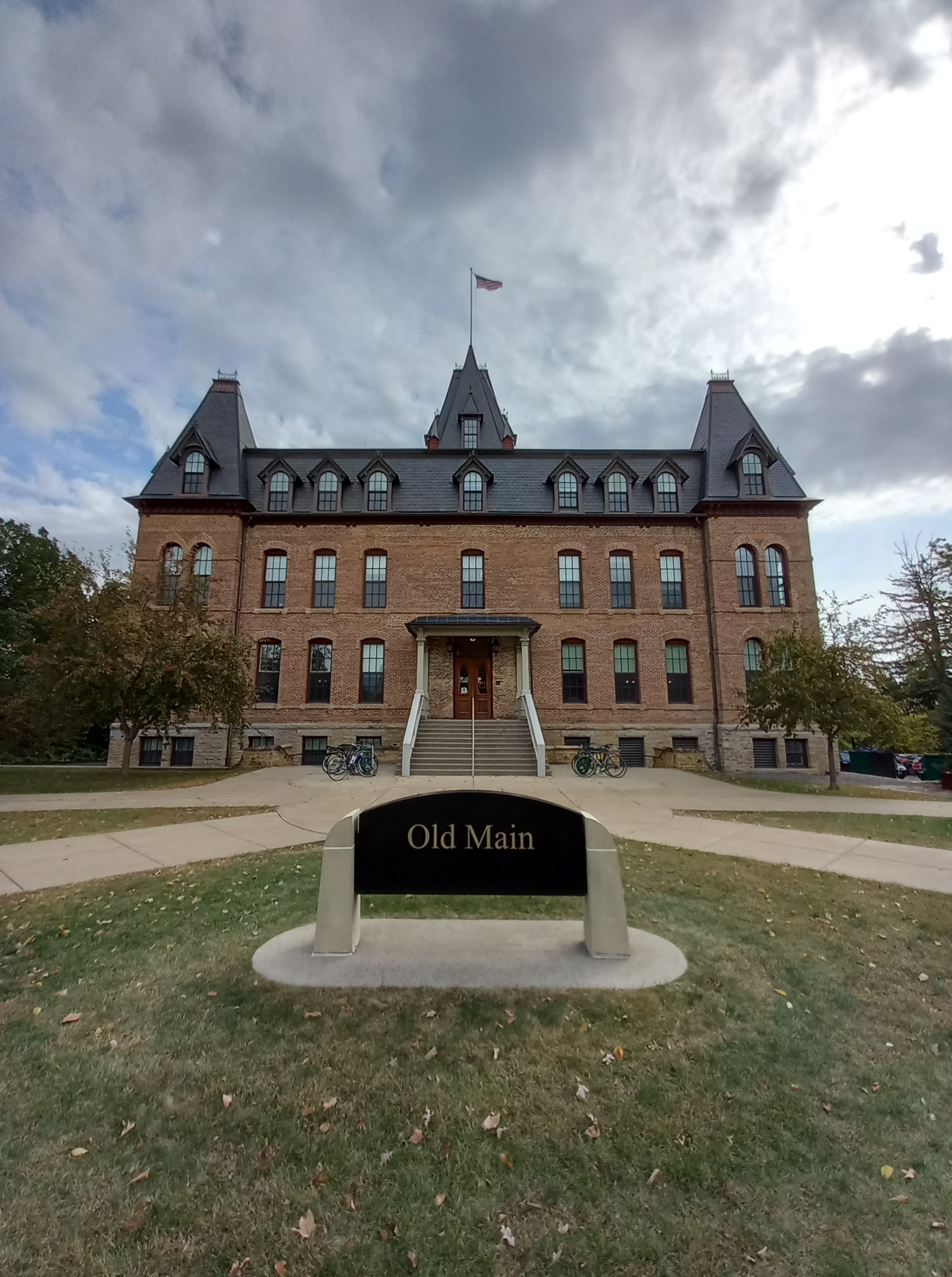
Northfield was a straight shot down the 35 south.  I got gas halfway there and continued on, turning left onto highway 19.  Before arriving in town, I reached the campus and drove up the long driveway to get to it.  Wow.  There it was.  Still intact.  I parked and set out on foot, past the International Dorm I’d lived in my sophomore year, then over to my freshman dorm, Kildahl, then to what used to be the cafeteria.  It was now an art building.  There was a new building, Hoyme Hall, that housed the new cafeteria and student store.  I walked past Ytterboe, then over to Old Main, the first building when Saint Olaf was founded in 1874.

Behind Old Main, I found a chair, at the top of The Hill.  When I’d shown up for college, I’d had no idea who I was or could be, just a depressed preacher’s kid, getting as far away from his family as he possibly could.  Now what was I, beyond just a leaf in the wind.  It was a good place to be a leaf in the wind.  I had a lot of company that morning.  Yellow leaves and memories were swirling all around me, like butterflies descending on a flower. 

We used to take trays from the cafeteria and use them to sled down the hill.  That’s probably the most innocent activity we ever engaged in.  Before going off to college, I’d never known that artists could be heroes.  I’d discovered a whole slew of dangerous new role models, stopped believing in God for a while, started taking new drugs, and plotting new adventures.  It was there I’d constructed my vision, an almost laughably impossible one, that I’d stuck with all these years.  Sometimes I would grow quiet for a season, do whatever job I needed to raise funds, but never let go of the vision.  Life, without it, would’ve been unbearable.

Leaving the college, I drove towards downtown on St. Olaf Avenue, detouring to visit the Arboretum at rival college, Carleton, a site of many spring concerts and parties.  Parking beside the Cannon River, I discovered that the Archer House Inn, built in 1877, had nearly burnt to the ground.  Walking a little further, I reached the Northfield Historical Society.  In the front window was a picture of the legendary outlaw, Jessie James.

The lawless Wild West was in many ways a byproduct of the American Civil War, fought from 1861-65.  After a peace was surrendered from the South many disaffected soldiers and militia men went on to become Indian fighters or roving gangs of outlaws.  This was the background of Jessie James and his brother, Frank, who’d both fought as guerrilla Confederate bushwhackers under Bloody Bill Anderson.  The James-Younger Gang became famous for robbing banks, trains, and stagecoaches, and Jessie went on to develop a reputation as a modern Robin Hood, even though there is no evidence he ever shared any of his loot with the poor, and the worst of his crimes were beyond cold-blooded.

One of Northfield’s top claims is thwarting the gang from robbing the First National Bank in 1876 and killing three of the robbers in the shoot-out that ensued.  Both Jessie and Frank got away.  Jessie went on to live six more years, until he was shot by Robert Ford in the back of the head while straightening a painting on a wall.  Ford had earned his confidence and killed him for the reward money.  He then got his in 1892, when a man walked into a saloon he was working at and shot him in the throat with a double-barrel shotgun.

Pieces of the past were scattered all over on this trip, like the falling leaves that had engulfed me sitting on The Hill.  I knew nothing of the future, but still feared death.  When it came for me, my hope was to go out like Jessie James, all of my focus on a beautiful scene in front of my eyes, never knowing what hit me from behind.

pages fly away 36

One of my college friends, Lou Ann, half Chippewa, and half Norwegian, was out of town that weekend, but told me about a powwow that was going on at Roosevelt High School.  I’d had a mad crush on her back in the day, but she’d had a boyfriend she eventually married.  At Minnehaha Falls there is a statue of Hiwatha carrying the maiden Minnehaha in his arms.  That’s the same vision I’d had for Lou Ann in college, taking her in my arms and carrying her over the threshold.  Since I’d go on to be broke and unstable for the next thirty-two years, it appeared she’d chosen the right man.

Before tracking down the powwow, I drove over to Saint Paul to visit Luther Seminary, where my father had attended and been ordained in the Lutheran Church.  He’d been an English teacher when he and my mother moved to Hawaii, staying just long enough to have me, before he was accepted into the seminary.  My first memories are from that neighborhood and the houses we lived in.  It was there that my brother John was born.

Marin Luther was a German priest, who, in 1517, went against the Catholic Church and launched the Protestant Reformation, when he nailed his ninety-five theses to the door of the Castle Church in Wittenburg.  Both sides of my family were Lutheran, so there was a good deal of celebration when my father was ordained, until a year later in Hawaii, when he’d dropped out and become a Jesus Freak, going so far as to nail his own theses to the front door of the establishment.  About six years later, back on the mainland, with a growing family on his hands, he’d have to get down on his knees and beg, just to get back on the clergy roster.

The memories from those years are like still photos from a dream.  Finding the seminary wasn’t hard.  There was the house I thought we might’ve lived in.  Something about the porch seemed familiar.  Next door to it had been the family with the girl about my age and the sandbox.  There was the hill we used to go rolling down.  A flock of wild turkeys came lurching down the street.  I walked over to the campus grounds.  There was a bench beside one of the dorms that I went and sat down on.

The bench was beneath an oak tree.  The sky was gray, and the wind was cold.  A radio was playing loudly a few blocks away.  I thought about the time the girl next door and I had taken flowers to an old couple we knew.  They’d invited us in and gave us candy, so we tried it again the next day.  This time the old man had gotten very angry and chased us away.  All these years later, the memory was still upsetting. 

The radio tuned into a techno beat and began to thump away.  Two cars passed by.  The wind blew high through the trees.  There were bird cries, and then suddenly the honking of geese.  A woman came out of the dorm and sat down on the steps.  A few minutes later a second woman came out and joined her.  Another memory came to me, perhaps the memory of a dream, walking through a chapel, then looking back at a projectionist’s window, and seeing the face of a donkey.  What a frightening thing it had been.  The techno beat was dominating the soundscape.  A bicyclist passed with a green shirt and a helmet.  He seemed to be pedaling in time to the music.

The Back-to-School Powwow was being held at North High.  The grand entrance was at one o’clock and I wanted to be there for it.  I’d hoped to come across a powwow on this trip, and as fate would have it, Lou Ann, who’d helped fill my head with all those Native American fantasies in the first place, had been the one to hook me up, even if she couldn’t be there.  It seemed like a good sign. 

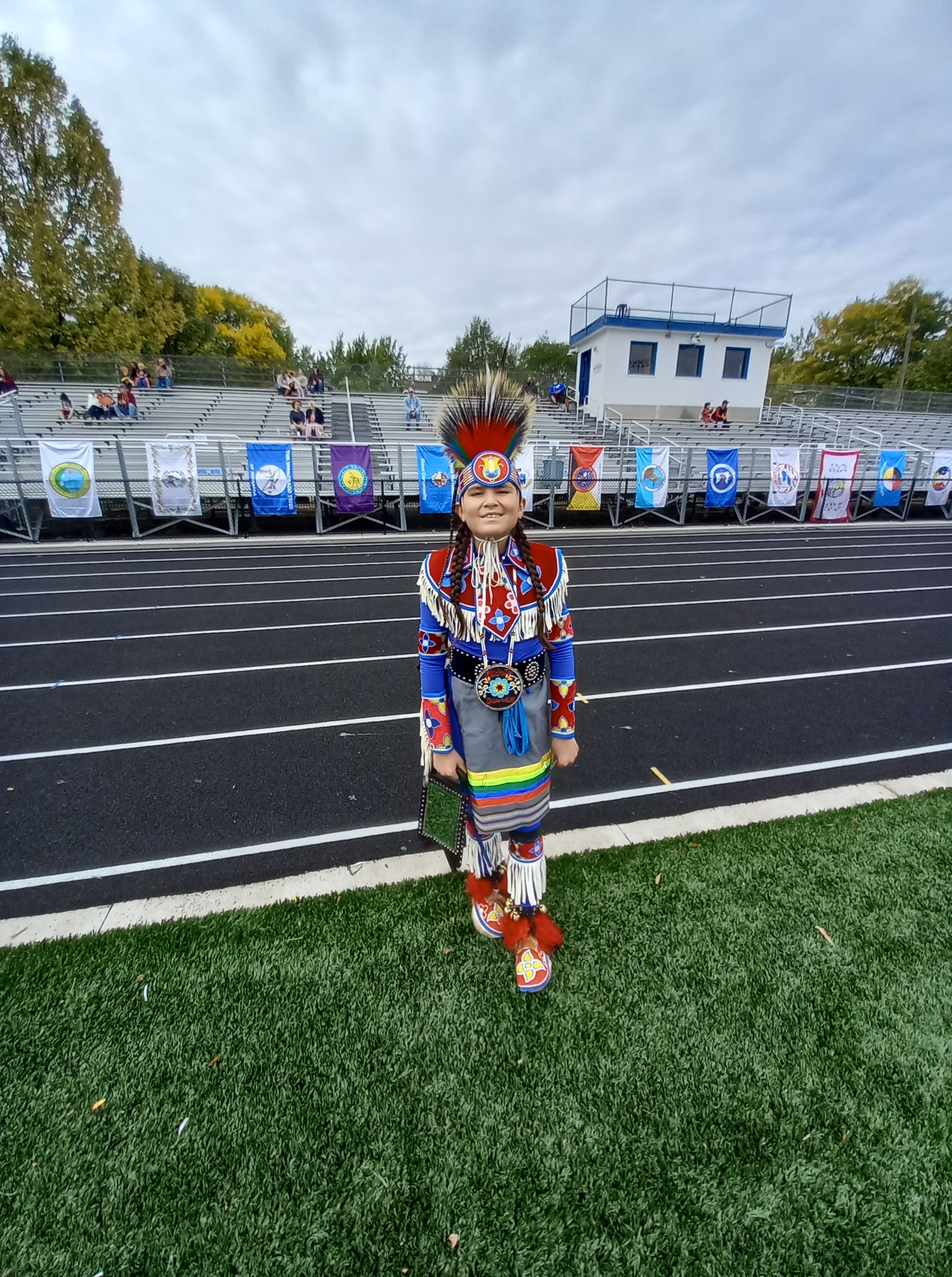
Even with Google Maps, I had a hard time tracking it down.  It was being held in an athletic field a few blocks away from the high school.  On a fence in front of the bleachers, hung flags from all the tribes that were representing that day.  About fifty dancers were dressed in the full traditional regalia to participate in the opening and compete in the dances.  A Head Man and Head Boy were on site, as well as a Head Woman and Head Girl.  Some of the featured drum groups had names like Midnight Express, Little Otter, and Little Kingfisher. 

I walked around, asking if I could take pictures of certain dancers, trying to convey enthusiasm and respect, not wanting to be intrusive.  The outfits seemed to combine traditional elements with a modern and personal flair.  There were feathered headdresses, buffalo bonnets, elaborate beadwork sashes and breastplates, wild displays of color, moccasins, and leggings, even one or two COVID masks tossed in.

The Master of Ceremonies introduced the performers and paid the proper respects.  The host drum team kicked into the opening song and the dancers streamed onto the field in single file, spreading out once they reached it, and dancing to their own interpretations of the music.  I felt ecstatic in this moment.  It was all I’d dared to dream of before hopping in a rental car and hitting the road.  The dancers danced this way and that, like birds, sacred animals, gods, and goddesses.  The overhead sky was all purple and blue ripples, with no wind at all.  I closed my eyes and felt the power of the moment pulsing through me.

Before heading back to Jaimey’s, I took a quick drive through downtown Minneapolis, stopping outside of the venerable First Avenue, where much inspiration had been found in my early twenties.  I then drove through Uptown and found the basement apartment where as a young songwriter I’d faced my own brutal day of defeat, not quite starving, but as broke and humiliated as a man can be, finally packing it up and going back to California to stay with my folks, rather than end it all there on a cold, bathroom floor. 

There was never a time that came after when I’d been so wild and free, but all that energy had gone awry, wanting so much, with no idea how to get it.  If I didn’t drink all day back then, I’d head down to Lake Calhoun and walk two or three laps to try to take the edge off the anxiety.  Now I drove down to the lake and took a calmer stroll in the early evening.  What had changed?  Everything and nothing. 

Living in that basement apartment, I’d once bought a box of old National Geographics at the Salvation Army, and cut out the pictures, pasting them all over the walls.  It was a symbol of what I’d wanted my life to be like.  Now I’d been to most of those places, the pictures were memories, not fantasies.  I was still as broke as I’d ever been, but not quite as desperate.  Give it six more months.  Then, when all my unemployment money was gone, I’d catch up on that front.  All I needed was time.

pages fly away 37

I’d given almost no notice before just showing up in Minneapolis, so I was lucky I got to stay with Jaimey and see anybody at all.  Kirstin Johnson and I went down to check out my old buddy, Nathan Coleridge’s, record store before I left.  Things seemed to be going pretty well for most of them.  I know things can always change in a moment, but for the time, I was happy to be out on this rental car odyssey, breathing new life into dreams that had fallen beside the road years earlier.

One of my classmates, Dean Shockley, had gone on to become a pastor and had a church in Marshall, Minnesota.  I’d known him as a musician in college.  By now, as a pastor, he had a congregation, a paycheck, a wife, kids, a house, and a farm.  I had a ukelele and suitcase in my trunk and that was about it.  Since my next destination was Pipestone, only forty-five minutes from Marshall, I decided to drop in for a Sunday service on my way past.

Sitting in the back pew, I felt a fleeting moment of jealousy, watching Dean up there surrounded by a community of family and friends.  It was what I’d claimed to have been looking for my entire life.  I couldn’t know the reality of how each person there thought and felt, however.  Perhaps what I’d been looking for was the fantasy of a home and community, one where love is reliable, full of stock-characters, only friendly people with good intentions.  So far it had been easier to go on searching than to stay.  Movement exhilarated me.  The freedom to just pack it up and go at a moment’s notice isn’t easily bartered away. 

Before I left, I got to meet Dean’s family in his office.  He presented me with a record he’d made that included one of my songs.  Now that was a true compliment.

It was another hour to get to Pipestone.  I took the 23 south, through fields of corn and wheat.  The Pipestone National Monument is a quarry, where pipestone used to make ceremonial pipes by the Native Americans was found.  The area is sacred to them.  At the entrance there is a pond where the Song of Hiawatha Pageant, based on the epic poem by Henry Wadsworth Longfellow, was performed for many years.  The last time I’d visited, there’s been tipis around the pond.  Now they were notably absent.

Inside the visitor center, I read about the rituals behind the pipes and the prayers.  What makes the pipestone sacred is that it’s exclusive to the area.  I read about the spirits of the rock and the history of the medicine wheel. Then I set out on a mile long walking trail.

The path ran through a meadow, past prayer flags tied to the branches of a tree.  I came to the red quartzite cliffs, then approached a sign announcing The Oracle.  It was eleven steps to reach it.  A sign on the oracle said, Look Through Here, and pointed to a hole.  Gazing through it, I could see the profile of a Native American, a natural formation of the stone.  Walking further, I came to a waterfall, then climbed stone stairs at the side of it to reach the top.  It was hot, only slightly lesser so in the shade.  It was a walking meditation I was on, at least that was the idea behind it.  I was finding it hard to sit still these days. 

Heading back down the steps I encountered a family, two little boys, both with blonde cowlicks.  Their mother was trying to get them together for a group picture, almost needing to bribe them in order to do so.  I got ahead of them on the trail and reached the Leaping Rock.  It is a pillar that warriors once leapt to from a cliff and tried to land on, planting their arrows in the cracks if they’d been successful.  Beyond that there was a sign warning of poison ivy and snakes.  Then a tunnel of red sumac trees.  Passing through that I came to more prayer flags, waving in the wind.

When I left the monument, I stopped at Fort Pipestone, a replica of a fort that was constructed in 1863.  There was a sentry box in the corner of the logged-in yard, and a wagon wheel leaned against the trading post.  I went in, not thinking to buy anything, but came out with a small bag of polished stones and a few fake arrowheads.  If my memories ever failed me, I’d still have something to reach for.

pages fly away 38

Our family is almost a hundred percent Scandinavian.  Although my mother is primarily Norwegian, my father’s side is one hundred percent Danish.  Both sides of the family came over to homestead South Dakota, around the time that the Indian Wars were winding down in the late 19th century.  My goal that day was to visit the Danish town of Viborg, where my father’s relatives had settled, and on the way, I drove through Sioux Falls, where my father had been born.

Sioux Falls is the largest city in South Dakota and named for the waterfalls that run through the middle of it.  I drove to Falls Park and found a place to park beside the Big Sioux River.  From an overlook, I could see the way that it cascaded over quartzite bluffs and collected in pools.  A walking trail led to an observation tower and an old sawmill.  It being Sunday afternoon, many families were out picnicking and sightseeing.  Upon leaving the park, I drove through downtown, which struck me as being quite artistic, with a lot of sculptures and cafes.

Viborg was only fifty miles away.  I got gas and an ice cream treat on my way out of town.  Gas had only gotten cheaper since leaving California.  The Mountain Bluebird was running like a dream, giving me the wings for this great quest, flying effortlessly across mountain ranges and endless plains.

When I got to Viborg, most of the Main Street was closed off due to construction.  It had risen up because of its proximity to the railroad and been incorporated in 1903.  At one point my great-grandmother had run the only switchboard in town, until Ma Bell came through, consolidating all the telephone lines.  My great-grandmother agreed to sell on the condition that her twin boys, one being my grandfather, get jobs with the company.  My grandfather went from being a lineman to an executive in Lincoln.

I’d been to Viborg a handful of times as a child.  My great-grandfather was a farmer, but by the time I knew him they’d moved into town.  He was a big man with big hands, soft-spoken and perpetually clad in overalls.  My great-grandmother went on to outlive him by a dozen years.  Her ritual was to wake up every morning and pray for every member of the family.  I had memories of Viborg, but no address for the house they’d once lived in.   It would’ve been impossible to find it.  There were no living relatives left.

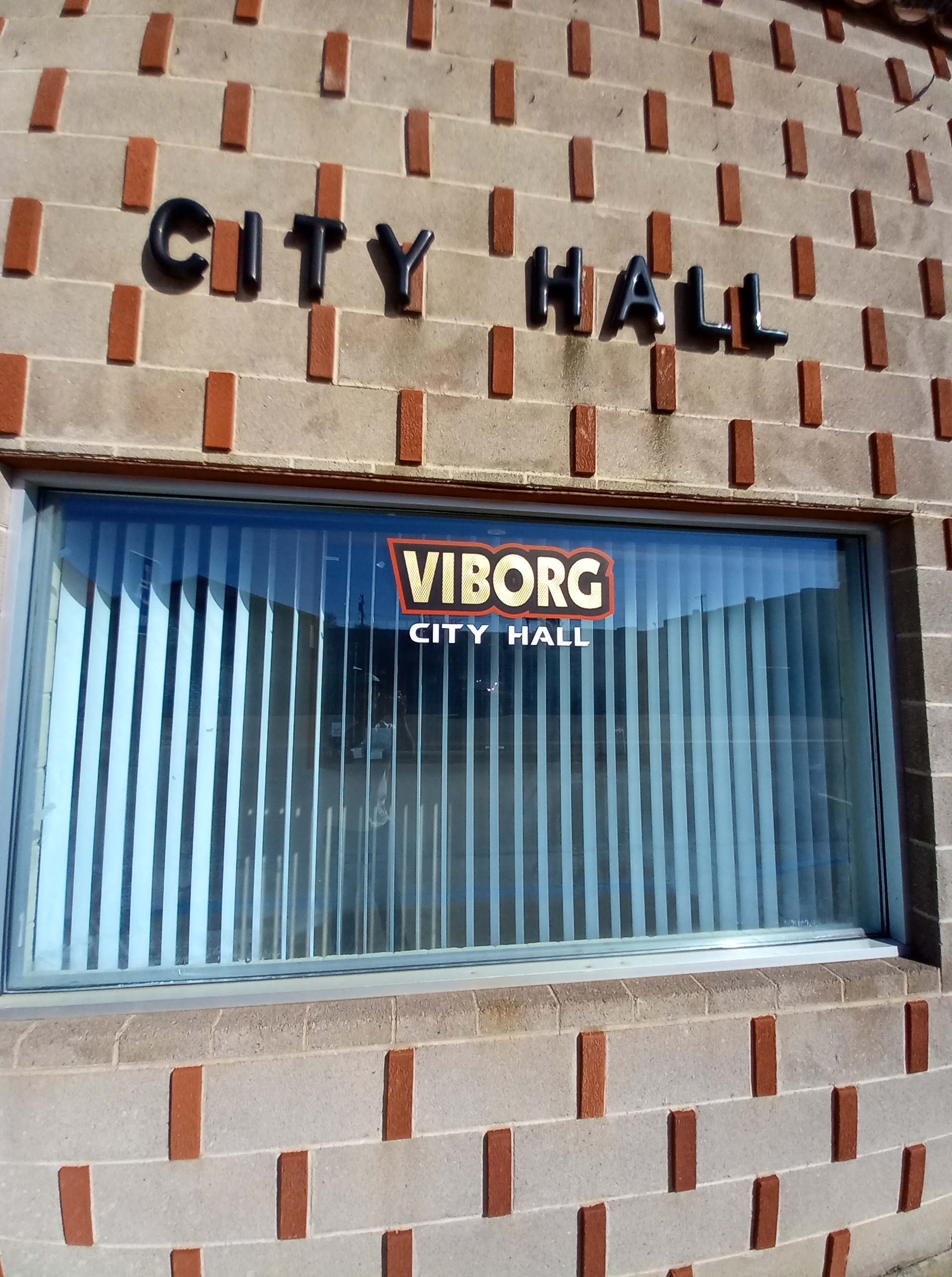
I parked the car and walked down Main Street.  A banner on a power line welcomed visitors to Danish Days, obviously still to come.  The street was deserted.  There was the city hall and the office of the newspaper, Star Advertiser.  A sign in the window informed that What Stays Local, Grows Local.  I walked past the Daneville Inn, Danish and American flags entwined, and past the Pub Viking, a ship with a dragon masthead worked into their logo.  There was the post office where my great-uncle had worked his entire life.  What I did not see was anyone I knew or much that I really remembered.

The direction from my trip so far had come solely from impulses.  I rarely knew where I was going a day or two before I headed there.  Sometimes it was just sitting there working it out on the spot.  The Yankton Reservation was only seventy miles away but would involve heading back west again.  I thought about it for about five seconds and charged towards it, taking the 81 south to the 46.  Karen, from Google Maps, was doing all the navigating.  I was just spinning the wheel.

The Yankton Indian Reservation is about six hundred and fifty square miles and borders the Missouri River.  From a distance I could see the tall water tower bearing the name of the tribe.  A sign at the travel plaza where I filled up with gas described them as being the Ihanktonwan Oyate of the Seven Council Fires.  Across the road was the Fort Randall Hotel and Casino.

Continuing west, I came to the Fort Randall Dam, where a sign at a visitor center discussed the importance of the tipi, the iconic mobile home of the Plains Indians, able to house more than seven people and up to three generations.  The shape of the base of the was inspired by the circle of life, which represents the Earth and the cycle of seasons.  Beyond that was Fort Randall itself.

The Fort Randall Military Post was established in 1856, mainly to protect settlers and keep the Indians confined to their reservations.  There wasn’t much left of it, just an old church.  By now it was getting late in the day, and I started thinking about finding a camp site.  I went south on the 281 and then east on the 12, the Scenic Outlaw Highway.  The first campground I came to was just barely adequate, right beside the road in the middle of a small town. 

I went looking for a place to buy groceries before setting up camp and never found any place, so kept on driving, all the way to the Niobrara State Park, along the Missouri River.  That was more like it.  I drove over the bridge and got a sandwich and some water, then returned to claim a site.  Deer skittered out of the road upon my return.  I got out of the car and cicadas were chirping like the buzzing of a high voltage electrical line.  There were mosquitoes to ward off as well, but this was the place. I got busy setting up the tent.

pages fly away 39

We know we live in the Milky Way, a spiral galaxy consisting of stars, gas, and dust, and will admit that we are only a very small part of it, but it is difficult to picture unless you get far enough away from the city lights to actually see a white band of it overhead, very much like a celestial river or highway, lined with glistening jewels. 

That was the situation.  I was walking up the driveway of the Niobrara State Park, trying to get a cell phone signal, when I happened to look up and see the Milky Way.  It was a revelation.  Is there life out there?  A better question would be this — where is there not life?

My mind was jumping, through space and down the road, and I barely slept.  By now my pillow was as flat as a dollar bill.  There was a reservation only twenty minutes away, the Santee Sioux Reservation.  Before daylight I was up, breaking down camp.  To get to the town of Santee, I took the 540 north until I reached the river.

The Santee Sioux Reservation was created in 1863 and has a population of nearly 900.  At one point in its history, the land was allotted to individual members of the tribe, with some of it reserved for agencies, schools, and a mission.  I parked by a boat landing when I got to Santee and set out on a path that ran through the recreation park, signs along the way telling tales from the tribe’s history. 

My idea was to make a walking meditation out of it.  I’d gotten pretty loose with my practice, now counting breaths as quicky as one does when they’re trying to hold their breath.  The greater point was to stay aware, which isn’t that hard when traveling, everything is new and interesting, seen through eyes that are open wider than usual.

One sign showed members of the tribe ice-fishing with bows and arrows, strings attached to the arrows.  There were pictures of the school building, Davis Hall, one of a dining room, another of the students, their hair cut to regulation length, dressed in western clothes.  There were tall trees on both sides of the path and a tyranny of insect sounds.  Dragon flies hovered in mid-air before zipping off at light speed.  Now, there in front of me, was the frame for a sweat lodge, a place for purification ceremonies. 

A white dog with a red collar came bounding up, but then got spooked and ran in the other direction.  A few steps later and there was a white dandelion, ready to scatter a thousand seeds like paratroopers.  I walked and looked intently at everything that crossed my path. 

Here came the white dog again.  It stood on the top of a crest and looked intently at me.  What was it seeing?

Returning to highway 12, I passed the Ohiya Casino and Resort.  There was the skeleton of a large tipi out front and paintings on the side and back of Indians hunting buffalo on horseback.  I stayed on the 12, passing Sioux City from a distance, and then arriving at the Winnebago Reservation.  Also known as the Ho-Chunk people, the land was ceded to the Winnebago by the Omaha Nation, when it became clear that the land that they’d been placed on earlier was not fit to sustain them.

I was pleasantly surprised to happen across the Ho-Chunk Sculpture Garden when I rolled into town, with twelve sculptures in a circle, meant to represent the twelve clans of the tribe; those who are above, the thunder, warrior, eagle, pigeon, and those who are below, the bear, buffalo, deer, wolf, elk, fish, water spirit, and snake.  Each clan was entrusted with a duty that was vital to the survival of the tribe.  A thirteenth statue stood nearby, that of a holy man, lifting a pipe to the sky, beneath the wings of an eagle.

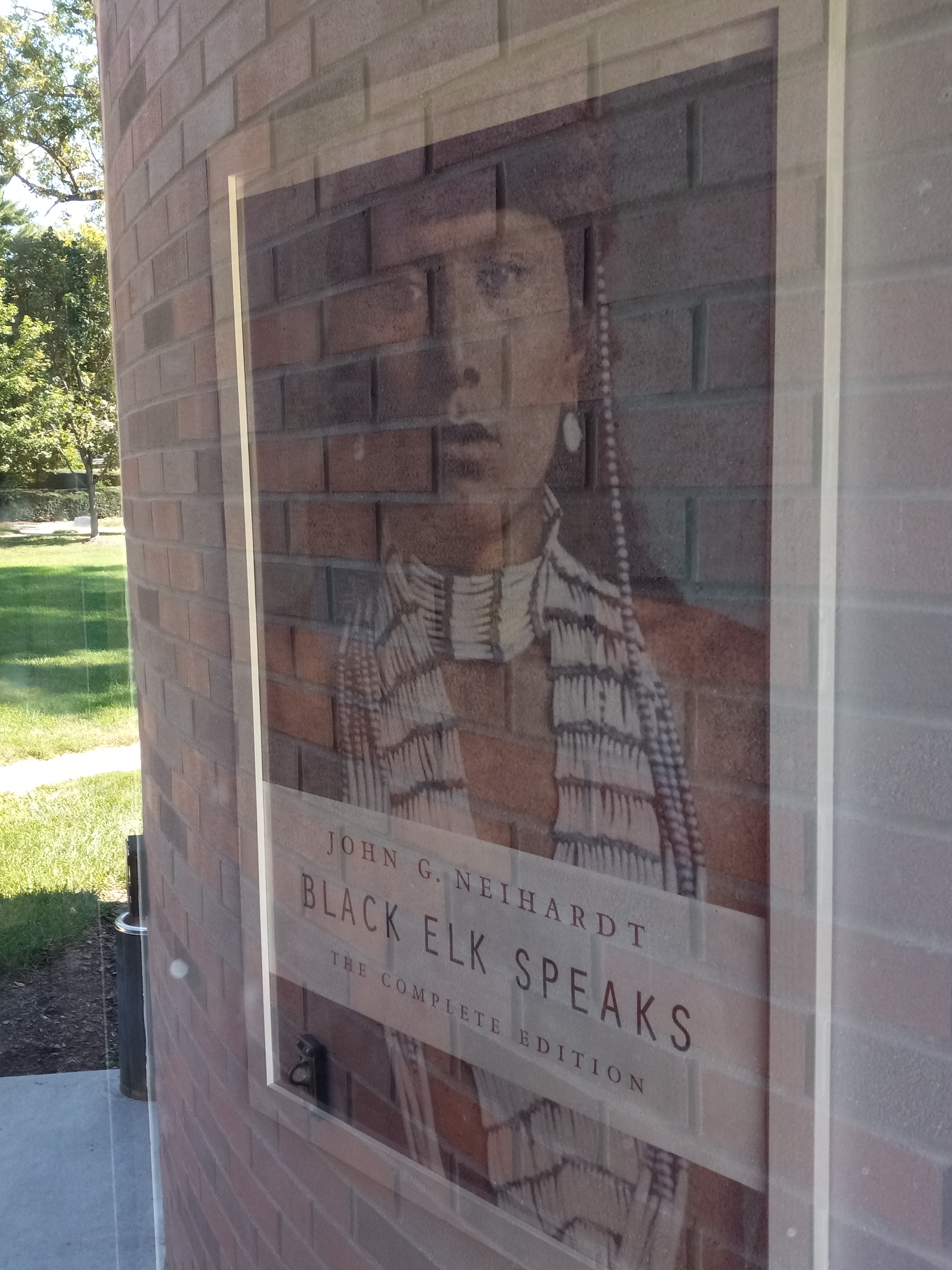
When my father was in college, he got interested in poetry and wrote a poem that won him a prize and the opportunity to spend an afternoon with the Poet Laureat of Nebraska at the time, John G. Neidhardt.  This is the same Neihardt who collaborated with the Sioux medicine man, Black Elk, a cousin of Crazy Horse, on the book Black Elk Speaks

This book describes a vision that Black Elk had as a youth.  The vision includes elements that are foundational to the Native’s beliefs about the spiritual world; twelve horses, three for each direction, six grandfathers, each imparting a magical gift, a tree of life, two roads that cross, the red one being the good one, the black one meaning death and destruction.  The vision is detailed to the point where some critics have questioned where Black Elk’s account ends, and Neidhart’s poetic fancy begins.

From the Winnebago Reservation, I saw that I was only a half-hour from the John G. Neihardt State Historic Site, so I drove there, following the 9 south until it became the 16.  The Neihardt Center is in Bancroft, Nebraska, at the place where he once lived and worked.  I was dismayed that it was closed, due to COVID.  That had been a risk the whole trip so far, but it hadn’t impacted me as badly as it might have.  So far, I’d driven through over twenty reservations and visited a number of parks and tourist attractions.  A year earlier, the whole world had been locked down for everyone.

Since I couldn’t get into the visitor center or study, I walked around in the yard out back.  There were statues of Neihardt sitting on a rock, and Black Elk next to him, with his hands raised to the sky.  A circular garden recreates the intersection of the red road and the black road in life.  Where they meet is sacred ground.  I stood on it and looked up into the sky.  A lot of things had changed since their time, but not the sun.  It was still up there, a bright ring of fire, casting its rays in every direction.