All posts by Haunted Rock

These are songs, poems and images from a life on the road. Enjoy your stay and safe travels.

pages fly away 40

The place were my parents met in college, and also where my grandparents on my father’s side are buried is Blair, Nebraska.  From the Neihardt Center to Blair was an hour away.  I took the 51 east to the 75 south. 

The college where my parents met was called Dana.  My father was a year older than my mother.  She was one of a set of twins.  My father came schmoozing around with his guitar and book of poems.  Later his grades fell, and he dropped out of school.  After taking a year off to work, he got into Peru State College, where my mother eventually joined him.  

Now Dana College was closed down.  The campus was still being kept up, but there were no students there.  I walked around the grounds, past Pioneer Memorial Hall, and the Hunt Student Center.  Trinity Chapel was empty.  There were circles of stained glass at the top of both windows, one with a dove in it, the other with a cross.  It was a different time when my parents met and went to school.  The girls had not been allowed to wear pants or smoke.  Half of the guys had crewcuts and horn-rimmed glasses.

Uphill from the campus, is the Black Elk Nature Trail, the centerpiece of it being the Tower of the Four Winds.  I’d been there before, with my father and brother, after graduating from college, and found it interesting that fate had brought me back again.  Near the end of his life, Black Elk converted to Christianity, without finding it necessary to refute his earlier experiences and beliefs.  The world is always as inclusive as we allow it to be.  The Tower of the Four Winds then, depicts a cross that can also be seen as a Tree of Life.  It is quartered like a medicine wheel, the red road intersecting with the black.

The four directions of the medicine wheel are interpreted as such.  The east is the source of the day and the home of the morning star.  From the light comes wisdom and peace.  The symbols are the peace pipe and the morning star.  The color is red.  The south is the summer and the power to grow.  The color is yellow, and the symbol is the flowering stick.  The west is the home of the thunder beings.  The colors are blue and black.  The symbols are the rain and the bow and arrow.  Lastly, the north is the abode of the Great White Giant.  It is the source of cold winds and cleansing snows.  The color is white.  The symbols are the wind of the goose and the stem bearing four blossoms.

There were family members living in Blair at one time, not any that I would know or think to look up if they remained.  All there was left to see was the grave of my grandparents.  My grandmother outlived my grandfather by eighteen years.  I remember his funeral.  I remember being at the cemetery.  When I tracked it down, however, I wondered if I was at the right place.  It had grown significantly.  There were headstones all over the place.  My remembrance of their headstone was of it being in an isolated corner.  Now they were surrounded by neighbors.  It was almost a fluke I found their grave at all.

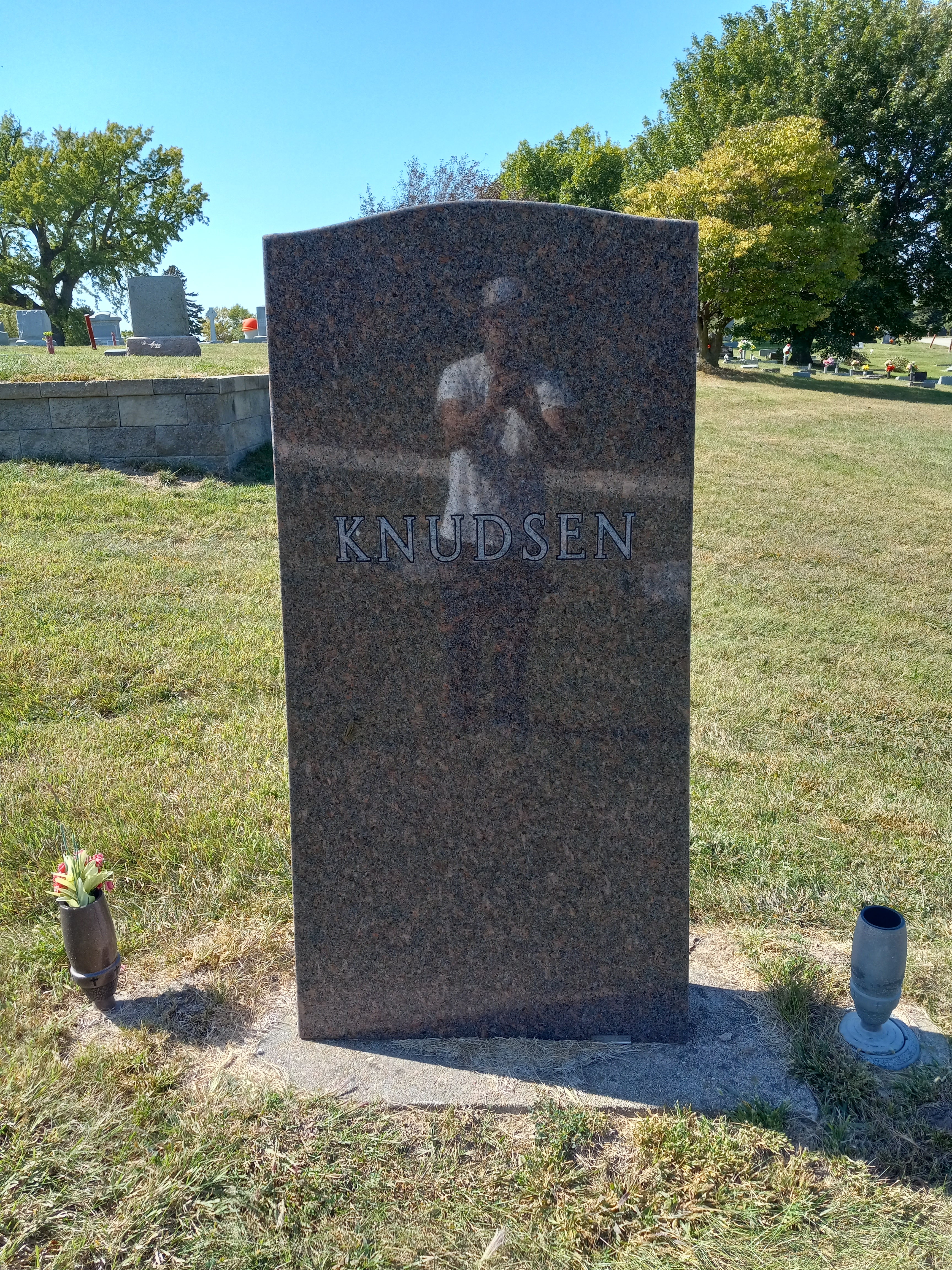
I parked the car and went up to it.  The headstone states our family name, then theirs and the dates of their births and deaths beneath it.  My grandmother is buried on the left.  My grandfather is on the right.  Beneath their names is a scripture from the Bible.  It says, Thanks be to God, who gives us the victory through our Lord Jesus Christ

Standing over their graves, it was hard to believe their remains were in two coffins beneath my feet.  I remembered them talking and sitting in the dining room at their house in Lincoln.  I remembered Grandpa taking us out in the lake with his fishing boat.  I remembered Grandma, bringing in tomatoes from her garden.  Now they were mingled with the grass beneath my feet. 

Going around to the opposite side of the headstone, there is just our family surname.  Looking at it, I saw that my reflection was captured in it, reminding me that just like my grandparents, my time was surely coming.  Then where would I be?  Beneath the ground?  Ashes in the breeze?  Off on another adventure?  A stone skipping across the sea?  I could look behind, and could look in front, but I couldn’t look beyond.  Off in the distance were the graves of more ancestors.  The trees overlooking the valley started dancing in the wind.

pages fly away 41

We didn’t have much money when I was growing up, but never considered ourselves poor.  Both sets of my grandparents came from small farms and grew up during the Great Depression.  My grandfathers became businessmen in Midwest cities and my grandmothers worked as teachers for a spell.   My father’s parents owned a home in Lincoln and my mother’s parents owned one in Denver.  Given my family’s semi-nomadic existence, these would always be the two cornerstones of my life, the red house in Lincoln and the green house in Denver.

If my immediate family didn’t have much money, it was because my father was a free-lance preacher during my early childhood in Hawaii.  Then, when he started working in the Lutheran church again, it was for a modest salary, with four kids.  My mother didn’t start working as a special ed teacher until I’d already left home.  We were taken care of, but never spoiled. 

Back then it was a huge treat to go to the movies or eat fast food.  If we got to go to Dairy Queen, it was like we’d won the lottery.  We’d scrape together any change we could find, behind couch cushions and under car seats, to try to bump up our order, from a simple cone to a chocolate dip, from a buster bar to a peanut buster parfait.  I doubt I ate a banana spilt more than a dozen times before getting out of high school.

Nowadays, we could watch movies any time we wanted, and although eating fast food wasn’t a daily routine, it wasn’t a special occurrence either.  I knew about a Dairy Queen in Blair though, that was still a treat to revisit.  After visiting my grandparents grave, I made it a point to swing by and pick up a vanilla milkshake.

The next stop was Lincoln, to track down the red house.  I took the 133 south to the 80, continuing on through Omaha and Council Bluffs, without an address, thinking I’d just pull into Lincoln and recognize the neighborhood.  In addition to visiting regularly throughout my life, I’d also spent four months with my grandma during a lost period in my early twenties.  I should’ve had some sense of the town.  Instead, as soon as I pulled into it, I was totally lost, driving through ethnic neighborhoods I’d had no idea even existed.

I managed to make my way downtown and find the capital building, remembering The Sower on top of it, and then found the Children’s Zoo.  Now I was making some progress, but still drove around another half hour, feeling like I was close but not recognizing anything.  In desperation I turned to Google Maps, searching for bowling alleys, as I knew there was one in the vicinity of where they’d lived.  Parkway Lanes!  That was it.  As soon I located it, I could put things together.  No wonder I’d gotten lost.  The street had been taken over by corporate chains and fast-food restaurants.

Prairie Road.  That was their street.  About halfway down the block I came to the red house and parked in front of it.  It looked the same, except now the big yard in back had been fenced off.  The neighborhood didn’t look that different, the house remained, but the people that I’d known inside it all were gone.  It was someone else’s cornerstone now.  All that was left were the memories.

After dropping out of Dana College and taking some time off to find himself, my father had regrouped and enlisted at Peru State College.  After getting married, my mother had joined him there for their senior year.  That’s where the recruiter from a Hawaii had found them, looking for English teachers.  It would be my next destination.

Peru is seventy miles east of Lincoln.  I took the 2 to the 75 to the 67.  It is a tiny town, with less than a thousand residents, but the Teachers College looked like it had grown and was doing well.  It was established in 1867 and most of the buildings, like many of those in Lincoln, are made of red brick.  I walked around the campus, stopping in front of a statue of a bobcat, and then a famous footballer, and then drove through town, thinking it might be a good time to look for a campsite.

Karen, from Google Maps, led me to a boat landing far from town on the Missouri River.  There were no facilities.  I returned to town and filled up on gas and got a few pieces of pizza at Casey’s.  Then I tried Google Maps again and came up with the Duck Creek Campground.  The way Karen took me there, down backroads, across an open field in one case, almost led me to believe she was conspiring against me.  Were the agents of my doom out there lying there in wait, like the Butch Cavendish gang?

Incredibly, I arrived at the campground, on a road so ribbed that the whole car was vibrating, and it turned out to be just fine.  No one else was staying there.  The fee was only five dollars.  I threw up the tent just as the sun setting.  A short time later, either wolves or coyotes started kicking up a big ruckus all around.  One lonesome cow stood mooing in a field.  All the crickets chimed in.  I’d lived to see another day.

pages fly away 42

After my family had returned from Hawaii in 1976, and my father had been accepted back on the Lutheran clergy roster, he’d gotten a job at a Bible camp outside of Story City, Iowa.  We were only there three years before he was asked to step down, but it had been a fun place to be a kid, right on the cusp of adolescence. 

There were campers all summer long.  The counselors were mostly college kids.  There was a swimming pool and rec center, with foosball, air hockey, and pool tables, a snack stand that I worked at, a river, a pond, a lagoon, canoes, kayaks, paddle boats, air rifles, bow and arrows, even a horse stable.  We were neither in town, nor were we on a farm.  We’d always lived in a world of our own.

The plan was to head straight to Riverside Bible Camp first thing in the morning.  I broke camp before sunrise and got on the road, taking the 29 to the 80 east.  It took three and a half hours to get there. 

The first thing I saw pulling into Story City was the grain elevator that I’d climbed to the top of with some friends in junior high.  Beyond that was the water tower.  It was another town so small that many of the stores on Main Street had gone out of business, outflanked by larger retailers and online shopping.   I passed the high school and swimming pool, then tracked down the elementary school where John and I had been enrolled.  Our brother Luke had still been too young for school, and sister, Grace, wouldn’t be born until the next year.

It is just a few miles from the town to the camp.  I drove by the house we used to live in and past the new swimming pool.  The camp had originally been built on the flood plain of the South Skunk River, which used to flood on an annual basis.  Much of it, had been rebuilt on a higher bluff, leaving some of the old buildings to rot.  Things looked in rough shape.  I parked in front of the old cafeteria, which looked deserted, and crossed the footbridge over to the basketball court.  The river was just a muddy trickle.  The pond on the other side had evaporated.  No more paddleboats.

Crossing back over, I walked up to the iconic Chapel, the image of which serves as part of the camp logo.  Beside it was the good old hill, with the firepit for late night worship sessions.  It was hard to tell if the chapel was still in use or not.  I looked through the windows, remembering church services, concerts, and talent shows.  So far, I hadn’t seen one single person on the campgrounds.

What I’d been calling meditation on this trip had largely just been struggling to sit still and stay in the moment.  If I couldn’t sit still, I called it a walking meditation, and since I rarely managed to stay in the moment, a lot of times it was just walking and thinking.  To be back at the Bible Camp, seemed like a good occasion to do some kind of reflection, maybe offer up one of the prayers I’d rehearsed in my life and actually try to mean it.  I sat on a bench out front of the chapel, and thought about my father, the pastor, up there at the pulpit, directing things through thick and thin.  One time a few of the campers had egged my youngest brother into booing him.

A cold wind immediately blew in my face.  There’d been so many storms in Iowa, intense thunder and lightning storms, great tornadoes that upended the camp and sent canoes flying through the air, blizzards so thick in the winter, you couldn’t see the road ahead of you.  The leaves were changing all around me.  They rustled across the empty volleyball court.  There were now soccer nets.  They hadn’t been there before.  A ridge ran through the playground, some construction project that had left a scar.  There was the old slide.  Once during a tornado, I’d seen it flapping in the wind. 

Not far off, I could hear the sound of cars on the 35 south.  I closed my eyes and saw the movement of sunlight and leaves.  There used to be tractor tires at the foot of the hill.  We’d push them up to the top, get inside, and then roll ourselves down, end over end, a thrill that couldn’t even be matched by an amusement park ride.  The danger was real.  It wouldn’t have been hard to get knocked out cold.  The tires were gone now.  Too much liability, I imagine.  Everything is too much liability now.  You can’t even hurt someone’s feelings without getting sued. 

Back in the time, before drugs and alcohol, right around the time that rock and roll entered the picture, all our thrills came from playing rough and getting hurt.  Turning the air rifles on each other.  Jumping our bikes into a ditch, solely for the crash.  Up on the top of the grain elevator, dancing near the edge.  Oh my God.  That makes me dizzy just to think about.  Climbing in the tractor tire, saying you were ready, then starting to roll.  In the world we were living in, it was one of the few things that made sense.  You knew why you were being tossed around and knew that it would stop.  When you got out and staggered to your feet, you belonged to the clan, those who were willing to take a risk and roll the dice.

One day the Skunk River flooded so bad, that we had to get up in the middle of the night and sandbag all night long.  I went down and saw a few bloated dead pigs, bobbing down the river like driftwood.  Now there wasn’t enough water in the river to call it a river.  I got up and walked towards the car.  Next stop, Kansas City.

pages fly away 43

Considering how much I’ve traveled in my life, it’s a wonder that I’d never really been to Kansas City.  I’d passed through it on freeways and trains, but that was about it.  If my luck held up, that was about to change.  It was three and a half hours from Story City, a straight shot on the 35 south. 

On the way I stopped at a rest stop with a marker that recognized the Mormon Trail, a 1,300-mile route that stretched from Illinois to Utah.  Between 1848 to 1867, over 70,000 Mormons traveled on it to the Salt Lake Valley, hoping to find their own promised land.  Like most acts of manifest destiny, it didn’t take into consideration that there might be people already living on it, which there were.

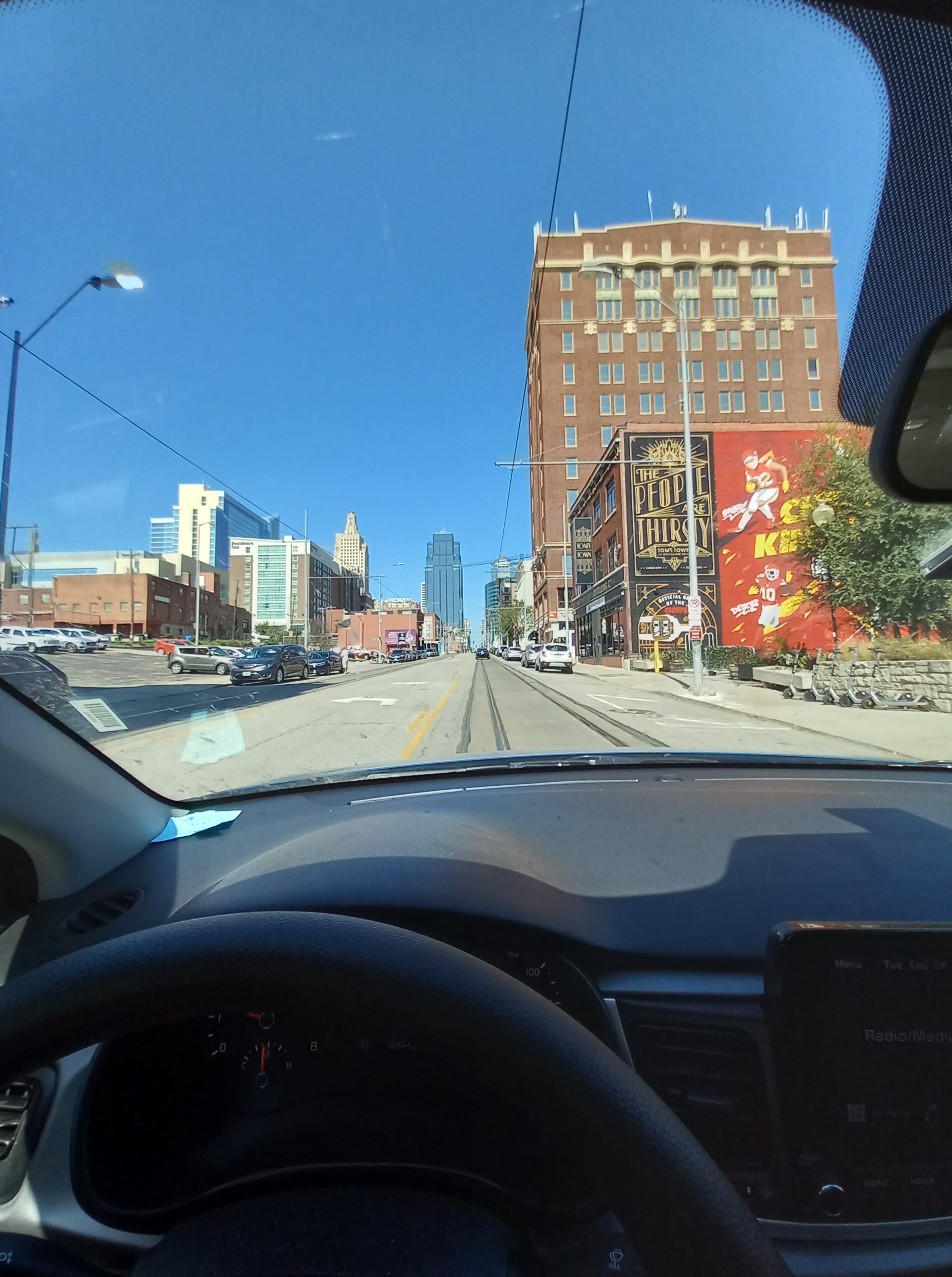
I was mostly avoiding cities on this trip but wanted to at least drive through Kansas City.  I got out on a downtown exit and then parked briefly beside Washington Square Park, where a homeless man was sleeping beneath a statue of George Washington at Valley Forge.  I stood there and watched another guy going down the middle of the street in a scooter, holding up all the traffic.  From there, I tracked down Arrowhead Stadium, home of the Chiefs, which ended up being right next to the stadium where the Royals play baseball. 

The idea for the day was to make it as far as Lake of the Ozarks and look for a place to camp.  I’d never been there either, or to Branson, which I figured I’d hit up the next day.  I took the 70 east to the 65 south.  It had been a long driving day already.  I reached the Lake Ozark Dam in the late afternoon, only to find that the road was closed for construction.  Along the way I must have passed ten thousand billboards, half of them for realtors.  It was almost like watching page-flip animation.

Lake of the Ozarks was a tourist hot-spot, with lake cruises, live music, a big pirate, a big Indian, old-time photo shops, restaurants, gift-shops.  I did a search for a campground and Karen from Google Maps ended up taking me halfway across the lake, on a little road, as steep and winding as a rollercoaster.  The cars behind me looking to pass were going just as fast.  The real estate billboards were paced every hundred feet.  Life on the Lake.  Living the Lake Life.  The sun was glaring through the windshield.  It nearly caused me to melt down.

At last, I arrived at the Iroquois Campground.  It was only for RVs.  There was no one there to talk to.  Google found another site for me, the Little Niangua.  I blindly followed where Karen led, like a man in the desert stumbling towards a mirage.  Somehow, I still missed a turn.  Karen began to harangue me, insisting that I do a U turn.  I did and regrouped at a gas station.  The campground was only a mile away.  Finally, I found the long-ass driveway and pulled into it.

There was no one at the office.  It looked like another place just for RVs.  A few of them were parked about fifty yards from where I pulled in.  By now it was so dark, I had no option but to throw up my tent on a patch of grass.  If anyone came around asking, I’d just pay them whatever they wanted.  I was no longer fit to be driving.

One of the battery lamps I’d invested in had gone missing.  The other was without a charge.  I had no groceries.  There was no way to start a fire.  Ducks were quacking on a nearby river.  A cow was mooing.  Then a dog started barking.  Four deer came out of the trees and just stood there observing me.  Then I saw the flicker of fireflies.  Once again, things had turned out all right.  Even when a horde of mosquitoes arrived on the scene a half hour later, things had still turned out better than they could’ve.  It was important to keep that mind.

pages fly away 44

Around four in the morning, I went out to use the bathroom, with my only source of light, a small flashlight, and came across a small possum stumbling along the edge of the tree line.  Littered across the grass were small glowworms, lighting the land like the fireflies had been lighting the air only a few hours later.  I looked up and there were stars, like glowworms in the sky.  The world was alive, both above and below my feet. 

The moon was an open portal that shined through the wall of my tent once I returned to it.  I sat up, cross-legged and listened to the chirping of the crickets and cicadas.  Then I counted my breaths and listened.  Dew drops were falling from the branches.  All got quiet, and then one single insect returned, rattling alone with all its might.

It was still dark by the time I began breaking down the camp.  By now I had it down to an art, a five-minute operation at most.  I threw the blankets and pillows in the back seat.  Then folded the tent in half, quartered it, and laid it in the trunk, on top of everything else.  The bag the tent had come in?  Forget about that.  The tent pegs?  I hadn’t tried using those since the first night of the trip.  This was guerilla camping, the only thing more primitive being the trips to San Onofre we used to take in high school, where we’d drink two cases of beer and then sleep facedown around a smoldering fire.

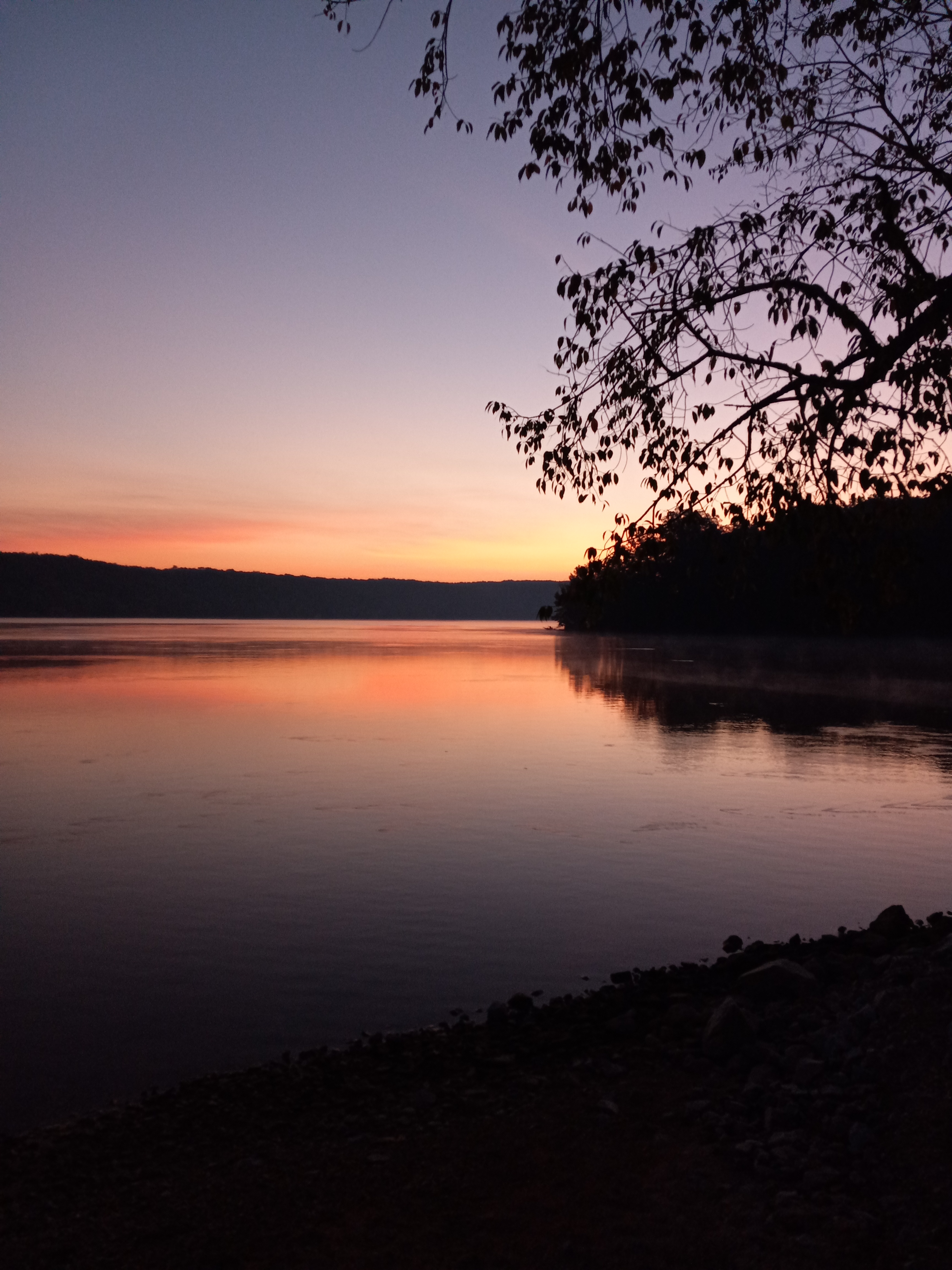
Although I was at Lake of the Ozarks, I still hadn’t seen much of the lake.  I did a search for the National Park and was directed to the McCubbin’s Point Entrance.  I reached the shoreline just as the sun was beginning to rise.  The surface of the water was absolutely calm, with touches of pink, purple, and blue, framed by the silhouette of branches.  It could’ve been a lake of magma, the very evolution of the earth taking place.  The chirping of the bird was nearly deafening.

It was two hours to Branson, a place I was curious about, knowing it has a reputation for live music and shows.   I took the 5 to the 44 south, passing but not stopping in Springfield.  When I arrived at Branson Landing, I wasn’t sure where to go.  I parked beside a Giant Bass Pro Shop and walked down to the White River.  From there, I made it over to Downtown Branson, a place of restaurants, gift shops, and small theaters, but felt like I wasn’t at the center of the action.  That turned out to be W 76 Country Boulevard, a five-mile strip, something of a cross between Las Vegas and the Grand Ole Opry. 

It was a grand slice of Americana that awaited me there, starting with go-karts and batting cages, a toy museum, the Bigfoot Fun Park, a Ferris Wheel, Ripley’s Believe it or Not, the Hollywood Wax Museum, with King Kong and Jack Nicholson, a Mount Rushmore replica with the heads of John Wayne, Elvis, Marilyn Munroe, and Charlie Chaplin.  There was the Titanic Museum, Outlaw’s Old Time Photos, Presley’s Country Jubilee, the Wonderworks Amusement Park, an aquarium with a giant octopus, the King’s Castle Theater, the Andy William’s Moon River Theater, more go-karts, a giant Rooster in a star-spangled vest, McDonald’s, Crispy Crème, and near the end of the strip, the Dolly Parton Stampede.

By the time I reached the end of it, I was wiped out and dispirited.  Up until now, I had no idea if I’d even go much further east than the Mississippi River, but I still had the Mountain Bluebird for three more weeks, and instead of being satisfied, wanted to see even more, to drive all the way across the country.  I’d gotten away with it so far and felt I could keep it up.  How far could I go?  Memphis was five hours away.  I could be there by early afternoon.  After that maybe Nashville?  Kentucky?  Ohio?  Virgina?  I wasn’t sure, but as long as there was still road ahead of me and a bit of money left in the bank, I was bound to find out.

pages fly away 45

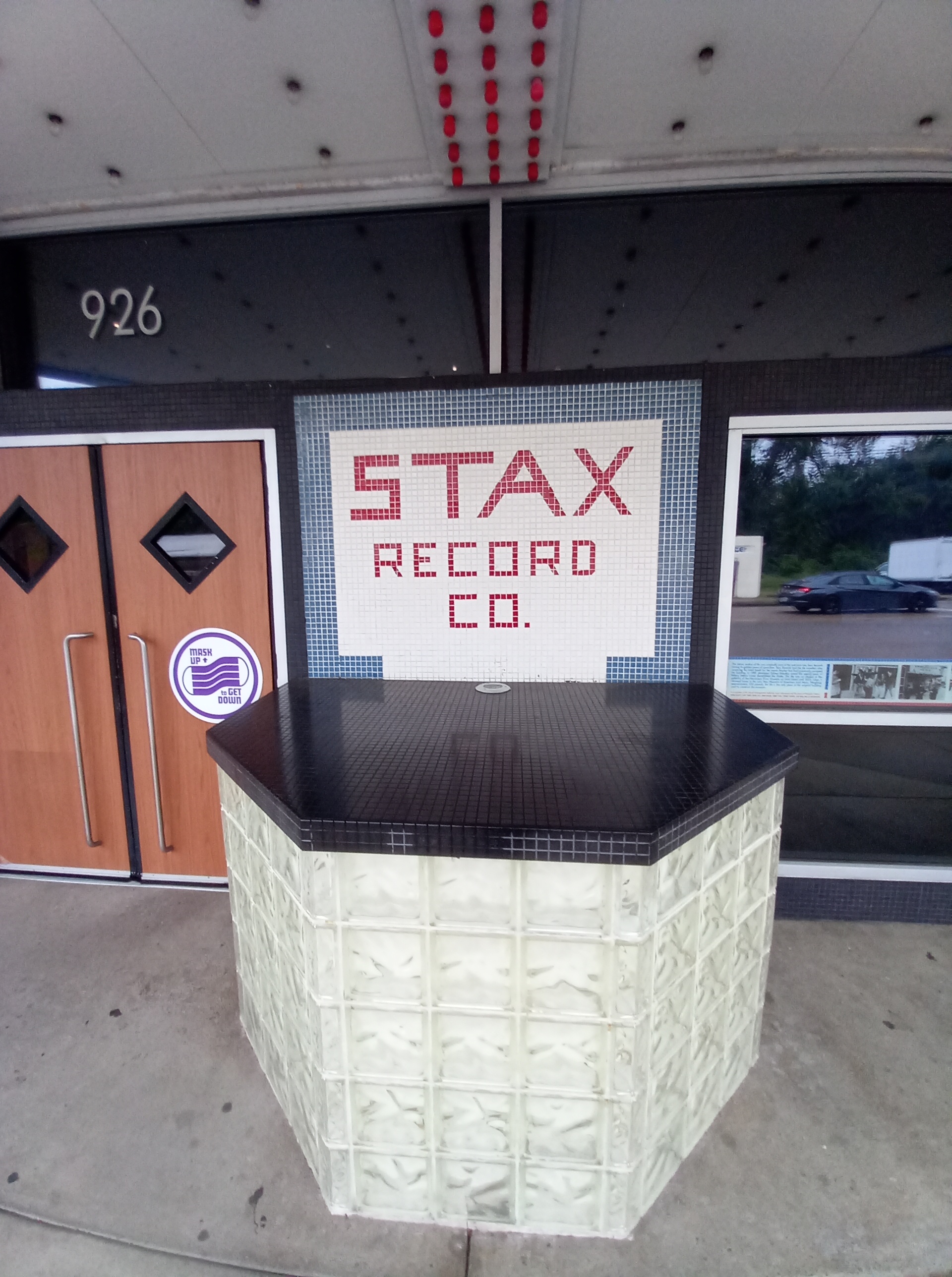
When I’d rented the Kia for six weeks, I’d had no idea where I was going, but had the rough idea to visit as many Indian reservations as I could.  By now the scope of my journey had expanded.  I was on my way to Memphis, the birthplace of the blues and rock and roll.  I’d been there a few times before, to Sun Studios, where Elvis, Jerry Lee Lewis, Roy Orbison, and Johnny Cash had all gotten their starts, also to Beale Street and Graceland.  For some reason I hadn’t visited Stax Records yet, however, and vowed to rectify that.

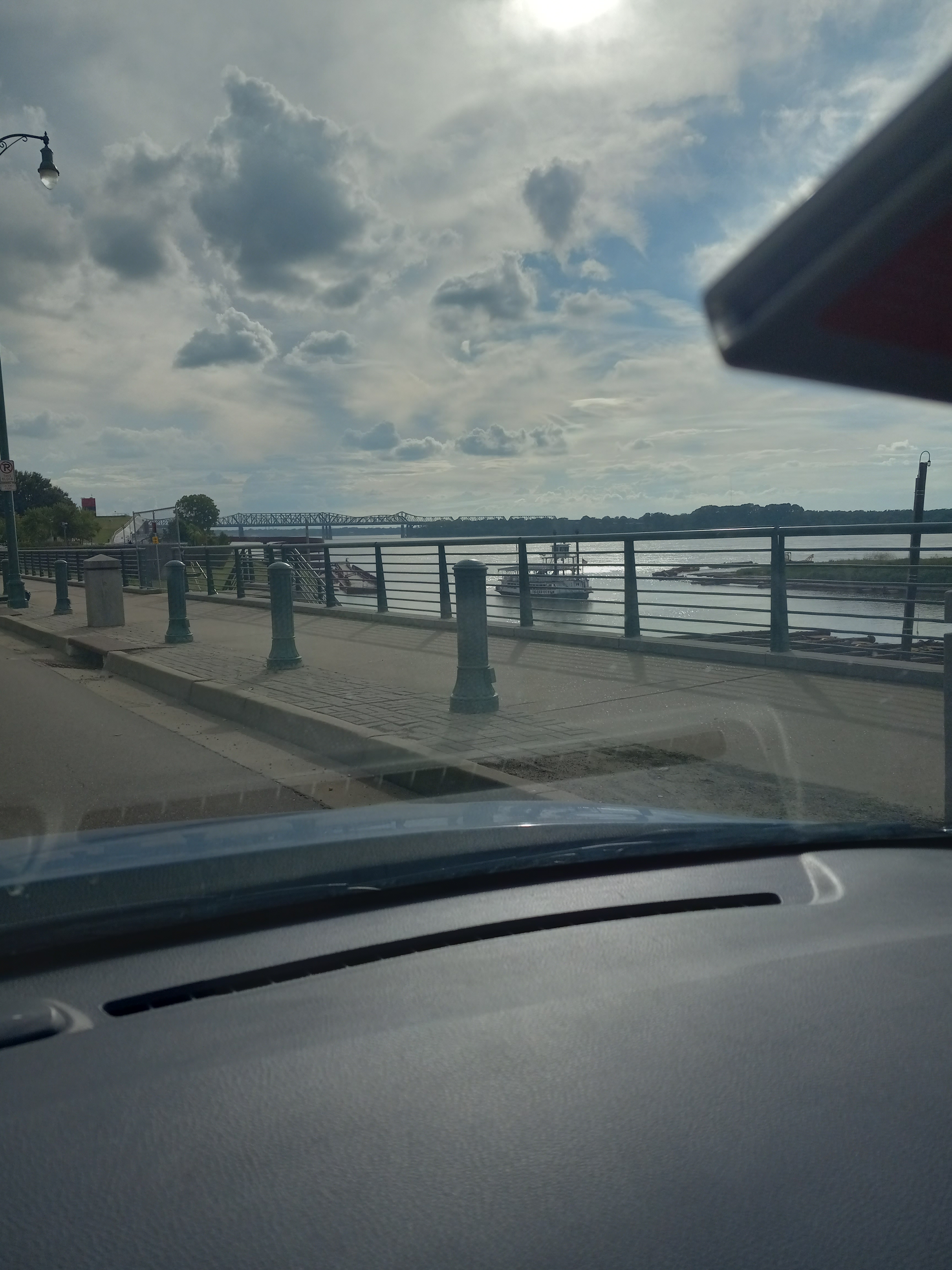
I took the 160 through Gainesville to West Plains, then the 63 south.  There were many rolling hills, and it was slow going.  Sometimes eight or nine cars would get all bunched up, looking for a straight section of road where we could all pass.  When I reached the 55, I caught up with the Mississippi River again, all grown up now and going to school.  I crossed the Hernando do Soto Bridge and got off at the Mississippi River Park, across from Mud Island. 

Inside the visitor center was a statue of Elvis and one of B.B. King.  It was time to look for a place to sleep, but I was spent, driving around downtown for twenty minutes, before finally looking for a campsite on Google.  Karen began directing me to a place called Dogwood Ridge that was almost twenty miles north of town.

It wasn’t easy to find the campground.  I’d almost given up and was at a gas station, filling up the tank and buying chicken strips, when I decided to try again, passing expensive homes and horse stables on my way back.  This time I found it and there were a few sites open.  My spot was on bare earth and even before the sun had set it was swarming with mosquitoes.  It was going to be one of those survival nights.  As soon as the sun set, I climbed in the tent and waited for it to come back up. 

There were a few Chickasaw Indian monuments I hoped to find the next morning.  The first was just a plaque on Mud Island, but by now it had started to rain, only the second time on the whole trip, and didn’t seem as if it would let up anytime soon.  It was raining too hard to look for it on foot, so I set off to find the Chickasaw Heritage Park. 

Here I discovered two earthen mounds, the first in a series of mounds I would encounter, built by paleolithic tribes, perhaps as a foundation for their temples.  These mounds had been hollowed out and used for storage during the Civil War.  There was also a statue of an Indian women, with other figures above the hem of her dress, a woman and child, a man with a guitar, a Spanish explorer on horseback.

It had continued to rain off and on.  Walking back to the car, it started pouring.  It was too early to visit the Stax Museum.  I decided to try to do my meditating, or measured breathing, right there.  Rain was pounding on the roof of the car.  Above the sound of that, I could hear the squawking of a bird.  A man with an umbrella was out walking a dog.  Behind him came another man, with no umbrella, but a COVID mask.  They entered the park together. 

Two cars passed with their headlights on.  Then a gas truck came by.  The rain kept drumming on the roof.  My mind was jumping all around.  The two dogs with the dog came out of the park.  Rain started falling even harder.  By now, I had to piss.

I thought about revisiting Graceland, but saw a sign when I got on the freeway, pointing in the direction of an archaeological site and museum called the Chucalissa Indian Village.  There was a mosaic of two serpents on the outside of the building.  Although they only accepted credit cards to get in, they let me in for free once I stood stalling long enough, holding out the cash in my hand.  The mound in the back is over a thousand years old.  The stratigraphy suggests that it was built in three phases.  It also suggests that there may have been a fire on the top at some point. 

Walking back to the car, I saw something moving in the grass.  It was a turtle, plowing ahead, its shell wet and glistening in the rain.  It was time for me to do the same.

pages fly away 46

The Stax Museum didn’t open until ten.  It was still raining as I drove there, past the Holy Ghost Temple and a sign that said I Love Soulsville.  I parked in back and walked past the Satellite Record Shop.  As soon as I’d entered and paid, a security guard came in and told them not to let anyone else in.  The whole neighborhood was under lockdown orders due to a recent school shooting.  Two minutes later and I would’ve been out of luck and desperately unhappy.  As, it was, I got to go inside and have the museum all to myself.

Stax Records was created in 1957, by siblings Jim Stewart and Estelle Axton, who put their last names together to come up with the name.  Prior to that they’d called it Satellite Records.  It wasn’t their intention to invent Southern Soul Music, but that’s what came out of the mix of gospel, country, and blues music that was coming into the studio at the time.  This resulted in ethnically diverse musicians working together and a singular sound, based on the fact that they always used the same studio, setup, songwriters, and session players.  They went on to partner with Atlantic Records for distribution and make an enormous impact on the world of music, until finally being forced into closure in 1975.

The tour started with a short movie clip about the label.  It was just me sitting there, then getting up and walking into the next room myself.   There, the front room of a country church had been set up, much of the soul in soul music coming from gospel and spirituals, that surrendering to a higher power, be it God or just love.  The Stax groove was explained as the power that the drummers had to make you want to dance and move.  There were exhibitions on Booker T and the MGs, the Bar-Kays, the mixing board from Studio A, Isaac Hayes gold-plated Cadillac, and a long hallway lined with all the hit records they’d produced.

Now feeling inspired, I realized I was for sure busting east of the Mississippi River, in fact I knew exactly where to head next, the famous music town of Muscle Shoals, Alabama.  I Googled it when I got back to the car and found out it was only two and a half hours aways.  Somehow, I noticed that if I veered slightly north, I could also hit up the home of mythical railroad man Casey Jones, so I got on the 40 heading east.

Casey Jones has become a folk hero in story and song, since giving his life in 1900 to slow an out-of-control freight train that was hurtling into a packed station.  The legend is that he died with one hand on the whistle cord and one hand on the brake.  The Casey Jones Home and Railroad Museum is in Jackson, Tennessee.  When I got there, I went and stood outside the small home with the white picket fence where John Luther “Casey” Jones was living at the time of the accident.  A sign talks about the folk song that was written about his death behind the throttle of the Old 382.  I’d heard a few versions but knew him best from the song by the Grateful Dead.

From Jackson, it was still two hours to Muscle Shoals.  I took the 45 south to the 224 to the 69, arriving at Muscle Shoals Sound Studios in Sheffield in the late afternoon.  There are two famous studios in Muscle Shoals.  Sound Studios is an offshoot of Fame Studios, which was established in the late 50s by Rick Hall.  Etta James, Aretha Franklin, Otis Redding, and the Rolling Stones all recorded there.  In 1969, the famous group of backing musicians at Fame, the Swampers, went out on their own and set up Sound Studios.

The next tour at Sound Studios didn’t begin until 3:30, so I raced over to Fame and found they closed at six and their last tour was at 4.  I hurried back to Sound Studios, just in time for the 3:30 tour.  It was a tiny building, and the studio was just one room, with an isolation booth for the drums.  It was where Lynrd Skynrd had done their first recordings.  There was a piano that had been used on Freebird.  There were also black and white pictures of Mick Jagger and Duane Allman.  They played us recordings by Aretha and Paul Simon.  It was incredible to think that all that music had been recorded live in one room with the same group of players.

It was late when I got out, but I still rushed back over to Fame Studios, and was able to sit in on the last tour of the day which was already underway.  It was being led by the grandson of Rick Hall, the founder.  He took us into the control room and played recent recordings by Steven Tyler and Kid Rock.

What a day of music it had been.  I realized I had to break down and get a hotel that night. Although the rain had stopped, my feet were still wet and cold from the morning.  On one strip of hotels and fast-food joints I found a Red Roof Inn which was eighty-five a night and worth about half of that.  It seemed like people were living at the hotel.  My room stunk like cigarette smoke.  Once I turned the TV on, I couldn’t turn it off again.  I managed to get the volume down, but images kept splashing across the ceiling and through my mind all night long.