All posts by Haunted Rock

These are songs, poems and images from a life on the road. Enjoy your stay and safe travels.

pages fly away 61

Five tribes in Oklahoma, the Choctaw, Chickasaw, Cherokee, Creek, and Seminole, became known as the Five Civilized Tribes.  This was because they acclimated to American culture and adopted European dress and Christianity.  Some even owned slaves.  After being relocated to Oklahoma they were established as independent nations, but lost much of their autonomy over the years.  The Dawes Act of 1887, which divided the reservations into individual allotments, decimated the communal holdings of the tribes.  This had happened elsewhere, and though the Act was later repealed much of the damage could not be undone.

After leaving Oklahoma City, I went looking for the Seminole Reservation.  Google Maps, and the voice of it, Karen, had done a lot of good so far.  In this case, however, following her directions took me on a wild goose chase.  Exiting the 40 on the 377, I passed through the town of Bowlegs, and then kept driving, down a solitary, country road, across a nearly demolished bridge. I was notified that I had arrived at my destination when I reached a lonely farmhouse. 

The Seminoles came from Florida.  Some of them married runaway slaves and became the Black Seminoles.  The government launched two wars against them.  After the second one in the 1830, four thousand were moved to Indian Territory.  Although I was on the reservation, the only sign I saw of it was on a water tower and at a high school, where the football team was called the Chieftains. 

Two hours away there was the Five Civilized Tribes Museum in Muskogee.  Driving there, the song Okie from Muskogee, by Merle Haggard came to mind.  That was a small revelation.  I took the 69 north, past the Creek Nation Casino and Thunderbird Speedway.  I got to the museum an hour before it closed.  It was standing on a hill.  There were exhibits dedicated to each of the tribes.  I read about Te Ata, or Bearer of the Morning, a storyteller from the Chickasaw tribe who performed at the White House and in Europe.  A movie was later made about her life.

By now it was getting late and I was wasted with exhaustion.  My plan was to make it as far as Tulsa.  I was interested in visiting anything related to the musician JJ Cale, but by the time I got there couldn’t even concentrate.  In fact, I almost needed help.  It was too late in the day to search for a campsite.  I Googled Motel 6, a go-to from back in the day, and was directed to one about a mile away from the gas station I was parked at, too bewildered to continue.  Karen led me there, but when I arrived, found it wasn’t even a Motel 6 anymore, but a step down.  It looked like a dormitory for meth-heads. 

My initial reaction was just to drive off, especially with the crowd surveying me from the second -floor balcony.  Since I was already there, I figured it wouldn’t hurt to see what they had.  It was forty dollars a night.  The receptionist eyed me twice and said I didn’t need to put down a deposit.  I was good to go. 

My room was on the ground floor, right beside the cracked, empty pool.  I made sure I could see the Mountain Bluebird from the window.  When parking it, there’d been a lot of activity from the next car over, as if someone were living in it.  Two guys on an opposite railing were leaning over with cigarettes, smiling with only a few teeth left in their heads.

 I’d lived in cheap hotels like this one for years.  They were my joints.  Now I wasn’t even sure if the bed was fit to sleep on.  The lampshade was all busted up, but someone had patched it up with playing cards, two Aces and a Jack.  Right beside it, someone had suggested what all cops can do to themselves.  It’s not an adventure if you get too comfortable.  I had a long, classy night ahead of me.

pages fly away 62

It used to be a Motel-6.  Now it was a step beneath a Motel-6, so low that it didn’t even have a name yet.  If it did have a name, it wasn’t posted.  The swimming pool had become a dumping ground.  The building looked like it had been hit like an earthquake.  Some of the balconies resembled ramps.  I liked the fact that someone had patched the lampshade with playing cards.  That was a nice touch.

It was in that room, truly the abode of many a lost soul, that I decided to try and meditate, focus on where I was and why, before hitting the road.  There were two plastic chairs outside the office.  People had been walking past my room all night.  I’d kept a curtain open a crack, just so I could keep an eye on the car.  The air conditioner was clanging like a bell, filling the room with cold, canned air.  There was a hole in the wall by the bathroom.  Inside the bathroom, one of the walls was coming down. 

What had led me to stay in hotels like this for years of my life, besides economy and pride?  Is that what it meant to be an artist?  To suffer, starve, and be neglected?  I’d seen the reality of that myth.  All that matters is the quality of the work, no matter what you need to get it done.  I’d done a lot of bad work in rooms like this, locked up in the bathroom with a bottle and a pipe, but I’d also done some good work.  When I put the good ones aside, I had a decent body of work, one that I could live with. 

Also, who was I kidding?  To live wild and loose is terrifically fun, at least for a while.  But seasons pass, and if you don’t change you either die, or even worse, become boring.

There was a beeping coming from the parking lot.  A truck was backing up.  The room was cold.  My feet were cold.  It was still dark outside.  Where would I go next?  North to Kansas, then Nebraska, and Colorado, where I had family.  After that, there was all of New Mexico and Arizona, home to some of the largest reservations in the States. 

There was a Waffle House across the street.  I’d never been to a Waffle House before.  Breakfast had never really been my thing.  After checking out of my room, I drove over to give it a shot.  The parking lot was crowded.  They only had a seat at the counter.  When they brought out my order, I understood why.  My breakfast filled two whole plates and covered most of countertop in front of me.  Pancakes, eggs, hashed browns, biscuits and gravy, bacon.  I was stupefied.  The waitress asked how everything was.  I told her it was my first time ever at a Waffle House, but I’d be back.  Boy, would I be back. 

I crunched down on a piece of bacon for emphasis and a crown in back of my mouth exploded, filling my mouth with shrapnel, bacon, and blood, the same smile fixed on my face for thirty seconds, until she turned away.  Then I reached for a wad of napkins and spit it all out.  That’s what you get with no dental insurance, when you get all your dental work done in Mexico and Saudi Arabia, fillings that explode like pop rocks, bridges and crowns that shatter after two years.

It was too early yet to do much in Tulsa.  I’d have to return at a later date.  By now I needed to hit the road if was going to make it to Dodge City that day.  I’d seen something on the map about the Pawnee Bill Ranch that looked worth some investigation.  It was an hour away.  I took the 412 west to 18 north.

Most everyone has heard of Buffalo Bill, but how many people know about Pawnee Bill?  I didn’t, not before I showed up at his ranch.  It turns out that they had both been Wild West showmen who’d briefly combined their shows to create the Two Bill’s Show, ultimately a financial disaster that nearly led to bankruptcy. 

Pawnee Bill got his name working on the Pawnee Indian Agency.  He briefly worked for Buffalo Bill’s Wild West Show as an interpreter, before starting his own show in 1888, Pawnee Bill’s Historic Wild West.  His wife May was one of the stars.  After the failed collaboration with Buffalo Bill, Pawnee Bill largely retired to his ranch on Blue Hawk Peak.

There was a corral with a small herd of bison when I pulled up in front of the museum.  It looked like I was the first visitor so far.  I put on my COVID mask and walked to the door.  Considering that only a year ago most every place was still locked down, I was pretty fortunate to get to see what I was seeing.  In the window was a picture of Pawnee Bill, with his stage suit, boots, and hat.  There were Indian artifacts and memorabilia from his shows inside.  It appears that he’d once hired Geronimo to tour with him. 

In a black and white photo, taken with Buffalo Bill, there is no question who the junior partner is. Pawnee Bill comes off as a stumpy sidekick.  If things didn’t work out between them, it is assuredly he who got the short end of the stick.  Somewhere I saw that he’d called Buffalo Bill a boy who’d never grown up.  That is probably a charitable summation, as there are those over the years who found way worse ways to describe him.

pages fly away 63

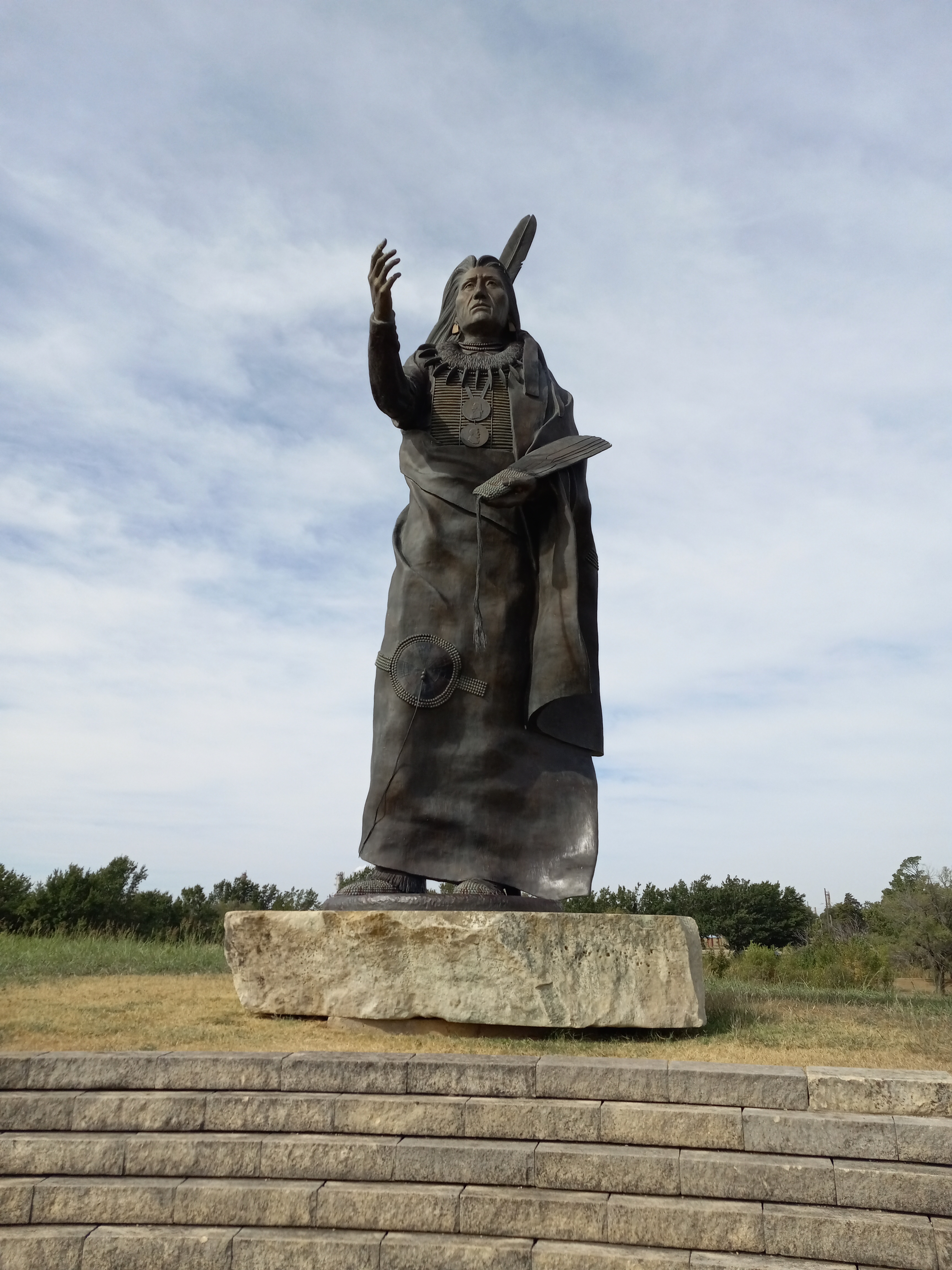
Forty miles from the Pawnee Bill Ranch is the Standing Bear Museum and Education Center in Ponca City.  I took the 15 to the 177 north to get there.  Standing Bear was a Ponca Chief and early civil rights activist, who argued before the US District Court in 1879 that Native Americans deserved the same rights as the European settlers.  He pointed out that though his skin was dark, if cut, he would still bleed the same blood.  The judge sided with him and declared him a person under law. 

When I got to the museum, I saw the twenty-two-foot statue of Standing Bear from a distance.  There was a walking trail to reach it.  I stood at the periphery of the large medicine wheel in front of it, and then backed away slowly and took a series of pictures in which the statue grew smaller, and the horizon grew larger.  There was also an interpretive center that introduced the six tribes of the region: the Osage, the Ponca, the Pawnee, the Tonkawa, and the Otoe-Missouria.  A replica of each tribe’s seal was on display, like round shields, with their own designs and symbols.

It was four hours to get to Dodge City.  I got on the 35 north, which just happened to be a tollway.  That caught me off guard.  There was a machine that I needed to take a ticket from.  A few miles later I pulled over at a gas station and rest area, on an island, so to speak, between the north and south lanes of the 35.  I wanted to see if they had an ATM. 

I’d tried getting money in Tulsa that morning, but the transaction had failed.  Now it failed again, and I got worried.  It was the EDD card I’d been getting my unemployment payments on.  I called the number on the back of it and was informed that they’d placed a block on it, due to all the improbable locations that had been popping up on it.  Thanks for looking out for me, I let them know, but I need it to work.

The woman I was talking to transferred me to the IT department.  While she was doing that, I drew some money off a credit card, not happy to be doing so.  It took a while for anyone to pick up.  The guy who finally did was as suspicious as an FBI Agent, asking me all kinds of insane questions about my movements in the past month.  Then he asked me to answer three security questions, one about a home equity loan I’d never applied for, another about a telephone number I’d never had, and the third about an address I’d never lived at.  My total confusion at the questions seemed to affirm my identity.  He put me on hold.

Meanwhile, Karen from Google Maps, was giving me directions on where to go once I got to Wichita.  She started hounding me to exit, right when the security analyst got back on the phone to ask a few more questions.  Just then, I arrived at the exit for the toll road, and needed to feed cash into the machine to get out.  I was parked too far away.  When I stood up, all the money I’d just gotten out of the ATM spilled out onto the road.  I was trying to wrap things up with the agent.  Karen was nagging me.  The seat belt alarm started beeping.  I got down on my knees, sweeping up twenties, stood up, tried to insert a crumpled five-dollar bill into the slot three times before it finally went through, then got back in the car and started screaming at Karen.  Shut it.  Shut it.  Would you please shut up?   The guy from the bank had hung up by now, at least I prayed that he had.  I was losing it.

They say that Kansas and Nebraska are flat, but you don’t know what that means until you’ve driven across them.  There was not a mountain in sight, not a hill, not a bump, not a ridge, only miles and miles of farmland, flat as a tabletop.  I was on the 400 heading west now.  With nothing to distract me, the drive became a torturous grind.  The grass was bleached out and the sky was pale.  By the time I reached Dodge City I was sore in the saddle.  I got out at a gas station, swung the doors open wide, walked up to the ATM, and reached for my EDD card.  If it didn’t work this time, all hell was going to break loose.

pages fly away 64

Dodge City grew up around Fort Dodge on the Kansas frontier and became a boom town in the 1870s when the Great Western Cattle Trail started running through it.  For a few years it may have been the wildest town in the West, full of gunfighters, gamblers, saloons, and brothels.  Famous figures who once roamed the streets include Wyatt Earp, Bat Masterson, and Doc Holiday.  It was the setting for the popular TV Western Gunsmoke, although the filming was actually done in Utah. 

It was late in the afternoon by the time I pulled up adjacent to the Boot Hill Museum.  There was free parking and the façade of an Old West town.  At the first intersection I came to there was a statue of Wyatt Earp, an opportunist who drifted from boom town to boom town with his brothers, both a lawman, gunfighter, prospector, possible brothel owner, and even boxing referee.  Like many legends of the Old West, he was a storyteller and mythmaker, and it is sometimes hard to know where the truth lies when it comes to the many adventures and deeds attributed to him.

There were supposed to be gunfight reenactments and can-can dancers, but I was arriving late in the season as well as the day.  There was a statue of a longhorn and one of Marshall Dillon from Gunsmoke.  By the time I got to the museum, they were getting ready to close.  I didn’t beg to be let in, but the attendant took mercy on me and let me run up to Boot Hill.  I passed a rack of law badges at the door and made my way past a replica pioneer town with a wooden boardwalk. 

The cemetery had been on the highest hill in town and only used for about seven years.  There was a poem written from the perspective of the unsung dead, urging passing travelers not to cry for them.  Some of the causes of death included shooting, hanging, scalping, and freezing.

After leaving the Museum, I passed The Western Hotel, then the Gunfighters Wax Museum.  They too were closed, so I missed out on the chance to see Davy Crockett, Calamity Jane, Frank and Jessie James, General Custer, Wyatt Earp, Doc Holliday, the Dalton Brothers, Belle Star, Bat Masterson, Sitting Bull, Billy the Kid, John Wesley Hardin, Buffalo Bill, Wild Bill Hickock, really almost the entire Old West Gang, most of them only famous for killing people.

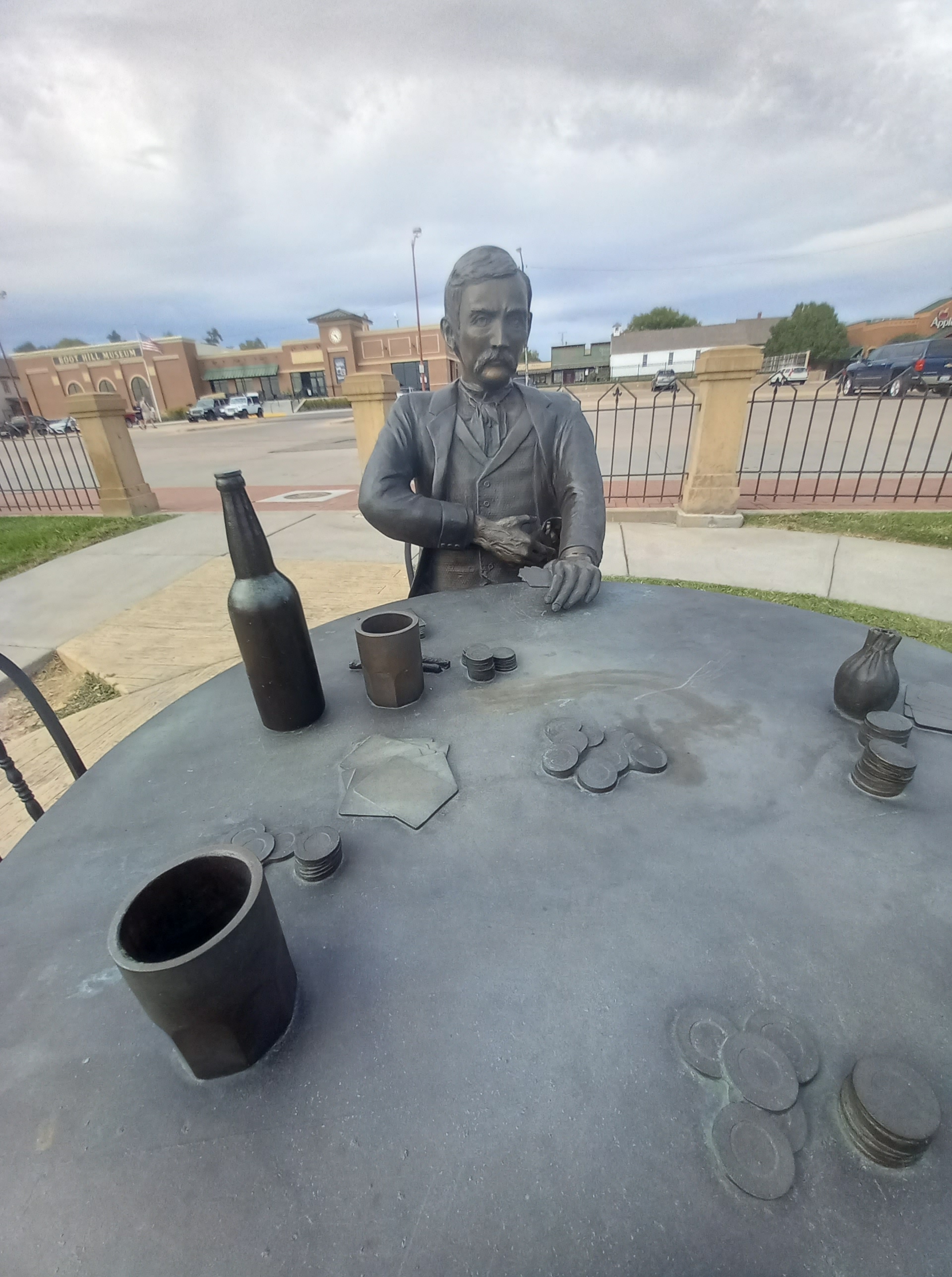
As I was leaving, I passed an old locomotive and statue of Doc Holliday, sitting at a table covered with money, cards, and alcohol, reaching for his pistol.  He’d been a dentist with a bad temper and a drinking problem, and now sat there, inexplicably, a hero to many.

I’d passed a hotel on the way into town, advertising rooms for twenty-nine dollars.  That seemed too good to be true, and it was, but I got one for forty.  The woman who owned the place had been a refugee from Vietnam who’d worked at a meat packing plant for twenty-four years before buying the hotel.  Room 24 in the back was large, with pictures of white-tailed deer on the walls.

There was a Chinese restaurant with a buffet that I ate dinner at.  So far, I’d bought most of my food from gas stations so the whole night felt like a luxury.  At the next table, the group of young people were talking about a real-life outlaw they all knew who was back in prison again.  Would he get a statue on Main Street?  That was doubtful.  Maybe if he started rapping about his criminal lifestyle.  Then there was a chance.

pages fly away 65

When I’d picked up a rental car in Huntington Beach over a month earlier and just started driving, I’d only had a vague idea that I might drive through Indian reservations.  By now the trip had become a crash course in the whole history of Western expansion, and I was still flying across the land with some of the most interesting lessons ahead of me.  Fortune had mostly smiled on me the whole time, from the weather, to what was open, to the places I’d found to camp.  If I’d started my trip needing to find hotel rooms right away, it would’ve been over within a week.

My plan that day was to drive from Dodge City to North Platte, Nebraska, and Ogalala, then on to Denver that evening.  It was a lot for one day, possibly too much.  I got up while it was still dark and loaded the car.  When I was ready, I looked up North Platte on Google Maps and asked for directions, hesitating for a moment when I remembered how I’d yelled at Karen the day before.  Would she even answer?   That was ridiculous.  We’d spent so much time together, and honestly, she’d saved my skin so many times, that I’d gotten oddly attached to her.  I was relieved when her voice came through bright and clear, my angel of the morning, directing me to take the 400 west to the 23 north.

In a half hour, the sky opened up in bands above the highway, pink, pale blue, and a darker shelf of gray-blue above that.  Talk about flat.  You could have laid the foundation for a house on the horizon.  I passed through Grinnell and Oberlin.  A flock of wild turkeys strutted across the road.  Later, I drove past huge pens of cattle, tens of thousands of them.  The air reeked of sulfur. 

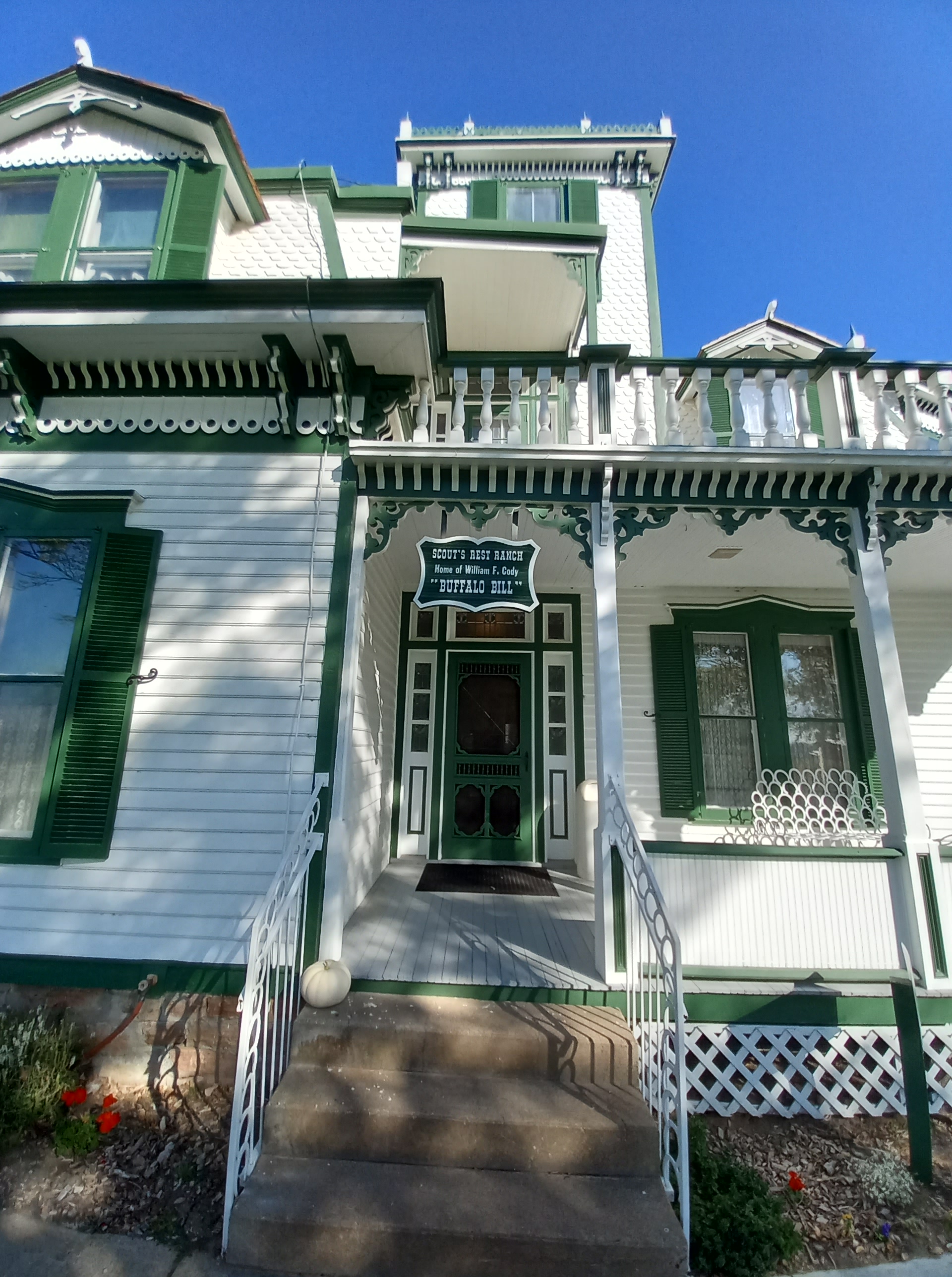
I had a cousin in North Platte, but I’d be seeing her at my aunt’s in Ogalala after lunch.  My destination was the home of Buffalo Bill, Scout’s Rest, as well as the trading post and tourist trap, Fort Cody, which had been a favorite childhood stop on our trips between my grandparents’ homes in Denver and Lincoln.

Buffalo Bill was showing up everywhere on my trip.  His Wild West Show had gone on to define an era for most people, in the same way that certain movie actors define a generation.  What was he like as a man?  It depends on who you ask?  He gave audiences what they wanted to see, white heroes restoring order to the universe.  Was he a drinker and philanderer?  By some accounts he had to be tied to his horse to keep from sliding off, and his relationship with his wife was barley civil. 

Was he influential?  Enormously so.  His vision of the Wild West would go on to inform all the stereotypes about it that we’ve come to know by heart.  If you grew up playing Cowboys and Indians, you already knew how the game should go.

When I reached the Buffalo Bill Ranch State Historical Park Museum, there was a wedding party meeting up in the parking lot.  On the other side of the road was a rodeo arena.   Scout’s Rest, the home where Buffalo Bill rested up and entertained guests in between tours, was built in 1886.  I did a quick tour on my own.  There were pictures of him at various ages, one with his daughter, Irma, a couch he used to recline on, a buffalo robe, in one case comic books and action figures, a picture of Sitting Bull, and one of Pawnee Bill.

Out back in the barn, there were stables, riding gear, a covered wagon, artwork and posters from his different tours, and pictures of the cast members, many of them Native Americans who’d only recently been conquered and forced onto reservations.  From what I understand, Buffalo Bill respected them and treated them well, even if they were expected to lose every fight.  I read some of the names:  Moses Flying Hawk, Amos Two Bulls, Bull Ghost, Amos Little, Mrs. Yellow Hair, Whirling Horse, Sam Surrounded, Crow Eagle, Charles and Julia American Horse, Mrs. Black Tail Deer, Iron White Man, Bad Bear, Chief Iron Tail, Joe Black Fox, Buffalo Fat. What names, what pride, what identity, what culture. 

There was also a picture and poster that billed Annie Oakley, one of the top stars of the show, who could shoot a cigar out of her husband’s hand or hit a playing card at thirty paces.  Outside was a tipi and small park, that was decorated for the upcoming fall holidays.  When I left the home, I went and parked in front of the tipi, to gather my thoughts for a moment.  It had become nearly impossible to stop and count my breaths for any length of time.  If I didn’t get to it right then, it wouldn’t happen.

There was a pumpkin patch beside the tipi and a cold wind blowing through the trees.  Some cattle and a few buffalo were standing inside a corral.  Children were running around, playing and yelling.  The whole property was the perfect playground.  Off in the distance I could see a mule and a couple of goats.  What was exciting the children was a zipline.  I could see the movement of bodies flying through the air, but not where they started or stopped. 

We made our own ziplines when I was growing up out of rope, we jumped out of trees and swings into bushes, we rode laundry baskets down flights of stairs, coming close to annihilation, yet somehow surviving.  That had been the thrill of it all.  The wind was rustling, and orange leaves were flying all around.  An old man in a cowboy hat walked by carrying a gas can.  My mind began racing like the wind.

Next up was good, old Fort Cody.  As children, we’d had to beg and plead from a hundred miles away to get our father to stop at Fort Cody.  He would’ve pulled over regardless.  It was one of our most cherished traditions.  Back then they’d had Indian dancers performing in the back court.  It was an adventure just to be there.

As I pulled into the parking lot, I was flooded with the nostalgia.  There was the sign, Buffalo Bill, in his fringed jacket and hat, cradling a rifle in his arms.  Outside were a buffalo, grizzly bear, pony, and kachina doll.  Along the fort walls were posted sentries from the Calvary.  One was folded over with an arrow sticking out of his ass.  Yellow flags were flying.  A cannon stood ready.

Inside there was a miniature version of the Wild West Show and a two-headed calf.  There were two mannequins standing in cases side by side, one an Indian in full regalia, the other Buffalo Bill.  Overhead was the skin of a bobcat.  There were drums, moccasins, pictures of Red Cloud, Kicking Bear, Sitting Bull, and Gall.  In the backyard was a small jail, a rider on a bucking bronc, with a hole around his head for you to look through while someone took a picture, a big Indian, and another buffalo.

It was largely how I remembered it as a young child.  It looked like they had removed the lewd merchandise that had infiltrated some of the shelves during my teen years.  My brother and I always joked about a cup we’d seen when we got older that was a tit, where you were supposed to drink out of the nipple.  We’d always considered that to be the end of the innocence.

pages fly away 66

From North Platte it was an hour drive to my Aunt Barb’s house in Ogallala.  Her and my Uncle Vern had started up a business there nearly thirty years ago.  Vern had passed away in 2020, around the same time I’d suffered a nervous breakdown under quarantine and then had a seizure.  I’d barely given Barb any notice, but the timing worked out as my cousin’s Stacy and Roy would both be there with their families.  I took the 80 west.

Ogallala was once a stop for the Pony Express and served as a crossroads between the Great Western Trail and Union Pacific Railroad on cattle drives.  My first stop once I got there was the Boot Hill Cemetery, maybe not as famous as the one in Dodge City, but just as interesting.  The name came from the practice of burying bodies with their boots on, often in canvas bags.  I read about horse thieves and gamblers buried there, one of them, Rattlesnake Ed, who was shot down over a nine-dollar bet in a saloon called The Cowboy’s Rest. 

There was a narrow stairway to get up to Boot Hill, with the name on an overhead sign.  The centerpiece of it is a sculpture of a horse and cattle driver, leaning on the saddle, gazing back towards Texas, the way he’d just come.

When I got to my aunt’s there was a football game going on between their team, the Cleveland Browns, and the Los Angeles Chargers, formerly of San Diego.  Stacy and Roy’s children were nearly grown up.  I had never known them well.  There was pizza on hand.  Aunt Barb had to run to choir rehearsal.  I’d recently seen her at a wedding, so we’d had a chance to catch up.  It was strange not having Vern around.  My father was gone now, my uncles were gone, all my grandparents and great-grandparents were gone.  All that remained were my mother and three aunts.  Our family had been scattered around like seeds in the wind.  There were few cornerstones or hiding places left. 

I only stayed until half time.  Denver was a long way off, over three hours.  When I left, the Browns were winning, though I later learned the Chargers snuck it past them at the very end.  It was a good thing I got out of there when I did.  I took the 76 all the way through. 

By the time I arrived on the outskirts of Denver the sun was setting down behind the Rocky Mountains, illuminating their rugged profile.  My stop that night was at my college buddy Riley’s place in Littleton.  In the morning I’d try to find the lot where my grandparents’ house had been in Englewood, as well as track down any family members who were available.  The plan was to stay with my cousin Gwendolyn that second night.

Even with Karen from Google Maps doing her heroic best, I still got tangled up in the foothills looking for Riley’s place.  She looped me through a labyrinth tract of identical suburban homes before finally narrowing down his cul-de-sac.  Then I was inside, greeting him, his wife, and grown son.  Most of my friends had houses and families by now.  All I had were wild stories that had largely devalued with the passing of time.  Still, it was fun to catch up.  As with my college friends in Minneapolis, there comes a day when you’re just excited that anyone out there still knows and cares that you’re alive.  They had a guest bedroom for me with a towel folded at the foot of it.  I slept about four hours beneath the towel and woke up bucking to hit the road.

It was not far to Red Rocks, the famous amphitheater chiseled out of stone.  I’d never been to a concert there but had been up to hike around it a few times.  On this occasion, it was still early in the morning.  I parked and walked up to it.  The sky could not have been any bluer and the rocks could not have been any redder.  The sun shining through a railing on the walkway cut a symmetrical shadow ahead of me.  When I reached the amphitheater I found a seat about halfway up, in the very center of it, and sat down on a bench.  Workers below were readying the stage and people were exercising, running up and down the stairs.

The weather and temperature were perfect.  The sun was not yet too hot.  Outside of random voices, the only intrusion was the sound of someone cleaning with a high-pressure hose.  A woman to one side of me was doing sit-ups.  An old couple were posing for a selfie.  They picked up their dog and forced it into a group shot.  Some kids were playing at the front of the stage. 

In high school I’d gotten a cassette tape of U2’s live show at Red Rock.  That’s where I knew it from.  The sun was shining in my face.  The high-pressure hose was getting closer.  It began to drown out the other sounds.  One time in college we’d climbed up to the top of the overlook here and tried to smoke some weed out of a beer can.  The can had popped back into shape and catapulted our only bud over the ledge.  That had been a bummer. 

Someone came running up the seats right next to me.  That incident in college had happened over thirty years ago.  People always ask, where has the time gone.  Most of my life I’d been unable to get rid of it.  Maybe at the last second, I’d wish to have it all back.  For now, I’d found a small eternity inside of it, but the high-pressure hose was on me now.  The serenity shattered into a billion bright shards.  Denver was waiting below.

pages fly away 67

Because we moved around a lot when I was growing up, away from our extended families, the only two cornerstones I had growing up were the red brick house in Lincoln where my father’s parents lived, and the green one in Denver that belonged to my mother’s parents.  Those had been there my entire life, places for family members to meet up and regroup when they needed to.  Though a very modest home, the green house had once seemed immense, with a converted attic and a basement.  We would make haunted houses and play hide and seek.  There were thousands of places to hide.  The backyard had a swing set with a trapeze, the site of countless circuses and stunt shows. 

After my grandfather passed away at the age of 95, still living on his own, the house had been sold and torn down.  Now I was going back to revisit the old neighborhood for the first time since.  I took the 70 west to the 25 south.  The largest thoroughfare was South Broadway.  Once I got close enough, I knew how to get there, although the surrounding blocks looked sketchier and more downtrodden since the last time I’d passed through.  What dominated now were the fast-food restaurants more than anything. 

When I got to the site where the green house had been, there was nothing to remember it by.  Even the hill out front had been brutalized.  It had been chopped in half and leveled.  The house was modern and sterile, void of memories and emotions, someone else’s obsession to carry with them now.  The great tents of the world were becoming unpegged.  Scrapbooks had been left outside in the wind.  Pages were flying away.

My aunt Joan still lives about a mile away from her parents’ old property.  I’d given her a call and said I’d stop by before heading over to Gwendolyn’s.  She is my mother’s twin sister, once the Bobbsey Twins of Flood Middle School.  Joan was waiting for me in the dining room, looking a little older but still getting on.  She was eager to hear about my travels and presented me with a little banjo that her fingers had gotten too arthritic to pluck.  She was going to join us for dinner that night, so after a short visit I excused myself and raced towards Casa Bonita.

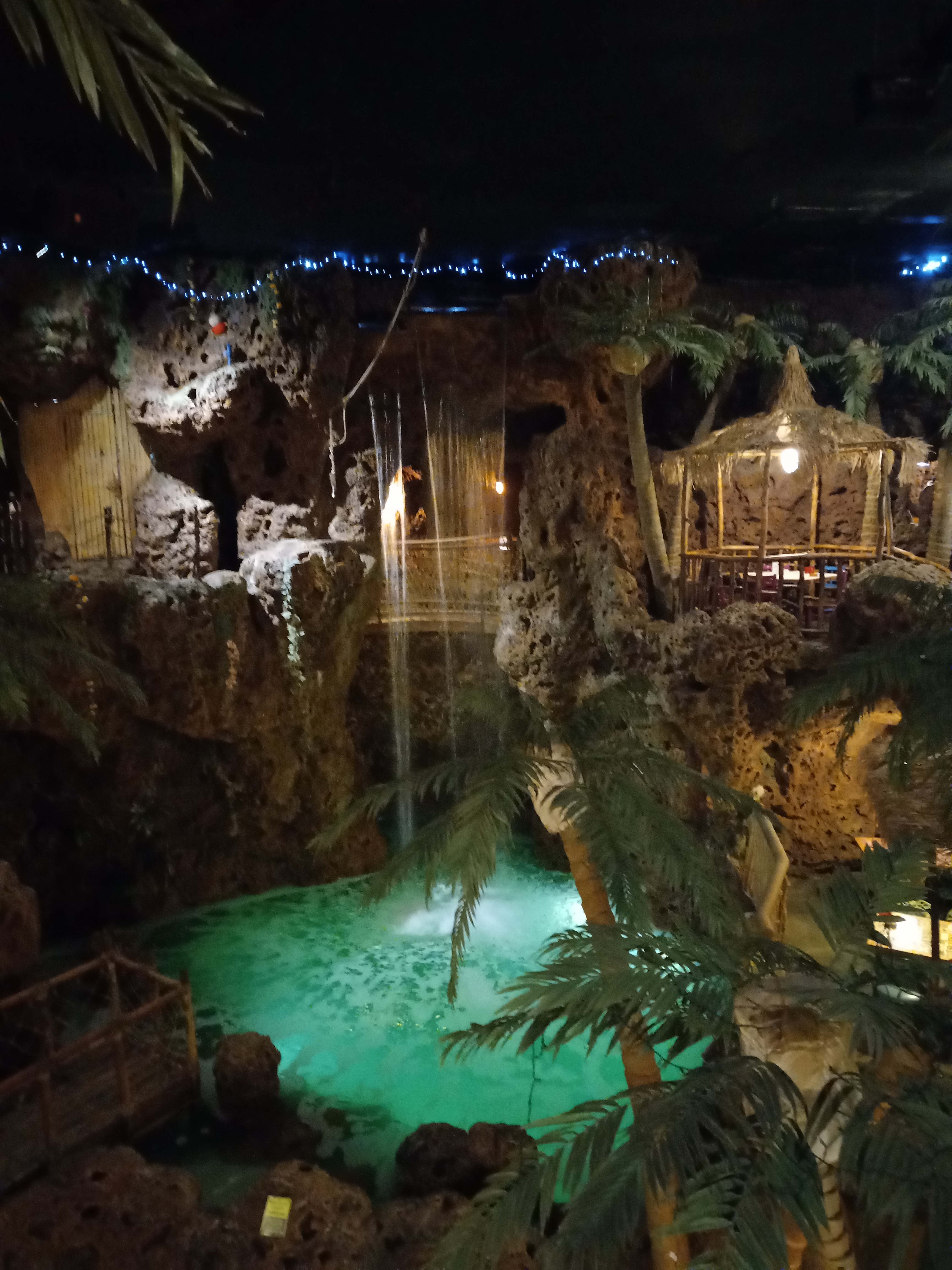
Casa Bonita had been another treasure of our childhood, right up there with Fort Cody.  Because we only saw our relatives once a year, a trip to Denver always meant an outing to Casa Bonita.  A Mexican restaurant and entertainment complex, with a bell tower that rises above the mall it operates out of, it is almost up to amusement park specifications, with an indoor waterfall, divers, variety shows, mariachi bands, a puppet theater, and video arcade.  Some of the tables and viewpoints are carved out of a rock façade.  It had been shut down for a few years now, but I stopped by just to look at it and found they were conducting daily tours.

Gwendolyn only lived a few blocks away.  I ran over to fetch her and dragged her back for the last tour of the day.  Talk about a lucky break.  What wasn’t going right on this trip?  We drove over and joined two couples who were waiting for the tour as well.  The guide was dressed in black, like a medium or witch.  It was getting close to Halloween, but she also took us to a secret banquet room where lights were said to flicker off and on by themselves.  Overall, Casa Bonita was how I remembered it, although without any customers.  The waterfall still fell thirty feet into a pool.  The air was misty and smelled like chlorine.  There were posters of bullfights on the wall.  We could’ve been in Acapulco.

One of our favorite things back in the day had been to wander through Black Bart’s Hideout.  Now as middle-aged adults, Gwendolyn and I tromped through it.  There was the snarling face of a witch, a bottomless pit to cross, a dragon mouth to enter, in which Gwendolyn posed for a picture, in addition to some kind of ice zombie, and the threat of exploding dynamite. 

When we exited, I walked over to the wishing well.  It had once been the home of a green ghost, whose face would ripple beneath a thin veil of glass and speak in an ominous tone.  Now the well had been given a makeover, all red and yellow, with nothing but coins inside.  Glancing inside it was just as unsettling.  As a kid, the scariest thing you can imagine is running into a ghost.  As an adult, what really gives you a fright is running out of money.