All posts by Haunted Rock

These are songs, poems and images from a life on the road. Enjoy your stay and safe travels.

pages fly away 82

The three most famous Old West gunslinging towns were Deadwood, Dodge City, and Tombstone.  When I set off on my six-week road trip I didn’t think I’d visit one of them, let alone all three, and yet here I was, just an hour away from Tombstone.  I’d been there once before to do some field-recordings and was looking forward to revisiting it.  On the way, I stopped to visit the old mining town of Bisbee, and the nine-hundred-foot Lavendar Pit on the outskirts of town.  When I showed up in Tombstone, I couldn’t have been happier that I’d arrived just in time for their annual celebration, Helldorado Days.

Tombstone is most known for the Shootout at the OK Corral, between US Marshall Virgil Earp, his brothers, Morgan and Wyatt, and Doc Holliday, against cowboys Billy Clairborne, Ike and Billy Clanton, and Tom and Frank McLaury.  Bad blood had been brewing between both parties for some time, and Billy Clanton and the McLaury brothers were killed in what has also been described as a massacre.  Apparently, it was all over in thirty seconds, and when the dust cleared history been made. 

I parked across from the City Hall and wondered past old OK Corral.  Since gunfight reenactments are part of the daily routine in Tombstone, it took me a while to realize that all of the people dressed up as cowboys, saloon girls, and mountain men, were there for the festivities and many would be taking part in a parade down Main Street that was starting in a few hours.  It seemed my luck was still holding out.  Too wired to sit and meditate that day, I decided to do a walking meditation on the boardwalk.

A church bell was tolling as I crossed the street.  A car stopped to let me pass and a cowboy waved me across.  I was standing right next to my own shadow on the ground.  A picture of Billy Clanton and the McLaury brothers in their coffins bore the caption, Three Murdered in Tombstone.  Tom was hit by a shotgun fired by Doc Holliday.  He and Billy both died slowly.  Frank was shot in the head and died instantly.

Across the street was a stand selling sarsaparilla sodas.  A saloon girl rode by on a golf cart.  In the city park was a bounce house for children.  The OK Café was selling real buffalo burgers.  Up ahead on the street was a stagecoach, being drawn by a mule.  A cowboy approached me selling tickets to the gunfight.  I turned on to the boardwalk. 

A leather-clad biker came out of Outlaw Books.  I looked into a shop window.  There was an Indian drum, dreamcatchers, wanted dead or alive posters, an American flag, a Mexican blanket.  There were movie posters.  The Magnificent Seven.  Geronimo.  The Good, the Bad, and the Ugly.  The Unforgiven.  Two cowboys stopped and posed when I asked for a picture.

In another shop window was an Indian head in a headdress, one half of his face painted white.  There was a fox hat.  A kachina doll.  I had to stop a mountain man for a picture, clad in buckskin.  He put his hands on his hips and puffed out his chest.  There were Navajo rugs, pottery, a buffalo-headed medicine man holding up a pipe.  Two Indians danced on a shelf, one with hoops, the other with feathers.  A wooden Indian stood outside the shop. 

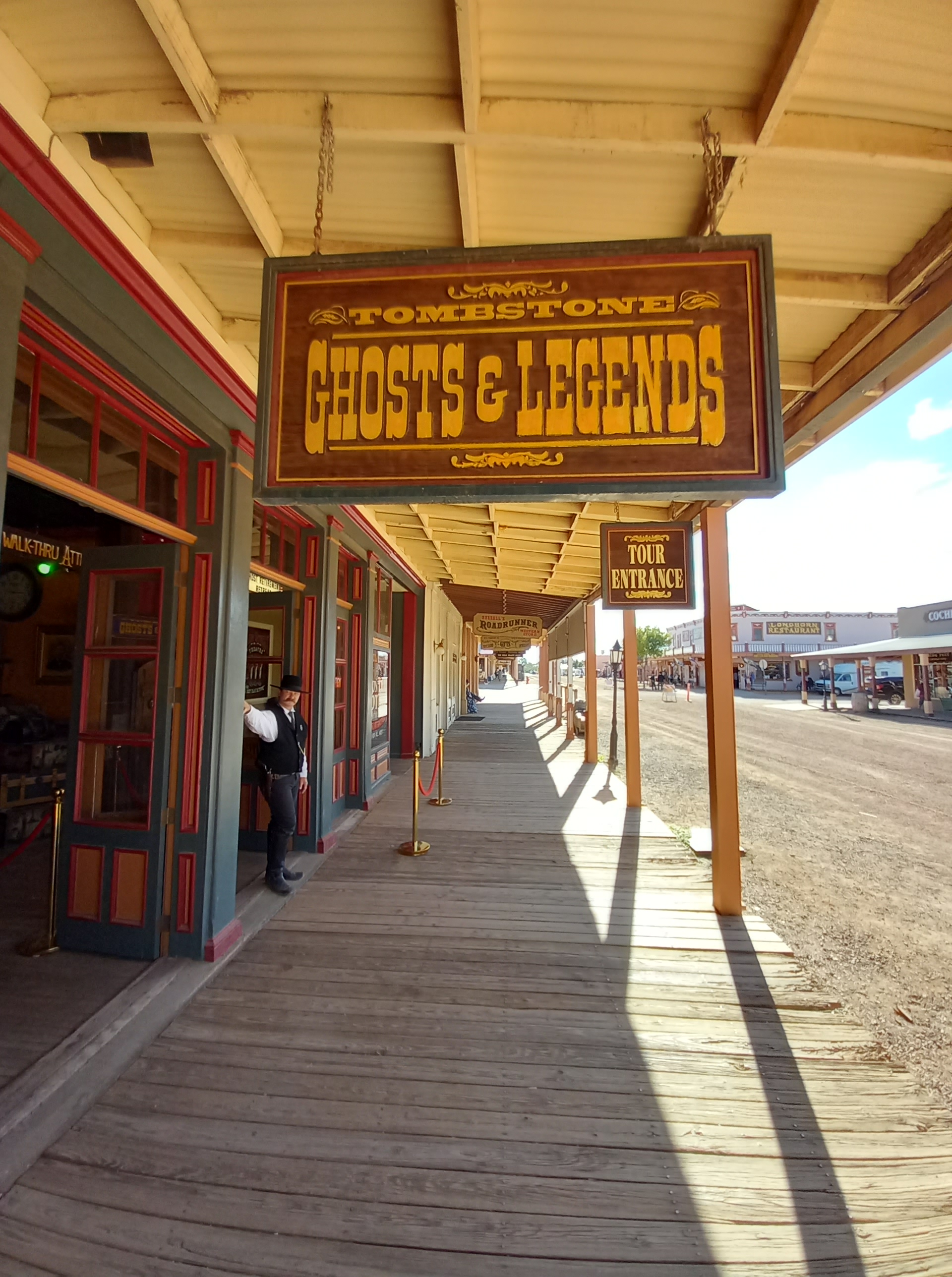
Wyatt Earp looked out the door at me as I approached Tombstone Ghosts and Legends.  I told him he looked like Kurt Russel.  He said he got that a lot.  I passed Ike Clanton’s Haunted Hotel and Russel’s Roadrunner Stetson.  Dwarf Wrestling was coming to town.  Also, How the West was Fun.

The Oriental Saloon featured the kicking legs of showgirls in the window.  You could get a pressed penny souvenir for fifty-one cents, right next to Lilly’s Tombstone Memories.  I looked in a window and saw a coyote howling at the moon, a rattlesnake, a buffalo, and a cactus.  Across the street was the Birdcage Theater. 

Cowboys on horseback were lining up for the parade.  I came down the other side and saw Big Nose Kate’s Saloon.  There was the Dead Man’s Hand, two black aces and two black eights.  Tombstone.  RIP.  Longhorn cattle.  Totem poles.  Handcuffs.  Cap guns.  Racoon hats.  Legends of the West.

Where was I at, outside of lost in time?  From somewhere the National Anthem was being sung.  Spurs were coming up behind me, ringing louder and louder in my ears.  The parade was about to begin.  I found a seat on the boardwalk and sat down to watch the show.
pages fly away 83

One time I got irritated at my nieces, which I don’t often do, when they started to complain about how bored they were at a Fourth of July parade that we’d waited a long time to see.  They wanted to go back to the house and use their tablets and phones.  I’d ended up sounding like an old man when I informed them that back in my day all we had was the parade.  We waited all year for it.  We liked it no matter what.

Now the Helldorado Days Parade was making its way down the street, and I was excited as a boy would be back when I grew up.  What were the chances of randomly rolling into town on the only day of the year they’d be out celebrating?  I knew it was destined to be, but didn’t know why.  Here came the Board of Directors, holding a sign, kick-stepping to the music.  Next was a repertory company, Code of the West.  I knew that mountain man from somewhere. 

Behind him came Wyatt Earp, next to a woman in bloomers swinging a baseball bat.  Who was that behind them?  Another mountain man, this one with a rifle, five cowboys, a US Marshall. 

Next came a coven of witches, one really hot one, twirling brooms.  Then a gang of motorcycle banditos.  Right behind them, John Wayne as Rooster Cogburn, bellowing out a greeting to the crowd.  The Calvary riders came right behind him, then the Shriners in their tiny cars, whizzing around in circles.  Another group of riders brought up the rear.  Wow.  What excitement.

There would be activities all day long, but I’d been there for the best of it.  I went to look for the car and then saw it was over four hundred miles to Joshua Tree.  I wouldn’t be making it that far.  On the outskirts of town was the Boothill Graveyard.  When I saw they were charging an entrance fee I almost blew it off and even got in the car, but then turned back.

All of these people parading down the street.  Me, in the Mountain Bluebird, racing against the wind.  What is our final destination?  Where are we all going?  I got out and began walking past the rock piles, cactus, and wooden headstones.  There were the three cowboys who’d been killed in the Shootout at the OK Corral.  Were they even bones anymore or just dust?  Unlike most of the others buried there, at least they had a story that had outlived them, if that’s any consolation. 

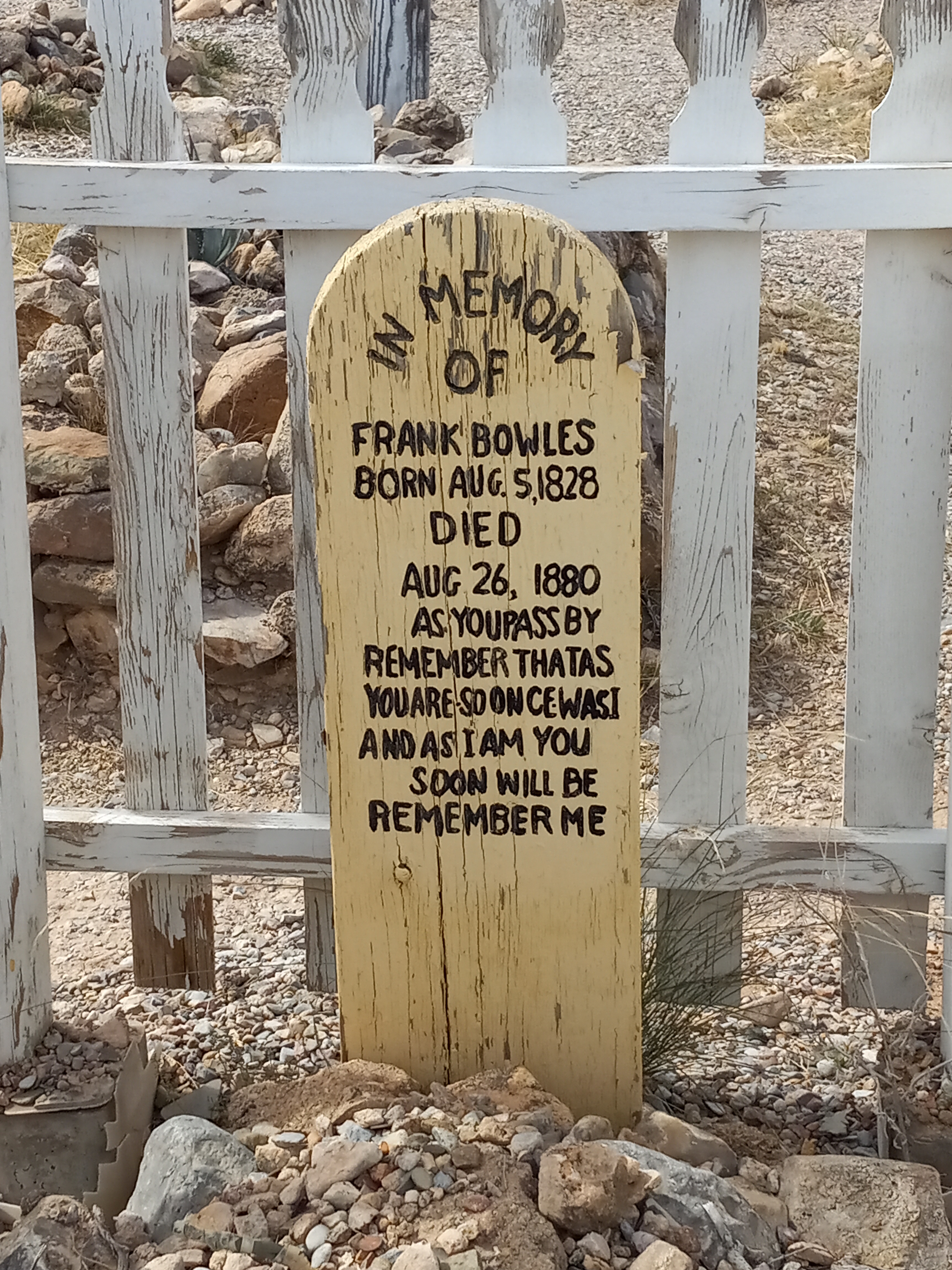
Florentino.  Chas Helm.  Frank Bowles.  George Johnson, who’d been hung by mistake.  Who were they?  Where were they now?

I got back in the car and started to drive.  Most of the fun was over, but what a way to ring things out.  The car was due back in two days.  There was some cleaning up and possibly a little explaining to do.  I took the 80 to the 10 and then passed Tucson on my way to Phoenix.  Some major work on the freeway was underway.  It was entirely shut down. 

If I didn’t have Karen from Google Maps to guide me through the obstructions, I would’ve been lost.  It had taken the three of us to make the trip happen, the car, the phone, and me.  When it comes to technology, you have to take the good with the bad.  We live in different times, there is not as much opportunity for physical exploration on the planet, and yet there is still space, other planets, new heroes, new legends, new dreams.

By the time I got to Blythe, it was impossible to drive any further.  The Colorado River seemed like a good place to spend my final night.  Camping?  No way.  Not tonight.  This was a celebration.  I got a room for forty dollars at the Relax Inn, then walked over to Steaks and Cakes to see what else they had on the menu.  Why bother, actually.  Steak and cake were perfect.  The Steelers were playing the Seahawks.  What a way to bring things home.

pages fly away 84

Sometime during the middle of the night, the TV went off, but then came back on close to morning.  This was the day I was supposed to get all the way back to Los Angeles, but I wasn’t ready to quit the trip yet.  I was out in the desert, not far from Parker.  I figured I’d drive up there and then head over to Joshua Tree.  If I went that way, I could pass the Colorado River Indian Reservation.  One more day, one more reservation.  That seemed appropriate.

The Colorado River Indian River Reservation was established in 1865 for the Native Americans who lived in proximity to the river and its tributaries.  These were originally the Mojave and Chemehuevi people, but in 1945 some Hopi and Navajo were relocated to it.  The seal of the reservation shows four banded feathers beneath a rising sun. 

To get there I drove north on County Road 1.  I passed the Water Wheel Resort along the way, and then came to the community of Earp, where Wyatt Earp had staked some copper and gold mines.  There was a minimart with his picture on the wall.

From there I crossed the Colorado River and parked the Mountain Bluebird beside the bridge, beneath an American flag.  That would go on to be the picture that best summed up the trip.  I drove once around town and then headed back across the bridge again.  The idea was to take the 62 west to Joshua Tree, but on the way came across some vagabond art installations. 

First, there were some spray-painted mattresses.  Then some PVC pipe, stuck in the ground with shoes wrapped around it.  Next, a whole fence of discarded shoes.  Someone was sending a message.  When I came to a bush that was covered with COVID masks, it suddenly occurred to me I’d never been to Slab City.  I looked it up and it was three hours away, right next to the Salton Sea.  Man, that was pushing it, but I still had all day.

When I got to the 177, I headed south.  That took me to the 10 and the General Patton Memorial Museum where I got gas.  It was a long drive through the desert from there, on Box Canyon Road, through a series of steep-sided cliffs.  It was a relief to get to the 111.  I was now at the Salton Sea.  The sky was pale and the clouds were thin.  I’d been there many times before.  Now I pulled into Mecca Beach and sat there facing the sea.  It seemed like as good a place as any to try to mediate.  A big bug was splattered right on the windshield in front of me.

When I was in high school my father wanted to take a fishing trip out to the Salton Sea and had enlisted me and my brother as first and second mate.  We had a small fishing boat from the Midwest that we’d hauled out to California when we moved there.  It wasn’t fit to take fishing out west and would almost never start. 

On this trip the wind had been raging, and we’d drifted across the lake while my father yanked on the starter rope.  Eventually, we’d been stranded close to shore, casting into the wind.  When we got back to the car, I’d needed space and run off to the top of a small hill, where I shut my eyes and leaned into the wind, almost daring it to push me back and keep me from falling.  Down below I could see my father and brother loading up the car and looking around for me. 

Now I could smell the stink of dead fish.  The Salton Sea is toxic.  One side, at the very least, is always littered with dead fish.  A train was passing to the east of me.  It must’ve been three miles long.  The whistle went on and on.  Strong gusts of wind pushed and tugged at the car.  After a few minutes, the last boxcar passed and gradually the whistle grew fainter.  Then it was just the wind.

pages fly away 85

Slab city is a makeshift unincorporated community just east of the Salton Sea.  If you’ve ever wanted to escape from society but can’t afford to leave the country, this might be the place for you.  People live an unstructured lifestyle in campers, RVs, and whatever else they can assemble, sometimes just huts made of scrap wood and tarp.  It is a little bit freedom, a little bit anarchy, and a little bit crystal meth, at least that was my first impression.  I had lived in a tent city for two years on the Spit in Homer, Alaska, and that’s what it reminded me of.  Ten people hanging around in a broken-down vehicle, drinking and passing a pipe around.

The cement slabs that are responsible for the name were left over from a military installation that ceded the land to the state after shutting its doors.  I don’t know who the first peaceniks were who thought to occupy it, but the idea spread.  Apparently, it is busiest during the winter when snowbirds come down from the north to escape the cold weather. 

The guard posts for what used to be Fort Dunlop have been painted over and graffitied on.  On the first one I came to there were a few tags and a picture of a vibrator with the accompanying admonition.  Good Vibes Only.  Other cement posts bore messages as well.  Welcome.  The Last Free Place on Earth.  Not all who Wander are Lost

This was my tribe, in spirit at least.  I’d been looking to get off the grid my entire life, but had eventually found it easier to escape to affordable tropical countries, rather than staking my claim in a broken vehicle, out in the middle of nowhere.  Also, whenever you choose to live outside of society, you keep mixed company, sometimes with others who didn’t make that decision voluntarily.  There are allegedly neighborhoods in Slab City, but it was largely deserted the day that I chose to drive though.  Either that or the residents were lying low, watching me through binoculars.

There were a few RVs with cars parked outside a church, an old pickup truck that had become an art installation.  In the center was a compound with a wooden tower and an American flag. It claimed to be the Church of Enlightenment.  One guy crawled out of some wreckage and ran up and got in the back of a pickup truck that was passing by.  They eyed me in defiance, and made a show out of getting all groovy.  What did I care?  I might’ve looked like a federal agent but wasn’t one.

Leaving Slab City, I stopped and got out at Salvation Mountain.  Opening the door, a gust of wind nearly tore the car door off its hinges.  That would’ve been extremely unfortunate, the day before I was set to return it.  Salvation Mountain was the thirty-year project of an artist named Leonard Knight, who used thousands of gallons of latex paint to create a colorful, Biblical shrine in the middle of the desert. 

A cross sits on top of the painted hill, and abandoned vehicles, similarly adorned with paint and scripture, around it, like toy cars in a sandbox.  God is Love.  Love is Universal.  The Holy Bible.  Salvation.  Jesus loves You.  Around a trailer sat hundreds of empty cans.  The artist had gotten his point across.  Salvation Mountain resembles a giant confection, all sugar, and gumdrops, and frosting, like something Hansel and Gretel would’ve broken into looking for candy.

Back on the 111, I drove parallel to another long train for a few miles, relentlessly blowing its horn.  At a curve in the road, it briefly appeared to be circling through the sky.  When I got to the 10, I pulled over at a gas station to get something to drink.  Walking back to the car, I saw a dirty whirlwind making its way toward the lot where I stood.  Just before it hit, it dispersed, bombarding the station with all the debris it had sucked up; plastic bags, paper, Styrofoam cups, weeds.  It was an ugly exhalation, a reminder to keep moving.  Those wild years in Alaska had been ages ago.  Time was no longer on my side.

pages fly away 86

It was sixty miles to the south entrance of Joshua Tree.  My sister and I had discovered it by happy accident on a camping trip nearly thirty years earlier.  Through the years it had always been a special place to visit.  The Joshua Tree, a variety of yucca, look like a prophet with his arms raised.  Throw in a number of giant expressive boulders and you have the makings for an otherworldly destination. 

The plan was to drive through the park, and then take a run up to Pioneertown.  At that point the trip would be over, all except the crying, and the explaining.  In six weeks, I’d run up sixteen-thousand miles on the Mountain Bluebird.  How would Avis respond to that?  I could hardly wait to see.

Most of Joshua Tree was just more desert driving, looking through a bug-splattered window.  It wasn’t until I got to Jumbo Rocks that things got a little interesting.  This was the secret spot that my sister and I had discovered, perched on a rock with guitars beneath a full moon, listening to the wailing of the coyotes.  One of the rocks, Skull Rock, does resemble an oblong skull.  You can kind of see it.  The traffic got bunched up here, people stopping for pictures.  Jumbo Rocks has never been much of a secret.  Now it was even less of one.

I’d had some interesting experiences at Joshua Tree.  Once I spooked a herd of Big-horn sheep that rose up on high-heels and went clattering off.  Then there was the bobcat crossing the road one early morning.  Also, how could I forget my second seizure, one of three.  Let’s not get into why it happened.  Just trust me that it did.  I went into town to get some firewood and was standing there looking at a psychedelic poster for an upcoming concert. 

The next thing I knew, I woke up strapped flat to a board in the back of an ambulance.  When I realized where I was and remembered I’d recently quit my job and didn’t have insurance, I begged them to let me go.  They wouldn’t.  As soon as they got me to the hospital, I jumped up and tried to escape.  The doctor argued with me, but then let me go. 

The hospital was far from town.  I was just wearing a Led Zeppelin T-shirt and cut-off shorts.  I stood out in the cold, dark night and spied on the hospital from a distance.  A shuttle bus came up and I ran over and jumped on it.  Unfortunately, it took me to Twenty-Nine Palms instead of back to Joshua Tree.  I needed the last fifty dollars in my wallet to take a taxi back to my truck. 

Since that time, I never felt exactly the same about Joshua Tree, especially after getting a five-thousand-dollar bill for the ambulance.  Someone had made sure to go through my billfold and get my contact information while I was still unconscious.

Now I felt OK about things, not good, not bad.  I drove past the Joshua Tree Saloon and the Inn where Gram Parsons died of an overdose.  Not only had he made better music, he also had a better ambulance story, although not one he’d be telling anytime soon.  I took the 62 to Sage Avenue, then took a left on Sunnyslope Drive. 

Pioneertown is a movie set that was dreamed up in the 1940s by a team the included Roy Rogers, the Sons of the Pioneers, and Gene Autry.  It was designed to be a place for both work and play and over the years over two hundred productions were filmed there.  The on-site cantina later became the biker bar and live music venue, Pappy and Harriet’s, a true institute of California honky-tonk.  Out back is the famous sign.  Hippies Use the Side Door.

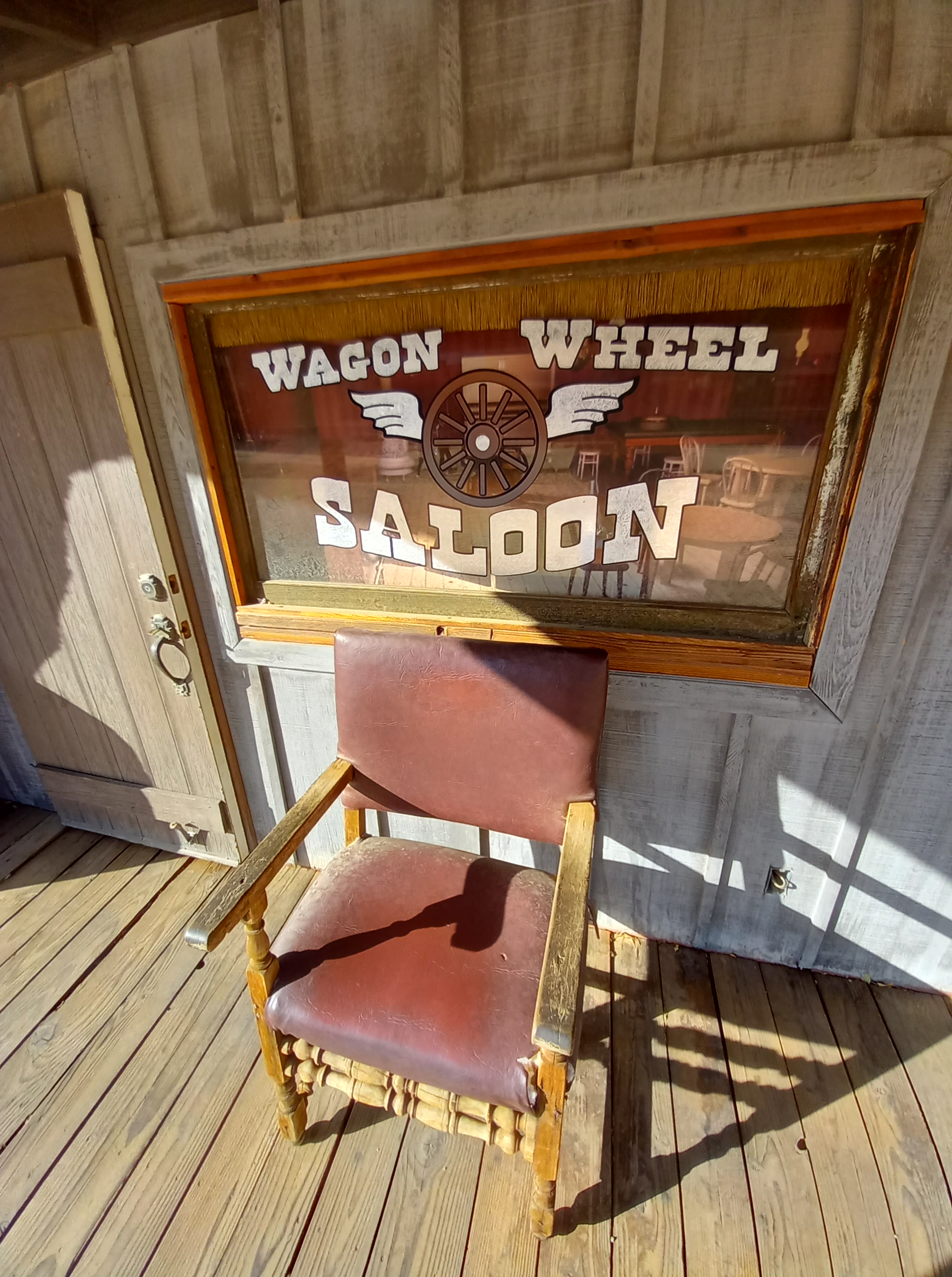
I parked the car and had the whole of Pioneertown to myself, if you didn’t include my shadow which staggered behind, some twenty feet long.  There was the Film Museum, the Pioneertown Bank, the Wagon Wheel Saloon, now an actual wagon, and an actual l wheel.  If I’d been a gunfighter my only opponent would’ve been my mind, which had already started future-tripping, now that the trip was almost up. 

There were other things I should’ve spent the unemployment money on, like finding a job, a car, someplace permanent to live.  What would happen next?  Where would I go?  Bang.  Bang.  Bang.  I needed to shoot those thoughts dead.  One thing at a time.  It was still a hundred and twenty miles to Los Angeles.  A lot could happen between now and then.

When I got back in the car, it was the first drive I hadn’t been looking forward to in the past six weeks.  Up until now, all I’d wanted was to drive, drive, drive.  Suddenly, I wasn’t in such a hurry.  When I got to the giant turbine windmills that line the hills outside of Palm Desert, I wished that they could blow me back, back a week, two weeks, a month, with freedom still ahead of me, but the only choice I had was to go forward.  The sun sat like a great white eye in the center of the road, and the clouds kept blowing past it like an endless succession of days.

pages fly away 87

Strange after traveling so far and wide to visit reservations and tribes across the land, that I’d visited none in California, which has the highest population of Native Americans of all of the States, nearly 800,000.  My reasoning was that I could make a smaller trip of it at a later time, even if I was back to work and could only head out on weekends.  I did happen to pass the Morongo Casino as I was driving west on the 10, but by now the exploration was over. 

I took the 10 all the way to Los Angeles, passing Redlands, San Bernardino, and Riverside.  It was twilight as I reached the outskirts of downtown and I got caught up in the stop and start traffic.  I knew the city well, yet didn’t know it at all.  It had been more of a death star than a home, one of life’s cruel jokes, to have my only base in the world be such an impossible to navigate logjam.  The sun was setting just to the left of the skyscrapers, the sky beside it orange and capped with clouds.

Desperate for one last rush of adrenalin, I pulled off on Alameda, thinking I might drive through the Art District where I’d briefly lived and recorded some music.  Somehow, I got lost, even though I’d driven through that neighborhood a thousand times.  There was no sense of homecoming, only isolation and dread.  Los Angeles is not a community as much as a coalition of warring parties.  I’d had no desire to compete and conquer.  The stress of living in the rat race had seen me fall through the cracks fourteen years earlier, and I’d been largely untethered since.

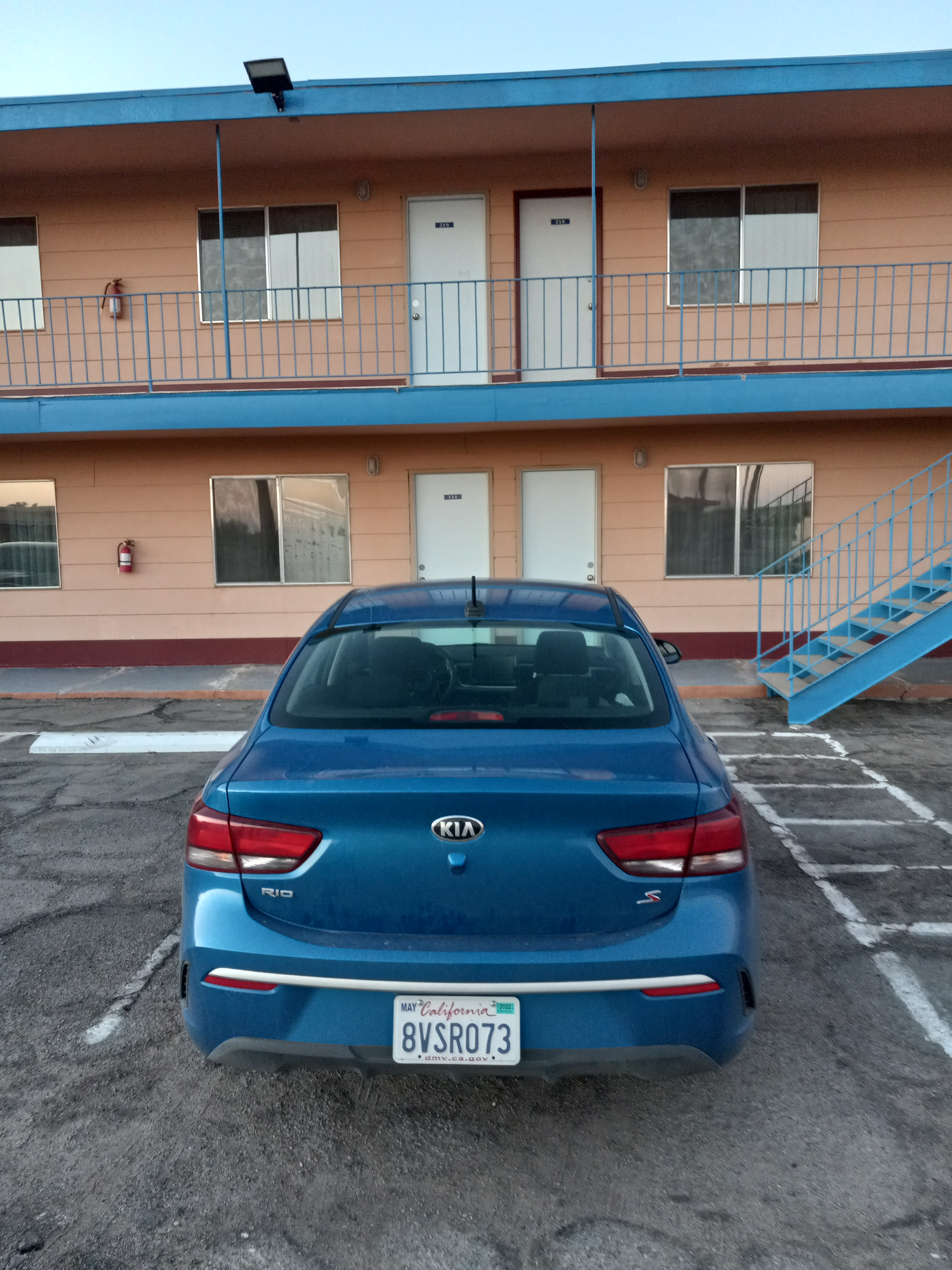
I took the 10 to the 110, then the 405 to Seal Beach Boulevard.  It was dark by now, after sitting in bumper-to-bumper traffic for most of the last hour.  When I got to Huntington Beach, I parked in back of my mother’s cottage and used the back gate to unload the car, tossing everything in one unorganized pile on the auxiliary bed in the popup camper.  The Mountain Bluebird was intact, but looked shaken and was trembling a little.  I’d get up and return it the next morning.  The number of miles I’d put on it weighed heavy on my mind.

That night it was cold.  I’d been camping for a year and a half by now, ever since the pandemic had brought me back from Vietnam and my brother had gotten the camper from a neighbor.  It was my space, but hardly private.  Everyone in the surrounding houses could look into the yard and see what I was up to.  The cloth walls neither kept out the cold nor the noises from the neighborhood.  That night I just lay there and worried.  It made no sense, but I couldn’t avoid it, not until the Mountain Bluebird was back at the agency and everything had been settled.

That morning I sat up cross-legged on the bed and attempted to suppress my nervous energy by focusing on the moment.  Sparrows were chirping in the hedge.  At the end of the block came the whine of a power drill.  There was the cawing of a crow and the barking of a dog.  Someone across the alley was always locking a dog in their garage and it would bark all day.  That was beyond maddening.  A garage door went up and then came back down again.  I could hear the crunching of gravel beneath the tires of a car that was slowly passing. 

The past was gone everywhere I went.  The places where my family had settled had changed.  No one was left from the old days.  The country was not what it had been.  Outside of the nature, the most colorful part of my trip had been history, the remembrance of old ways.  What was left was largely a machine, a cold monster. 

Southern California was as difficult as it gets, yet this is where my family had moved and where my mother and siblings lived now.  It was the closest thing to a home that I had available.  This was the moment I’d been brought back to once again.  Maybe it was time to accept it and look for the good in it.

From downtown came the ringing of a church bell.  A plane passed overhead.  It was Tuesday, street sweeping day.  From two blocks away I could hear the street sweeper getting closer and closer.  Then it was upon me.  The roar of it filled my ears.

pages fly away 88

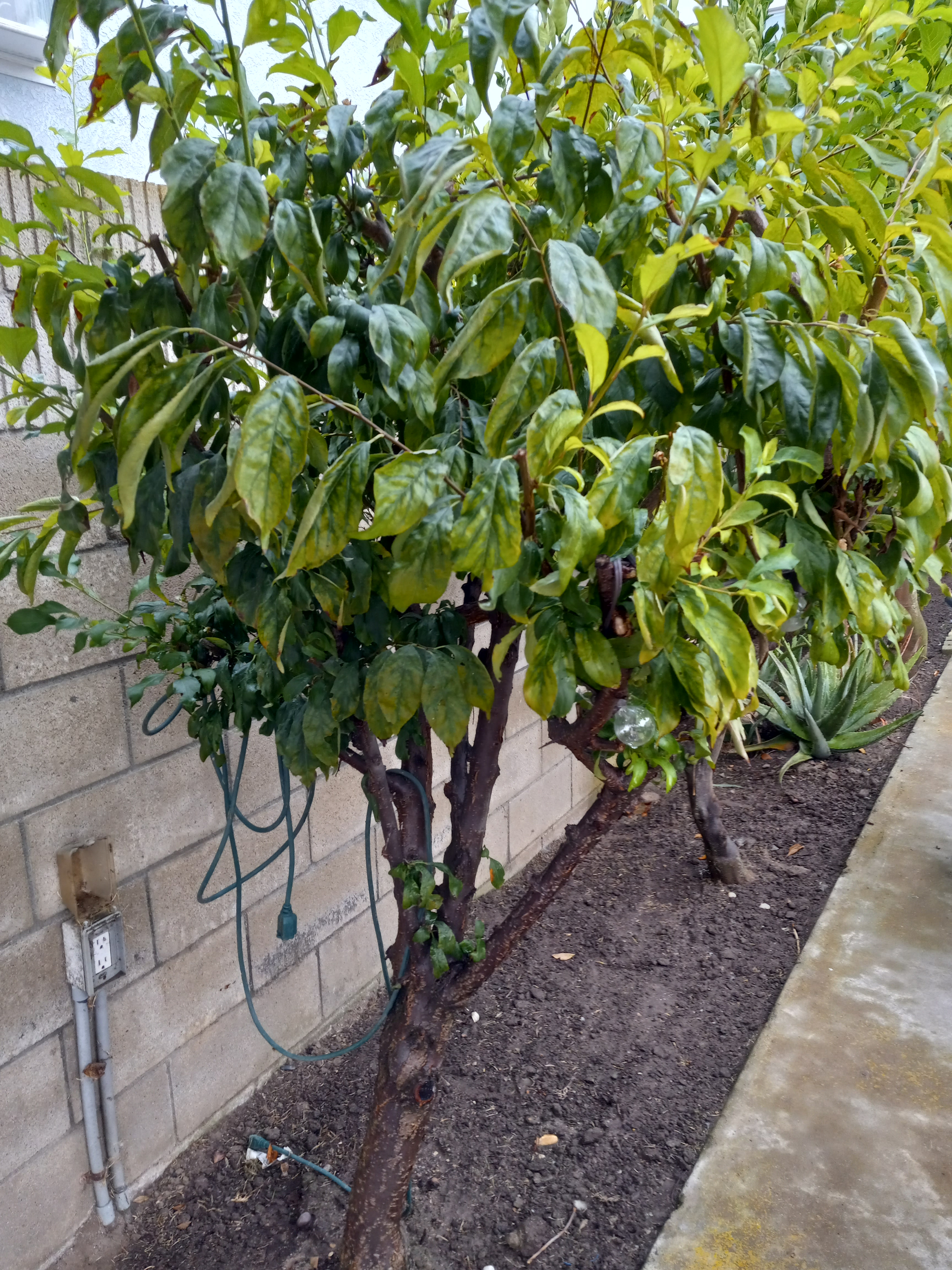
In Black Elk’s vision as a boy, he’d been given a red stick by the Fourth Grandfather that he plants at the center of the nation, right where the good red road, meets the black one of difficulty.  When he does so it blooms, and all living things are happy.  Stepping out of the camper that morning, on my way to return the Mountain Bluebird, I saw that the plum tree we’d planted over my father’s ashes six years ago was full of leaves. 

That was a nice change.  For two years it had stood there, just a dead stick, never any change at all, until the third year some tiny leaves unfurled from it.  By now it had blossomed a few times over, but in all that time had only produced two plums maximum, both in the same year.  We’d taken that as a sign, however, that miracles and healing can happen over time.

I don’t know why I didn’t take the Mountain Bluebird to be washed before returning it.  My feeling was that I was going to get called out on something more substantial on whether the car was dirty or not.  Sixteen thousand miles is a lot to drive in six weeks.  I can tell you how many hours you need to drive a day to match that.  Mendez didn’t seem to be paying attention when I brought the keys and paperwork into the office, however.  I asked about the incident in Mississippi, where they’d tried to get me to bring the car in.  He said the lease had been in two parts, one for a month, the other for two weeks.  There was no issue,

He went out to check the car, but didn’t say anything when he came back in.  I thought that was it, but as I turned to go, he shouted out.  Hey!  I wheeled around in alarm.  What he said was that the car was really dirty and that they’d charge me five hundred dollars to clean it.  There was a car wash right across the street.  I could avoid the charge if I had them wash it myself.  That was no problem, even though it drew out the suspense.  I drove over and told them to give me the platinum service, to make sure they waxed it and even did the tires. 

When I returned, Mendez was busy with another customer.  He stepped to the door and acknowledged the shine coming off the car with a satisfied nod of the head.  What a brave, plucky little friend it had been.  I owed everything to it.

Once home, I started dispersing the pile of things on the bed.  The real challenge would be getting the tent back into the bag it came in, the one I hadn’t used once the entire trip.  If I could do that, I could do anything. 

That night I had a dream, one that would come off as contrived if it didn’t happen to be true.  I am driving the Mountain Bluebird, racing down the road.  I pass beneath a red arch.  The road began to go through hills, that same roller coaster ride, and on one bump I get bounced out.  The car continues down the road without me.  I start walking down the road in the direction it has gone.  I see a black raincoat and pick it up.  Then I see a blue jeep, but it is not the Mountain Bluebird.  It has traveled for miles now, and I know that I will never catch it, but if it happened once, it could happen again.  Given six more weeks, I believe we could do the whole of South America.  They’ve got a lot of Indians down there.  At least that’s what I’ve been told.