All posts by Haunted Rock

These are songs, poems and images from a life on the road. Enjoy your stay and safe travels.

riding the rails 9

Hurricane Ian was bearing down on the west coast of Florida and was supposed to hit on the very day I was going to be traveling through on a train.  Although Miami was expected to be spared from the storm, the tracks pass through Tampa Bay, where sandbagging was already underway.  A number of evacuation orders had also been issued.  Although no one from Amtrak had contacted me yet, I knew the Silver Star line was going to be cancelled and had to come up with an alternative plan fast. 

My first thought had been New Orleans, but when I contacted a representative, she informed me that the City of New Orleans was fully booked that night.  What about the Empire Builder to Seattle?  Yes.  There were some openings.  That train left at three.  That would mean I was heading straight back to the West Coast, but that was all right with me.  At least I’d have a place to stay for the next few days.  While I was at it, I went ahead and booked the Coast Starlight down to the Bay Area, the day after I arrived in Seattle, and then the California Zephyr, back to Chicago, the day after that.  What I discovered was that a lot of the trains were filling up fast.  If I wasn’t fast on my feet, I risked getting stranded.

By now, for the first time, I was getting a vision for this trip, which had originally been me just running for my life.  I’d had no intention of spending time in any of the major cities, but now that I’d been in both downtown Los Angeles and Chicago in just a few days, and was on my way towards Seattle and San Francisco, I began to see how I could get an intimate view of some of the other big cities by just showing up on the train like I was doing, and spending one night in a hostel.  If I could also hit up New Orleans, New York City, Washington, DC, and eventually Miami, that would be a lot for a little.  Could it be done?  I didn’t see why not.  Would it be comfortable or fun?  Did it matter?

About fifteen minutes before checkout, I decided to jump in the shower, then hurried to get dressed, pack, and drag my bags down to the front desk on time.  I knew that the hostel was in no way responsible for all the snoring that had gone on the night before, but was grieved when they asked me to pay to store my bags for a few hours, and almost brought it up.  There wasn’t much I planned on doing, now that my train left at three, rather than six.  I figured I’d just walk down to Lake Michigan and back.

Because of the construction they were doing, I went down to Van Buren Street and headed east, crossing the Chicago River, and then continuing all the way to Grant Park.  Once there I walked towards the two large Indians on horseback that act as sentries to the park, and made my way to Buckingham Fountain.  It was a warm, sunny day, but I wasn’t there for leisure.
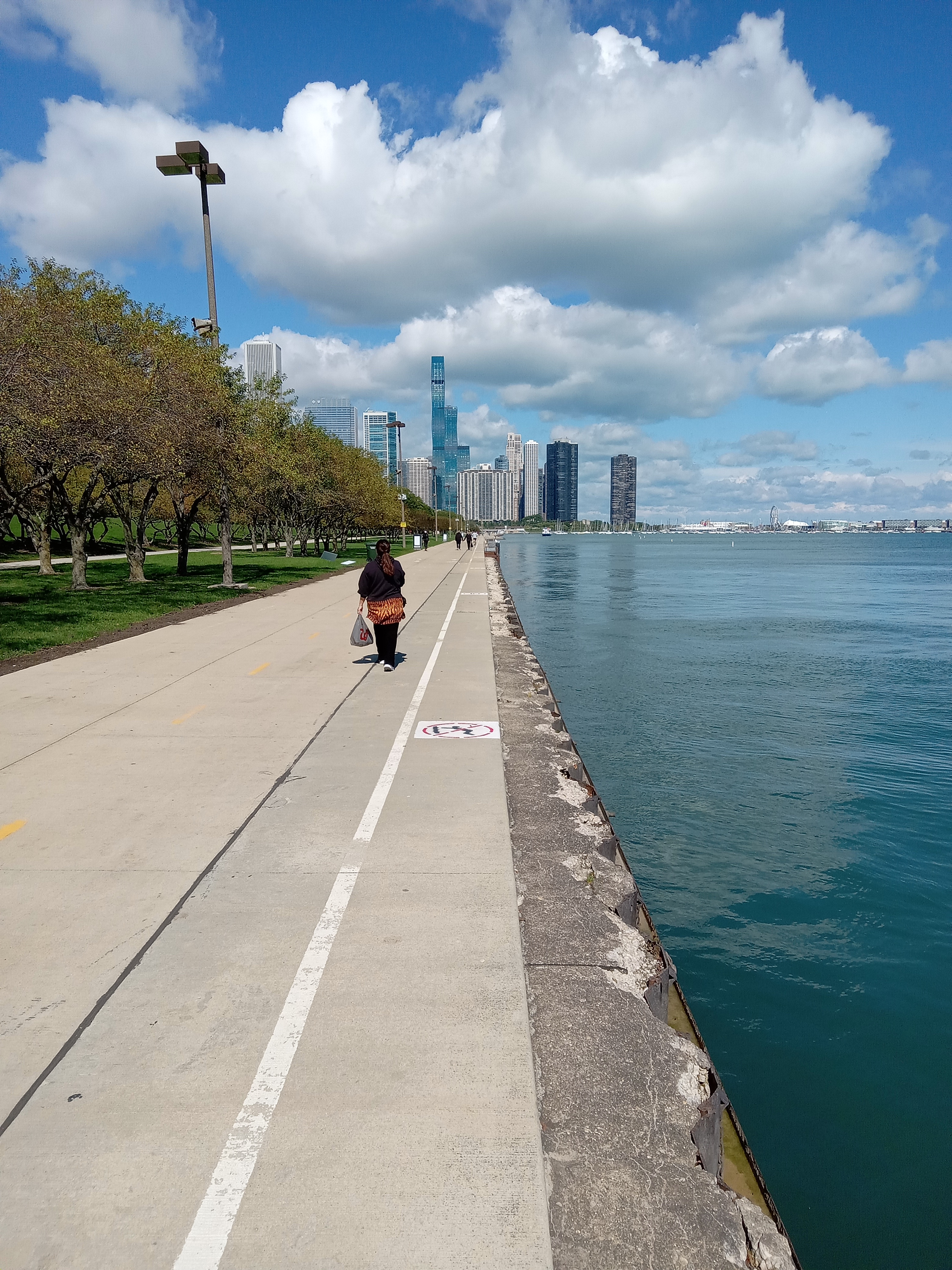
I walked as far north as the aquarium, then turned around and followed the trail that ran along the shoreline of the lake back to Jackson Drive.  My feet were badly hurting, but that came as no surprise.  Something was always hurting these days.  If it wasn’t my feet, it was my back.  If it wasn’t my back, then recently it had been my tailbone.  In fact, just before leaving on my trip I’d gone to have my tailbone X-rayed.  The discomfort it was causing me I could live with, but my concern was that there might be something more sinister going on, like a tumor.  I was supposed to be getting a call from the doctor that very afternoon and was hoping that my phone wouldn’t fail me.  It had already cut out a few times on the ride from Los Angeles.  Now would not be a good time to have that happen.

Walking back towards Union Station, in between the enormous skyscrapers that lined both sides of the street, I felt pitifully small and alone, and what struck me about them was that they were designed for gods or supermen to live in, not ordinary people who need to be close to the earth and part of a community.  There were a few homeless people scattered around, in doorways and alleys, but nothing like what I’d just witnessed in Los Angeles.  Perhaps they were being contained in a different section of town.  The winters are brutally cold in Chicago, and I would’ve hated to even be walking down the streets in a few months, let alone living on them.

By the time I’d retrieved my bags and walked over to Union Station, I was dead on my feet.  Passengers were already starting to line up at gate B-19, so I went over and joined them, not wanting to be one of the last ones to board and chance ending up with an aisle seat.  There were a big group of Amish folks ahead of me, and when I got on my car three of the men, in their blue shirts and black vests, had gotten seats close to the door.  There was a garbage can blocking off most of the seats in back and I sat down in front of it.  A few minutes later, the attendant came onboard and angrily accused someone of moving the garbage can.  What could I say?  It wasn’t me.  She still made me move to the front of the coach.

Across from me, some long, tall dude was already stretching out, spreading his limbs and his belongings all over both seats.  If anyone needed a seat, he looked like the last person on earth they’d want to ask to slide over.  He had his phone on speaker phone and was conducting business on it as if he were in his own living room at home.  The tag above his seat showed him going all the way to Seattle, and that pissed me off.  I was already full of resentment and we hadn’t even left the station yet.

We were just pulling out of Chicago when my phone rang and I rushed to answer it.  It was a doctor from the clinic in California, calling with the results of my recent X-rays.  Yes.  The X-rays showed that I had fractured my coccyx, or tailbone.  They also revealed osteoarthritis in one of my hips.  Well, that explained things.  Good thing I was going to be sitting on hard seats and sleeping crunched up in a little ball for the next two or three weeks.  I didn’t ask the doctor what he thought about that plan.
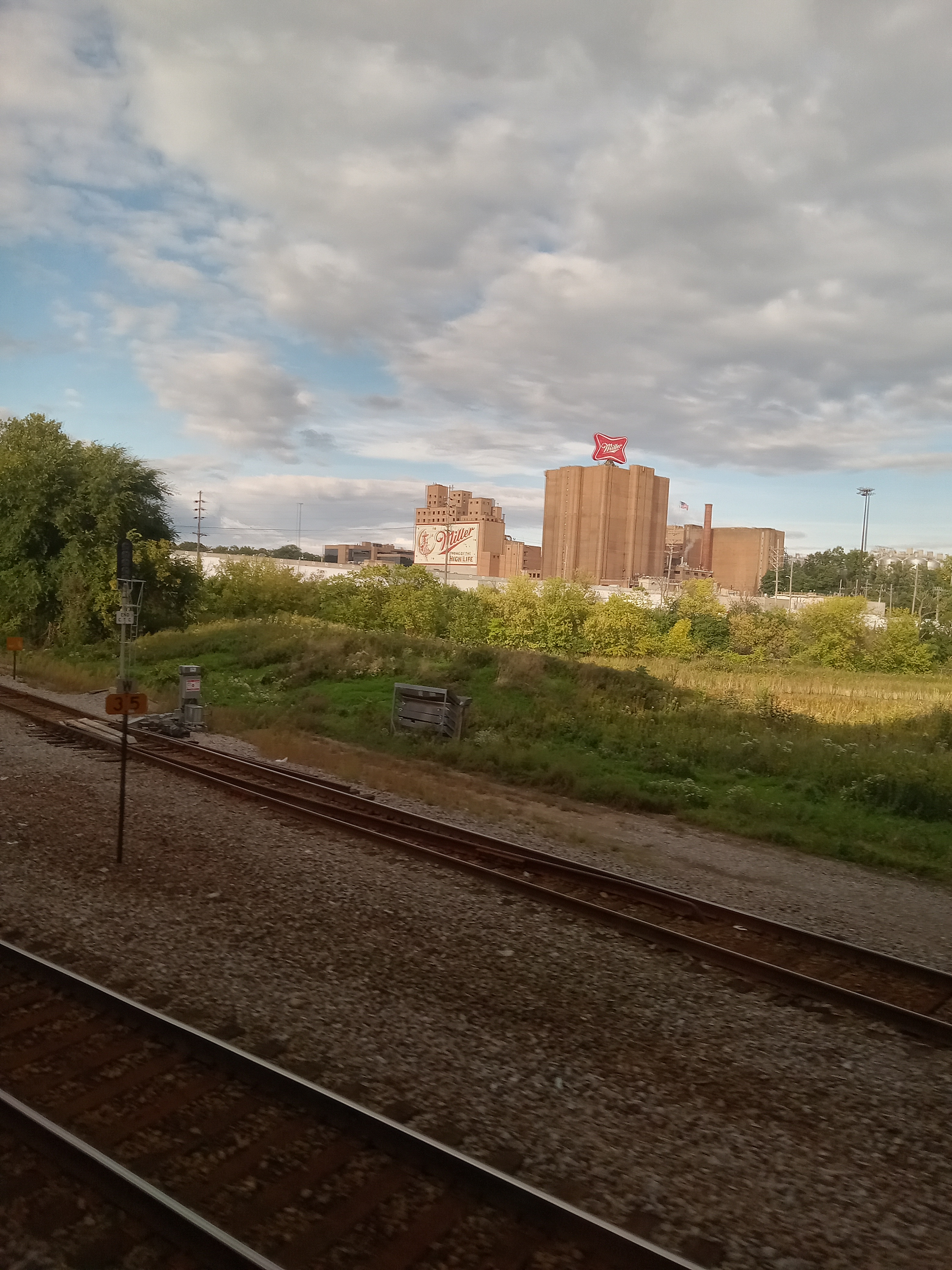
After an hour and a half, we reached Milwaukee, the ultimate beer town, and passed the Miller Brewery, home of the High Life.  On the side of the brewery facing the tracks was a picture of a girl sitting on a crescent moon, raising a toast to the stars.

The train next passed through Columbus and Portage, reaching the Wisconsin Dells around sunset.  The Dells is one of the biggest tourist attractions in the Midwest, as famous for its theme parks as for the dells, which are the unique rock slabs that line the gorge.  Entertainment options include water slides, zip lines, go karts, rollercoasters, and duck boats, amphibious tour buses, capable of floating down river, like something out of a James Bond movie.  Only one side of the train had a view of the dells, while the other one faced the station.  Everyone on the wrong side of the observation car jumped over to try to take pictures, but it was late, and the light had largely faded. 

At a stop in Winona, I got out and talked to the attendant for a few minutes.  She hadn’t come out and accused me of moving the garbage can that had been set in the aisle to reserve seats before we left Chicago, but that had been her implication.  No worries.  It was cold, way too cold for the middle of September, but welcome to life in the Midwest.  Having done most of my schooling there, I wasn’t judging it, but if I do have one claim to fame it’s that I haven’t endured a winter now, going on twenty-seven years.  The attendant told me her son felt the same way.  He’d escaped to California and swore he’d never return, even though the high cost of living there was giving him troubles he’d never dreamed of.  Are things tough all over?  It would be safe to say so.  Are some places worse than others?  Pick your poison.
riding the rails 10

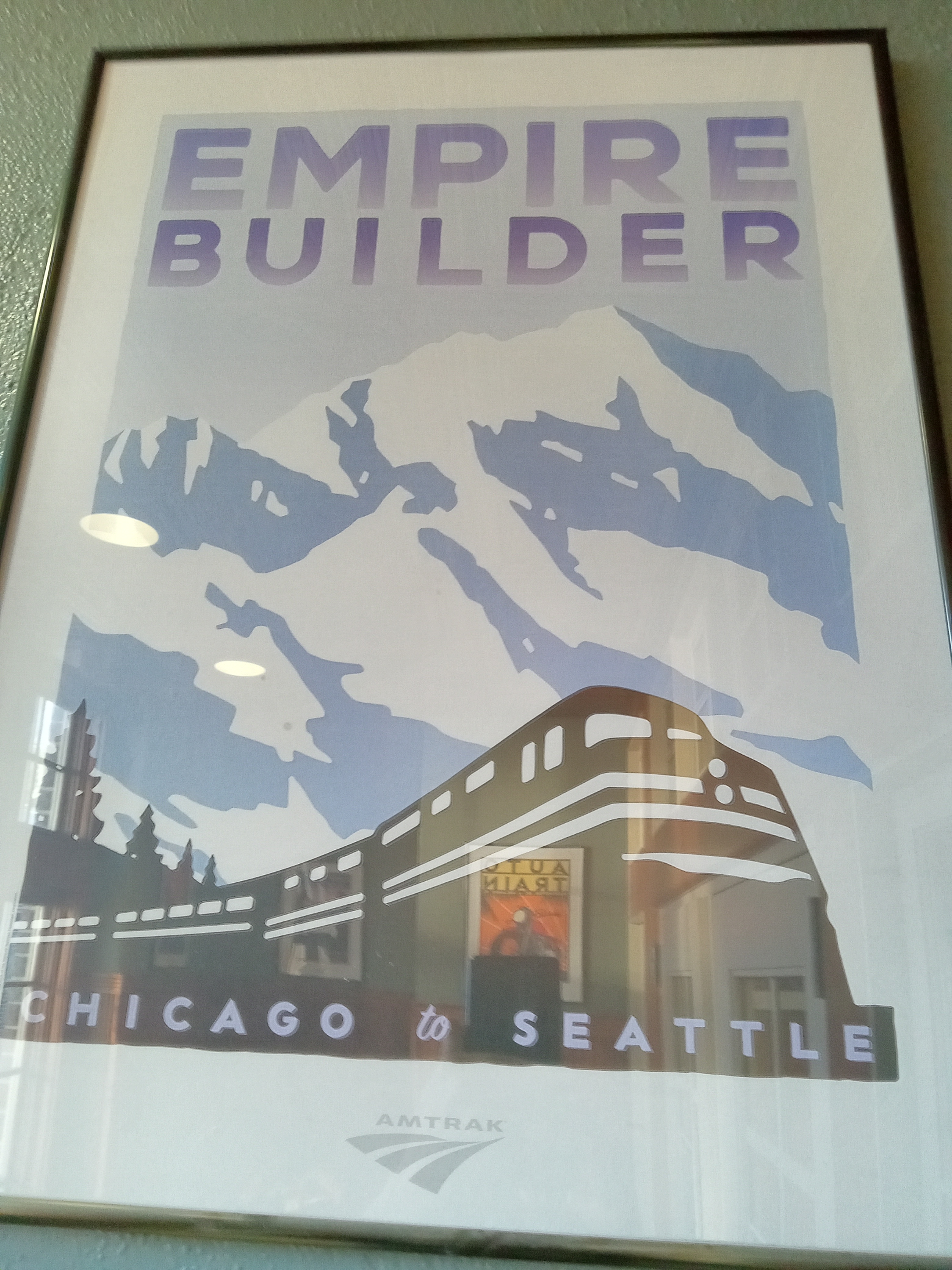
The Empire Builder goes all the way back to 1929, when it was owned and operated by the Great Northern Railway, and later the Burlington Northern Railroad.  It runs from Chicago and then splits in two at Spokane, continuing on to either Seattle or Portland.  Much of the route parallels the Canadian border. 

I’d taken the Empire Builder once before and will never forget it.  We were crossing from Minnesota to North Dakota, out in the wide-open country, and you could see a dust cloud being tossed up on a dirt road as a guy in a pickup truck tried to beat the train across the tracks.  He failed and struck the rear of the engine, disconnecting it and sending it flying down the line solo while the rest of us shuddered to a halt.  It took them seven or eight hours to remedy the situation, and in the meantime no air was circulating and the toilets wouldn’t flush.  Not long after we got moving again, the train once again came to a sudden halt and a crew change took place, way out in the middle of nowhere.  To compensate us for the inconvenience we were all given a six-inch Subway sandwich, a bag of chips, and a soda.

No mishap of that magnitude had occurred on this morning, but the long, tall dude next to me was back on his phone, almost shouting into it from two feet away as he sprawled across both seats.  He didn’t care that everyone could hear his conversation.  No one else existed, as far as he was concerned, even the other person on the phone, who was just a sounding board for his ego.  I had to look around for hidden cameras.  Maybe he was the star of some reality show I didn’t know about.

Now that I’d talked to the doctor and found out that my tailbone was fractured, it did seem to hurt more.  The arthritis in the hip too.  I got up, almost limping, and headed to the café car to get a cup of coffee.  We were passing by Devil’s Lake, an intriguing name which I discovered to be a flimsy translation of a Native American name, which referred to the high salinity of the water and the bad spirits they blamed for it.

The observation car was full of Amish people.  The reason so many of them take the train is that they are not allowed to drive cars, and when forced to travel are required to take the lowest form of transportation. The men were wearing black coats, pants, and boots.  Some wore felt hats while others donned straw ones.  Those who could grow facial hair had beards, but no moustaches.  Their hair looked like the bangs had been cut straight across with a pair of hedge clippers.  The women wore dark dresses, and their bonnets were either black or white.  Sitting in a car full of them made me feel like I’d traveled back in time four hundred years and was in the hull of a wooden ship, sailing across the Atlantic in search of religious freedom.

We had a half-hour layover in Minot and I approached one of the younger Amish men, who was smoking a hand-rolled cigarette and had a sly grin on his face.  I asked if he was Amish and he admitted he was, but didn’t elaborate.  I then wandered from one end of the train to the other, loitering at the edge of Amish conversations, unable to understand one word of the Old-World language they were speaking.

Once we got back on the train it occurred to me that I better track down hostels in Seattle and San Franciso, and was glad I did because there were only a few spaces available.  My first choice in Seattle ended up being sold-out so I went with the Green Tortoise Hostel near Pike Street.  In San Francisco, I booked a bed in a place that said it was also the San Francico Music Hall of Fame.  It was a good thing I made the reservations when I did, because shortly thereafter my phone service dropped off and from then on only worked intermittently until we were just outside Seattle.

There was an old couple I’d seen earlier.  The man had been wearing a Dodgers hat and I’d commented on the team.  Now he was sitting beside me in the observation car, without the hat, but with a head full of memories about his life in the world of baseball, first as a player, then as a coach. He talked about Satchel Paige and Jackie Robinson being some of the first black players in the league, and how Ronnie Lott, who later played football for the 49ers, had been one of the most talented athletes he’d ever had the pleasure of coaching.  His memories were all over the place, something he apologized for, but I had nowhere to go.  He recalled an incident from his wild youth where he’d gone to a bar to hear some music with some buddies, and on a dare at intermission had hidden the accordion player’s accordion.  He wouldn’t do the same thing now.  He’d given his life to Jesus after a close call he’d had a few years ago during a heart valve operation.  He might’ve talked into the night, and that would’ve been OK, if his wife hadn’t come looking for him.  They had reservations in the dining car and it was time for them to eat.

After hearing the old man talk about his satisfying career, successful kids, and how they’d just come from visiting their grandkids, I became overwhelmingly unhappy, thinking about my own life.  I returned to my seat, where the long, tall dude was calling every woman he knew and talking at length about what they could be doing better and who they shouldn’t trust anymore.  I leaned back in my seat and closed my eyes, trying to mediate my way out of a bad depression.  Instead, I was consumed by it.

Late in the afternoon, the train stopped in Havre, Montana for twenty minutes.   Two curiosities they had on display in the yard were an antique steam engine and a statue called Hands Across the Border, featuring a Canadian Mounty and US Border Patrol Agent, shaking hands over their commitment to protecting the border.  A few hours later we stopped again, this time in Shelby, and I wandered into the station and found a book of Louis L’Amour stories in a small library of free books.  Louis L’Amour is the best-selling Western novelist of all time, and the cover featured a man in classic cowboy garb, raising a pistol, and ready to defend the law, however he saw fit.

To distract my tortured mind, I began reading the book as soon as we got back on the train.  The protagonist was the classic drifter, with the mysterious past and growing reputation.  He wandered from town to town, sticking up for those who showed him kindness and gunning down those who didn’t.  He was impervious to the things that would destroy most normal men, long days in the saddle, cold nights in the canyons, rattlesnake bites, treacherous women.  It reminded me of an article I’d once read about the disparity between the myth of the drifter and the reality.  To highlight this, the photo they used beneath the headline was that of a homeless man sleeping on a bench. 

We were going to be passing Glacier National Park right after sunset, which was unfortunate timing.  There was just a little light left when we reached the East Glacier Park Station, but in the few minutes we sat there, the night fell quickly.  As we journeyed on, I could just make out the dark outline of mountains and trees, and couldn’t avoid my own reflection, lit up in the midst of them, that of a true desperado if there ever was one.  Would I shoot up a saloon or rob a stagecoach anytime soon?  Probably not.  What I was about to do with a credit card, however, wasn’t for the faint of heart.

riding the rails 11

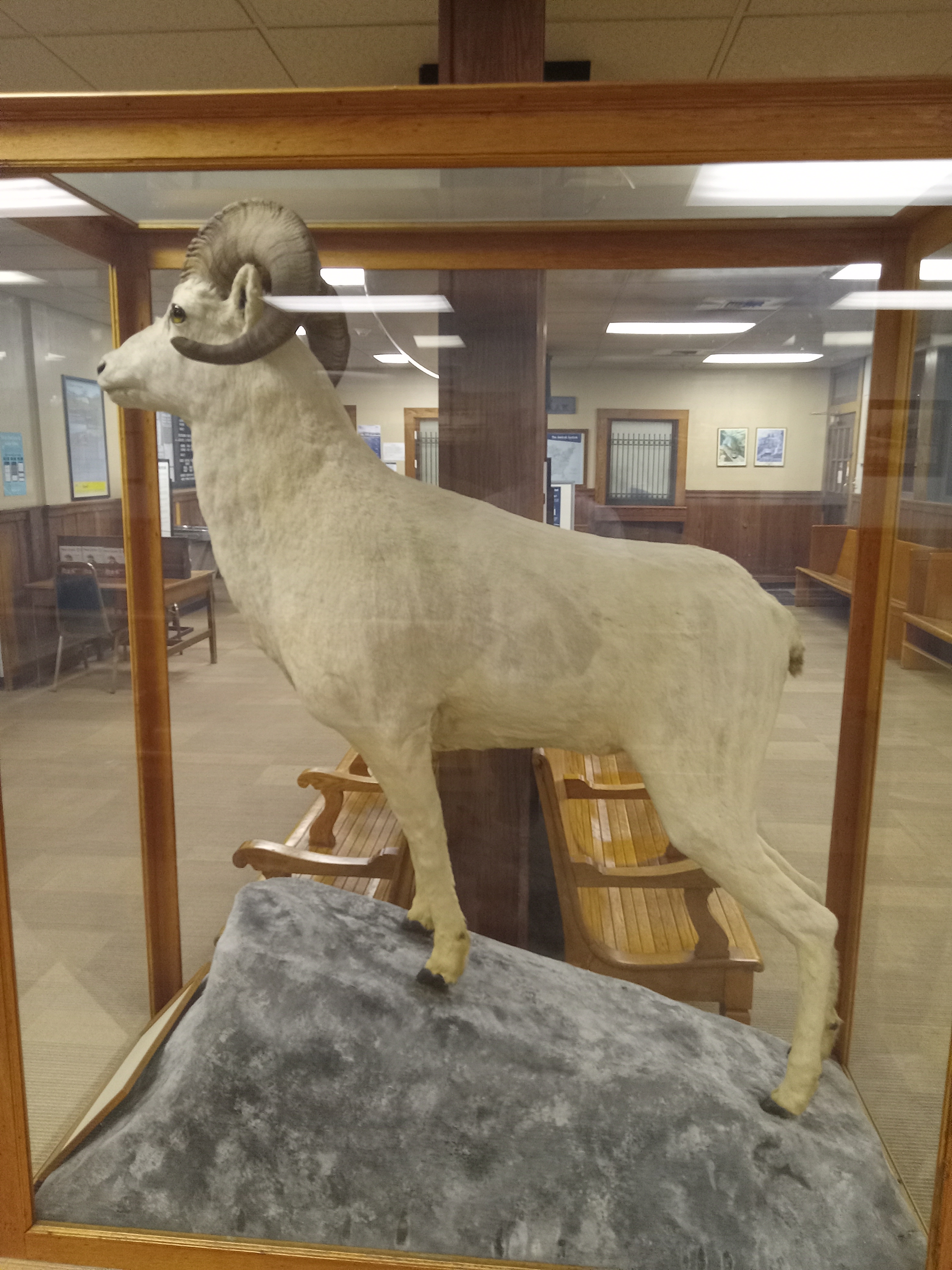
After passing through Glacier National Park in total darkness, the train I was riding on, The Empire Builder, pulled into Whitefish, Montana a little after ten.  We had fifteen minutes to stretch our legs and grab a smoke, if so inclined.  Beside the platform there was a statue of a mountain goat, and inside the station there was a stuffed bighorn sheep in a glass case.  An old upright piano sat in one corner.

Reboarding the train, I was grateful to still have two seats to myself.  The long, tall dude next to me was finally off the phone and out cold.  I lifted both leg-rests and leaned over on my side, drawing my knees up under my chin.  Right away I started to doze off, but then the train began to shake from side to side so violently that I sat up, certain I was back in California in the middle of an earthquake.

At some point I must’ve slept, because when I woke up it was light out.  The long, tall dude was back on the phone and I decided to head straight to the café to get a coffee.  The observation car, which had housed the café, was no longer there.  Now I remembered.  At Spokane the train had been split in two.  The observation car was on its way to Portland, while those of us going to Seattle had to order from the first two tables in the dining car.  I got a coffee and blueberry muffin and sat looking out the window.  It seemed like we were traveling through a haze.

Although I’d been looking forward to this section of the ride, traveling through the mountains and green forests of the Pacific Northwest, the view continued to seem hazy, and I heard someone attribute this to a string of wildfires that were burning in the area.  The pine trees were still there.  The mountains were still there.  A river still ran beside the tracks.  They were all just swathed in smoke.  We passed the little communities I’d once imagined settling in, when I was a young guy traveling around with my guitar.  They too were swathed in smoke, but seemed to be doing fine without me.  

We crossed over the Columbia River and then stopped at Wenatchee, where a new engineer took over.  It was our last chance to get off the train before we reached Seattle.  After Leavenworth it was two hours before our next stop in Everett. From there, we traveled along the shore of the Puget Sound for another hour and a half, until suddenly, almost without notice, we arrived at the King Street Station, and it was time to get off the train.  I let everyone else get off before me, since it was still too early to check into my hostel, and I didn’t even know how to get there yet.

Entering the King Street Station, and passing through the Compass Room, beneath a glass chandelier, I had the sensation, once again, that I’d been transported back to a more glamorous past.  The great clock tower outside the station only added to the effect.  But then I began to trudge up 2nd Avenue with my bags and the illusion quickly fell away.  One of the first things I saw was the long, tall dude from the train coming out of a liquor store, looking over his shoulder, left and right, then cutting across the street and heading uphill.  A homeless guy sat outside the store; his head collapsed onto his lap.  Another one passed with vacant eyes and his backpack flapping open on his back.

The last time I’d been in the Northwest, which was 2019, I’d been taken aback by the aggressive strain of homelessness plaguing Vancouver, Seattle, and Portland, due largely to meth and the legal opioids that have flooded the streets.  Long gone are the days of the harmless old wino, with his hobo stick and harmonica, eating baked beans out of a can before hopping a freight train.  The new breed of homeless drug addict is more akin to a zombie from the Walking Dead, a person who’s been robbed of their soul, who will go so to any length to get at what they crave.  When I got to Pike Street there was a large crowd of them, smoking fentanyl off aluminum foil, not trying to hide it at all.

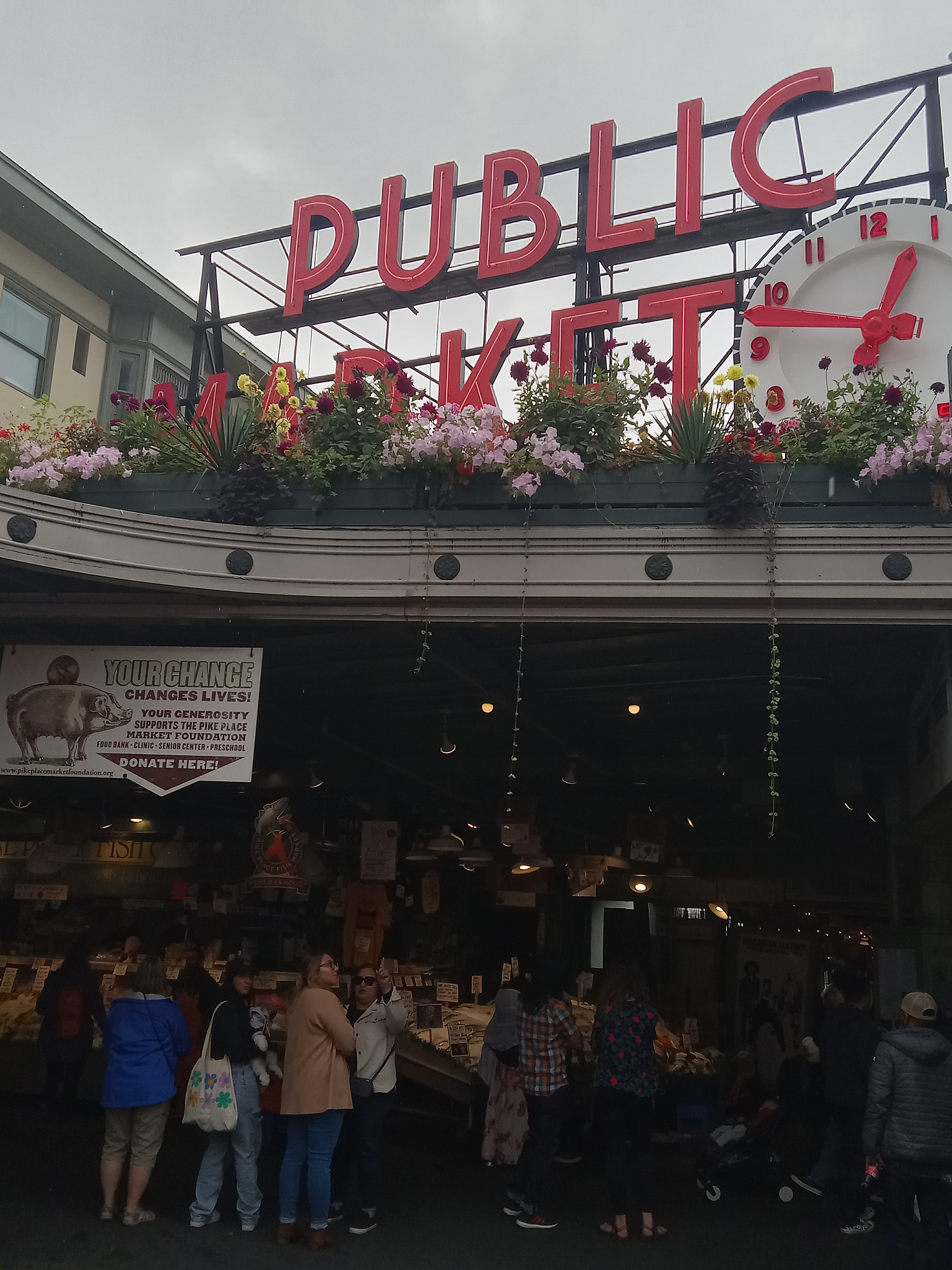
The Green Tortoise Hostel was fine, however, in a perfect location, on the corner of 1st and Pike, right across from the Pike Street Market.  As I already knew, it was too early to check in, but they let me store my bags and I went and sat down in the common room and called my friend, Diaz, letting him know I was in town.  Diaz and I had taught together at two different projects in Saudi Arabia, an oil company and a military base.  He’d been out of the country as long as I had, but had recently returned and was looking to stay in the area.  We made a plan to hook up later that afternoon.

To kill time, I headed across the street and walked through the market.  The last time I’d been in Seattle a bartender had mistaken me for a homeless man and started to shout at me.  I don’t know if that said more about the bartender, more about me, or more about the magnitude of the homeless crisis that they have on their hands, but I’d left there deeply rattled, not really caring if I ever came back to Seattle or not.  Yet, here I was walking around the Pike Street Market, only two days earlier thinking I’d be in Miami.  If you think God works in mysterious ways, you haven’t seen the way I operate.

A few hours later I was standing outside of the Green Tortoise Hostel, waiting for Diaz, who I hadn’t seen in a few years, when a guy who could’ve been Diaz if he’d been smoking crack that entire time, appeared on the opposite side of the street and seemed to be trying to get my attention.  No.  It wasn’t possible.  My mind was playing tricks on me.  A minute later, here came Diaz, looking very much like his normal self, still supporting the Dodgers, judging by the jacket he was wearing.  We walked over to an Irish Pub and talked about the difficulties of trying to adjust to life in the States again.  He was doing better than I was, having already lined up a part-time job with a local school district.  Before he left, I gave him a bobblehead of Big Red, or Dustin May, that I’d gotten at the Dodger’s game.  I’d never heard of him.  Diaz said that was because he’d spent most of his career on injured reserve, but his mom still liked him.  He’d give it to her.

Back at the hostel, my room was ready and I was pleased to see that once again I’d gotten a lower bunk, but this time the bed was more of its own little room, with electric outlets, a light, a fan, and a curtain that could be drawn, as opposed to your standard bunk with the metal ladder and squeaky springs.  I could’ve climbed inside it and slept for two days, but it was still so early I decided to take another walk instead. 

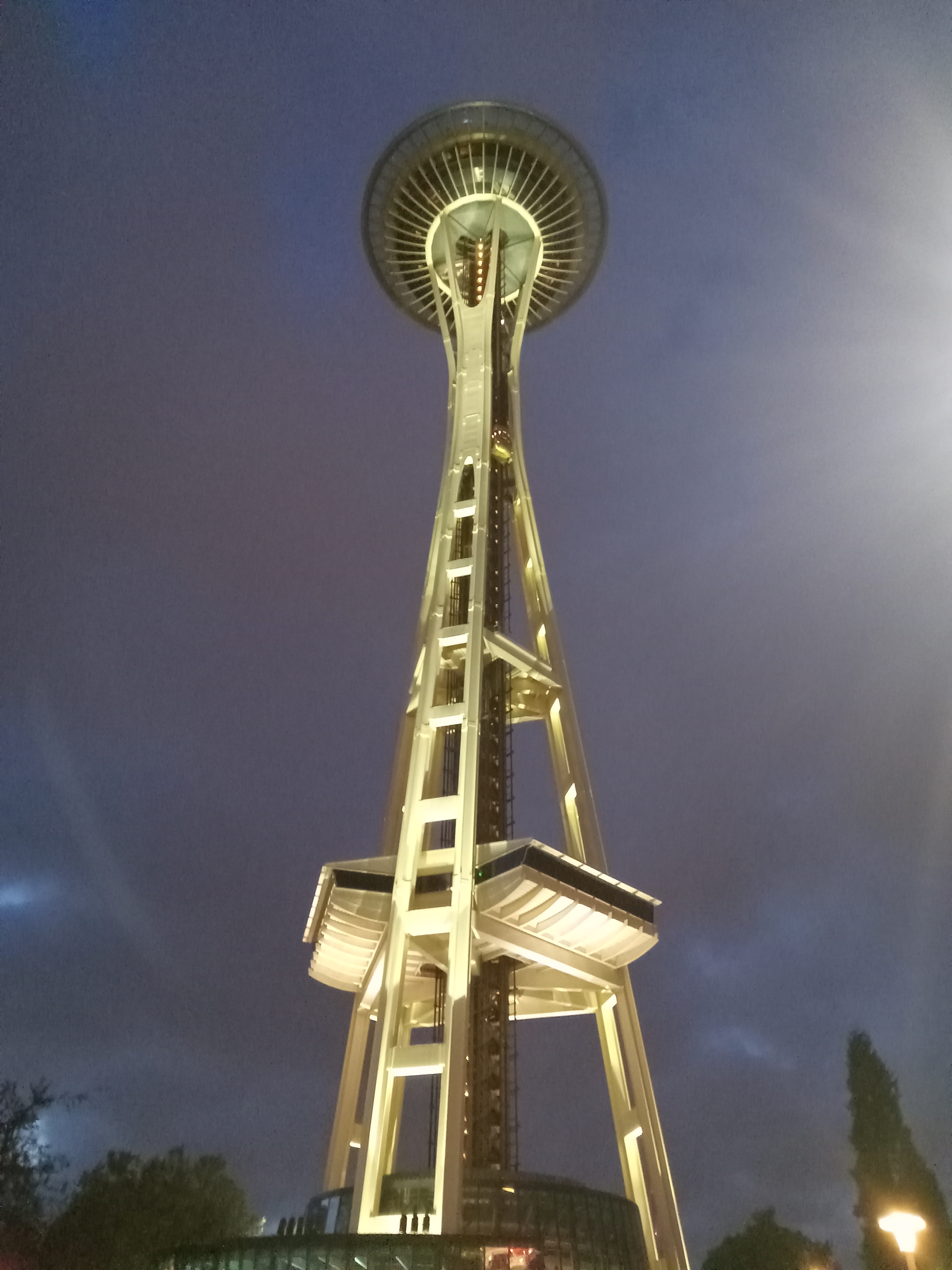
It was only a mile to the Space Needle, but I was dragging so badly it seemed to take a few hours to get there.  On the way back, I passed the same bar where the bartender had shouted at me two years earlier.  By now that was ancient history.  I limped back to Pike Street, passing the same crowd of junkies I’d seen earlier that day, outside of Target on the corner of 2nd Avenue.  When I got to the hostel, they were giving away free beer and the common area was packed with revelers.  They were young and had everything to celebrate.  I went up to the room alone, to enjoy the privacy while it still lasted.

riding the rails 12

The Coast Starlight wasn’t leaving until 9:50, so that gave me time to take a shower and eat breakfast.  It wouldn’t take long to get to the station, but I didn’t want to get there too late and get stuck with an aisle seat.  The whole point of taking the trip was to see the country, and I didn’t want to have to look over someone’s head to do so.

By the time I got to King Street Station, people were already standing in line to board the train.  I ended up in seat 33, which was the window seat I wanted.  Behind me was a German couple, who’d already unpacked their bedding and reclined their seats all the way back.  An old hippie that I’d seen checking out of the hostel that morning came up the stairs and headed for the rear of the train.

The Coast Starlight has been in operation since Amtrak consolidated most of the independent railway lines in 1971, and is named for two trains that had previously been run by the Southern Pacific, the Coast Daylight and the Starlight.  It covers almost the entire length of the West Coast, from Los Angeles to Seattle, and many points in between.  I’d probably taken the train three or four times and like it because it passes through a lot of my old stomping grounds.  On this particular train I could tell I was back with the West Coast freak crowd.  One bemused old-timer who was having a hard time finding his seat let all of us know that riding the train wasn’t just a job, it was an adventure.

With my primitive grasp of technology and innovations like cloud storage for safeguarding data, I have been relying on an external drive for years.  I will take pictures on my phone, then transfer them to my laptop and back them up on the drive. This has some serious drawbacks, such as someone potentially robbing me and getting away with my phone, laptop, and drive all at once, but so far, I’ve avoided that happening.  There was an episode on a night bus in Jakarta once where a thief got away with my camera and laptop, but I had the external drive strapped to my body, in the same way that a spy packs a pistol.  Thank God for that.  I’d just spent a month in India, one in Sri Lanka, and a third in Indonesia, and all that documentation would’ve been lost forever if I hadn’t been so paranoid.

Now I was about to do something stupid that never would have been an issue if I’d switched over to the cloud by now.  The memory on my phone was nearly full and I wanted to start off on the Coast Starlight with a blank slate.  I got out my laptop and started downloading the pictures on my phone, but it was taking longer than usual and the train pulled out of the station.  There were images I didn’t want to miss, so I picked up my camera and took a few pictures while the transfer process was still going on.  When it finally finished, there were twice as many pictures in the folder and some were out of order and not the right size anymore.  I became so stressed trying to remedy the situation that the next time I looked up we were just outside Tacoma.  Eventually, I found that the pictures were there.  The miniatures were just replicas that had been shuffled into the sequence out of order.  It would take a long time to go through them all, but at least I hadn’t destroyed all the pictures I’d taken between Kansas City and Seattle, which would’ve been devastating.

It was overcast outside and cold on the train.  The attendant was having problems keeping people in their assigned seats.  There were too many anarchists aboard.  There were brief stops in Olympia and Centralia.  Then we came to Kelso.  The dining car was running late.  The twelve-thirty seating time had been moved back fifteen minutes.  Only those who were traveling in the sleepers were allowed to eat in the dining car.  At twenty-five dollars for lunch and forty-five dollars for dinner, they were the only ones who could afford it anyway.  By now I’d eaten four or five of the microwaveable cheeseburgers, which came out like bags of hot glue, but were strangely tasty once you got used to them.  Before they closed for the night, I always made sure to grab a bag of pretzels and a bottle of water.  The water onboard was allegedly potable, but had come out cloudy and tasted like coolant the one time I filled an empty bottle to save money.

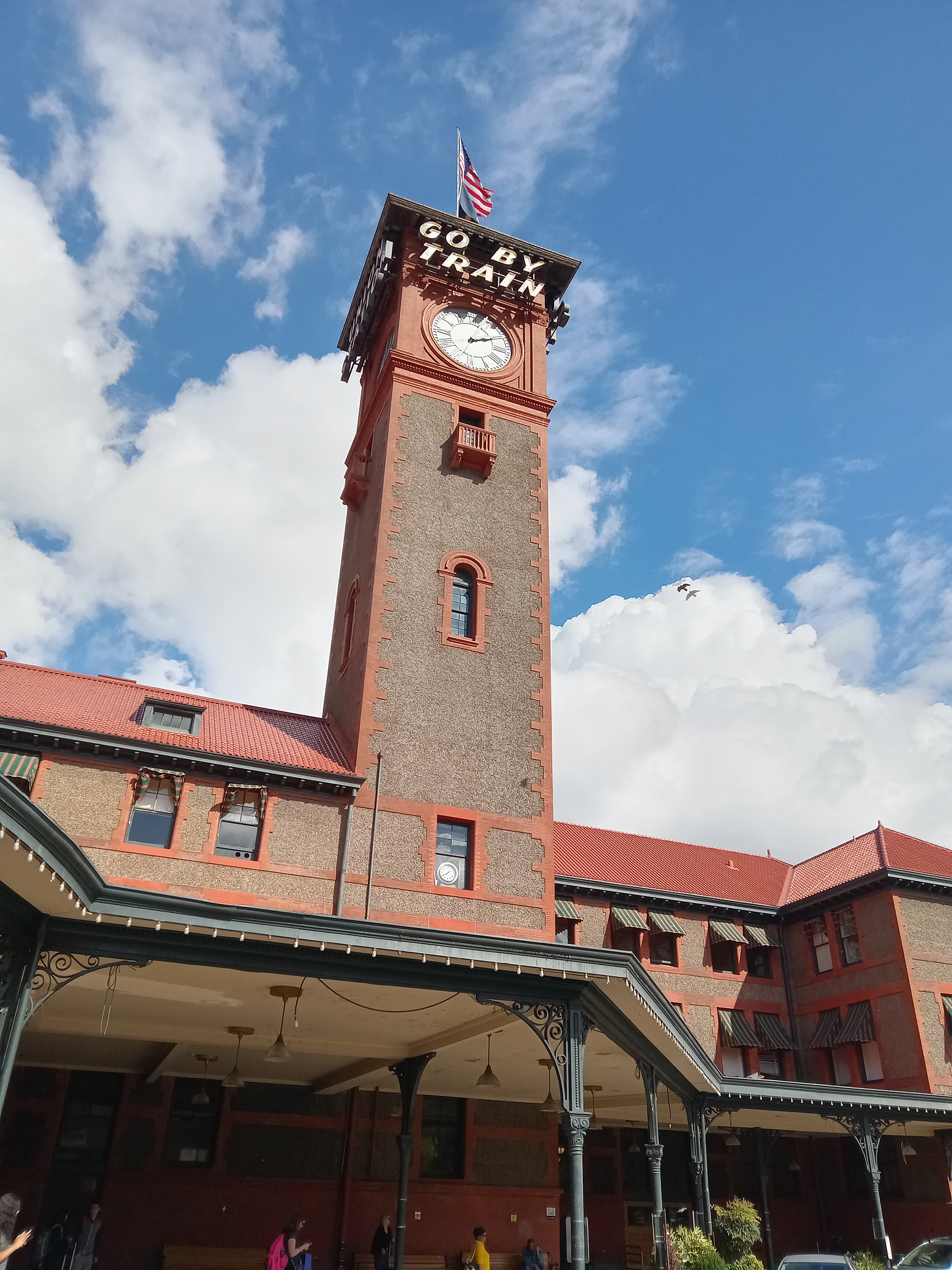
At Vancouver we crossed over the Columbia River and soon arrived in Portland, where we had a thirty-minute layover.  There wasn’t time to wander far, so I just walked through the station and stepped out in front for a few minutes.  The Union Station in Portland is memorable because of the big clock tower that says GO BY TRAIN.  People didn’t always need this prompt.  Between 1900 and 1940, the Golden Age of railroads, most travel was done by train, but following the Second World War, the competition from airlines and the auto industry caused ridership to plummet.  These days almost no one takes the train, unless it’s to work.  When they do talk about taking a trip on the train, it is generally regard as a novelty, something they wouldn’t ordinarily consider, but hey, why not?  That could be fun.

There were a lot of passengers getting on at Portland and when I reboarded there was a teenaged girl in the seat next to mine, wearing Doc Marten boots and writing in a journal.  I headed straight to the observation car.  Eugene was coming up and I wanted to see what it looked like, even though I’d been there a few years earlier, as well.  I’d lived a short time there after college and still have a lot of affection for the place, even though it didn’t work out all that well for me in the end.  We passed Salem and Albany, but I wasn’t paying much attention.  It was Eugene I was interested in.  As we reached the outskirts and I began to recognize some of the landmarks, I became dizzy with nostalgia.  There was Willamette Park.  There was Skinner’s Butte.  I could almost see myself up there as a twenty-three-year-old, with a guitar strung around my neck, watching the train come in.  I wondered how everyone was doing up at the old High Street Brewery?  Would there be a blues band playing tonight at Taylor’s?

We had about ten minutes to get out and stretch.  The crowd milling around the platform was the same counterculture stalwarts I associated with Eugene.  There was the Jesus guy with his round sunglasses and sandals.  There was the yoga girl, with her mat under one arm and a guitar under the other.  There was the fake gangster.  He was actually from Chico.  A couple guys in backwards baseball hats were kneeling down by the Eugene sign packing bowls.

Right when we were ready to depart, a young woman appeared on the tracks, shouting for us to wait, she was coming.  It wasn’t possible for her to run, but she still tired herself out to the point that she fell to her knees just outside the door and it took half of the crew to get her onboard.  For the next twenty minutes she squatted on the floor, hyperventilating and trying to explain about her asthma.  Finally, she was OK, and very apologetic to everybody.  She wanted everyone to know it was her asthma that made her almost miss the train.

I’d been monitoring the situation in Florida every chance I could get, but only now received confirmation that I’d made the right decision, when I saw that Amtrack had suspended their Silver Star service to Miami, at least until the end of the week.  Hurricane Ian had made landfall in Fort Myers the day before.  The damage was said to be catastrophic.  Now it was making its way towards the Carolinas.  No one could say when, if ever, things would be getting back to normal.

The girl in the Doc Martens had left the train and another one had taken her place.  I saw her suitcase on the floor, but not her.  She was up in the observation car reading a book, but I wouldn’t make that connection until later.  I was up there myself when a Goodwill cowboy came in.  He’d gotten on the train in Klamath Falls, and had the hat, boots, corduroy coat, and all, but they were mismatched.  The brim on the hat was too small, with a strap under the chin, like something an Australian would wear to a rodeo.  I thought about the hero in the Louis L’Amour story I’d just read.  He wouldn’t be caught dead in something like that.  All of his outfits had to be color-coded, right down to the bandana he chose.  The guy was looking to rustle up some grub, but the café car was closed for another half hour.  When he found that out, he sighed and sauntered back down the aisle.

Returning to my seat, I found the girl next to me had finally set up camp.  She’d decided to keep her suitcase on the ground in front of her, so getting around her during the night was going to be a challenge.  In a sense I’d been lucky.  Out of five nights riding the train, this is the first time I’d needed to share the seat with someone else.  It would be interesting to see how that was going to affect my tailbone, which now seemed to be hurting all the time.

Sometime during the night, I passed out and collapsed into the crack between the seat and window.  When I woke up it was pitch black and my neck and right arm were almost paralyzed.  I sat munching on a bag of pretzels, one by one, and waited for the sun to rise.  We were still two hours outside of Sacramento.

riding the rails 13

A big guy with plug earrings had been hanging around the bathrooms all night, giving the attendant a hard time, pretending he couldn’t remember where his seat was at.  When we got to Sacramento, he was one of the first ones out on the platform, complaining about how rude they’d been to him.  The sun was only now rising so he didn’t have much of an audience.  Walking up to the observation car to get a coffee and back, it looked like a bomb had been tossed into the coach section.  Limbs were jutting in every direction.  Heads were tilted at grotesque angles, the mouths drooped open in agony.  Blankets and articles of clothing were scattered everywhere.

Originally, I was going to hop right on the California Zephyr when we got to Emeryville, but had gotten cold feet when I saw there was only forty minutes to make the connection.  If I missed it, I couldn’t even be sure there’d be a seat open the next day, so had decided to play it safe and book a hostel in San Francisco for one night.  Now I could see that we were going to be on time, however, and was second-guessing myself, since not only was it going to cost money to rent a bed, but there was also a bus that needed to be caught to get to the other side of the Bay and I wasn’t sure how that was going to work out.

The night before, a woman had come up behind me in the observation car, saying, I need to get by, just that, not excuse me, or anything.  I’d waited until she was about ten yards away and just replied, yes, you do.  She’d turned around, took five steps, then turned around again.  Now she was sitting next to me and I’m glad the situation hadn’t escalated, as we ended up having a decent conversation.  She was from Oakland, and had been visiting a friend up north, staying in a cabin that had been besieged by wasps and flies.  We got to talking about the Rail Pass.  I told her it’s a good deal, but you have to know how to use it, like a chess player, constantly studying your next move.  You have thirty days, but only ten sections to ride.  You don’t want to waste them on short trips when you can get halfway across the country on one.  Ironic, here I was playing the Chess Master, about to fall into a trap and lose two of my sections before the day was done.

When we got to Emeryville, the bus to San Franciso was sitting right beside the tracks, and a line began to form outside it.  I’d taken the bus before, but couldn’t remember if it was a free shuttle or not.  Most people who get off the train there aren’t looking to spend the night in Emeryville.  It seemed to me that some of the passengers had tickets in their hands that said SFC.  I decided to ask the driver, who didn’t really understand my question and asked to see my ticket.  She scanned it and said that I was good.  That didn’t sit right, but I was too tired to think straight.  As we were crossing the Bay Bridge, however, I realized that she’d just charged the twenty-minute ride to my Rail Pass.   When we were let off on Mission Street, I asked about buying a ticket to get back to Emeryville and she said there was no way to do that.  That news sat like an anvil in my stomach.

I googled the hostel I was staying at and navigated my way through a labyrinth of skyscrapers to get over to Bush Street.  It was a long walk, mostly uphill, dragging my suitcase behind me, brooding over what had just happened with the bus.  Though it was way too early to check in, they let me store my bags in the office, and I went down to the common room with my computer and phone, hoping to straighten things out with Amtrak.  If it came down to it, I was willing to accept that I’d just lost one of the sections, but I had my credit card in hand, hoping that I could just pay for it, as well as the return the next day, and have the ride restored to my pass.

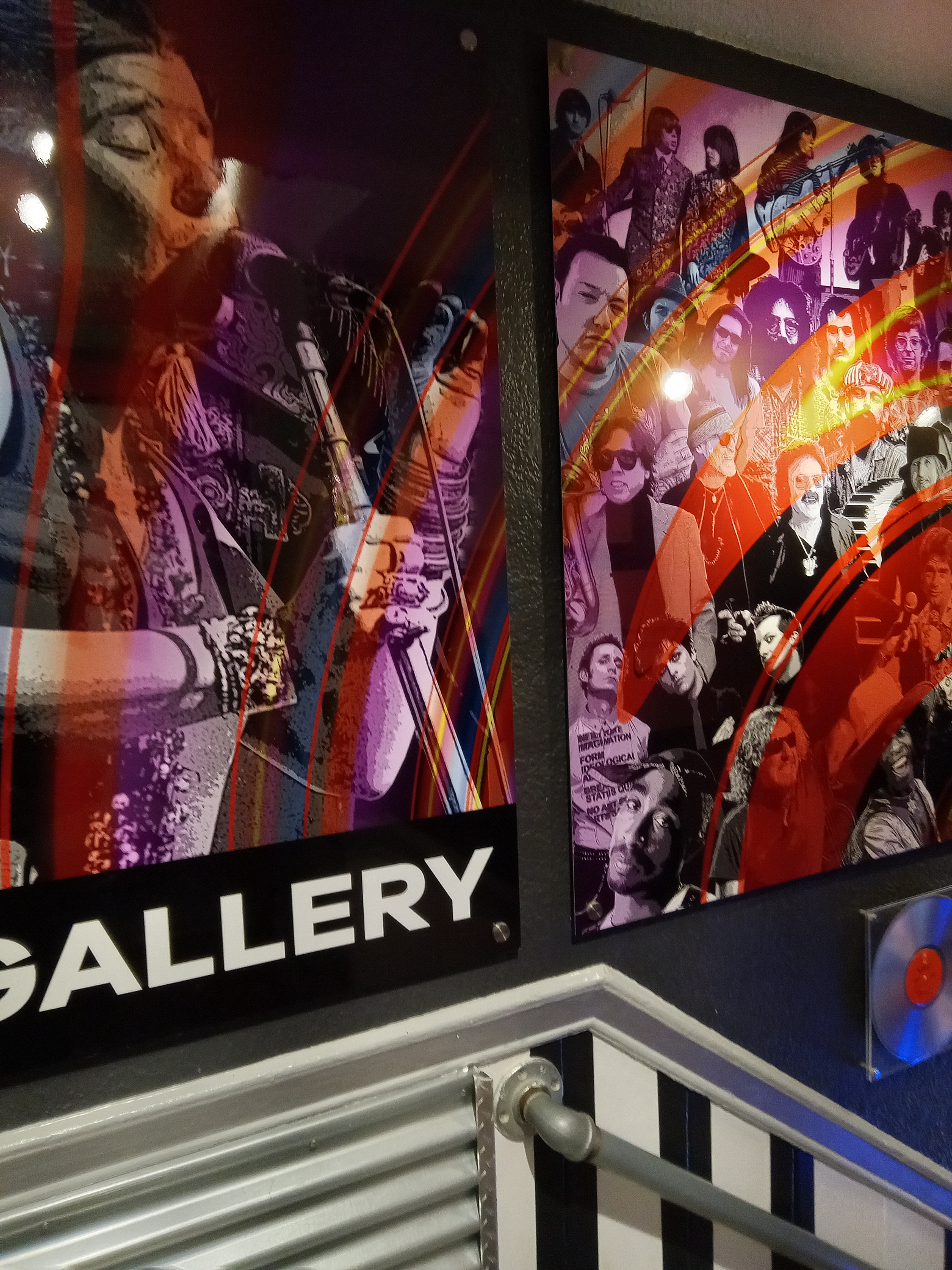
There was a man in the common room with glasses, a checkered short-sleeve dress shirt and a tie.  He was either working on a pyramid scheme or for a cult, and was making cold calls off a list he had in front of him, calling everybody Mister, and trying to ingratiate himself by talking in the most general terms about topics such as the weather, the benefits of a four-day work week, and the complexities of daily-savings time.  Isn’t that a game changer?  I was on hold with Amtrak and was hoping he’d take a break before long, since he was making his presentations as if he were addressing a packed assembly hall.  Finally, an agent answered, but I couldn’t hear her, so had to go out in the hall which was full of ear-splitting psychedelic music.  It was the San Francisco Music Hall of Fame, after all. 

The agent claimed to understand my problem, but then had to put me on hold for a half hour to talk to a technician.  When she finally got back to me, she said not only could I not pay for the ride I’d just taken and get the section back, I’d also have to use another section to travel across the bridge the next day.  There was no way to just buy a ticket for the bus.  I was stung and let her know, if that was the case then and nothing could be done about it, they just might be losing their biggest fan.  Didn’t she know I’d been traveling across the country, plugging the Rail Pass to everyone I met?   She apologized, but offered nothing more.

I was too tired and upset to think straight, and realized I better go for a long walk if I didn’t want to have an embarrassing meltdown.  What I really wanted to do was grab the cult salesman by the tie and bounce his head off the table.  I’d seen much of downtown not that long ago, and could only think to head towards Haight-Ashbury, an area I hadn’t been in since my youth.  Google maps had me take a left on Polk Street, where I passed the Great American Music Hall, and later the Civic Center.

After getting out of school, I’d bought a used pickup and hit the road, my plan being to live out of the back of it.  My first stop had been San Francisco, which I only associated with the Summer of Love and the bands that had come out of it during that time.  As an aspiring hippie myself, I thought it would be the perfect fit for the acoustic songs I’d just started to write.  I had a friend living there I’d met in Oxford, and without a phone number or address, in the days before the internet, had tracked him down simply by driving around his campus once and running into a mutual friend.  What I’d discovered was that the Haight had become a war zone of drugs and homelessness, and that the Bay Area was the last place on the planet I could afford to live.

Now google maps had brought me back to the Lower Haight, and it was mostly uphill for the next mile.  I passed some murals and a sculpture of a grimacing skull looking out of a bunny costume.  There were the famous Victorian Mansions that bands like the Grateful Dead had teamed up to live and practice in. 

By the Buena Vista Park there was a coyote warning as well as a group of gutter punk street kids, with their tattoos, packs, and dogs.  If anyone has adopted the hobo legacy and fitted it out to express the modern age it is them, congregating in packs, defying authority, scraping up change, and squatting wherever they can.  It might’ve been one of them who’d scrawled Capitalism Ruins Everything outside of an anarchist bookstore, which may be true, but has also kept the legend of the Haight flourishing. It is both a monument to the 60s counterculture and a giant shopping mall.  All the stores selling clothes, records, Tibetan artifacts, meditation workshops, cannabis and shrooms, what have you, are done up in the same psychedelic regalia, like a vibrant acid trip, but as one young guy leaning up beneath a Hendrix mural complained to me, it’s been gentrified to the point where no real hippie can afford to live there anymore.  He longed for the old days, when you could still feel the love on the street.

I hadn’t felt much love on the streets thirty-three years ago, and wasn’t feeling it now.  It was just another cold American city, where if you’re doing OK then things are fine, but if you aren’t, God help you.  I wanted to take a different route back to the hostel, so made my way over to the panhandle, then took Fell Street up to McAllister.  There’d never been a Summer of Love in my lifetime, and the music that was popular now was all electronic beats and shouted boasts.  I’d been too young for the action the first time around, and was too old for it now.

When I got back to the hostel, they let me check into my room.  There were only two bunks in it, and I’d been assigned one of the top beds, which was unfortunate.  I climbed up in it and tried to figure out what to do next.  Hurricane Ian had destroyed Fort Myers, but largely spared Tampa.  Both Orlando and Jacksonville were dealing with flood waters, and it was difficult to measure how long it would take them to recover.  I figured New Orleans might be a good place to lay low for a few days, but when I called Amtrak, the City of New Orleans was once again booked the day I’d be arriving back in Chicago.  I ended up making a reservation on the Lake Shore Limited, bound for New York City, and then the Silver Star, which was heading to Washington DC the next day.  According to the agent, they were scheduled to begin making the run to Miami on the 7th, so I went ahead and booked that, remaining skeptical, however, that it wouldn’t fall through. 

That night I was lying down when the guy beneath me arrived, slamming the door three or four times, before getting in bed, and right away beginning to breathe heavily and grunt.  A short while later, the guy in the opposite bed showed up and went into the closet for a long time, which was strange.  When he came out, he got into bed and began to cough and clear his nose. 

I climbed down the ladder and went into the common room, where a French woman was speaking to an older local one.  The French woman was planning a trip down to Los Angeles and looking for recommendations.  A Ukrainian woman who was sharing a room with them came in, upset about the conflict going on in her country.  Then a few young guys showed up with a pizza, and one of them began to dominate the conversation, speaking as if he knew more about the situation in Ukraine than anyone, including the woman who was from there.

When I went back to my room, both of the guys in the lower bunks were snoring, as if it were a competition.  I knew I wasn’t getting any sleep that night.  Out in the halls were framed pictures of famous bands from San Francisco; the Dead, Jefferson Airplane, Janis Joplin, Santana, Sly Stone, the Steve Miller Band, as well as some of the lesser-known bands that were important in their own way; Moby Grape, Commander Cody, the Beau Brummels, Camper Van Beethoven.  I stayed in the hall most of the night, reading the biographies that were featured beside the photos.

By three in the morning, the snoring contest had been won by the guy in the opposite bunk, who sounded like he should’ve been on a respirator.  I had to be up at five to make the connection back over the bridge to Emeryville.  Now I worried that if I did manage to fall asleep, I’d miss my alarm and the bus.  There was nothing to do but grind it out.  Homicide was another alternative, but I wasn’t going there yet.

riding the rails 14

It was still dark as I made my way down Bush Street to the pickup point for the bus back over the Bay Bridge to Emeryville.  People used to warn me about going out after dark or walking through certain sections of town.  Now I fear those who did the cautioning, more than the ones I was warned about, who ninety-eight percent of the time are just victims, who’ve been left out in the cold.  If you have nothing, you technically should have nothing to lose, although you can still be fined for sitting down on the sidewalk and if you need to go to the hospital, may never pay back what you owe.  Walking through the financial district, between the dark skyscrapers, there were figures sprawled out in nearly every doorway, often with nothing but a newspaper for a sheet.

Even though I was using google maps, things still got a little confusing when I was a few blocks from the pickup point.  There was no street sign on a pedestrian path I was being directed down and I began to panic.  It didn’t look like the same area I’d been dropped off in the day before.  But, no, there it was, the multi-colored statue, human figures standing on top of each other, or something to that effect.  With some relief I noticed a handful of other people waiting with luggage.  I was still nervous about getting to the train on time.  As far as the two sections of the Rail Pass that I’d lost, I figured I’d just try to get ahold of customer service at a later time and explain what had happened. 

There was some confusion when ten minutes before the pickup time a bus rolled up.  The driver claimed to be there for an earlier pickup time, however, and most of us still had to wait for a second bus.  There was a woman in a handicapped scooter that I’d noticed when she arrived in a taxi.  The man she’d been with had been on crutches.  They’d got into a big argument, and she’d blown her top at him, her shouts echoing through the streets and getting everyone’s attention.  Now he hopped on the first bus, and she sat facing a wall.

After all that fretting, when the bus arrived it only took twenty minutes to cross the Bay to Emeryville, and I ended up with two hours to kill.

The California Zephyr runs between the Bay Area and Chicago, a distance of some 2,438 miles.  It has a reputation of being one of the most scenic routes in the nation, crossing both the Sierra Nevada and the Rocky Mountains, and passes through California, Nevada, Utah, Colorado, Nebraska, and Iowa, and Illinois.  For the third time in just over a week, I’d be traveling between the West Coast and Chicago, but as long as I was going somewhere and didn’t need to get off the train anytime soon, that was fine by me.  The trip was scheduled to take 52 hours.

At 8:30, the Coast Starlight arrived, right on time, just as it had the day before, and I kicked myself for changing my ticket and losing those two sections in the process.  On the other hand, I had another big city under my belt, and was scheduled for New York, DC, and Miami, so there’d been some experience gained, even though much of it had been hellish enough to rival Dante’s tour of the Inferno.  Possibly worse, in that he’d had a guide who knew his way around, while I was just out winging it, falling into every pitfall and trap along the way.

About ten minutes before the Zephyr arrived, they had us go out on the platform and gather in groups.  All those riding coach were supposed to form a line at gate C.  When it did pull in, however, the line got jumbled as the passengers jostled to get close to the door.  When I got to the bearded conductor, he scanned my ticket three times and it didn’t go through, which gave me a surge of anxiety, even after he nodded for me to get on anyway.  It seemed to me there’d been a lot of glitches with my reservations so far, and now I worried that the connections I’d lined up in Chicago, New York, and DC, wouldn’t go through.  What was I thinking heading to New York City anyway?  The very idea of just showing up at Penn Station after dark made me worried sick.

We started off traveling in the same direction the Coast Starlight had traveled the day before, past Martinez and Davis, with a stop in Sacramento.  From there we headed east, however, towards Nevada.  Some guy, a modern-day meth hobo, of sorts, had gotten on the train with a skateboard, guitar, hooded sweatshirt, wearing, for some reason, a COVID mask.  He was very vocal in his appreciation of them letting him take the train instead of the bus, very vocal, in general, and when a girl came wandering down the aisle, looking like she didn’t know where her seat was, he shouted and motioned to her that there was room next to him.  Then the train whistle blew, and we were off.

There was no time to get comfortable.  A few minutes later I received an automated call from Amtrak, letting me know that my train to Miami had been cancelled once again.  That didn’t come as a surprise, but was too much information to process.  At this point the only option would be to take the Crescent to New Orleans, if I didn’t wish to get stranded in DC for two nights, but that was very much like trips I’d taken in the past.  If Amtrak wasn’t going to Florida, perhaps Greyhound was.  I’d have to look it up later.

As we got into the foothills of the Sierras, things began to look interesting so I went up to the observation car to get a better look.  The meth hobo had tromped up there a while ago, with his guitar in one arm and skateboard in the crook of his elbow, and now I discovered him, totally collapsed in one of the seats, his mask pulled down under his chin, offering his guide services to an elderly couple too polite to just ignore him.  He knew something about everything.  The geothermal activity in the region.  The Gold Rush.  The Donner Party.  When they showed interest in hearing more about the Donner Party, he made a joke about us becoming the next Donner Party.  That was finally enough to send them back to their seats, while he just looked over at me and shrugged.

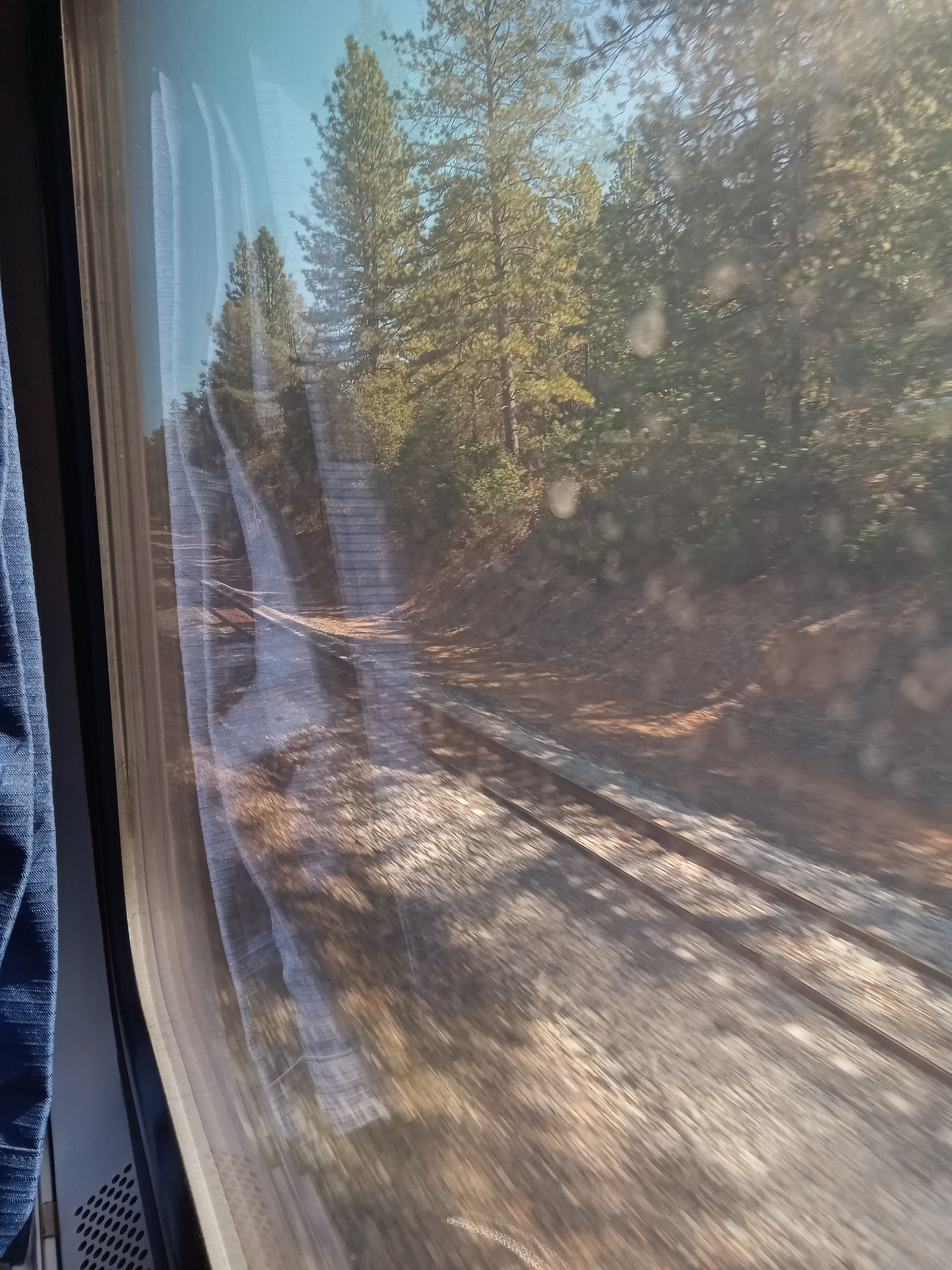
We were north of King’s Canyon by now, and the views of the pine-covered mountains were spectacular, what you would take a train trip hoping to see, pristine wilderness.  It was like this for the next two hours, from Colfax to Truckee.  A couple next to me in matching National Park T-shirts and Tivas, went from one side of the car to the other, pushing their phones right up against the window, while a local guy with a professional camera had hedged his bets on the left side of the train and didn’t budge.  He’d been right.  As we approached Lake Tahoe, a string of small lakes appeared in the valley far below that made everyone who hadn’t been sitting on that side get up and try to squeeze in.

The California Zephyr passes through twenty-nine tunnels, and we passed our third or fourth while I was on hold to speak with an Amtrack agent, trying to get back to them about the cancelled train to Miami.  After ten seconds in the darkness, the phone went dead.  I’d have to wait until we got out of the mountains. 

Soon after passing through Truckee, the eastern slopes of the Sierras give way to the high desert of Nevada, and a sudden and shocking change of scenery takes place.  It now looked like we were traveling through a gravel parking lot.  A lot of people were getting out in Reno, the meth hobo for one, who’d been kicked out of the observation car and taken his guide services back to coach. 

The platform in Reno looked like a concrete bunker.  There was nothing to see, so I took the opportunity to get back on the phone with Amtrack, confirming that the Silver Star to Miami on the 6th had indeed been cancelled, and that the other reservations I’d made were still good.  Needing to come up with a backup plan, with no time to think it over, I went ahead and booked the Crescent from DC to New Orleans on the same day I’d been scheduled to travel to Miami.  I then booked passage on the Sunset Limited, traveling from New Orleans to Los Angeles the day after that.  It felt like a mistake, but I figured if worse came to worse, I could go with my original backup plan and take the Pacific Surfliner to San Diego and then head to Mexico from there.  As soon as I got back on the train, however, I read that service on the Surfliner had just been suspended indefinitely, as well.  It felt like things were falling apart all over.

riding the rails 15

A group of five chatty Mexican businessmen had gotten on the train in Winnemucca, and were traveling to Salt Lake City.  They were in high spirits and seated all around me.  Fortunately, there was no one next to me, so I laid my head down as soon as it got dark, and tried to escape my situation by shutting my eyes.  After passing through Elko, there were no scheduled stops for the next four hours.  Gradually, thing began to quiet down.

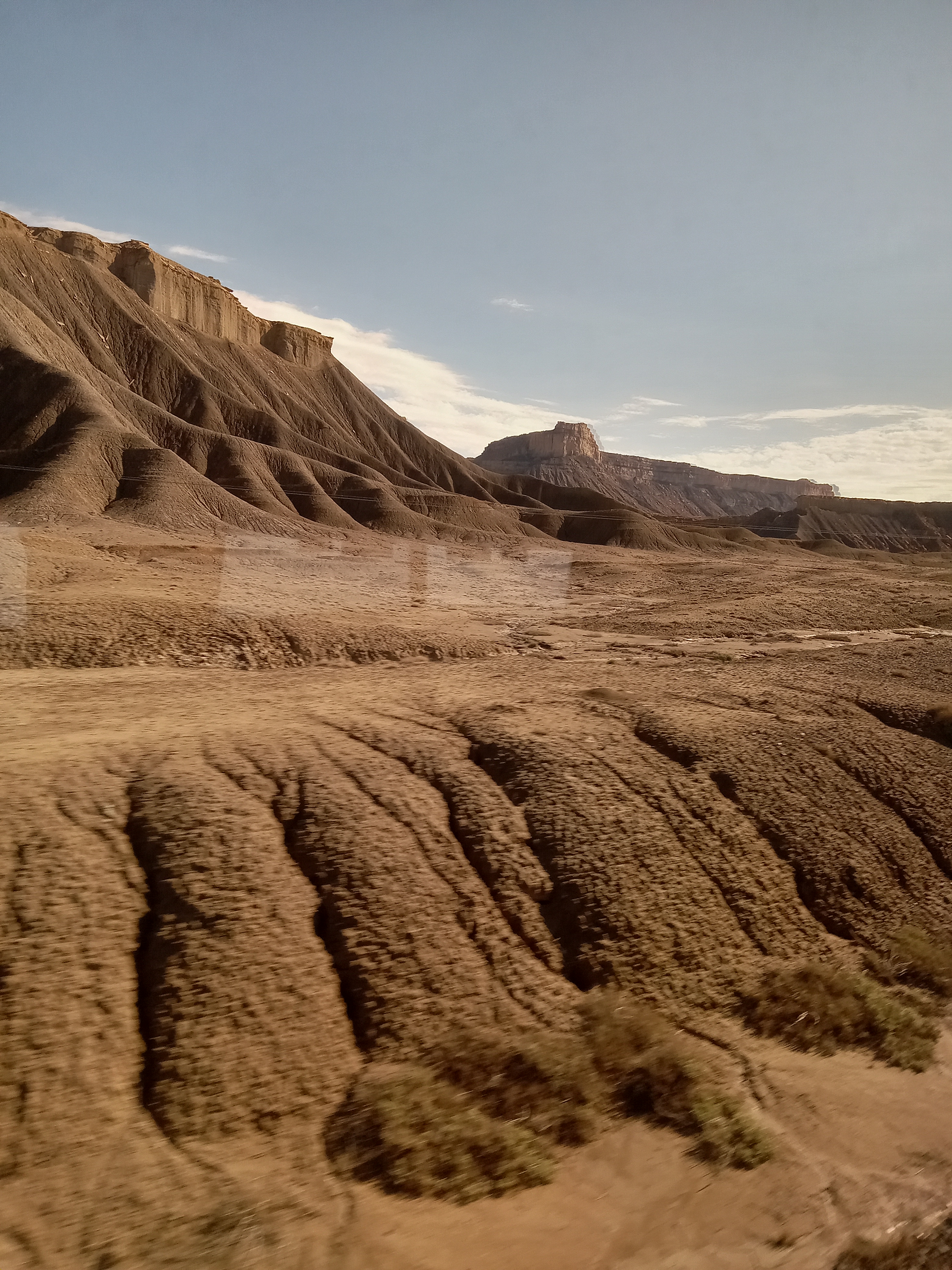
When I awoke to the gray light of day, we were just outside of Green River.  We went around a curve and I could see the locomotive and other cars bending into the purplish, low clouds on the horizon.  The trip had been full of discomfort, but also full of scenes of rare beauty.  If it had mostly been a disaster so far, it had also been a strangely, photogenic one.

The couple with the matching National Park T-shirts were in the observation car when I went up to get a cup of coffee and a breakfast sandwich.  We’d run into each other enough that if we were going to talk it would’ve happened by now.  My impression was that he’d served as some kind of mentor in the past and that a relationship had developed from there, since he was considerably older, but that could’ve been way off and was none of my business.  He was showing her once again, how if you press your phone right up against the window, you can avoid the glare.

I went back to my seat to study the train schedules.  I was not happy at all with my itinerary, now that the Silver Star to Miami was out of the picture.  I was scheduled for one night in New York City, one night in Washington DC, and one night in New Orleans, before heading back west on the Sunset Limited.  That was no good at all, especially since the Pacific Surfliner had just been suspended, and it had been my backup plan to take it to San Diego, then head to Mexico. It did occur to me that I might be able to hop off the Sunset Limited in El Paso and cross over into Juarez from there.  Seeing that the train stopped in El Paso in the early afternoon it was possible, but I’d been in that area a few years earlier, so the idea didn’t excite me.

On Hostelworld, I found a place in New York that was only about a mile from Penn Station, then another in DC that was about the same distance from Union station.  They weren’t cheap for shared accommodations, but way better than I could do otherwise.  Being unemployed for years now, with my financial situation what it was, the last thing I needed to be doing was taking a tour of big cities in America, yet, lo and behold, on the circus rolled.

A woman sitting in the aisle seat, two seats ahead on the other side, had been helping people with information since she’d gotten on the train.  We got to talking and I found out she was traveling on a Rail Pass as well.  So far, she’d done some of the regional routes in the Northeast and was returning from a trip on the Empire Builder, very similar to the one I’d just undertaken.  She’d been a free spirit most of her life, a retired educator who’d spent a few years working for Americorps in Alaska, and was now just traveling across the country, visiting friends. 

After we were done talking, another woman who was sitting a few seats back and had overheard us talking, came up and wanted to ask me a few questions about my lifestyle.  I said I wouldn’t recommend it.  It was something she’d been dreaming of doing her whole life, however.  Now she was married and her and her husband had a small business that had been impacted by the pandemic.  She’d just been visiting in relatives in Utah and was on her way to Colorado where they were hoping to make a new start.  Still, she’d always felt like a bit of a gypsy and wondered what it was like to be riding around the country with nothing to tie you down.

First of all, I assured her that I wish I did have something to tie me down.  It was true that I’d been seduced by the nomadic lifestyle at an early age, but there are pros and cons to every situation in life.  I’d always imagined that I’d find that magical place, fall into the right community, meet the right girl, and have kids and settle down, just like everyone else.  The trouble is that I’d never found that magical place or any kind of community.  Perhaps, I’d been sabotaged by romantic ideas about what life could be, but mostly everywhere I went the things I was asked to do were unimaginative and repetitive, and I’d done them mostly in isolation.  The songs I’d written and albums I’d recorded hadn’t reached anyone.  Living as an artist might have worked for others, but it hadn’t worked for me.  So, I’d burned everything to the ground and become a wandering spirit.  It wasn’t quite what I wanted, but was within my control, and, yes, I still did get a kick out of it after all these years.  It was a terrible way to live, but the best I could do under the circumstances.

She thanked me for my honest response and took the business card I handed her, the first, and last, I would be handing out on this trip.  If a traveler doesn’t have someone to tell their story to, then what do they have?  I should have thanked her for listening.

The conductor passed through, announcing that our next stop would be in Glenwood Springs and that eighty people would be getting onboard there.  He asked us to clear the seats next to us if we were traveling alone.  The train would be full until we got to Denver.

Glenwood Springs is a popular weekend trip from Denver, with hot springs, caves, and adventure parks, so that made sense.  It was the perfect time of year for a weekend getaway.  When we arrived at the station there was a large crowd, ready to board the train.  The side of the observation car I happened to be sitting on had a phenomenal view of the Colorado River and the high mountain bluffs that tower over it.  The leaves on the trees had started changing to yellow and red.  Enclosed in glass, there was something to see from every window.  It felt a bit like traveling through a dream, that for a short while wasn’t a nightmare. 

A half hour later, the view had switched to the other side, which was good timing as I’d just returned to my seat, finding I still had it to myself.  The conductor had warned us that this stretch of the river was known as Moon River, and we found out why when the first white-water rafters we passed stood with their backs to the train, dropped their shorts, and grabbed their knees, drawing chuckles and squeals of surprise from those who were now in on the joke.

Although I have family and friends in Denver, I’d recently seen most of them, and since our stop in Denver was only going to be a half-hour, I hadn’t bothered telling anyone I’d be passing through.  Coming out of the Moffat Tunnel into the foothills, however, with the lights of the city glittering below us, I decided to call my old friend Riley and just say hey.  Back in the day a half hour layover would’ve meant trying to coordinate a quick joint and a beer, but he was living on the outskirts of the city and that was no longer the order at hand.  He’d always been sensible and had done well for himself, managing the house, wife, kids, and career, while still playing in a band, while I, on the other hand, had played the fool and was having a hard time putting on a brave face these days. 

It was good to talk to him anyway.  I brought up the time we’d tried to score some pot in Oregon and the guy had ended up tossing him a brown paper bag with a pair of binoculars in them.  I said he’d tried to justify it later by claiming to have gotten some good use out of them on a camping trip.  He denied that ever happened.  That didn’t stop either one of us from laughing even harder.