Category Archives: Travels

pages fly away 2

When you don’t know where you’re going, you leave a lot of room for surprises.  Right until the last minute, I wasn’t even sure what direction I’d be heading on my six-week road trip.  I had a vague idea about driving through as many Indian reservations as I could, but that was it.  There was a powwow in North Dakota happening in a few days, but heading straight there would mean a lot of backtracking at a later date, and I’d still miss the opening ceremonies.

The more logical route was to drive up the West Coast and then cut across the country from there.  Unfortunately, there was a heat wave going on and most of the national forests in Northern California had just been closed on account of wildfires.  Sequoia National Park was still open, so I decided to head there first, which proved to be a fortunate choice since the highway running through it would be shut down only a few days later.

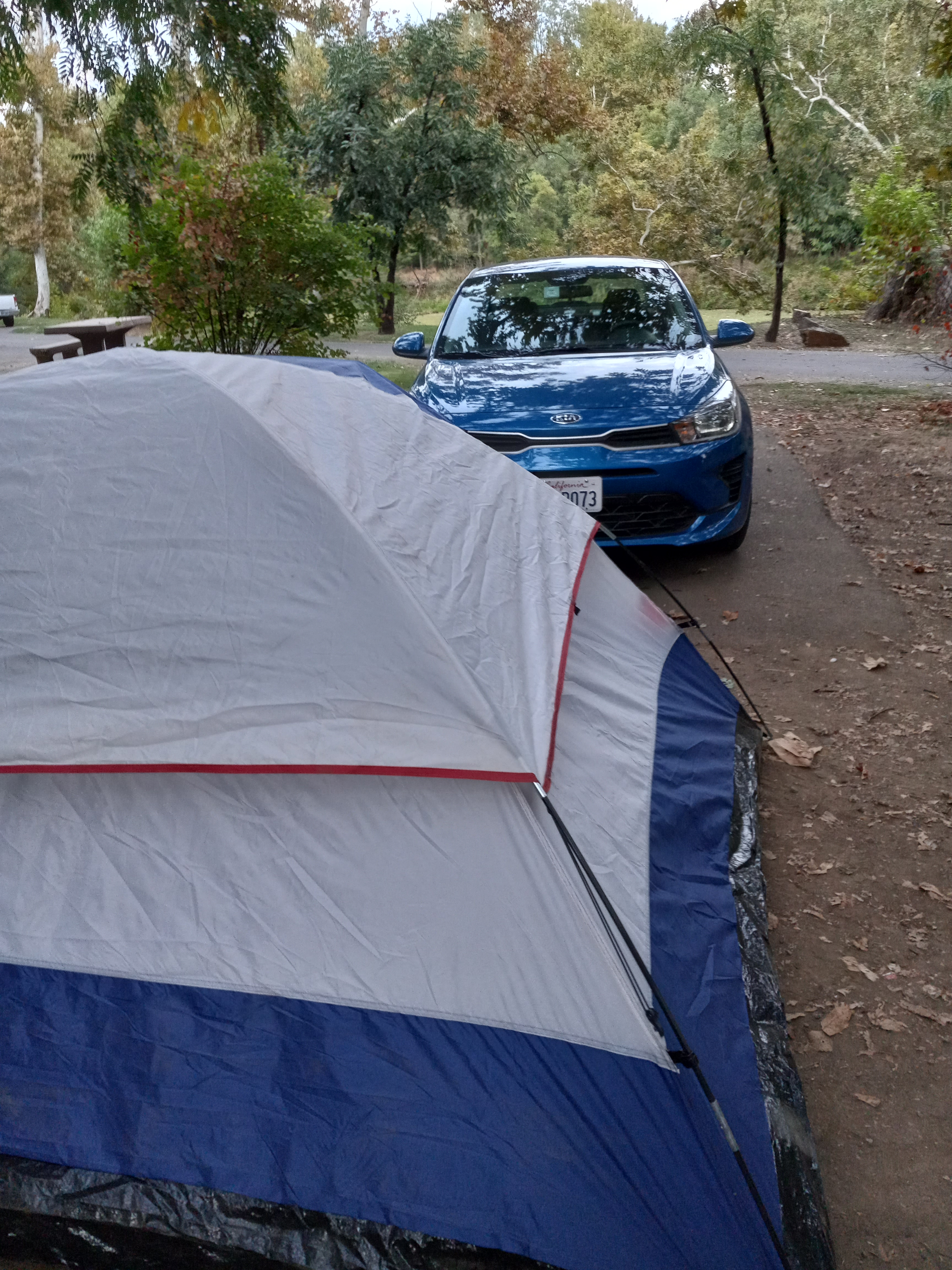
Since I’d been living in a pop-up camper for a year and a half, there wasn’t much I needed to invest in, outside of a tent, which I picked up at Big-5 for forty dollars.  I threw it in the trunk along with a sleeping bag, a few blankets, two pillows, a yoga mat to use as a pad, a small suitcase and my ukelele.  In front, I had an Atlas, a few books about Indian tribes and wildlife, two notebooks, a lantern, a flashlight, and a blue cloth cooler.

The plan was to fly, to hit the road and not stop driving until it was time to return the car.  It was the perfect time of the year to be hitting the road, heatwave, and wildfires aside.  The days were still relatively long and the weather across most of the country would be mild.  Just looking at the blue Kia made me happy.  God could have not designed a better vehicle for my journey.  I could almost see the wings sprouting from its sides.

At around 10:30, assuming by now that the worst of rush hour had passed, I said goodbye to my mother and hopped in the car, racing up to PCH, and then taking it north to Seal Beach Boulevard, passing the beaches and blue waves of Huntington and Bolsa Chica, where I’d spent much of the pandemic surfing. 

There is a story about a Chinese farmer who owns a beautiful horse.  One day the horse runs away.  The neighbors say, oh, how unfortunate, but the farmer refuses to acknowledge any event as being truly good or bad, because no one can know how things will work out in the end.  Later, the horse returns with a dozen wild horses.  Oh, how fortunate.  Then the son of the farmer tries to mount one and breaks his leg.  Oh, how unfortunate.   Lastly, the soldiers of the king come by conscripting all the young men for a war that the son is forced to sit out because of his broken leg.  Again, how fortunate.  Really, in the end who can say what is good and what is bad?

That is a little like how the pandemic played out for me.  I’d gotten a job in Vietnam that I needed to evacuate from.  Then I had a seizure and lost my driver’s license.  I moved into a popup camper behind my mother’s cottage.  There was no chance of finding a job or making money.  I had no option but to start surfing.  After time, however, I got my license back.  Then I started getting unemployment money.  Before too long I’d paid off my debts.  Now I was off on this road trip.  Who can say what is good and bad?  Who can truly say?

From Seal Beach Boulevard, I got on the 405 heading north, and the traffic was flowing, even up around LAX where it usually jams up regardless of the hour.  I passed Washington and Venice and the apartment where’d I’d lived with my brother for seven years.  Those had been good times.  Someday soon I’d need to stop in at the Cinema Bar and say hello.  In addition to being one of the smallest honky-tonks out west, it’s also one of the best.

I needed to slow down a bit when I got to the 10, but then things sped up again and I flew past the Getty, merging onto the 5 and racing past Santa Clarita and Magic Mountain.  Before long I was climbing up the Grapevine, the yellow hills burnt black as toast by recent wildfires.  Then I was descending down the other side and getting into the far-right lane to take the 99 towards Bakersfield.  What a stretch of road that is; flat, desolate, hazardous, only occasional stretches of fruit trees to break up the monotony.

Bakersfield approached like a blight on the horizon, trapped somewhere between being a small city and a dirty suburb.  There is country music history there.  Buck Owen’s Crystal Palace.  Merle Haggard Way.  Outside of that, not much, until you get up to the Kern River and start heading west towards Lake Isabella.

I’d been diverted to the 65, perhaps preemptively, by signs pointing to Sequoia Park.  That led me through fields of oil derricks, pumping away at the land like black waterbirds.  Those eventually gave way to orchards.  The gas gauge on the Kia was already down to half and had me worried, but when I stopped at a gas station to top it off, found that twenty dollars was more than enough.  Relief.  Relief.  Things could be much worse.  A LOT worse.  I grabbed a sandwich and Monster energy drink and kept driving.

After passing Exeter, I got on the 198, and knew I was getting off the beaten path when I came across a large redwood sculpture of the head of John Muir and another of two Indians and a buffalo, staring out of the same stump.  These were around Lemon Cove, in the vicinity of The Big Orange, which was a fruit stand, selling grapefruit, peaches, honey, olives, and jelly.  I got out and took pictures then continued on to Lake Kaweah, which sat in a low valley, surrounded by parched hills.  Good thing I would soon be setting up my tent beneath a canopy of sequoias, or so I thought.

After passing through Three Rivers, it was just a few miles to the entrance of Sequoia and King’s Canyon National Parks.  There was a young woman working the gate who had two surprises for me.  The first was that due to COVID they no longer accepted cash.  I had to use a credit card for the Park Pass, which was still a good deal for eighty dollars, especially since it cost thirty dollars for each park, and I planned on visiting all of them I could.

The second surprise, which was harder to swallow, was that I had to have a reservation to camp in one of the campgrounds.  I couldn’t just drive in and claim any site that was open, as I’d always done up until now.  A sign claimed that all of the campgrounds were full, which struck me as suspicious, having seen no cars on the road or at the entrance when I arrived.  I’d have to turn around and head back to Lake Kaweah.  There’d been plenty of open spots there.

The campground at Lake Kaweah looked like a construction site, with the hot sun perched up on the hills, still casting a blinding light.  There was no one else there.  The best spot I could find was beneath a leafless tree on hard-packed mud.  It wasn’t until I got my tent set up and took a long walk that the sun began to set and the day cooled off.

One tool I’d used to survive the pandemic was meditation, or my own version of it.  I’d never been able to rid my mind of thoughts but had created a regimented breathing pattern that I added some relevant prayers to.  If I could make it through those, I could sit still.  Without any structure, my eyes would pop open, and I’d just jump up and start doing something else.  One goal of the trip was to find new settings to sit and be still in.  If I couldn’t stop my thoughts, I’d at least try to tune it to what was happening in the moment.

The first evening then, after setting up camp and walking off the last of my restless energy, I sat down on the picnic table by my tent and began to breathe.  Who was I?  Where was I?  Birds chirped all around.  A beating of wings came rushing by.  From a distance, I could hear a car approaching.  It pulled into the campground.  Gravel crunched beneath its tires.  It had seen enough.   It was backing up.  A crow began to caw.  Some bird was drumming on a branch.  Insects were whirring all around my face.  They were trying to mess with my plan, fly up my nose.  I sat rigid and resisted. 

Around the time I was ready to wrap things up, a bird began screeching over my left shoulder.  I opened my eyes and turned in time to get a glimpse of it, a blue upper body, grey below, a black beak and bands around its eyes.  I’d brought an Audubon guide to the flora and fauna of California, so turned to the section on birds and identified my new friend as a scrub jay. 

On the same page was another bird, bluer than the first, that I immediately took a liking to.  The mountain bluebird.  It was as blue as my blue Kia.  The Kia needed a road name.  It became the Mountain Bluebird.  I saw us flying over the mountain ranges and plains of America together.  We would fly like a storm cloud, like a bolt of lightning, all around the country, faster than the wind.

After the sun went down, the stars came down from the sky and hovered over the dark landscape like clusters of celestial grapes.  I’d done some amateur stargazing during the pandemic, but now could hardly pick out a reference star.  The sky was too thick with them.  I was laying on my back, looking up into the heavens, when I heard some heavy boots approaching on the pavement.  It was a ranger, wondering if I’d paid my fee for the night.  At Lake Kaweah there were no reservations required.  He saw the pay stub fastened to the site post and wished me a goodnight.

Before he left, I asked if he could direct me to the Big Dipper.  He strained his eyes upward for a good long while, but eventually had to admit defeat.  That was OK.  I was just asking, not testing him.

pages fly away 3

At the first light of dawn, I jumped up and began to take down the tent.  It’s a wonder I’d managed to get it set up in the first place.  It was its first time out of the box.  The design was pretty simple.  Two crossing poles provided the frame.  The tent clipped onto those. Putting the tent stakes in was like trying to pound nails into concrete, however.  Then the cord for the rain cover had gotten so knotted I’d almost pitched a fit. 

In the light of day, I took a few breaths and managed to get it unsnarled.  The tent was never going to fit back in the little bag it had come in.  I just folded it up like a sheet and laid it in on top of everything else in the trunk.

Passing through Three Rivers, on my way back to the park, I took a picture of a totem pole and drove up to a museum.  There was a redwood sculpture of Paul Bunyan, America’s legendary lumberjack, as well as a timeline that gave his birthdate as 1511 and had him moving to Porterville and opening a restaurant in 1962.  Other, less notable, dates on it included the first Punic War, the fall of Rome, the discovery of California, the Civil War, and World War 1.

Back at the park entrance, there was a young guy on duty.  He inspected the park pass I’d bought the previous day and had me sign the back of it.  I asked him about the reservation system for the campsites.  He gave me a website I’d need to reserve sites on if I wanted to camp at any National Park in the future.  What was left of the land of the free when even camping was becoming a Ticketmaster event?

It took a bit of driving to reach the Giant Forest.  When I did and had the road to myself it was like traveling back to a prehistoric age.  Sequoia Trees live up to three thousand years and are some of the oldest organisms on earth.  They can reach three hundred feet tall and almost a hundred feet around.  Some of them were breaching the crest of the forest as I approached the visitor center and parked beside the Three Sisters.  Sunlight was streaming down through the branches.  The damp air smelled like pine needles.

A large sequoia known as the Sentinel was standing watch out front of the visitor center.  Here, I discovered that the museum was closed, due to COVID, yet the gift shop was open, one of those paradoxes surrounding the pandemic that has yet to be explained.  The implication seems to be that safety always comes first, unless there are large amounts of money involved.  Even then, it can no longer be cash money.  We have reached the living end.

What I really wanted was to get to the General Sherman Tree, the largest tree in the world, not by height or even circumference, but by volume.  I had been to the park before.  I’d seen it more than once.  Still, I needed to visit it again.  It’s a celebrity among trees.  Your trip to the park is not complete unless you make it to the General Sherman and get your picture taken in front of it.  I continued up the Generals Highway until I reached the parking lot for the tree.  Here there were more visitors, certainly not enough to fill all the campgrounds, but the greatest concentration of them, by far.  I got out, already impatient, and made my way down the trail.

My mind was racing, leaping, and skipping down the road ahead of me, thinking of all I wanted to see on the trip, wandering how far I could drive that day.  Once I reached the General Sherman I decided to try to slow down and sit and meditate in front of it.  If my goal was to be in the moment, I was far from reaching it.  My inclination was to run around the tree, run back up to the car, and just keep driving.  No one else seemed to be of the same persuasion.  They were taking their time, reading every sign, leisurely strolling, stopping for pictures.

The General Sherman is a big tree all right.  There were a few benches in front of it.  I sat down and tried to compose myself, drawing a few deep breaths.  Then I shut my eyes.  There was a group of senior citizens with a guide gathered around the sign in front of the tree.  The guide was offering to take pictures.  He knew everything about the history of the park.  Did they know a socialist group of loggers called the Kaweah Colony had lived there in the 1890s and named the tree after Karl Marx?  It was the Buffalo soldiers who came after them, employed by the park service, that renamed the most prominent trees for Civil War generals.  My eyes fluttered open to put a face to this loud lecturer.  Then I clamped them shut again.

A bug started buzzing in my ear.  Loud wings flapped overhead.  Some shoes came scuffling down the trail.  Then there was the sound of wheels on a stroller – a couple telling their baby all about the big tree in front of them.  The bug called for reinforcements.  They began to dive bomb me in an attempt to shatter my serenity.  My eyes cracked open again.  A Chinese tour group was about to replace the first one.  The senior citizens came shuffling past me.  One man with a cane nodded and boomed out a greeting.  Couldn’t he see that I was in my zone?

The General Sherman is the biggest tree on the planet, but bigger trees have come before.  Perhaps, bigger trees will come after.  In the grand scheme of things, three thousand years is not that long, but it’s still a small eternity compared to the life span of a human.  Who was I sitting beneath the tree, growing older by the second?  Where was my consciousness coming from?  I couldn’t pin it down.

After completing my breath cycle, I jumped up and hurried back towards the car.  On the way, I passed the senior citizens.  They were pacing themselves, stopping to rest on benches along the way.  The man with the cane recognized me and warned that the trail was all uphill from there.  When I responded that it was just like life then, he laughed and agreed that there was a lot of truth to that.

pages fly away 4

All I wanted to do was drive around the country as fast as I could.  After leaving the General Sherman tree, I jumped in the Mountain Bluebird and began speeding down the highway towards the General Grant Grove.  When I reached it, however, I couldn’t focus and began jogging down the trail that the General Grant tree was on, only wanting to lay eyes on it so I could hit the road again.  There it was.  The second largest tree in the world.  Duly noted.  I hurried back to the car, ducking down to hurry through a hollow log that served as a tunnel.

My goal was to make it to Yuba City that day.  It didn’t look far on the map.  I got onto the 180, heading towards Fresno, and rapidly began to descend from primeval forest to the same yellow, baked hills that I’d been driving through the day before.  In Squaw Valley I pulled over to take a picture of a signboard advertising an upcoming event, a rodeo with broncs, bulls, and wild horse races, followed by a dance. 

Back in my truck driving days I’d been all over the San Joaquin Valley and had taken some runs down to Fresno.  When I reached the 99 freeway and stopped to fill up with gas at an Arco, the group of guys loitering there on the corner didn’t surprise me.  One shirtless, with black shorts, a headband, wrist bands, and a pit bull on a leash, another one skinny, with no front teeth, drinking from a jug of milk, the third, a Mexican with a backwards baseball hat, on a bike, clamping a boombox to the handlebars with his fingers.  They all set off together in the direction of some dive hotel.

Back on the 99, I realized what a hell of a highway it had always been, two narrow lanes in both directions, cars and trucks five feet apart, going seventy miles an hour, hot as blazes, ugly as anything.  There was a freight train to the right of the road, at least a hundred cars long.  I thought I’d zoom right up to Yuba City, but it was taking forever and rattling my nerves.  I passed through Merced, Modesto, Stockton, landlocked rural cities, like Fresno, lately plagued by meth and opioid addiction, shattering the last bastions of sanity left in the country, those of small farm towns and simple country folk.  Now it was hillbilly hell all over.

When I got to Sacramento there was some mix-up on the freeway.  Instead of continuing north on the 99, I got rerouted onto the 80E and by the time I got turned around, the sun was beginning to sink fast.  I thought to look for a campsite at Discovery Park, along the American River, but it wasn’t that kind of park.  Pulling out I passed a gangster with a red bandana and face tattoos, pedaling a big tricycle.  He nodded his head in acknowledgement.

By now, there was no time to waste if I hoped to make it to Yuba City by nightfall.  The muscles in my back were strained with tension.  The traffic just got thicker once I was back on the 99.  There were a lot stops and starts, not at all how I remembered it from back in the day when I’d be out on a midnight run and have the whole road to myself. 

On the outskirts of Yuba City there seemed to be at least twenty new stoplights, all turning red, red, red, one after another.  I still didn’t know where I was going to sleep that night.  I seemed to remember a camp spot beneath the bridge separating Yuba City from Marysville, on the banks of the Feather River, but that had been many years ago.

Even though I’d been based out of Yuba City for three years as a truck driver, I’d never seen much of it during the day, as I’d always driven night shift.  Now, I recognized the fast-food restaurants, but that was about it.  There were even more of them, if that was at all possible.  Highway 20 had become just another corporate avenue, indistinguishable from any other main drag in America.  I was so exhausted, I considered getting a hotel.  What a cosmic collapse that would’ve been, my second day on the road.

Up until a month ago, I’d never used Google Maps, but I’d been at a wedding a month earlier where two of my nieces had coached me on how to access voice navigation on my phone.  Up until then I was always looking up places and then writing down directions on a scrap of paper.  It wasn’t until I crossed the Feather River, looking down to see that what I thought might’ve been camp spots had become soccer fields, that I remembered that was even an option. 

I pulled over at a Jack in the Box next to Ellis Lake and typed in campgrounds around me.  What came up was a campground called Sycamore Ranch, thirteen miles east.  I asked for directions and pressed start.  The robotic voice of a woman filled the car, insisting that I turn left on 8th Street.  I didn’t know where she was taking me.  I just did what she said.  Soon we were making our way out of town.

Highway 20 was one that I knew well, particularly in the direction I was taking it.  The Gold Rush towns in the Sierra Madres had been favorite hideouts back in those truck driving days.  Only forty minutes from the valley, they were easily accessible on a day off and a world away, all mountains, pine forests, meadows, rivers, and streams.  If I found a place to camp, I’d hit them up in the morning before making my way over to the Redwoods.

There was a road crew doing construction, right where the turn off for the camp was supposed to be.  I took a left into a trampled lot, but then looked back over the highway and saw the sign, almost hidden from sight.  Thank God.  My hands were trembling.  I crossed the road and pulled up at the entrance booth.  A sign said to use the kiosk, but someone had left that disabled.  I drove in and found a spot along a slough, choked with algae.  A nearby sign warned off swimmers.

No sooner had I thrown up the tent up, then it began to rain, which seemed highly improbable since it had been a cloudless day.  Yet, there it was, big, gray drops of rain, and a distant rumble of thunder and small flicker of lightning. 

It had been another lucky day, right at the brink of throwing down for a hotel, now dry inside my small tent, beating the odds, sitting cross-legged on a blanket, trying to slow my breathing.  No.  No.  It was almost impossible.  I still wanted to run.  I still wanted to fly.  The rain was making me happy.  The world was making me happy.  My body was ready to collapse, but my mind and spirt were still racing down the road.  The Mountain Bluebird sat glistening in the rain.

pages fly away 5

The land that makes up California existed long before the Gold Rush, but it is that galvanizing event of 1848 that made the state the myth, destination, and eventual republic that it would become.  After gold was discovered at Sutter’s Mill, north of Sacramento, more than 300,000 prospectors, or 49ers, swarmed in from all over the world to seek their fortunes and stake their claims.  That’s back when you could just show up and take whatever you found, never mind the fact that someone might already be living there.  The most conniving and ruthless of the invaders became kings.

All night long there’d been a lightshow on the wall of my tent, trees blowing in the breeze, thunder clouds, backlit by flashes of lightning, to a soundtrack of constant drizzle.  As soon as the first dim light of morning moved in, I jumped up, ready to roll.  The ground outside was wet, and the tent was splashed with mud.  I took it down, folded it, and put in in the trunk, still dripping.  No one had come around to collect money yet.  I looked for anyone on my way out, but it was still dark.

There were some low dark clouds and occasional flashes of lightning, as I headed into the foothills of the Sierras.  Having braced myself for a heat wave, the rain came as a pleasant surprise.  Grass Valley was my first stop.  I filled up on gas and got some coffee and a muffin, then parked in visitor parking and took a walk down the boardwalk, remembering weekends feeling like a cowboy, drinking in the saloons, eyeing the banks.  I walked up to the Holbrooke Hotel, established during the Gold Rush and in continual operation since.  It once hosted US presidents, Jack London, Mark Twain, even the notorious outlaw Black Bart. 

Nevada City was next.  Here it was a simpler walk, starting at the Methodist Church and strolling down Broad Street past the various bars and small businesses.  I stopped outside the Mine Shaft Saloon and looked at a mannequin of a prospector in a shop window, rain clouds welling up in the reflections around his head, the trappings of the modern world, traffic jams and ATM machines, unable to touch him.  It made me nostalgic for a simpler time.

Then it was on to Washington, a secret little town that someone needs to tell you about to find.  What used to be the Indiana mining camp on the South Yuba River is still largely off the grid, with only a few hundred residents.  It’s about seven miles off Highway 20, all downhill, through thick pine forest.  I parked outside the Washington Hotel, a favorite haunt from the past.  It was all locked up.  There was no one around outside of an old miner type, with a white beard to his waist, walking his dog beside the road.

My idea was to sit and meditate beside the river, so I figured I’d get that taken care of first.  I drove a few miles down to the bridge and found a delivery truck parked in the only parking spot, so continued toward a campground I knew about on the other side.  The road was closed due to the wildfires, so I went back to the bridge and parked on the side of the road. 

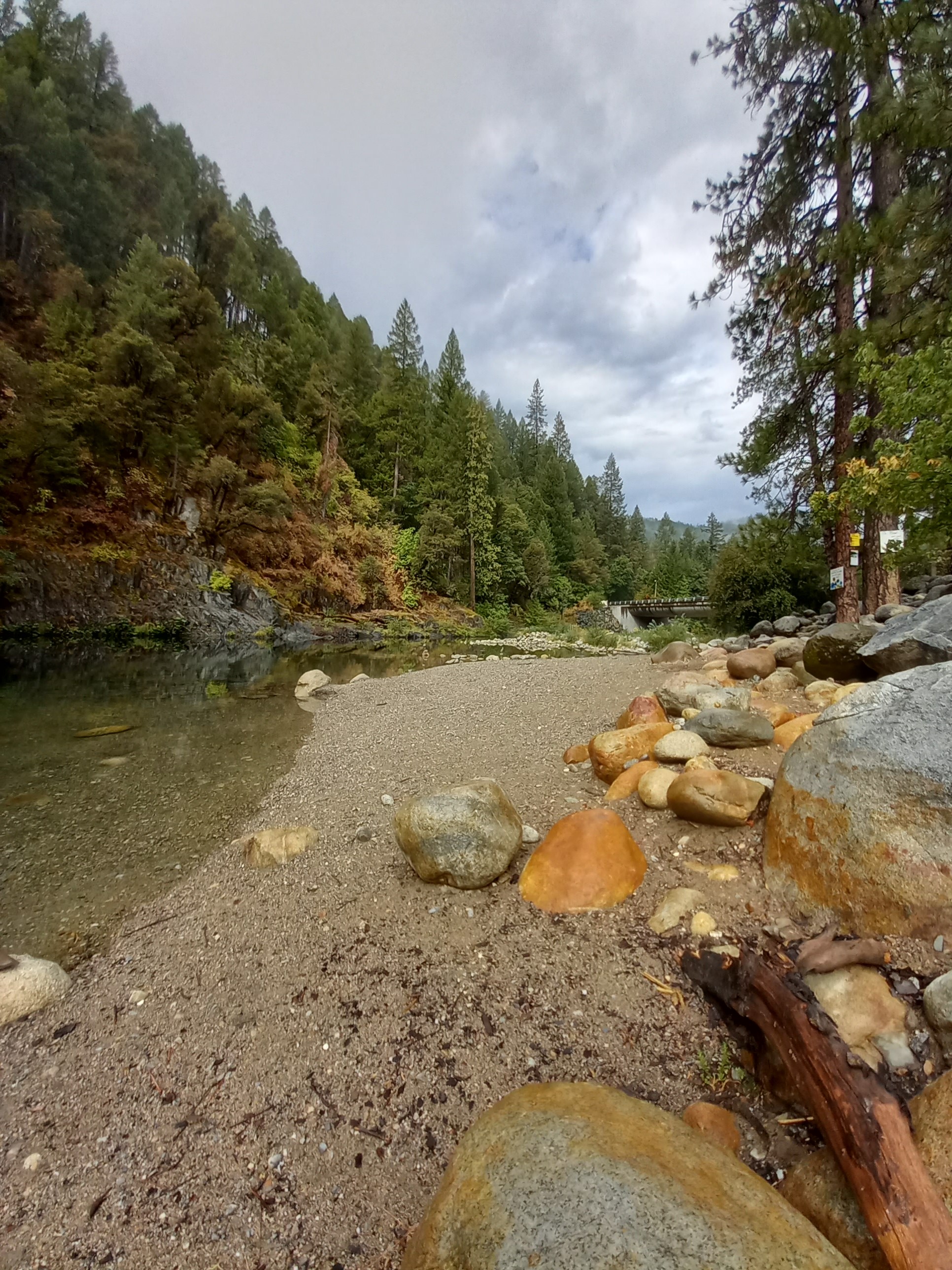
Twelve years earlier I’d been out half-heartedly promoting a record and had stumbled across a few gypsies beneath the bridge, having a jam session with a guitar and bongo.  My harmonica had been the special sauce back then.  Now I was alone, waiting for the rain to stop.  In a few minutes it did.  I got out and walked down to the river.  There I came upon a scene, serene beyond compare.  The shallow river reflected the green pines.  The sky above, temporarily all cried out, swirled like a blue and grey river above.  Someone had balanced rocks in the water like a Zen Garden.  Stray drops of rain plopped into the river like temple bells.

I sat down on a wet stone and gathered my legs beneath me.  A few birds were chirping.  A crow was cawing.  Outside of that there were only the few drops of rain that still fell.  If I was going to have a breakthrough, this was the place to do it.  Rain falling into a river.  Wasn’t that eternity in a nutshell?  Whatever was behind me was behind me now.  Where I’d sleep that night, I couldn’t know.  Until I arrived, nothing was real. 

Still, I struggled to make it through my breath cycle.  All I wanted was to drive.  As soon as I’d let out the last breath, I clasped my hands in a show of gratitude, then staggered towards the car, throwing the door open and leaping in, like the law was on my trail. 

In town, I passed the old miner and his dog.  They were almost in the same place I’d left them.  The town itself had almost escaped time.  That wasn’t happening to me.  Surging back uphill, the rain clouds parted.  Highway 20 came up fast.  I turned right and sped back towards the valley, the road ahead of me as wide open as the range in a cowboy song.

pages fly away 6

Rough and Ready is named for the 12th president of the United States, Zachary Taylor.  Established as a mining camp by a group from Wisconsin, they seceded from the Union in 1851 to avoid paying taxes.  That didn’t last long.  Driving through on my way back to Yuba City, I discovered that pioneer town, with a blacksmith shop, saloon, and post office.  On the other side of the road was a facsimile of the mine, complete with railroad tracks, a few carts, and a dummy standing behind the gate.  A wagon next to it advertised cemetery rides for only a dollar each way.

Arriving in Yuba City brought me right back to the here and now.  Fast food restaurants as far as the eye could see.  I stopped at Burger King for lunch and drove past the parking lot where I’d been tested for my class A license twenty-five years earlier.  I went looking for the plant where I’d worked.  It was now a Walmart.  The farmhouse across from it where we’d bunked had been razed.  Even the country music bar at the end of Harter Road, where the band had included a pedal steel player was gone, now a barber shop.

Most everything had changed except for the Sutter Buttes.  The Sutter Buttes, just outside of Yuba City, are sometimes called the smallest mountain range in the world.  The Native Americans had known them as the Middle, or Spirit Mountains.  With red radio towers blinking atop of them, at night you can see them from miles, in every direction.  Although they’re private property, I used to park my truck at the base during a night shift and stumble to the top, just for the thrill of feeling alive.  Now, in broad daylight, they resembled little more than yellow mounds.

Williams was the place I’d first been stationed when I got hired to drive trucks.  At the time it was designed to be the biggest tomato processing plant in the world.  Without all the kinks out of the system, they’d brought in a hundred of us drivers, only to hurry up and wait.  We were housed in trailers and ready to work, but the conveyors weren’t synching up right.  Since all we were getting was commission on the loads we hauled in, they had to promise us a stipend to get us to stay.  In the meantime, we hit up all the bars in town, and spent long afternoons throwing rocks at beer cans floating in an irrigation canal.

Those three years driving a tomato truck had been OK.  At the end of the season, we got laid off, so were able to qualify for unemployment.  There’d been a lot of time to sit out in a field beneath the stars and write songs.  After the second year, I’d saved up enough to make my first record.  It wasn’t something you wanted to do for the rest of your life, but at the time it had served a purpose.

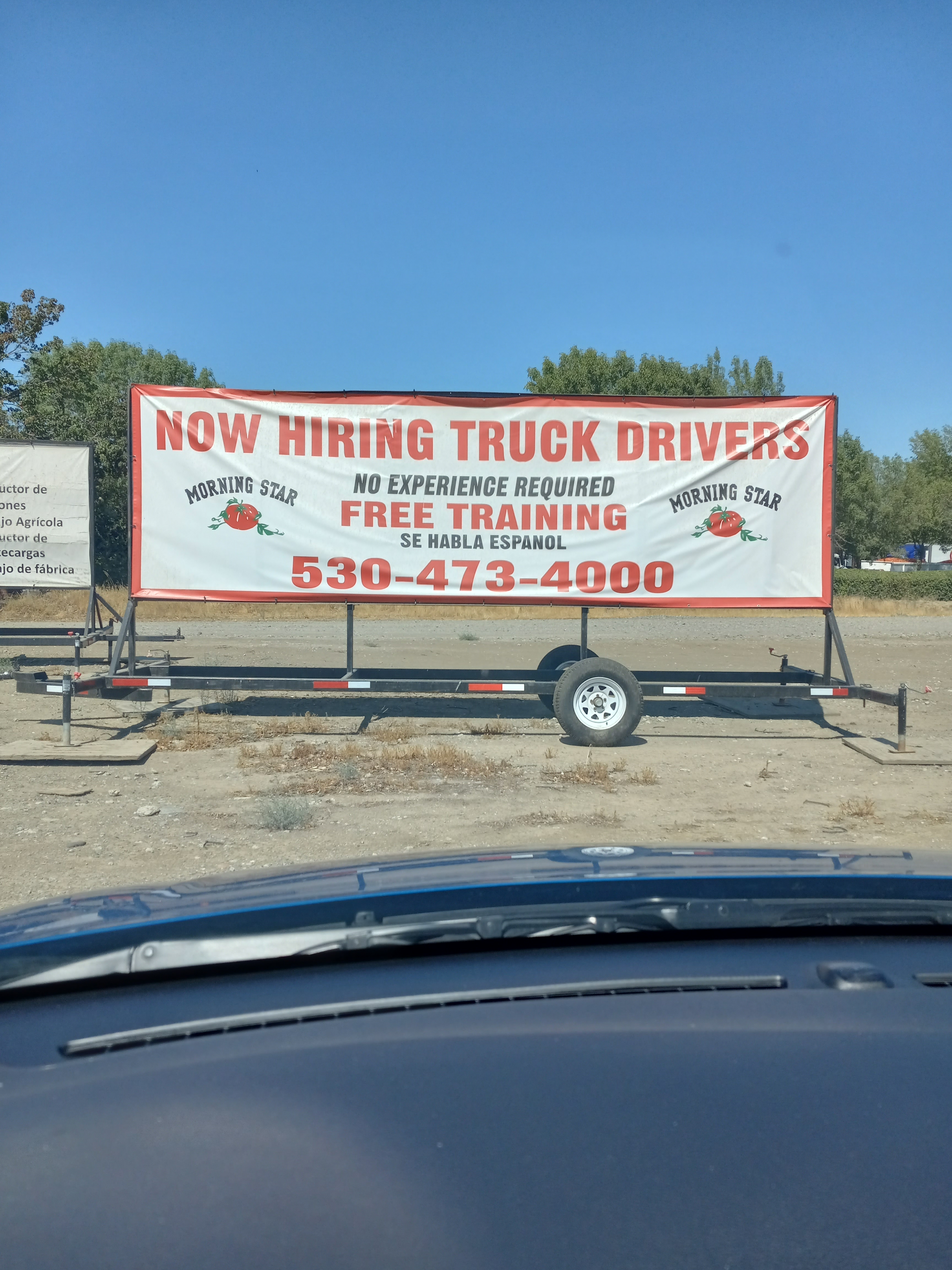
Pulling up in front of the Morning Star plant, I was surprised to see that the season was still going on.  Trucks were lined up at the scales outside, the drivers anxious to drop their loads and get out into the fields for more.  I saw that they were still hiring.  It had just been a lucky break that had brought me there years ago, meeting a driver in Guatemala, who’d claimed to have saved ten grand in the course of one summer.  I’d returned to California with his name and that of the company written on the back of a notebook.  One mention of his name, and I was in, although I never did work with him.

Those had been impossibly long, dreary, dreamy shifts.  Getting in a truck at six at night and finishing at ten in the morning.  I saw every sunset during those years, every phase of the moon, every formation of the summer stars.  There were times on a long run down to the Delta where I’d almost fall asleep at three in the morning and have to pull over.  A state of lucid dreaming would fall over the world.  In the morning, white cranes would rise up out of wetlands.  The sun would begin infiltrating the earth again.  In a few hours it would be as dry and dusty as an atomic blast site. 

Now I sat and watched the young drivers waiting their turns.  A white crane stood beside an irrigation ditch, staring me down.  I briefly thought about taking down their number and giving them a call.  After all these years, I was unemployed once more.  I no longer had my commercial license, however, and it wouldn’t be the same, even if I did.  The fact is that most of the job had been an excruciating drag, and all it would take to remember that is to climb back into a cab. 

All the promise of that situation had been extracted years earlier, just as most of the gold had been tapped from the mines.  The only option was move forward, even if that meant no longer knowing where to go.  So that’s what I did.

pages fly away 7

Clear Lake is the largest lake in California and one of the oldest lakes in North America.  I’d been there a handful of times in my life, once on a fishing trip with my father.  Another time I’d been given a three hour wait time while driving truck and had dropped my trailers in a field and set off for Clear Lake in the middle of the night driving bobtail.  It had been an impulsive gesture, one that I began to regret the further I got from Williams. 

All in all, it was an eighty-mile roundtrip drive, and if someone would’ve known that the truck was AWOL, losing my job would have been the least of my worries.  By the time I reached the lake I was panicking, and just hightailed it straight back to the field, not even bragging to my closest friends about my midnight run.

Now I was back on the road to Clear Lake again, but this time in the middle of a beautiful sunny day, driving a zippy blue Kia that I’d dubbed the Mountain Bluebird.  For a day that had started out cloudy and rainy, things had cleared up dramatically.  The sun was shining through the windshield, like a white hole, cut out of blue sky, and little wisps of cloud drifted over the hills. 

When I got to the town of Clearlake, it was different than what I remembered.  I searched for a campsite on Google Maps and just followed where the woman led me, not beginning to question her directions until I’d already traveled ten miles along the southern shore.  At that point I needed to double check to make sure I wasn’t being led on a wild goose chase.  The lake was way larger than I’d imagined.

At Clear Lake State Park there were four campgrounds to choose from.  Thank God, I didn’t need to have reservations to camp there.  The woman at the booth told me to drive in and pick out a site, then return to let her know what I’d chosen.  All the spots were taken at the Upper Bay Campground, which came as little surprise since they were perched on a steep cliff, and the view of the lake rivaled one of the Mediterranean Sea.  I drove through the Lower Bay Campground and most of the good sites were taken there as well. 

Finally, I came to the Kelsey Creek Campground, and that was nice too, within walking distance of the lake.  I drove back and told the attendant the site I’d chosen, number 46, and she gave me a receipt to clip to the post.

I’d just set up camp and was getting ready to drive down to the beach, when the attendant came rushing up in a white truck with a hesitant look on her face.  The site I’d paid for had already been reserved by someone else.  Would I mind terribly?  No.  That was OK.  I’d given up on the tent pegs, relying solely on the sleeping gear inside it to weigh the tent down.  It was a simple matter to pick it up and carry it over to an adjacent site.  Within a few minutes, I’d made the transfer.

It was a sunny day, warm and without a breeze, but I had no idea what to expect from the lake.  It turned out the water was lukewarm, but I needed to wade out far from the shore, through gooey black mud, to arrive at any depth.  The swimming area was sectioned off with a rope.  The only thing swimming in it was a few ducks.  A guy in an inflatable kayak was fishing just beyond it. 

To get to the deep water I needed to go past the rope.  When it was finally overhead, I thrust upwards with my arms to propel my feet to the bottom.  The same black mud was now cooler and squished between my toes.  I did somersaults underwater and watched the light in front of my closed eyes go from yellow to green to black. 

When I got out, I dried off and changed and then took my ukelele to a picnic table.  There were two teenage Asian girls at another picnic table, busy on their phones.   I’d come up with a song idea driving through the Sequoia Park, meant to be a theme song for the trip.  It was called The Ballad of the Mountain Bluebird.  Just as the Lone Ranger had Silver, and Zorro had Tornado, I’d found a true ally and friend in the blue Kia, one I would’ve been unable to embark on my journey without.

The next morning, I got up and followed a nature trail down to the same beach.  A turkey vulture sat in one tree.  Two great egrets were in another.  There was a fallen log on the shore that I sat down on.  The sky was already clear and blue.  There were a few fishing boats off in the distance.  From somewhere I could hear the honking of geese.  I closed my eyes and took a few deep breaths.  What I’d been doing wasn’t meditation as much as fighting to just sit still.  Still, I’d taken a vow to make time for it at least once every day that I was off on this unchartered driving trip.

The sound of a plane occupied most of the space in my head, and then gradually faded to a hum.  The excited voices of children came from the camp.  Songbirds were singing.  A gray squirrel scampered through the branches of a tree.  The lake splashed softly on the shore.

Three loud women came down the trail, walking their dogs.  One pointed out a few pelicans I hadn’t noticed.  She told the others how the lake had been flooded only a few years earlier.  It had been affected by drought since then and had badly receded.  A friend of theirs was moving in with her boyfriend after five years.  They all had their opinions about him.  Right behind them came two old guys who didn’t like the San Franciso Giants’ new uniforms.  According to one of them, they looked like they’d been spray-painted on.

My mind wasn’t clearing.  I was just listening and thinking.  Now I remembered fishing at the lake with my father years earlier.  I believe he’d driven me up to Williams to drop me off at my truck driving job.  Clear Lake was like the Midwest lakes we were accustomed to, with the same kind of fish: bass, bluegills, crappies, bullheads, carp.  Renting the poles had been my father’s idea.  We’d gotten a bucket of minnows and a carton of worms.  Fishing was something we’d always bonded over.  It was easier than talking.  We just fished from the shore and never caught anything.  The wind and waves had picked up and it was hard to really say what was happening with the bobbers.  It wasn’t the nibbling of fish that was causing them to sink.

A man came up behind me with a pug dog.  He threw a stick for it to fetch, and the little dog went wheezing after it.  I was wrapping up my breathing cycle, eleven sets of eleven deep breaths, and had gotten to my closing prayers.  A loud honking came from directly overhead and some shadows fell over the earth.  It was a flock of Canadian geese, flying in formation, heading out over the lake.  A minute later, here came another flock, in a tight V, following their leader. 

A woman came down to join the man with the pug dog.  All she noticed was the stink.  The lake was too smelly, she said.  It smelled like a cesspool.  True, but there was more to it than just that.  Two boats were drifting off on the horizon.  It was time to head back to camp and hit the road.

pages fly away 8

From Clear Lake State Park, I took Soda Lake Road to the 29 and then followed that north until it met up with the 20.  Just past Blue Lakes, beyond a bison ranch, with a small herd of buffalo grazing out front, it turned into the 101.  In Willits, I stopped at a Dinosaur gas station and filled the tank with gas, and also got a turkey sandwich and large coffee.  The Mountain Bluebird had been getting great mileage so far, and even filling three quarters of a tank only set me back thirty dollars.  I was getting into Redwood country.

Just outside on Laytonville I came upon the first of many unusual attractions that line the Redwood Highway.  It was called Area 101, and I wasn’t sure what it was supposed to be, perhaps a New Age amusement park or marijuana dispensary.  The sign showed a spaceship beaming down hearts.  There were statues of Buddha, Jesus, Mother Mary, Saint Jude, Ganesh, and an Eastern Island head, or Moai.  Paintings depicted multi-limb goddesses, mountains and streams, penetrating eyes, all that hippy-dippy stuff I know so well, being something of a latter-day hippy.

Next up were some more conventional curiosities; redwood carvings of loggers and bears, an eagle, and Indian chief, a tree house built out of the stump of an old redwood.  Then it was Confusion Hill.  Signs start appearing miles before you reach it.  Mystery.  Fun.  Is Seeing Believing?  The Mountain Train Ride.  The Gravity House.  I stopped and took a picture of the world’s largest redwood sculpture carved from a chain saw, bears standing back-to-back, six of them in total, three stories high.  Then I got a drumstick from the snack bar and went to see the Shoe House.

Just south of Garberville was another attraction, opposite the south fork of the Eel River.  This was the Legend of Big Foot.  The first footprints of Big Foot, the elusive ape-like creature reported to stalk the deep forests of North America, were captured in plaster casts in Humbolt by a logger in 1958 and measured sixteen inches long.  From there, the stories spread.  At the Legend of Bigfoot, the depictions of Bigfoot, or the Sasquatch, ranged from those of an upright ape to something that resembled a hostile, bushy-eyebrowed caveman.

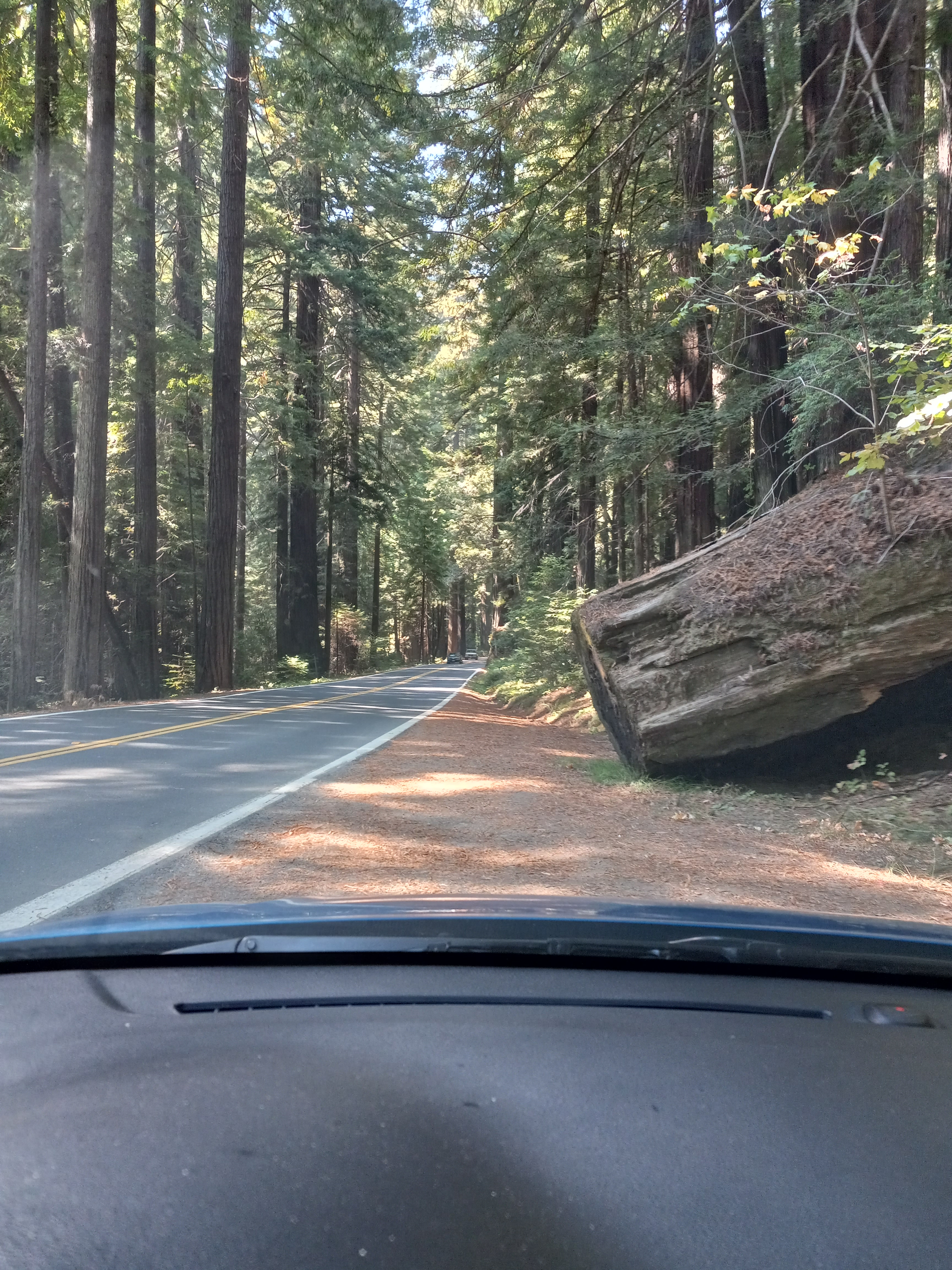
A few miles down the road, right around Phillipsville, I got on State Route 254, or the Avenue of Giants.  Redwoods are the tallest trees in the world, sometimes reaching up to four hundred feet.  They have less girth than their cousins, the Sequoias, and slightly shorter life spans.  The Avenue of the Giants runs through the Humboldt Redwood State Park, a small road that winds like a river through a tunnel of these ancient trees. 

The sun was high above as I went snaking through the forest.  Sometimes it got tangled up and lost in the branches.  Then there’d be a gap, and light would come streaming through, like a rogue beam reaching the bottom of the ocean.  At one straightaway, I happened upon the Immortal Tree.  It’s a thousand years old, had once been three hundred feet tall, and had survived floods, forest fires, a lightning strike, and the loggers’ axe. 

It was scenes like the ones I was seeing that had inspired me to move up to Humboldt County in my late twenties, not knowing a soul.  There was a fantasy I was chasing about getting back to the land, finding a hippy girlfriend, starting a band.  I’d driven up to Arcata and camped on Clam Beach for a week before finding a cheap apartment on the grounds of the university.  I’d signed up for a few classes, prerequisites for a teaching degree, and then went on to endure one of the rainiest, coldest, most depressing seasons of my life.  It had felt like I was a sea captain at a school for cadets.  I’d wandered through the redwoods alone and only managed to score a few gigs, before moving on.

Before reaching Arcata, I had to pass through Eureka.  A port city and lumber town, the many Victorian mansions still standing bear witness to a time of great prosperity.  Driving through on the 101, however, you get the impression of a town with a rough edge, fast food restaurants, rampant homeless, and an underlying drug crisis that gives off a sinister vibe.  It was the same thing I’d discovered living in the region years earlier, freedom turned to anarchy, recreational drug use yielding to psychosis.  A shirtless man was lying beside the road, face down.

At Arcata, I pulled off at Humboldt University and went looking for my old apartment, in the dungeon, or basement side of campus apartments, not far from the library.  I’d drank a lot and suffered from loneliness during those rainy months.  There was the apartment now, just one room, a sliding glass door, and a bathroom.  The sites where hard times went down are sometimes the best to revisit.   Don’t say I didn’t pay my dues, you get to say.

In the town plaza I found the same assortment of freedom fighters and lunatics, still holding their ground, sitting in a big circle, banging on drums.  Half of them were students from affluent suburbs, diving deep into alternative living, letting their freak flags fly.  The others were the resident aliens, those who’d gone so far into the lifestyle that they couldn’t return from it, many of them homeless, camping in the area, getting a buzz on while the sun was shining.  They traded stories for hits from a pipe, credibility for shots from a bottle.  I was just like them, a grizzled old-timer, banged up badly by life, needing just one bright moment a day, someone to listen to my story, to keep me afloat.

I walked around, looking into the bars, the Alibi Room, Everett’s, the Jambalaya, where I’d finally worked my way up to hosting an open mic, before leaving town to drive a truck and raise money for my first record.  That day I’d played my new song, Ghost on the Roam, and the room had gotten silent, maybe for the first time ever.  A breakthrough had occurred in the form of a break down, but when it was all over, what were left were memories and songs, like jewels in the bag of life.