Category Archives: Travels

pages fly away 16

The Grand Coulee Dam, completed between 1933 and 1942, stands at 550 feet and is one of the largest power stations in the United States.  It also provides irrigation for nearly 700,000 acres. 

If I knew anything about the dam before visiting, it was that Woodie Guthrie had once been commissioned by the Department of the Interior to write songs about the Colombia River and the construction of the dams.  He wrote twenty-six songs, but then the film that they were to be a part of got postponed because of World War II and didn’t come out until 1949.  The songs eventually made it on an album called Colombia River Ballads.

It was still dark when I broke down camp at the Spring Canyon Campground and loaded up the car.  By now I had it down to an art.  It was guerilla camping at its finest, in and out with hardly a trace.

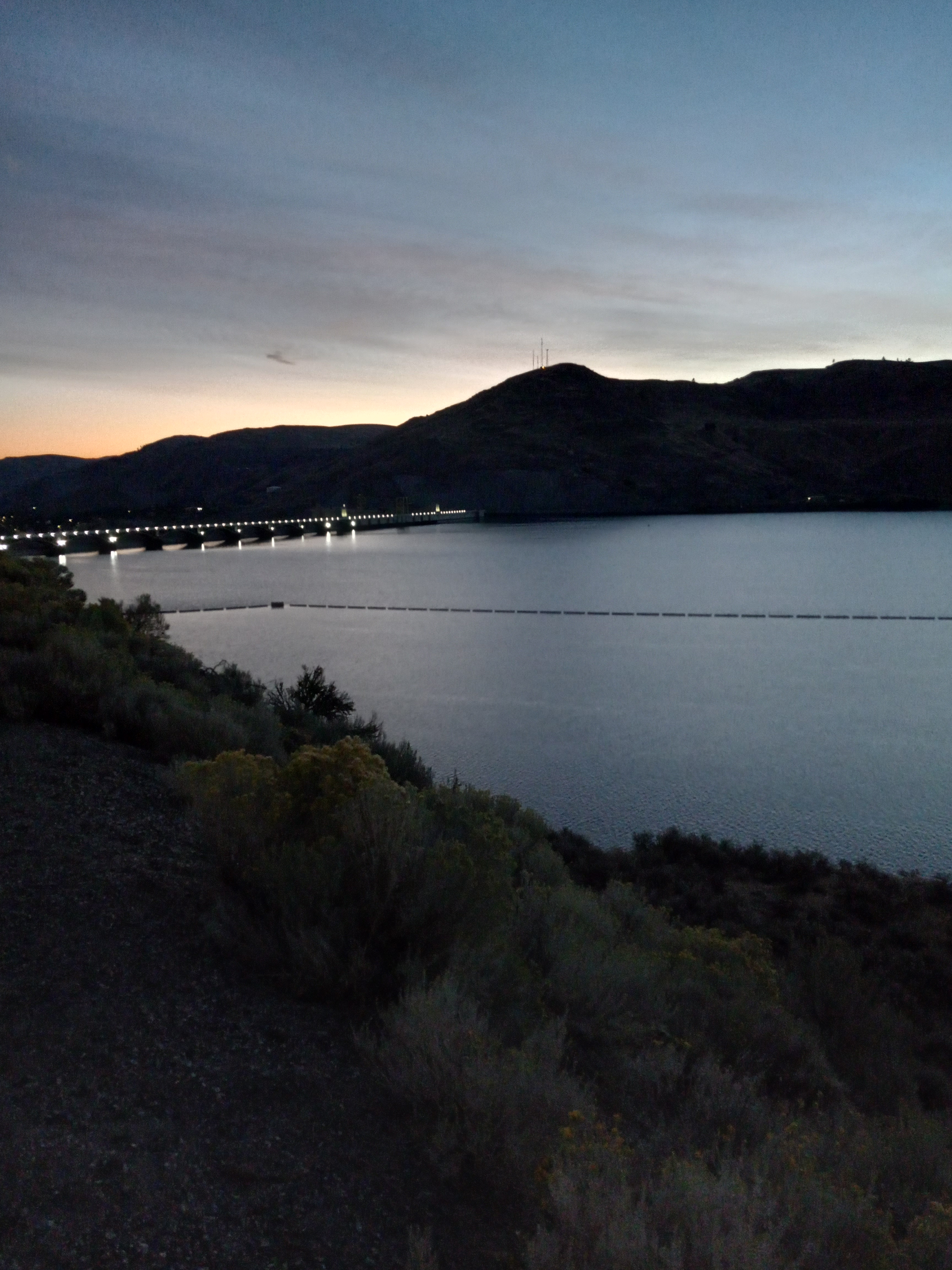
Before hitting the road, I wanted to go sit and meditate beside the dam.  I pulled up at an overlook beside the visitor center and sat down on a rock.  The faintest light of day was just showing behind the eastern hills.  It was cold, and though the wind had died down some, it was still gusty.  I went back and sat in the car, looking down at the lights of the dam, the ropes and buoys stretched across the surface of the water.  The window was down, and I could hear the cry of waterbirds below.

There was no one else out.  The awakening day was mine alone.  The light gradually grew brighter.  Ripples spread across the water.  In that grand setting, I sat and obsessed about the idiocy of requiring reservations for camping.  All night I’d lay there paranoid, the tent being battered by the wind, thinking I could hear the engine of a vehicle idling, imagining I could hear footsteps approaching my camp. 

What if there was a hidden camera set up somewhere?  Could they have gotten my license plate number?  Would they send a bill, and possibly a fine, to the rental agency?  Now I started worrying about the rental agency.   What did they really mean by unlimited mileage?  Was I even allowed to take the car out of state?  I was sure that they were tracking me.  In this day and age, how could they not be?

I sat there and worried until the sun came up.  Did sitting in a car worrying count as meditation?  If so, then perhaps I belonged to the most spiritually evolved nation that has ever existed.  All those millions of people sitting in their cars and worrying.  But were they counting their breaths?  Maybe, yes.  Maybe, no.  I was sitting in a car and worrying, but I was also counting my breaths.  That had to stand for something.

At one point I opened my eyes and simply drove off.  If I couldn’t conquer my energy, I could at least harness it.  There were days and miles ahead of me.  I simply had to get going.

The sky that had begun to brighten returned to slate.  I got on the 174 and then headed east on the 2 at Wilbur.  The land was barren and flat.  The highway stretched on endlessly.  I wasn’t sure where I was going.  From the looks of it, that would be Idaho.  I passed small farm towns with silos and grain elevators.  One bar with a painted cowboy outside promised live music and dancing.  I passed the Spokane Tribe Casino, and figured I’d stop in Spokane.  Instead, I just kept driving, seeing that Coeur d’ Alene was only thirty miles away.

Two reservations that I could get to that day were the Cour d’ Alene one and the Nez Perce one, both in Idaho.  I thought I might drive down to the Snake River and Boise after that.  I really had no idea. 

From the city of Cour d’ Alene I got on the 95 south, briefly pulling over at the Cour d’ Alene casino.  As someone without the means or inclination to gamble, I’ve never been interested in casinos.  So far, every reservation I’d passed through had one, so they must be doing some good, or at least somebody is prospering.  A statue of a warrior on horseback, in full headdress, raising a stick to the sky, sat atop a small waterfall, and welcomed visitors to this one.  Driving through the parking lot, I passed cutouts of a buffalo and a moose.

The sky had turned blue by now and white, puffy clouds drifted across it like grazing sheep.  I continued on my merry, frazzled way, until pulling over for gas in Plummer at the Warpath One Stop.  Everything here had a native theme.  Two buffalos stood at the door.  The ad for Seneca Cigarettes featured an Indian head.  There was a trading post selling regalia and supplies.  By the side of the store there was an old totem pole.

Cour d’ Alene, translated from French means heart of the awl.  An awl is a sharp tool used to punch holes through leather.  The name was bestowed upon the people by a French trapper who considered them the sharpest traders he’d ever met.  The reservation was established in 1873. 

Driving on through town, I passed the Tribal Police and then stopped at Benewah Plaza to pick up some groceries for the road.  Atop the sign for the plaza was a cutout of two dancers.  Granted, I’m no expert, but it looked to me like at least one of them was doing the Prairie Chicken Dance.
pages fly away 17

While it had been cold and overcast outside of Spokane, while traveling down the 95 through Idaho, it actually started getting hot, up to eighty degrees.  I thought I’d probably drive to Boise, but then saw that it was over three hundred miles to get there.  The other option was to get on the 12 once I reached the Nez Perce Reservation and head towards Missoula and the Flathead Reservation in Montana.  Up until the very last second, I didn’t know what I’d do, but once I reached the Lewistown Lookout, with a view of the first capital of Idaho, along with all the hills and Clearwater River below, I instinctively followed the river east and got on the 12.

Nez Perce means pierced nose, a name bestowed on them by the French, perhaps erroneously, as it better described the Chinook tribe.  The Nez Perce call themselves the Nimiipuu, or the People.  Although their ancestral territory is in Oregon, a treaty in 1863, that came to be known as the Steal Treaty, saw them relocated to reservations in Idaho, Washington, and Oklahoma.  The privatization of the reservations yielded subsequent losses, so that today a majority of the occupants of the reservation in Idaho are non-Natives.

As I drove along the Clearwater River, I pulled over at an archaeological site, that of a Nez Perce Village where pit houses were discovered that date back at least five thousand years.  A few miles from there I came across a signpost telling the legend of Coyote’s Fishnet.  Exasperated by nosy Black Bear, Coyote threw his fishing net upon one mountain, then turned Black Bear to stone, and cast him upon another.  They became landmarks that natives can easily identify.  Coyote also used the same magic powers to turn a quarreling ant and yellowjacket into a stone arch.  I read about that legend a few miles down the road.

It had been a week of manic driving and I was starting to crack a bit.  I’d started the day off by worrying, and was falling into a depression, beginning to fret about everything, even though the road I was on at the moment, running parallel to the river, with a sky up above, stacked with white clouds, was like something out of a vision.  I knew I was tired and kept reminding myself that was why.  It would be a good day to find a campground earlier than later and try to catch up on some sleep.

After driving about an hour, I came across a town called Kooskia.  A mural on the side of a bar proclaimed into to be the Gateway to the Wilderness and pictured Bigfoot stepping around the corner.  I was so tired at that point I thought of looking for a hotel, but instead filled up with gas, got a microwave cheeseburger, and kept driving.

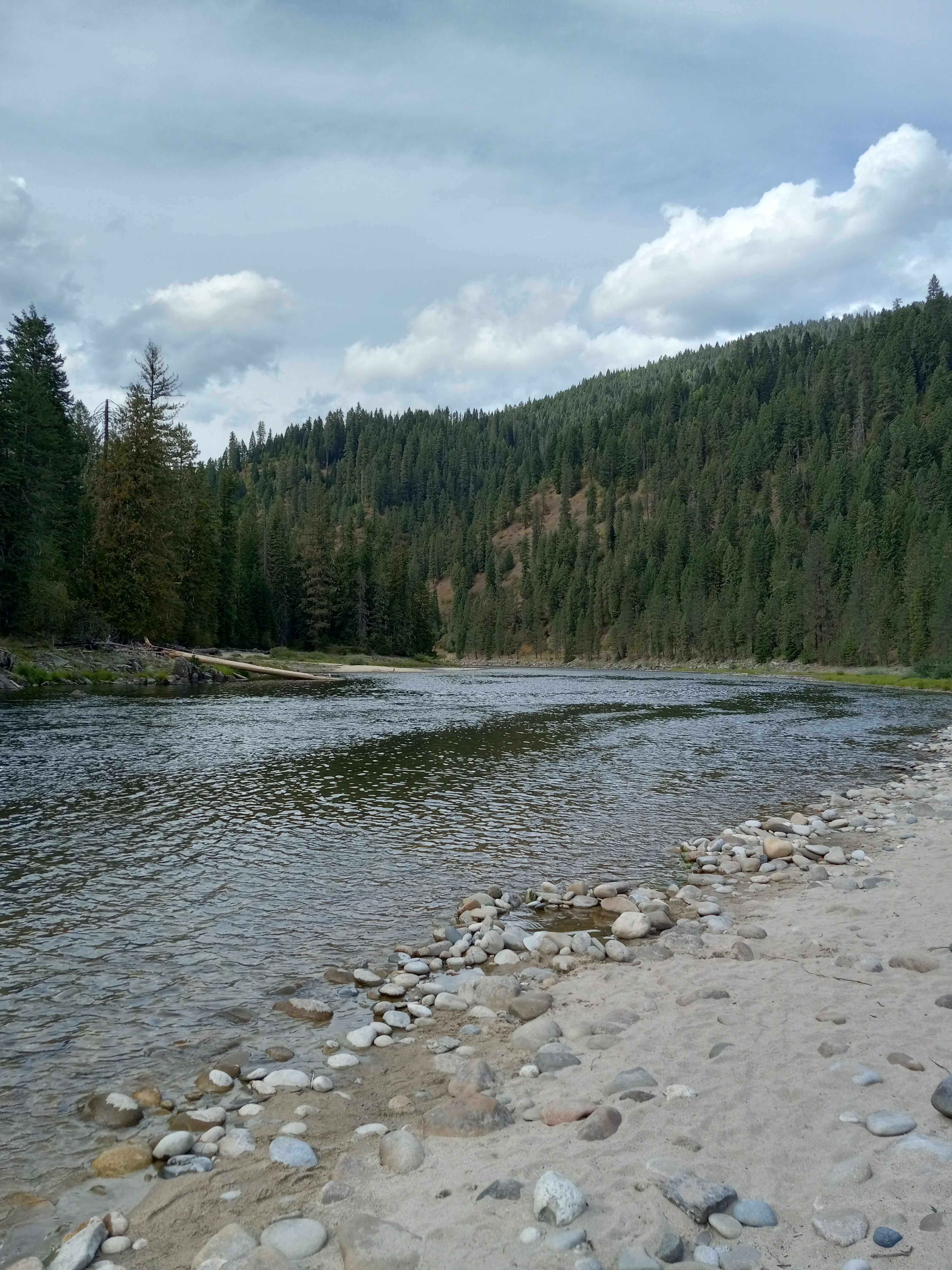
Just a few miles down the road, there was a bridge that crossed the river and an arrow pointing to a campground.  I crossed the bridge and ended up driving a long way down a dirt road to reach it.  It was a good thing that I did, as it was nearly perfect, with many open spots beside the bank.  No reservations required.  It was the good old-fashioned camping that I was used to, grabbing an envelope from the registration site, filling it out, stuffing the money inside, not much money either, maybe ten or fifteen bucks, then sticking the tab on the post to let people know the spot was taken.

It was perfect camping weather.  Not too hot and not too cold yet.  The only problem was the flies.  I went to sit on the picnic table and play ukelele and they attacked me.  If I would’ve tried meditating, they would’ve carried me off.  It was too early to zip myself up in the tent.  I sought cover in the river, changing into shorts and hobbling over the stones to get to it.  It was ice cold, but incredible.  I hadn’t bathed in a week.  The stink that came off me stopped the flies in their tracks.  The water was shallow where I was at.  I lay on my belly and pushed myself towards the small rapids with my hands.  Then I was off zooming forward, plunging headfirst into a waist-high pool. 

A little of that went a long way.  I got out freezing, with a big ice cream headache, and walked like a mime stepping on glass.  It took about ten minutes to get back to the car.  After changing back into my clothes, I went back to my ukelele trance.  Either the flies had learned their lesson, or I was just too blissed-out to care.

pages fly away 18

There were about six hours where I slept soundly, from about nine until three.  My mind was clear and sharp when I awoke.  I sat up in a cross-legged position and pulled my blankets over my shoulders.  The meditation I’d been practicing so far had been an honest attempt, mostly just sitting there thinking, trying to corral my thoughts and focus on my breathing.  The day before I’d just sat there worrying.  Now I closed my eyes and listened.  There was the sound of the river and the quiet chirping of a few crickets.  It was a moment that wasn’t hard to stay in.  I could almost see the river, shining in my mind.

When I finished my breathing cycle and said the last of my prayers, I stumbled out of the tent and could hardly believe what I saw.  The stars in the sky were so close it was like looking at a city of lights.  There was Orion.  Betelgeuse.  Bellatrix.  Rigel.  Beyond it, the Pleiades, magnified and throbbing.  The light of a satellite crossed the sky.  It seemed to be the size of a dime.  I was awake in body and awake in mind.  The connection between all living things had never seemed so clear, all pulsating cells in one great body.

In the darkness of early morning, I loaded up the car and got on the road.  It was three hours to Missoula.  By the time I arrived there it was still early.  My destination was the Flathead Indian Reservation.  It wasn’t far.  I took the 90 east to the 94 and then ran into some extensive roadwork that slowed things down considerably. 

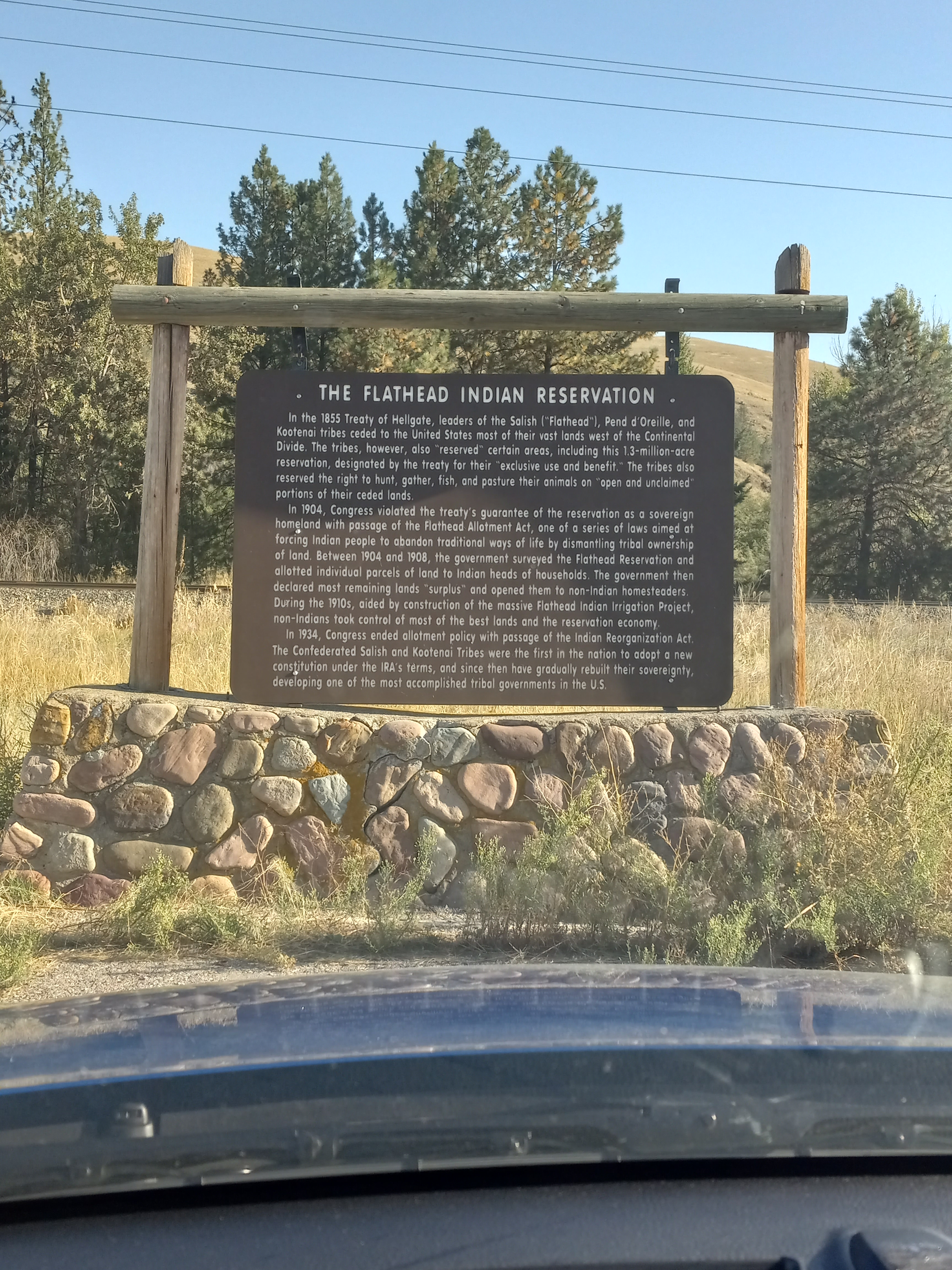
The Flathead Indian Reservation is home to the Confederated Salish and Kootenai Tribes of the Flathead Nation.  Although cranial deformation was practiced by some of the tribes at the time, the Flatheads were given their name because they didn’t compress their skulls into the peaks that some of their neighbors did.  Still, it is a curious name to bear, bound to conjure up some strange conceptions.

The reservation was established in 1855 when the Treaty of Hellgate was signed.  It occupies two thousand square miles, with only nine thousand of the population of nearly 30,000 identifying as Native American.  Like what had happened with the Nez Perce, this came about when the government began allotting lands to individuals instead of keeping the holdings communal.  Like the other reservations I’d driven through, there weren’t many obvious signs I was even on one, just ordinary houses and businesses, the land looking roughly the same as it did outside the borders.

On the Flathead Reservation what I was interested in seeing the most was the National Bison Range.  The American Bison, or Buffalo, once ranged from Alaska to Mexico, Nevada to the Appalachians, with numbers in the countless millions.  By 1889 they were almost extinct, down to five hundred animals, hunted by traders and settlers, often just shot for sport, and also systemically slaughtered by the U.S. Army as a strategy to strip the Native Americans of their greatest resource.  The tribes depended on the buffalo for physical and spiritual sustenance, and were lost without them, left starving and demoralized, without the vital magic needed to infuse their ceremonies or lift their morale.

To reach the Bison Range, I took highway 200 west and then got on the 212.  I could see a few bison on the side of a hill leading up to the entrance.  When I pulled into it, a man with a limp was walking towards a van.  He got in, just as I was passing, and followed me up to the parking lot, where a tribal flag was flying beneath an American one.  I went in and looked around.  There was a stuffed buffalo on a small, artificial terrain.  On a wall were the mounted heads of an elk and a deer.  Another wall had a medicine wheel that had been quartered into the four seasons. 

It was ten dollars to visit the range, which I was happy to pay.  The attendant then explained that the tour was a three-hour drive and could only be driven in one direction.  I asked what other animals I might see.  She said there were deer, pronghorn, and an area with blackberry bushes where some bears had been spotted.  Three hours sounded awful long.  My next stop was Yellowstone, and I was spending most of my time in the car as it was.

I went out and got in the car.  As I drove towards the wildlife loop, the man in the van suddenly started it up and began driving right on my tail.  It felt like I was being followed.  I drove until the road became one way and suddenly pulled off.  It was too late for him to make an adjustment.  I saw him looking back over his shoulder, unable to turn, suddenly committed to a three-hour tour.  That made me laugh.  What was up with that guy?

pages fly away 19

It was over three hundred miles to Yellowstone.  The plan now, which only materialized after reaching the previous destination, was to try to make it there by early afternoon.  I’d left before sunrise to be at the Flathead Reservation, and now sped south, from Kicking Horse back to the 90-freeway heading east.  I’d been on all kinds of roads the past week, but few freeways.  Speed didn’t feel much of a factor on the freeway.  At one point I looked down and saw I was going ninety miles an hour, and other cars were still passing me.  It was like I was racing for my life.  If I couldn’t see all of America in six weeks, then I was screwed.

Montana is the Big Sky State people dream about.  Beyond the windshield that was all I saw, an enormous blue sky and white clouds, with an occasional snow-capped mountain leaning into the picture.  I sped past Bearmouth and Deer Lodge, then took the 359 at Cardwell to the 287 south at Harrison.  That road was a wilderness rollercoaster.  I barely slowed down from the freeway, riding each hump high, leaning into every curve.  By the time I got to Hebgen, or Earthquake, Lake, the muscles in my back were strained.  I had to get out of the car to take a look.

The lake was created in created in 1959 when an earthquake killed 28 people and caused millions of dollars in damage.  According to some survivors, it was the loudest noise they’d ever heard.  If the victims weren’t killed by the earthquake, which opened up a chasm in the earth, then they were done in by the landslide, and if that didn’t get them, they probably drowned in the resulting flood.  Houses, roads, bridges, and even large sections of forest were all destroyed.

I knew I was playing with fire, showing up at Yellowstone without a reservation.  That summer season some of the National Parks had started requiring reservations to get in.  I knew that getting a campground was out of the question, but not to even get in would’ve been a stunning blow.  As it was, my luck held out.  Fortune continued to ride on my shoulders, at least until that evening.

At the West Gate I presented my National Park Pass and it was met with a smile and free map.  I’d been to the park three or four times by now and was only interested in the southern passage, the one with the greatest concentration of geothermal activity, leading to Old Faithful.  Once I got into the park, I saw that the highway was jammed coming from the opposite direction and jammed up on the 89 heading north.  Going with the flow had served me well, so far.

Yellowstone is mostly located in Wyoming, but also extends into Montana and Idaho.  It was created in 1872, the first National Park in America.  It provides haven for 70,000 species of plants and trees, and animals which include wolves, coyotes, cougars, lynx, black bears, grizzly bears, bison, moose, mule deer, elk, pronghorn, mountain goats, and big horn sheep.  It is the Serengeti Plain of the Americas.  All of the geothermal activity in the park is due to the fact that it rests on a volcanic caldera that runs 37 by 18 miles, and 3 to 7 miles deep.  This gives rise to the many geysers, hot springs, mud pots, and fumaroles, or steam vents, that make it such a singular destination, as if it weren’t already special enough.

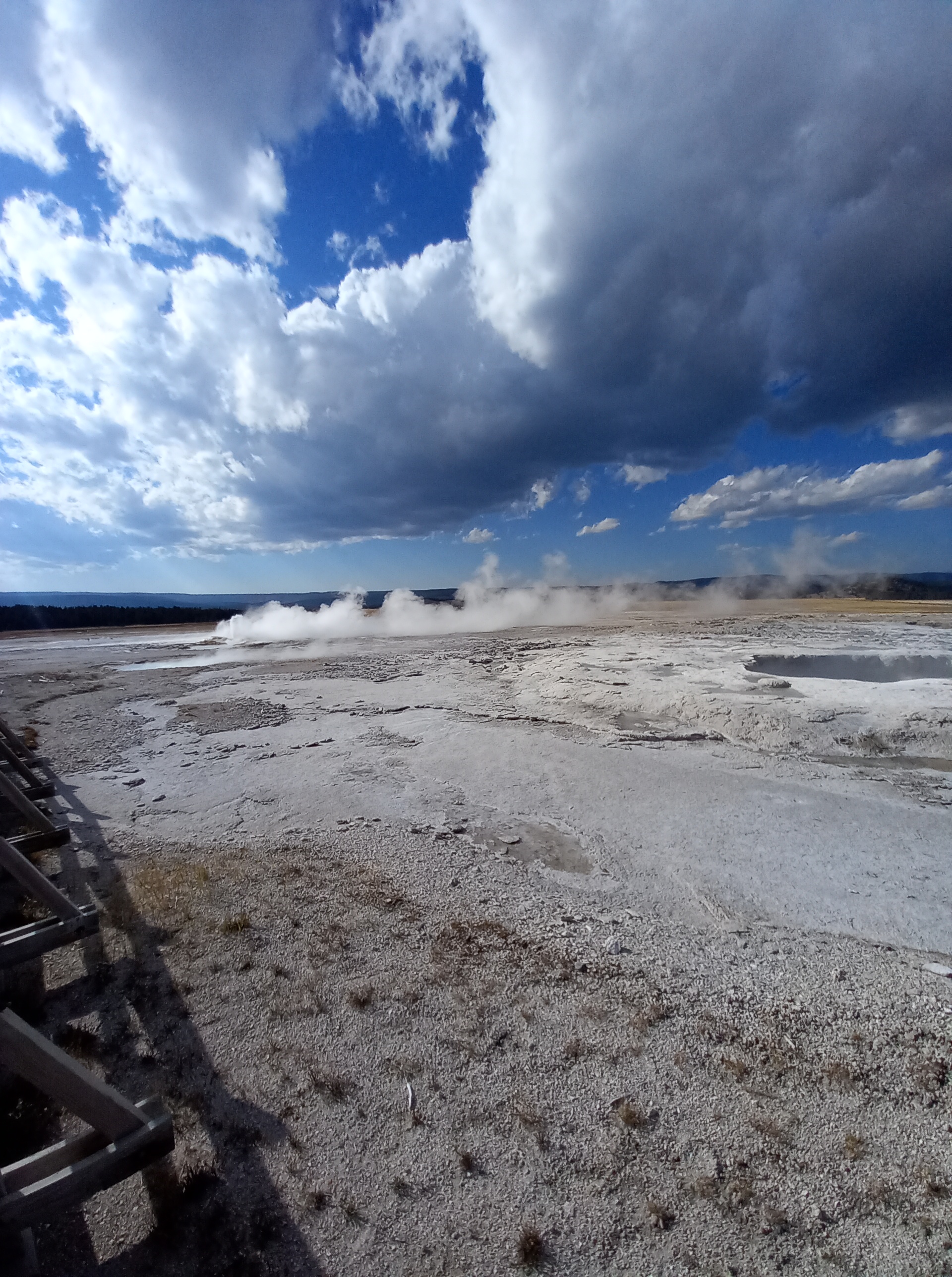
There were a lot of visitors when I pulled over at the Fountain Paint Pot Trail, but it could’ve been way worse.  There were still places to park and a little room to roam.  A sign at the entrance warns of boiling water and unstable ground.  It was like taking a Spirit Walk, no drugs or initiation necessary.  The landscape was that revelatory, a place where the sky and underworld meet, a collision of elements and minerals, danger, and shape-shifting vapors. 

I walked through a stretch of stripped trees, trapped in a chemical bath.  Ravines and fissures ruptured the earth, like a view of the desert from an airplane.  Beyond that, clouds of steam drifted beneath the great fortresses of white cloud rolling through the sky.

I reached the Celestine Pool, so very blue it sought to rival the sky.  To dive into it would mean being scalded alive, but what a way to go.  Across the way, a white mud pot gargled and belched.  Above it, the clouds had now turned blue.  My shadow, and that of the fence, fell across the walkway, the essence of a transitory moment.  I would go first.  The fence would go second.  The mud pots would outlast us all, but even they would meet a change.  What would last?  The earth?  The universe?  Not even those, not forever.

Down the road, was the Midway Geyser Basin.  Here I had to park beside the road and walk a long way back.  Crossing a bridge, I followed the walkway past the Excelsior Geyser Crater, on my way to investigate the largest hot spring in the park, the Grand Prismatic Spring.  The water on each side was shallow, acidic, and treacherous.  A dozen hats floated on it, blown off and never to be fetched.  In some areas the water reflected the sky like a mirror.  There were clouds above and clouds below.  Steam floated in between.  Other visitors, staggered along the boardwalk, took on ghostly attributes.  It was eternity, in the blink of an eye.

I’d already seen more than enough to justify my visit but couldn’t help stopping by the Old Faithful Inn to see if I could watch Old Faithful blow.  Since it erupts twenty times a day it seemed my chances were good.  Old Faithful is the biggest celebrity in the park.  If not the largest or oldest of the geysers, it is certainly the most famous, and that has something to do with its consistency.  At the Inn, they were predicting that it would blow within the next hour.  Although it was getting late, I could wait around for that.

In the cafeteria, I got a pulled pork sandwich and tonic water and returned to Old Faithful to get a seat up front.  A few hundred visitors were waiting.  A few times the geyser got a little active and faked everyone out, but then simmered down again and bubbled underground.  It wasn’t until I’d taken the last bite of my sandwich and put my garbage in a trash can that it went off.  Hurray, just like the 4th of July.  It shot a hundred feet in the air.  Everyone got to their feet.  A few people began to applaud.

As soon as it started going down again there was a mad rush for the parking lot.  It was like leaving a baseball game after a walk off homerun in the bottom of the 9th, a big celebration, but also a hassle to get out.  The sun was sinking quickly.  I needed to find a camping spot.  So far, I was eight for eight on finding some place to camp at the last second.  My luck was about to run out.

pages fly away 20

From the parking lot of the Old Faithful Inn to the Grand Teton National Park is a distance of about ninety miles.  To think that I could reach it was a stretch, but I knew I wouldn’t be able to camp at Yellowstone, seeing that I hadn’t made a reservation.  Old Faithful had just blown, and the traffic was horrible.  In a few minutes my mood went from elation to fury.

There were around twenty cars stopped in both lanes around the south exit, entirely blocking the road.  I hit the dashboard with both hands and craned my neck to see what the hold-up was.  It was a herd of elk crossing the road, taking their time, not shy at all about the tourists jumping out of their cars to take pictures.  Oh my God.  The sun had now set.  In less than an hour it would be totally dark.

I had had extremely good luck so far, using Google Maps to find campgrounds at the very last minute.  There were bound to be dozens of campgrounds outside the park, I reasoned, Yellowstone being one of the most popular campgrounds in the world.  I turned to my phone and found that I had lost service.  Curses.  There was no signal at all.  I couldn’t call anyone or use the internet.

The sky was still pink.  There was nothing to see besides the trees growing on both sides of the road.  No one else was in a hurry.  There was no way I was making it to the Grand Tetons, no matter how many cars I passed or how much I swore.  I was just going to have to just hunker down somewhere and wait it out.

All the campgrounds I passed were full.  My last chance was at Colter Bay Village, right beside Jackson Lake.  It was dark when I pulled up to the campground there.  It too, was all sold-out.  I drove down and sat in a parking lot beside the lake, wondering if I could just tilt my seat back and sleep there.  It was way too out in the open.  Someone was sure to come along and hassle me. 

Next, I went and parked in the parking lot of a lodge, crammed between two larger vehicles.  Someone was making the rounds on a golf cart, possibly checking license plates.  I got paranoid and bolted from there, not knowing where I was heading.

It was so dark by now I needed my headlights on bright.  For the first time on my trip. I was screwed and knew it.  I’d had to just pull over anywhere I could and wait for daylight.  One lot I happened across had signposts with information about the Tetons, and also a closed-down camper, that served as bear country headquarters.  No one else was parked in it.  I figured I’d take my chances.

It was one of the longest nights of my life.  Sitting in the car, driving around the country was one thing.  Sitting there trying to sleep, was another.  At one point, I tried to lock the car doors from the inside and the car alarm went off.  Nothing I did made it stop.  I was desperate, inconsolable, screaming at the top of the lungs.  Finally, I opened the car door, and it got quiet.  Then the car wouldn’t start.  The whole system seemed to be disabled.  Never had things gone from so good to so bad in such a short time.  I tried to calm myself down.  There had to be an explanation.  If there was, I never found it.  Just by fluke, I stepped out, locked and unlocked the doors a few times, and when I got back in, everything was back to normal.  That had been way too close for comfort.

That night it got freezing cold.  I put a blanket over my head and was buffeted by my own bad breath.  When I got out to take a piss, the stars were brilliantly shining overhead, on this night like cruel, sharp diamonds.  A few shooting stars streaked across the sky. 

At three o’clock in the morning, I started the car and turned on the heat.  A few hours later, I started to drive towards the Grand Tetons, figuring I’d try to be there by sunrise.  I got on the 191 and headed south, only the faintest ripples of light now appearing on the Snake River, which ran beside the road.  There were still a few stars left in the sky.  Most of them had dimmed considerably.

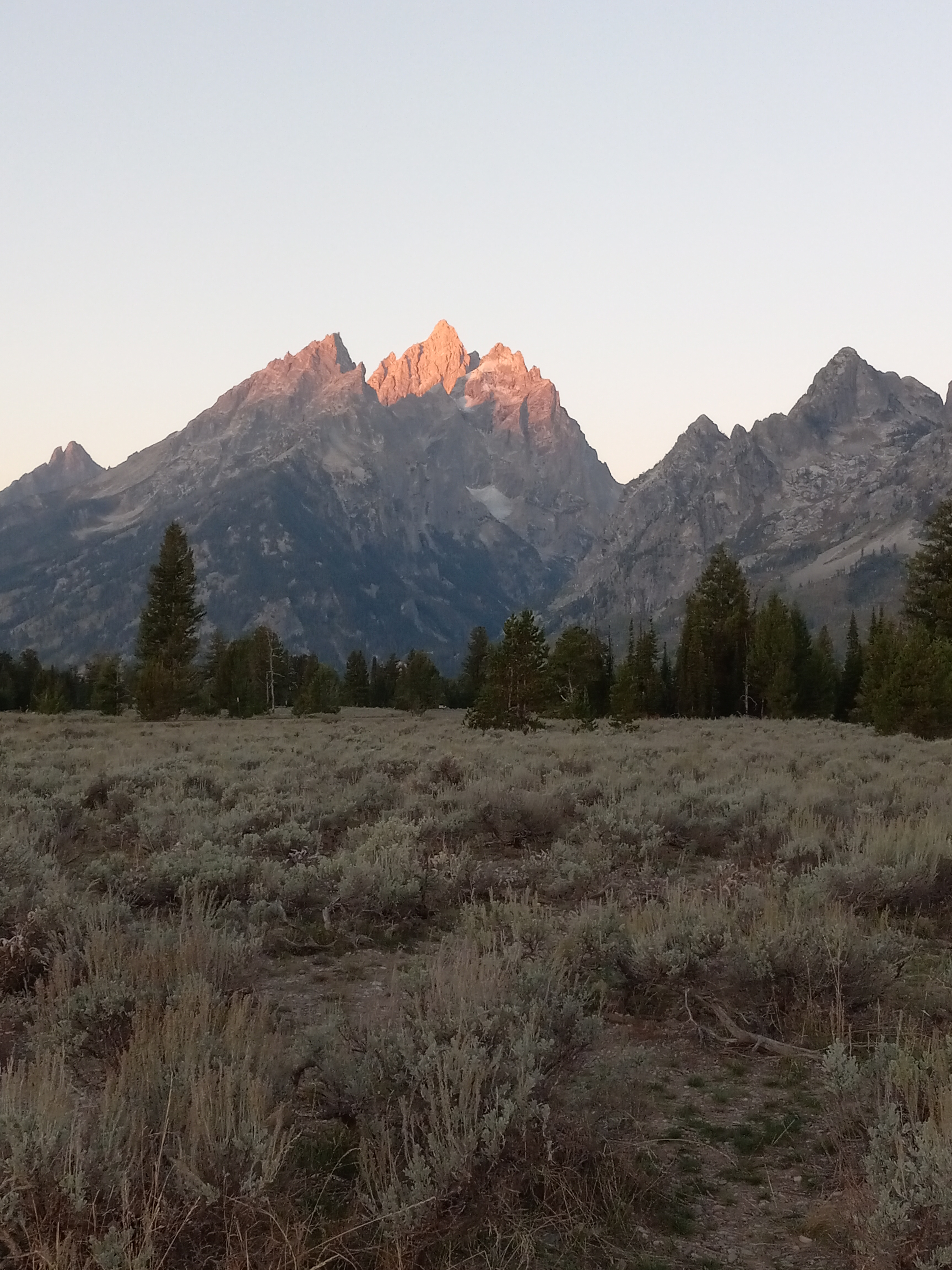
The Grand Tetons are the youngest mountain range in the Rocky Mountains.  They were formed between six and nine million years ago, when two faults collided and one shot skyward, giving them their jagged, rough-hewn edge.  They were of great importance to the Shoshone tribe, who hunted big-horn sheep there, and there are stones enclosures on the upper slopes that they journeyed to on vision quests.

Although, my thought was to meditate at the base of them, the journey I was most likely to take would be one into fitful sleep, having slept only one or two hours the previous night, at most.  I pulled over at the Snake River Overlook, with as good a view of the three peaks as I was going to get and turned off the engine. 

What I did then, was largely dream sitting up.  No white wolf came down from the mountain.  The voices of my ancestors didn’t ring in my ears.  No.  I just sat there in exhausted confusion and thought about getting a hotel that night.  I was running myself ragged and for what?  On this morning, I really wasn’t sure.

pages fly away 21

The Wind River Reservation in central Wyoming is shared by two tribes, the Eastern Shoshone, and the Northern Arapahoe.  At around two million square acres it is the seventh largest reservation in the US by size, and the fifth largest by population.  It was established at the Bridger Treaty Council in 1868.

The goal that day was to drive through the Wind River Reservation and visit the grave of Sacagewa, the Shoshone Indian woman who had joined the Lewis and Clark expedition with her husband and played an important role in their success.  My phone service was still out, so I’d have to go old-school with the Atlas.  The directions seemed simple enough.  It was just a two-hour drive to get there.

Along the way, I pulled over at the National Bighorn Center, only stopping out front to take a picture of a statue of a bighorn sheep with a blue bandana around its neck.  There was so much I was seeing, and still wanted to see, that there was barely time and space in my mind to process it all.  My brain was crackling with fatigue, but still surging forward, already anticipating how much further I could make it that day.

When I got to Fort Washakie, there was an arrow that pointed towards the grave of Sacagewa.  When I followed it, however, I only got as far as the grave of Chief Washakie.  Chief Washakie, who lived between 1810 and 1900 was one of the greatest Indian leaders, not only in Shoshone, but in American history.  He was inducted into the Western Heritage Museum in 1979, and even has a statue in the National Statuary Section of the Capitol in Washington, DC.

He was first named Smells of Sugar, but later changed that to Shoots the Buffalo Running, and was also known as Gourd Rattle, due to his success as a gambler, rolling stones from a gourd.  He proved to be a great warrior during intertribal warfare, and later helped lead the army of General George Crook to victory over the Sioux.  Doing so, he became the first Native American chief to have a military outpost named after him and be buried with full military honors.  One of the legends attributed to him is that of defeating his Crow enemy, Chief Big Robber, and returning with his heart skewered on his spear.

I looked for some sign of Sacagewa in the cemetery where Washakie is interred but could find no mention of her.  Without Google Maps, I was lost.  I had to go back into town and ask a woman at the gas station how to get there.  I’d been on the right road.  I just needed to travel further.

Sacagawea has become a heroine of Western lore, due to her involvement in the Lewis and Clark expedition, where she and her husband acted as guides and interpreters.  At one point, they met a band of Shoshones, and the chief was her brother.  She was able to use that influence to trade for horses.  Sacagewa was pregnant and gave birth during the journey, and from what I understand, just having a woman and child traveling with the party signified that their intentions were peaceful. 

There are two stories on what became of Sacagewa.  The first is that she died in her mid-twenties giving birth.  The second is that she returned to her homeland and married a Commanche, eventually living to be one hundred.

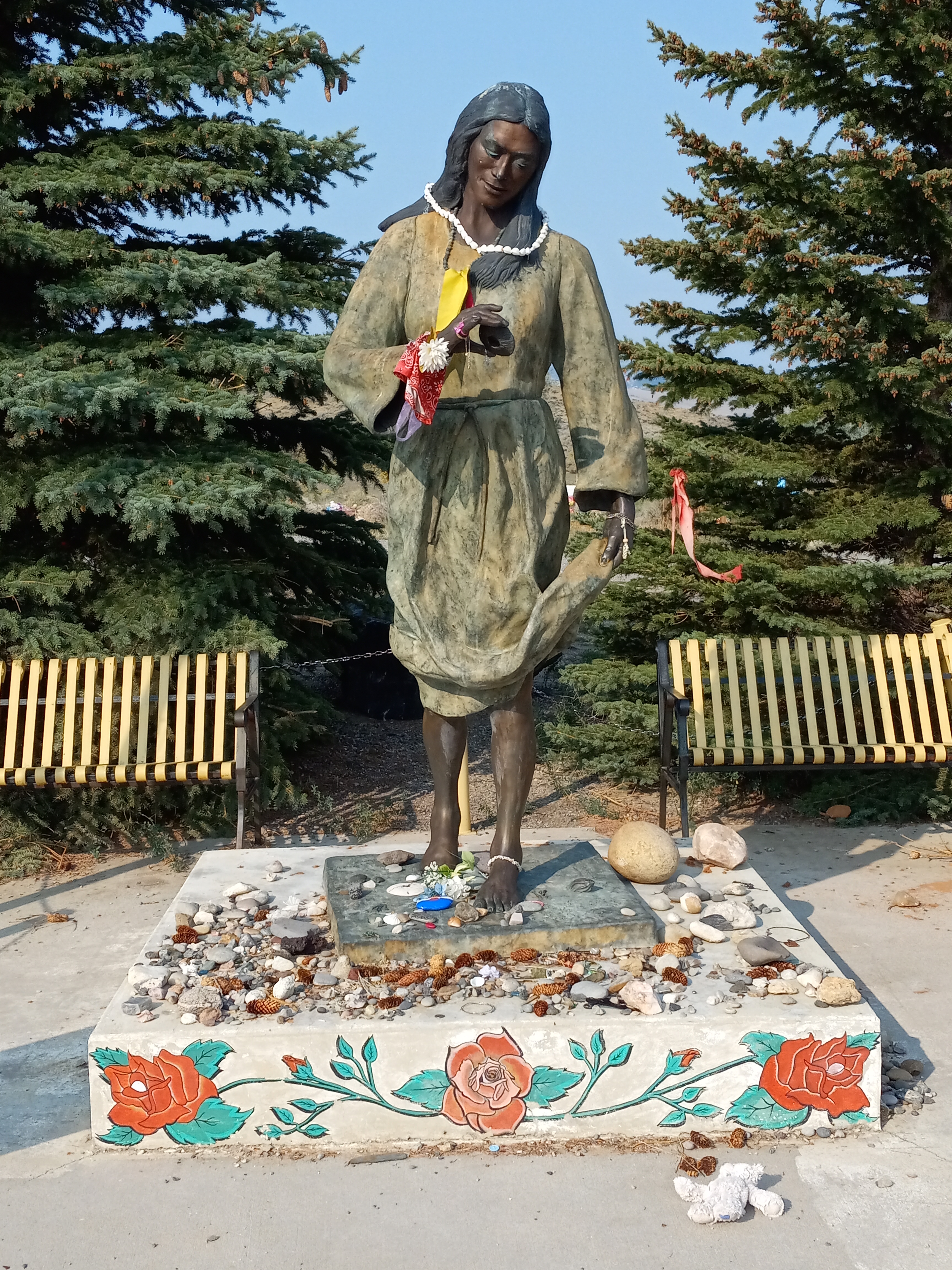
The cemetery was worth searching for and finding.  Colorful wooden crosses, marking the graves of other tribe members surrounded hers.  Flowers adorned many of them.  The statue of Sacagewa made her look like a Native Madonna, barefoot, with a flowing dress to her knees.  Someone had placed a string of shells around her neck and ankle.  The pedestal she stood on had three roses painted on the front of it, and stones and pinecones had been scattered around her feet.

pages fly away 22

Ten days into my big road trip and I was still flying like a bird, not knowing where I’d land next.  The blue Kia I’d rented, the Mountain Bluebird, was running like a champ, and had almost become a part of me, like the lower half of a Centaur.  Although I’d temporarily lost contact with Karen from Google Maps, I wouldn’t be thriving without her assistance either.  T-Mobile needs better allies in Wyoming, however.  I can tell you that. 

Right now, I could make it with just a road map, but come evening I’d need more help than I was getting if I didn’t want to spend another night sleeping in the car.  Maybe it was finally time to break down and get my first hotel anyway.  I could stand a shower and the chance to clean out and organize the car.

I’d seen something about an ancient Medicine Wheel in the northeast of the state but decided to head up to Cody first and have a look around.  It was about three hours from Fort Washakie.  I took the 287 to the 789, which became the 26 at Riverton.  Along the way I passed a statue of an Indian and frontiersman sharing a peace pipe, and the site of an early stage stop called the Halfway House.  When I got to Cody, I parked in front of the Chamber of Commerce, and got out to explore the town on foot.

William F. Cody, or Buffalo Bill, is one of most famous characters to come out of the Old West, and as the creator of the hugely popular Wild West show, practically invented the popular stereotype of cowboys and Indians.  Growing up in the Kansas territory, he is said to have ridden for the Pony Express as a teenager, fought for the Union Army in the Civil War, and gone on to work as a scout, guide, and Indian fighter.  The fact that he became the subject of a popular western serial, Buffalo Bill, King of the Bordermen, while still in his early twenties, and then became an actor, meant that the line between truth and fiction in his biography would always remain hazy. 

Do people want the truth, or do they want to be entertained?  Buffalo Bill knew the answer to that better than anyone, and established Cody, primarily because of its proximity to Yellowstone, as a place where visitors could have their own Wild West experience.  Even today, guests can stay on a dude ranch, go on pack-horse outings, attend rodeos, and hunt and fish.  The town is full of museums, gift shops, and variety shows. 

From the Chamber of Commerce, I walked over to the Buffalo Bill Center of the West.  Outside were many statues; young Cody riding for the Pony Express, an older Indian woman, a brave, a maiden, a wolf howling at the moon, two tipis, a moose, two cowboys on horseback meeting up.  I walked into the Center.  A guy in a wheelchair who was the spitting image of Buffalo Bill was greeting visitors.  It was twenty dollars to get in.  I passed on that, as I was already seeing plenty for free. 

By then I was so exhausted, I considered looking for a campground in Cody, but it was only afternoon and too hot to be setting up a tent.  The Bighorn Medicine Wheel didn’t look far.  It irritated me to no end that my phone service still wasn’t working.  I’d have to hope that there were enough signs beside the road to find it.

I hopped in the Mountain Bluebird and took the 14 north and then east, crossing Bighorn Lake at one point.  When I got to Bighorn Basin it was all uphill for miles.  The road switched back and forth up an enormous wall, with such a rapid increase in elevation that I feared for the engine of my sturdy little companion.  Fortunately, the way to Medicine Mountain was clearly marked.  I got off on a dirt road and followed it until I came to a parking lot.  Even though a small road continued up the mountain, a sign prohibited cars from going any further.

It was treeless at that height, with nothing to block the cold wind.  Looking at a map, it appeared to be a few miles to the summit, all uphill.  I started walking briskly, then turned around after about a hundred yards, to make sure I’d locked the car.  There was only one other car in the lot.  I considered the fact that someone could break a window and get at my stuff while I was walking but tried to put that out of my mind.  It was bright and the sun was out, but it couldn’t have been windier.  I was walking as fast as I could, lights exploding in my mind, breathing hard, just manic.

When I was about halfway to the top, a car pulled up behind me, some suburban couple, blatantly breaking the rules.  At the same time, a young hippie was coming down, a beneficent smile on his face.  I asked if cars were allowed to the top, and he assured me they weren’t.  Five minutes later, and the same car was on its way back down again, the driver oblivious to the stink-eye I was casting.

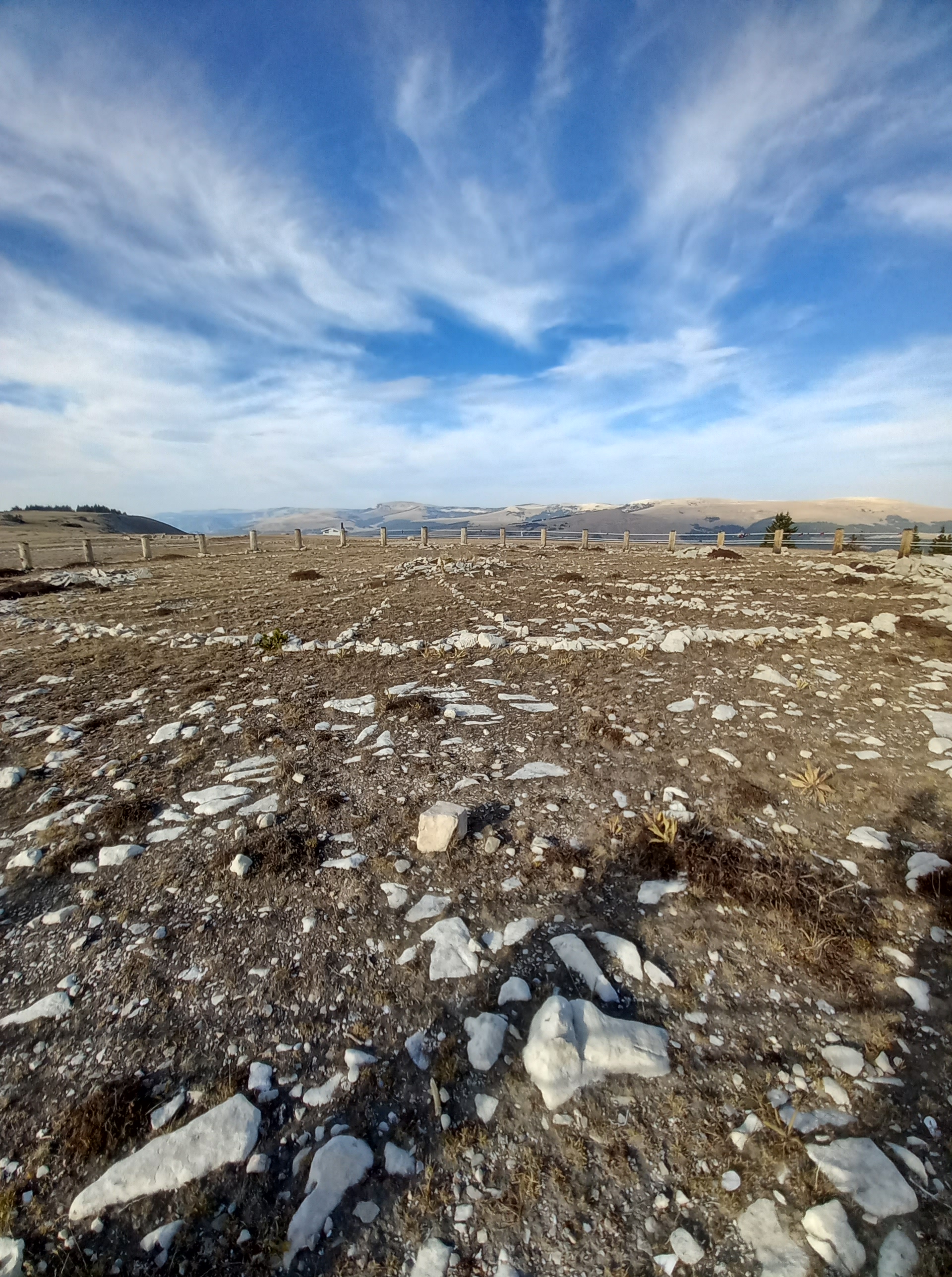
There was a young couple and older woman at the Medicine Wheel when I reached it.  With a diameter of over eighty feet, made up of twenty-eight spokes, radiating out from the center, it was hard to get the big picture standing next to it.  Although allegedly dating back to Pre-Colombian times, it didn’t seem like it would’ve taken long to assemble the mid-size white stones that give it its shape.  It was protected by a fence, from which people had strung bandanas, messages, prayers, and medicine pouches.

Like many sacred places, what makes them sacred is partly the journey and the effort that it takes to reach them.  There are visions, like dreams, that come at you aggressively, that capture you and take you hostage on a wild ride.  Then there are those you faintly remember, yet linger, perhaps just one or two images that stick with you, like a circle on the top of a barren peak.  Whoever constructed it, did it in the belief that life is infinite, and that healing comes with time, just as the wildflowers reappear every spring. 

I kept this in mind as I hurried back to the car, happy to see that no one had broken into it.  It was two more hours to get to the Little Bighorn Battlefield.  It felt like there wasn’t a moment to lose.