Category Archives: Travels

pages fly away 23

The idea was to get a hotel, the first of the trip, in Sheridan, and then visit the Little Bighorn Battlefield the next morning.  Back on the 14, however, driving through the Bighorn National Forest, I came across a small, deserted campground by the side of the road.  It was too easy not to pull over right there and set up camp for the night.  The sun had already gone down behind a mountain, and it was cold.  I foraged for wood, gathering kindling, and fishing a few half-burned logs out of another fire pit.  One of them was big enough to burn for a few hours once it got going.  There was a lot of smoke, which stung my eyes, and just a little bit of heat.  After a while I gave up and got in my sleeping bag.

There was a bull elk lustfully screaming all night long.  Around four in the morning I got up and loaded the car, the stars overhead like a bucket of jewels, and got on the road.  Coming around the first bend, what should be there, but the elk, enormous, at least ten points on each side of its rack of antlers.  I continued driving through the dark, my headlights flashing around the curves and at one point illuminating the Little Tongue River.  I reached the battlefield as the first bands of dawn were beginning to stretch across the sky, but they didn’t open until eight.  I returned to a gas station that I’d passed, to fill up on gas and get some coffee, and saw they were operated by the Crow Tribe.

The Crow Indian Reservation was established in 1868, and nearly, 7,000 tribe members live on it.  As a people, they were forced to relocate from the east, near Ohio, due to aggressive neighbors, and ended up in Canada and North Dakota, before eventually settling in the Bighorn region and adapting to the ways of the Plains Indians.  Their three greatest enemies amongst the other tribes were the Sioux, Cheyenne, and Arapahoe, who had encroached upon their reservation prior to the Battle of Little Bighorn.  It was the Calvary’s attempt to drive these three tribes back onto their own reservations that resulted in the Battle of Little Bighorn.

The Crows had more than one name for the creator, one being Old Man Coyote.  They believe that the world was begun when Old Man Coyote, floating in the ocean alone, came across two male ducks.  One duck dived to the bottom and retrieved a root.  The other went down and came back up with some soil.  Out of these, Old Man Coyote created islands and plants and trees.  Then he created man and woman.  Then two female ducks, before meeting another coyote, and embarking on many adventures.

They believe there are three worlds, the physical world, the spirit world, and the world where God lives alone, above the other worlds.  Spirits can come in many shapes, many in the form of animals that lend their specific strengths to those who appeal to them.  Maybe I had my spirit animal in the form of the Mountain Bluebird.  It was certainly serving me valiantly, so far.  Toss in Karen from Google Maps, and it was also like I had the assistance of Athena, guiding Jason and the Argonauts on their quest for the Golden Fleece.  My journey had been scattered and strange, but there was no doubt that the gods had been smiling on it ever since I’d set off from Huntington Beach.

Filling up with gas at the Crow Nation Express Center only cost twenty-five dollars.  While I was in there an old man in a wheelchair came in for cigarettes.  Another customer knew him and greeted him.  It took a long time for him to recognize her.  Next door was the River Crow Trading Post, but there were no lights on inside.  I drove a short distance and pulled into the parking lot of the Custer Battlefield Trading Post.  It too was closed.  I was exhausted but decided to try and meditate.

There were six tipis set up outside the store.  I sat facing them, white, yellow, red, white, white, white.  What were they used for, outside of ornamentation?  Had anyone ever lived in them?  Were they for sale?  Two flags were flying, an American one and a Montana one.  On the outside of the trading post, three buffalo skulls were mounted, interspersed by three sets of elk antlers.  Two wagon wheels were propped up in front of it, and a sign in the shape of a buffalo advertised buffalo steaks and burgers.

The sun began to rise in the east, beside a billboard.  Outside of that there was nothing to stand in its ways, no clouds, or obstructions, only miles of endless, rolling plains.  I shut my eyes and took a few deep breaths, unable to stop my mind from thinking back to all I’d seen, or wondering what I’d see next? 

Would my National Park Pass be good for the Battlefield?  I hoped so.  For eighty dollars, it had already been a good deal.  Strange though, how they hadn’t accepted cash.  All future wars will be fought on battlefields we can hardly imagine.  My eyes shot open.  The sun grew and grew until it was the size of an orange, a burning hoop of fire.  When I closed my eyes again, I could still see it, glowing in the center of my forehead.  That had to mean something.  Didn’t it?
pages fly away 24

Pyrrhus of Epirus, a Greek king from before the time of Christ, is widely credited with coining the phrase winning the battle but losing the war, but it could’ve been written to describe the Battle of Little Big Horn and the tragedy that ensued.  A few years after enjoying their most celebrated victory, most of the prominent Native leaders and warriors who’d taken part in the battle would either be killed or forced to surrender.  The Black Hills, which the Natives had fought to keep sacred, were lost in concessions, just to keep from starving.  The Indian Wars were drawing to a close.

It is hard to say exactly what happened at the Battle of Little Bighorn, or Custer’s Last Stand, since every soldier under Custer’s command, more than two hundred men, were killed that day, apparently in about the same amount of time it takes a hungry man to eat his lunch.  The goal was to drive the Sioux and Cheyenne back onto their reservations.  The number of warriors who were off the reservations at the time to join in the summer buffalo hunt, was greatly underestimated. 

Sitting Bull had recently had a vision about soldiers falling like grasshoppers that had fired up the tribes.  What was expected to be a one-way fight turned into a brutal rout.  No one from Custer’s unit lived to tell the tale, but evidence suggests that they had panicked and broken formation, turning the battle into a buffalo run.

I was glad they accepted my National Park Pass at the gate, since it was twenty-five dollars to get in.  The first thing I did was to stroll out to the National Cemetery, reserved for military veterans from both the Indian and later wars.  Identical white headstones mark the graves. 

From there I went over to the Visitor Center, COVID mask in place.  At least they were open.  Upon entering, there were pictures of Sitting Bull and Ulysses S. Grant, standing side by side.  An effort was made to take a nuanced approach and tell both sides of the story.  Next was a mannequin in a glass case, a soldier from the Seventh Calvary, with saddlebags, rifle, and cowboy hat.  Beside him, in a separate case, was an Indian warrior, with feathered headdress and bow and arrow.  A gallery of calvary fighters included Lieutenant Colonel George Custer, Major Marcus Reno, and Captain Frederick Benteen.  An adjacent one featured Sitting Bull, Crazy Horse, Chief Gall, Two Moons, and Red Horse.

There were only a few other visitors in the park at the time and my idea was to get out on the tour road ahead of them.  I hurried off and reached the monument first, but then couldn’t find parking, so left the car at the side of the road.  On it are inscribed some of the names of the 220 soldiers, scouts, and civilians, who died and were buried in the area.  Cloth prayer flags hung from the branches of a nearby tree.  At the Indian Memorial I got a look at the wire sculpture of three braves riding off into battle.  Then there are overviews of the spots where the units of Reno and Benteen got pinned down yet managed to stave off total annihilation.

By now it was mid-morning.  I wanted to drive back to the Crow reservation then go visit that of the Northern Cheyenne.  At the Apsaalooke Veterans Park, I got out and took a picture of a statue called The Mystic Warrior.  Beyond that was a sign claiming Jesus Christ as the Lord of the Crow Nation.  Traveling a little further I came across a country church, overshadowed by a sign for the Apsaalooke Nights Casino.

To get to the Northern Cheyenne Reservation, I needed to take the 212 about an hour east, but then I got caught up in roadwork for thirteen miles, and for a long time just sat there.  The reservation is 690 square miles and has 6,000 tribespeople living on it.  It was created after two chiefs, Dull Knife and Little Wolf, fled the reservation they’d been confined to in Oklahoma.  After splitting up, the party that followed Dull Knife was nearly wiped out in the Fort Robinson Massacre.  Little Wolf managed to make it to Fort Keough in Montana and began acting as a scout for the army.  Dull Knife eventually made his way there and the reservation was established in 1884.

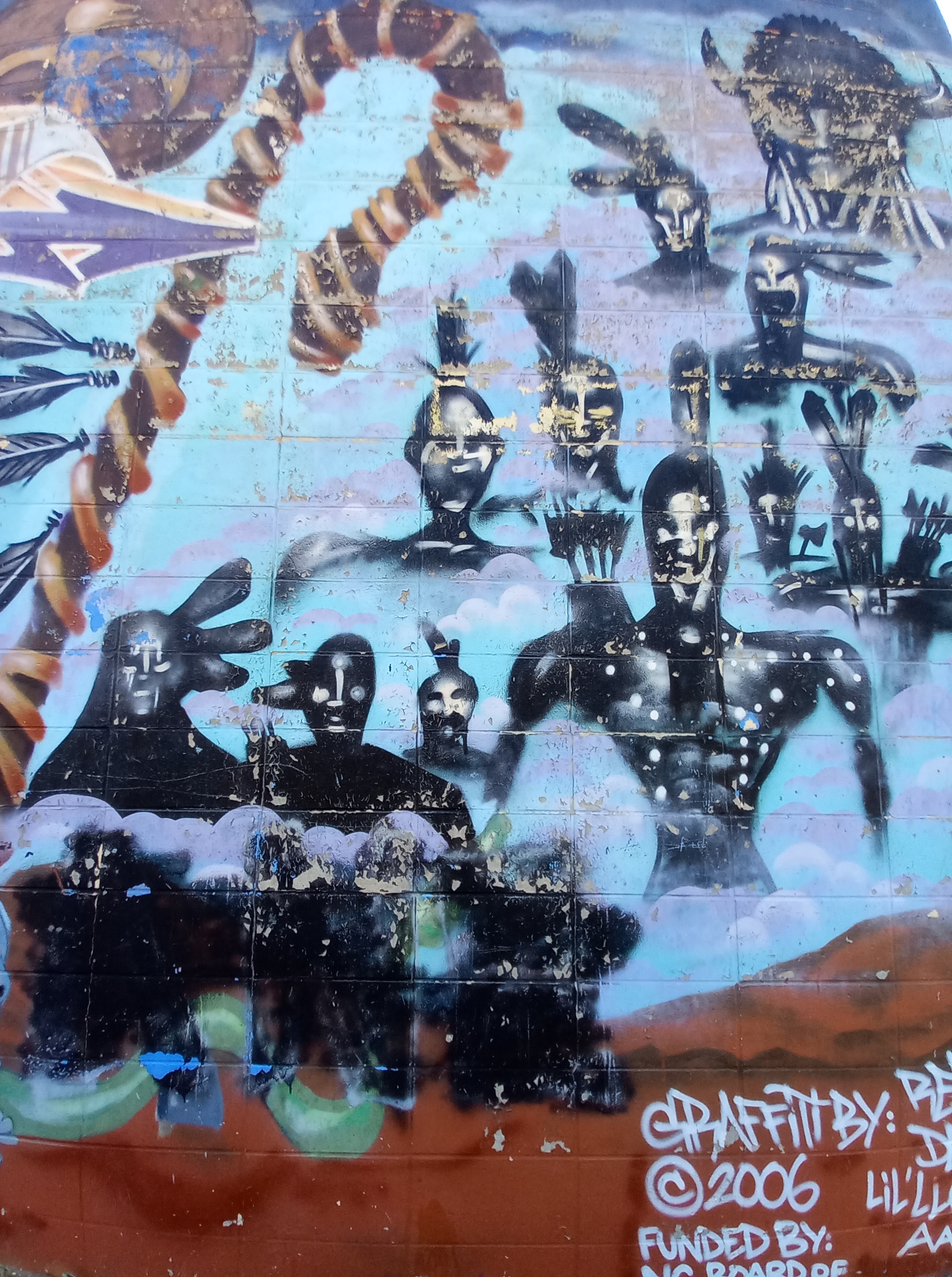
I drove into the headquarters at Lame Deer and had a look around.  It looked a little rougher than some of the other reservations I’d visited.  A giant wooden tipi was collapsing on the outskirts of town.  I passed a store called Custer’s Last Camp, then the Chief Little Wolf Capitol Building.  Up on a hill there was a water tower with a depiction of a maiden, beneath an umbrella, walking a dog.  One wall was full of graffiti and murals, a strong statement from the Northern Cheyenne Nation.  On one half was a buffalo and screaming eagle, with skulls and a conked-out dragon.  The other half was made of black warriors, like something from a nightmare, fashioned out of the night, their hair pulled back, feathers stuck into it, one with a buffalo head, their quivers full of arrows, coming to claim what is rightfully theirs. 

To be a Civil War veteran or immigrant who signed up for the U.S. Calvary at the time, thinking about three square meals a day and a little money in your pocket, only to find yourself waking up to that, one bright summer day, would be to know the true meaning of hell on earth, running through fields of chaos and terror, watching your friends being butchered, praying for the cry of a bugle, which meant relief was on its way, but then finally cut down, falling to your knees, leaving just a final scream.  It was time to get going, while the going was still good.

pages fly away 25

From the Northern Cheyenne Reservation, I started back on the on the 212 west, but then headed south on the 314 before running into the road construction that had tied me up on the way in.  That proved to be a lucky move.  It was a small road with almost no traffic.  The sky overhead was immense, with great formations of pure white clouds, like military units parading across the plains.  I felt as free as a bird, flying through the mountains. 

At one point I looked down and saw I was going a hundred miles an hour.  Zooming up over a crest, my head and heart would rise up, like they’d been pumped full of helium.  On the descent, my stomach would plunge, down into a bottomless pit of wonder.

Passing the Tongue River Reservoir, the road became the 338, and I soon met up again with the 90 heading east.  Just beyond Sheridan, I pulled over at Fort Phil Kearny, established in 1866 to provide protection for settlers and miners on The Bozeman Trail, and also the site of the Fetterman Massacre, being the greatest defeat of the US Army by Indian forces, prior to the Battle of Little Bighorn. 

No one else was there.  I walked into the log gate and inspected the marker commemorating the seventy-six officers and three officers who were lured into an ambush and cut down.  Heading back to the car I noticed a herd of pronghorn in a dry valley.  It was a scene right out of a movie.

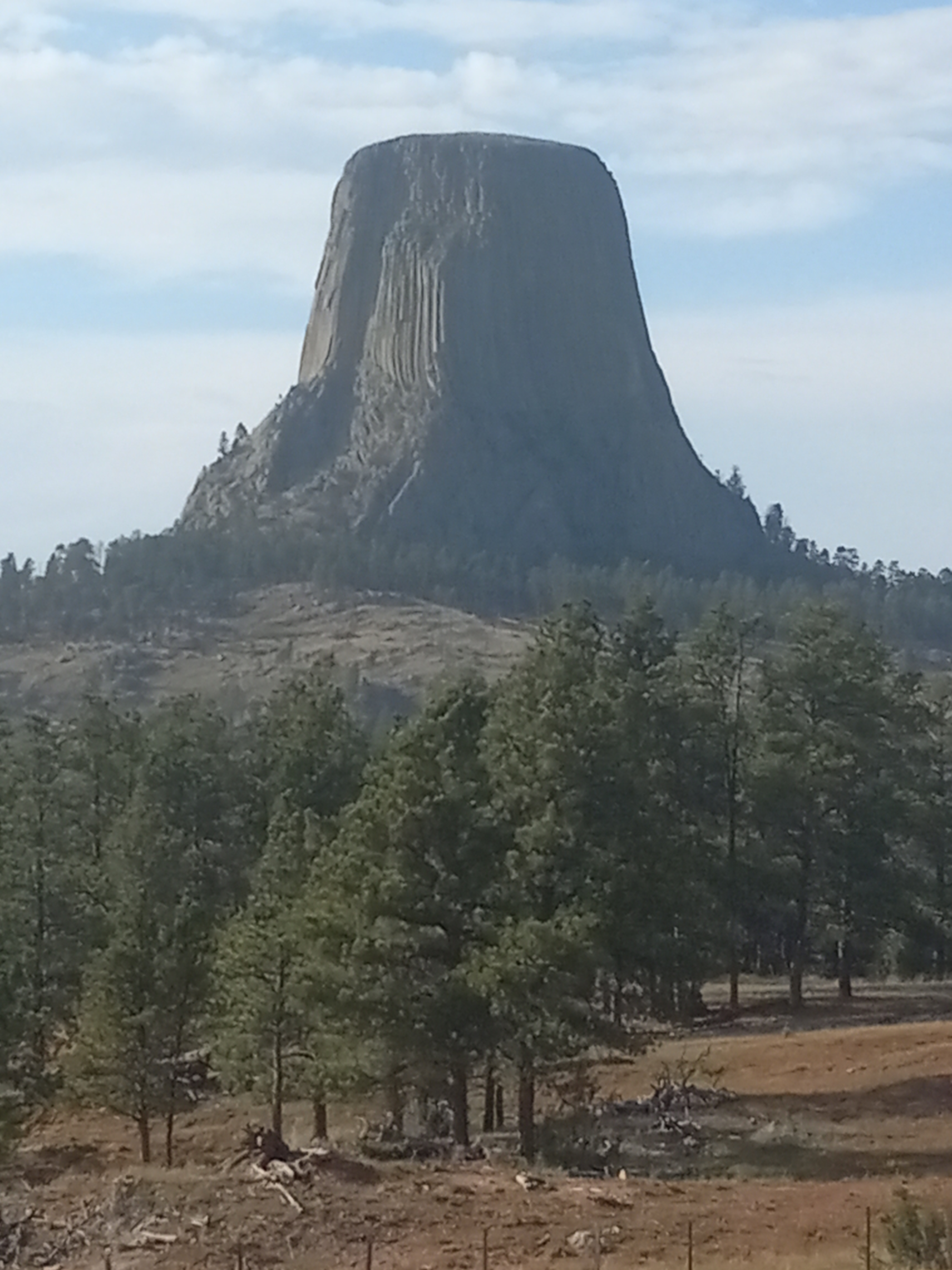
It was about three hours to Devil’s Tower.  The idea was to make it there and camp if there was anything available.  Right before I reached the Thunder Basin National Grassland, I got on the 14 heading north and passed the Keyhole Reservoir.  From about ten miles away, I caught my first sight of the tower.  It is one of the most recognizable geographical landmarks on the face of the planet, a great monolith, resembling a tree stump, rising nearly nine hundred feet from its base. 

Scientists believe Devil’s Tower may have been solidified lava that remained after a volcano crumbled away.  The Sioux believed that some sisters climbed it to escape from giant bears.  They prayed to the Great Spirit who caused the rock to rise.  The slashes down the side of it are from the claws of the bears.  The sisters went on to become the Pleiades.

In the movie Close Encounters of the Third Kind the aliens use Devil’s Tower as their base, the summit being a good place to land a spaceship.  In reality, the alien invaders are tourists, the surrounding campgrounds being a good place to land an RV.  It was late afternoon and hot when I arrived.  The park was full.  They were not letting any more cars in.  There weren’t even spots open in the KOA campground. 

I walked around and checked out the Campstool Café and Devil’s Tower Trading Post.  It was all about the Wild West.  There were wanted posters for the Sundance Kid, the Cassidy Gang, Frank and Jessie James, and Wild Bill Hickock.  In the trading post was an Indian mannequin in full regalia.  The bathrooms were designated for cowboys and cowgirls.  A stuffed mountain lion crouched above a photo of a Harley Davidson.

Leaving Devil’s Tower, I was in a daze.  I’d gotten a bag of beef jerky and it suddenly dawned on me that I was devouring strips of flesh, like a cannibal.  It seemed like the night where I’d finally need to spring for a hotel.  I passed through Sundance, however, and had just reached the Black Hills when I saw a sign for a campground.

Following it, I went from dry, yellow grassland, to a forest of evergreens.  It didn’t seem conceivable that they would have any spots available, but they did, one, right by the entrance.  There was a big cow patty, right where I needed to set up the tent.  I took a stone and dragged it off to the side, then used the stone and a few others to weigh down the tent. 

The surrounding pines gave way to the still-blue sky.  They made a circle above my head, just wide enough for the dreams to get in.  An hour later I could hear them riding on the heels of the setting sun.

pages fly away 26

The Black Hills had always been sacred to the Sioux that occupied them, and had been set aside in a treaty, until gold was discovered, and the US government reneged on those promises.  The struggle for ownership of this land was the impetus for much of the fighting that went on during the Great Sioux War in 1876. 

I don’t know much about gold but have definitely been around some spirits in my time, and could feel their presence that night, camping in the foothills, the wind blowing through the trees, rocking my tent back and forth.  It felt like the wind was blowing through channels high above my head, running in different directions, each with its own voice.  Then one would suddenly swoop down and lay its hands on me, shaking my consciousness so that nothing else mattered but the wind, the night, and that very moment.

It was my plan to head over to Mount Rushmore that day, but first I planned on driving through Deadwood and Sturgis.  I was up before the break of day, as usual, wanting nothing more than to be driving my trusty rental car, the Mountain Bluebird, across not only the face of land, but that of time, seeking out and finding pages from the past that had been scattered along the way.

As I drove towards Deadwood the sun was only beginning to rise.  It sat atop a telephone pole like a pink golf ball on a tee.  Deadwood had come to life as a boomtown during the Gold Rush.  Overnight, the population went from practically zero to over 25,000 fortune-seekers.  Prospectors, gamblers, prostitutes.  It was a good place to get rich and also a good place to get killed.  The most famous assassination was that of Wild Bill Hickock, shot dead during a poker game holding what has become known as the Dead Man’s Hand, two black aces and two black eights.

Wild Bill Hickock is one of those figures out of the Wild West, who largely created his own legend.  He is reported to have been a soldier, scout, lawman, and gunslinger, but he was also a showman and actor, who appeared on stage with Buffalo Bill, so it is hard to separate the fact from the fiction.  His hair trigger temper may have stemmed from an earlier nickname he was given, Duck Bill, in which he was mocked for his long nose and protruding lips. 

Although reported to having killed over a hundred men in his life, the number may be closer to six or seven, under circumstances that may not have always been fair.  The man who shot him, Jack McCall, was eventually found guilty of his murder and hung.

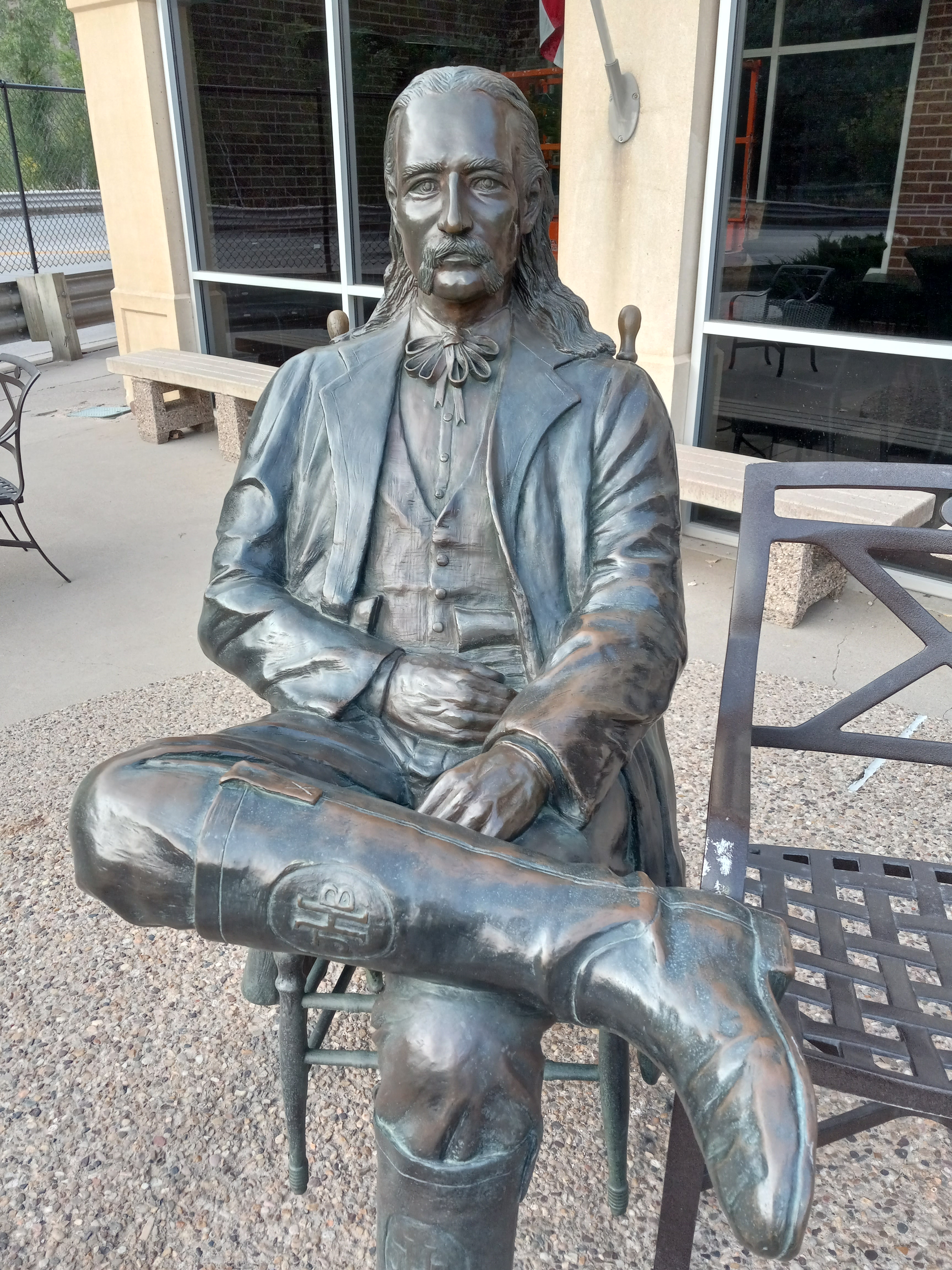
As I drove down Historic Main Street Deadwood it was still early.  I parked my car and the first thing I happened across was a statue of Wild Bill himself, sitting in a chair with his legs crossed, a plaque in front of him explain the origin of the Dead Man’s Hand. 

A mural not far from that showed an earlier version of the town with a bank, saloon, covered wagon, as well as Wild Bill, Calamity Jane, and a few other assorted frontier folks on horseback, facing the future.  There were shootouts on Mainstreet, every day except Sunday at two pm, ghost tours, old time photos, black hills gold and jewelry, casinos, the historic Bullock hotel, the Brothel, the Lucky Nugget Saloon.  None of these were open yet.  If anyone was out it was just a ghost, blowing down the street.

My next stop was in Sturgis, home to the largest motorcycle rally on the face of the planet, every summer for ten days at the end of August.  It was late September by now.  I’d missed it by a month.  Still, I went to have a look around.  Most of what I witnessed were just motorcycle shops and bars, not yet open yet either. 

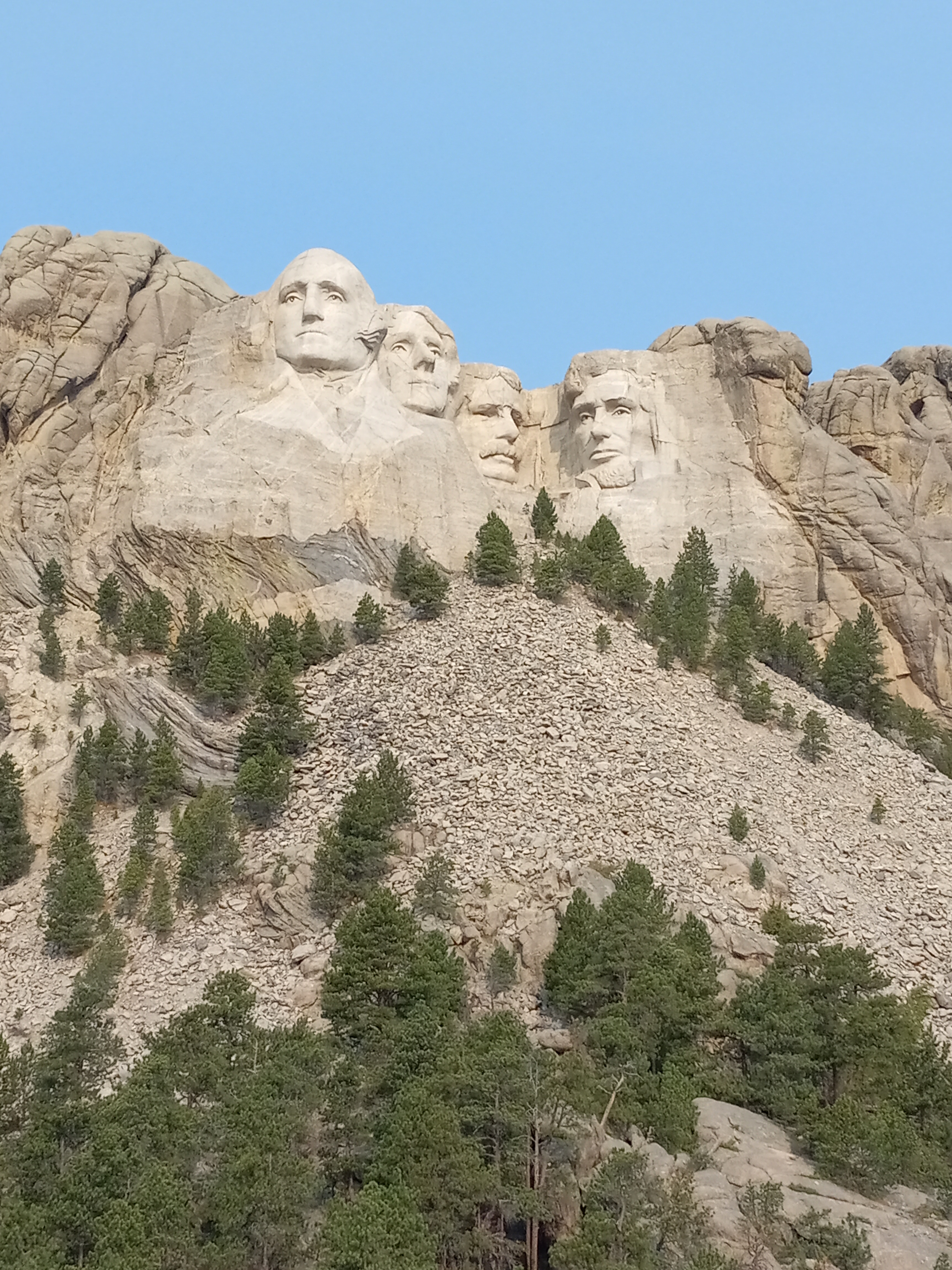
From there it was an hour and a half to Mount Rushmore.  I took the 90 to Rapid City and then the 16 south from there, passing Bear Country USA and Old McDonald’s Farm.  When I got to Cosmos Mystery Area, I turned left on the 16A.  In a few miles I could see them, the faces of the four presidents, looking smaller than expected.  I’d arrived at one of the greatest tourist attractions in the country, not for the first time, and hopefully not for the last.  It was time to get out and see, once again, what all of the fuss was about.

pages fly away 27

How many people know that Mount Rushmore is named after a New York Lawyer?   Or that the four faces carved into the mountain have a name – The Shrine of Democracy?   Or that the idea to create it came from a project that was already underway in the South called the Shrine of Confederacy, and that the same sculpture who was working on it, Gutzon Borglum, was commissioned for the job?   Or that the original idea for it was to carve out famous heroes of the West, including Lewis and Clark, Sacagewa, Buffalo Bill, Red Cloud, and Crazy Horse?  Or that once it was narrowed down to the four presidents the plan had been to show them to their waists?

Many people know that the Shrine of Democracy was caved on land that the sacred to the Sioux, but how many people know that the mountain had a name, the Six Grandfathers, four for the four directions on a compass, and two for the sky above and world below.  To put a sculpture of four presidents right there went down as well as if the Chinese were to carve the face of Chairman Mao onto the Statue of Liberty.  In 1980, it was formally recognized that the land was been taken illegally, and the Sioux were awarded 100 million, which they refused, wanting the land back, which had become known to them as the Shrine of Hypocrisy.

I don’t go there with any ideas about it or a political agenda.  Like most Americans, I’d seen images of it my whole life and was just enthralled to be there in person.  Perhaps, it was my fifth-or-sixth time visiting Mount Rushmore, the first time with my grandfather, in a helicopter that made him sick to his stomach. 

If you see it on television, one of those grand panoramic views of it taken from a helicopter, you envision Mount Rushmore as this sprawling, expansive thing that covers the side of a mountain, when in reality, upon first sight of it, the faces seem rather small, huddled together in one corner.  It is similar to arriving at the Pyramids in Egypt, only to discover that the famous Sphynx is not much larger than a trailer home.

The monument is free to get into.  There is a parking garage you need to pay to enter, but that is about it.  Outside of just looking at the faces from different angles, there is also a visitor center and gift shop and different trails that can be hiked.  The presidents from left to right are Washington, Jefferson, Teddy Roosevelt, and Lincoln, timeless in a way beyond Roosevelt’s eyeglasses and moustache.  As a young man I’d used a picture taken in front of Mount Rushmore, holding a beer with my eyes crossed out, as a flyer for my first concert.  Now, I just turned and took a few selfies, like everyone else was doing.

The next stop was the Crazy Horse Memorial, which involved driving west about thirty minutes on the 244.  Crazy Horse was a visionary leader of the Lakota Sioux.  He was named Curly as a child but had a vision where he saw a warrior on a horse come out of a lake.  The horse was able to float and dance in the air.  The warrior told him that if he remained modest and unadorned no one from his tribe could touch him.  If he took no scalps or war trophies, he would be invincible in war. 

Crazy Horse saw bullets and arrows flying around him, unable to hit him.  He witnessed a great thunderstorm.  His people could not hold him back.  Lightning struck his cheek and hailstones hit his body.  That became his warpaint.  He was a major player in both the Fetterman Massacre and the Battle of Little Big Horn.  Finally, forced into surrender, he was killed by a bayonet during a skirmish at Fort Robinson.

The idea for the Crazy Horse Memorial came from Henry Standing Bear, an elder of the Lakota tribe, and the job was given to Korczak Ziolkowlski, and was started in 1948.  Although the grand plan is to carve both Crazy Horse and his horse out of the mountain, to this date only the head and right arm have been completed.  The visitor center is still worth the price of admission, with artwork and artifacts from a number of tribes, and on this day Native Dancers on a small outdoor stage. 

After leaving the Crazy Horse Memorial, I drove back to Rapid City and headed towards Wall Drug on the 90 east.  I knew I was going in the right direction because of the ubiquitous billboards for Wall Drug that run for hundreds of miles along the road.  It started off as a roadside stop for travelers on their way to Mount Rushmore, offering free ice water, and went on to incorporate a pharmacy, art gallery, museum, and gift shop, in time becoming one of the greatest tourist traps in the land.  I was excited to get there.

I found a parking spot on Main Street and walked toward Café Entry No. 1, passing signs for five cent coffee refills, and windows that contained black and white photos, a cowboy drawing his gun, and boots for sale.  Inside was a menagerie of all things Old West, both real and make-believe, such as jackalopes, rabbits with small deer antlers grafted to their heads. 

There was Old Pappy the Cook.  Another shifty sidewinder with a slow-burning cigarette.  Calamity Jane, the rough, tobacco-chawing spitfire of the plain.  Wyatt Earp, lifting a pistol from his belt.  Next to him was the fortune-telling Cowpoke.  There were Annie Oakley and Buffalo Bill, mounted elk, caribou, and deer heads, a shaman lifting a buffalo skull, a saloon girl, and tough old granny, chomping a cigar and keeping her cards close to her chest. 

There was Wild Bill, the wagon train band, a snake oil salesman, a totem pole, George Custer, a giant Jackalope with a saddle, a buffalo, a grizzly bear.  Heck.  There was a frontiersman, a prospector and his mule, a recreation of one of the mines, complete with carts, stocked with minerals. 

A covered wagon and horses?  A bandit doing a shot?  Another showgirl in a bowler hat?  There was nothing they’d missed.  It was the wildest place to shop in the land.  The cash registers were ringing like Christmas bells.

pages fly away 28

Maco Sika, or the Badlands, were named so by the Lakota people because of their harsh, rocky environment, with high temperatures and a lack of water.  By the time I arrived at the north entrance it was ninety degrees, and I was feeling blown out and spent.  My National Park Pass came through in the clutch again, the Mountain Bluebird was calm and in control, and I’d regained my friend Karen from Google Maps, after passing through a dead zone of T-Mobile phone coverage in Wyoming. 

Still, I wasn’t sure what direction to take once I got in the park.  It all looked the same, miles of ringed buttes, bluffs, pinnacles, and hoodoos, the terrain of the underworld, forced up into the daylight.

It is small wonder that Table Mountain in the Badlands, was chosen as a site for a Ghost Dance in 1890.  The Ghost Dance came about through the Paiute holy man and prophet, Jack Wilson, or Wovoka, who saw in a vision that the white men would disappear, the tribes would be reunited with the spirits of their departed ones, and their hunting grounds would be restored to them by dancing the circle dance.  The Ghost Shirts that were created at the time, were thought to make those who wore them impervious to the bullets of their enemies.  It was following this particular dance that the Wounded Knee Massacre occurred, as the dancers were returning to the Pine Ridge Reservation.

It was a hot and dusty day, and I was irritable and didn’t know which way to drive.  I stopped at the Pinnacles Overlook and stared down at the jagged, banded landscape, then drove past Roberts Prairie Dog Town, seeing prairie dogs up scouting on their hindquarters, popping in and out of a small minefield of holes.  It didn’t seem like I was going the right direction.  I followed Sage Creek Road, and at one point seemed to have left the park.  When I reached the 41, I took a left, and soon came upon a checkpoint for the Pine Ridge Reservation. 

The Pine Ridge Indian Reservation is an Ogalala Sioux reservation that occupies three thousand square miles in the southeast of South Dakota.  It is famous for the Wounded Knee massacre, in which over two hundred and fifty Native men, women, and children, were killed, and fifty wounded, when the 7th Calvary under Colonel James Forsyth attempted to disarm them and a rifle went off.  The dead were then buried in a mass grave. 

Pine Ridge is also famous for the Wounded Knee Occupation of 1973, when two hundred Sioux, followers of the American Indian Movement, occupied the town of Wounded Knee in an effort to draw awareness to injustices that have been committed against their people.  The siege lasted for 71 days.  A US Marshall was shot and paralyzed and two of the protestors were killed by gunfire.  After ten weeks they surrendered their weapons, but a lot of awareness had been raised by then.  Much of the population became sympathetic to their cause, although little changed.

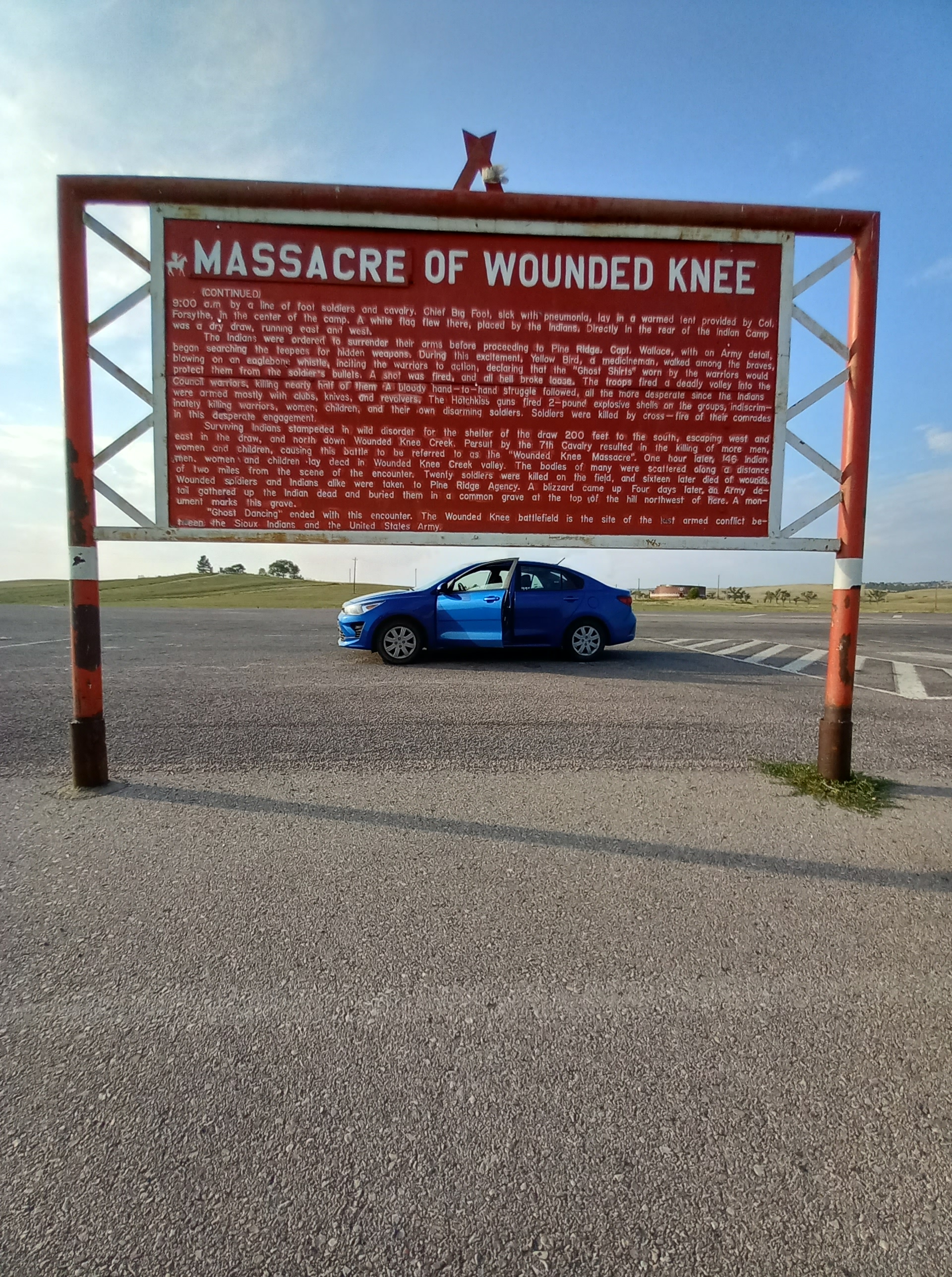
I drove until I reached the site of the Wounded Knee Massacre, where a large, red sign tells the tale of what went down.  Chief Big Foot, with 106 warriors and 250 women and children were camped and then surrounded by a force of 450 soldiers.  They had been dancing the Ghost Dance and were on their way to Pine Ridge. 

After surrendering, four Hotchkiss revolving guns were set up around the camp.  When a fight broke out, sparked by a single shot, the guns were used to mow down the crowd, which resulted in a stampede.  The shirts that they were wearing didn’t protect them and the Ghost Dancing largely ended with this mass slaughter.

To sit beside the sign, you would never know that something that awful had ever happened at the location.  The earth heals quickly, much quicker than the hearts and minds of people.  The grass was green.  A shelter, roofed by pine boughs, stood nearby.  I walked over and sat down on one of the benches beneath it.  It was late afternoon by now.  I had no idea where to stop for the night.  A Sioux in a cowboy hat pulled up in a pickup, but then quickly drove on.  I shut my eyes and could hear the wind blowing through the grass.  Dogs were barking in the distance. 

A fly began buzzing around my face.  Why does there always have to be a fly, buzzing around your face when you sit outside to meditate?  Some crickets were chirping and from somewhere I could hear the voices of children.  I thought about the bodies beneath the earth, and what, if anything was left of them. Four cars passed in a row.  A cool prairie breeze blew right in my face.  The voices of the children grew louder.  It sounded like they were coming through the trees.

pages fly away 29

There are nine Indian reservations in South Dakota.  My plan was to head up to North Dakota, driving though as many of them as I could, but it was late by the time I left Pine Ridge, and my attempts to find a campground, for the first time in almost two weeks, had come up short.  In the town of Martin, I gave up and checked into a hotel, getting a sub sandwich and bag of Doritos at a gas station across the street.  Having to pay a hundred dollars for the room made me anxious, not sure what I’d find for camping the further east I got.  If I had to start paying for hotels every night, the gig would soon be up.

In the morning I drove through the Rosebud Reservation, home of the Sicangu Lakota, known as the Burnt Thigh People, which may have come from an incident in the past where they were forced to flee a wildfire.  It was created in 1889 and the total land area is near 2,000 square miles.  I stopped outside the office of the law enforcement and later passed the Tribal Ranch.  On a grass hill were three crosses on a hill, above them a sign for the Rosebud Christian Center.  Continuing on, I passed a road marker dedicated to the Brule Chief, Spotted Tail.

At Mission, I took the 83 north to the 90 east, then got on the 47 north, crossing the Missouri River to drive though the Lower Brule and Crow Creek reservations.  A sign of an old woman holding the worlds in her hands implored Protect Unci Maka, or Grandmother Earth.  It was an hour to the capital of South Dakota, Pierre, from there.  The land was flat and the sky as blue as can be.  Clouds drifted slowly across the windshield like white buffalo.  Nothing else moved, just the car and the clouds.  All else was the same as it ever had been.

In Pierre I just drove past the capital building and continued on the 14 to the 63 north.  At Eagle Butte the headquarters of the Cheyenne River Sioux Tribe, there were a few murals, one of a hoop dancer, another of an old chief.  An eagle and feather were painted on the drive-through side of the Dairy Queen. 

The goal that day was to make it to Sitting Bull’s grave on the Standing Rock Reservation.  I was racing towards on the 63, going ninety miles an hour, just thinking to myself how I’d been flying over the land, when I was pulled over, for the first time on the trip, by a Tribal Police Officer.  He could’ve nailed me, but when he heard of my interest in Sitting Bull, let me go with just a warning.  I’d been lucky so far, almost every day, in almost every circumstance.  That doesn’t happen very often.  Maybe my karma was finally starting to level off.

The 63 turned into the 20 and I took that to the 12.  At the Grand River Resort and Casino, I took a right on the 1806.  It was a good thing Google Maps was working.  Karen told me where to go, like a spirit guide, and I just followed.  There are two burial sites for Sitting Bull, the one I was visiting now, at Mobridge, and one at Fort Yates.  The one I was visiting now was on extremely green grassland, overlooking the Missouri River.  There was a memorial to Sacagewa there as well, along with a map of the area. 

A grave marker describes how his death came about from his involvement in the Ghost Dance Movement.  It lists some of the notable events in his life and tells how his burial site was moved to the present location in 1953.  Beyond that, is a bust of his head and shoulders with his Lakota name, Tatanka Iyotake, Sitting Bull, and the years of his birth and death, 1831-1890.

If Sitting Bull is not the most famous Indian Chief in America, he is certainly in the top five.  This is due to his prominence as both a visionary and leader of the Hunkpapa Sioux and his involvement in the Battle of Little Big Horn.

When many of the tribes were turning to the reservations, Standing Bull and his followers, stubbornly stuck to their old ways, eventually seeking asylum in Canada for four years.  Decimated and starving, they were eventually forced into surrender and placed on Standing Rock Reservation.  In a paradoxical turn, he later went on to befriend Annie Oakley and became a featured attraction in Buffalo Bill’s Wild West Show, selling his photo and autograph for good money. 

In his last days, word spread that Sitting Bull was getting involved in the Ghost Dance, and tribal police were sent out to see he didn’t cause trouble.  A struggle broke out, and he was shot in the head and chest.

The sun was low on the horizon by now, a white circle, with white clouds fanning out from it, over miles of green, green prairie grass that were stirring in the wind.  I sat down on the hood of the Mountain Bluebird and faced the monument.  In that moment the wind picked up and began pushing at my back. 

Where do we come from and where do we go?  We know so much, but not the answer to that question.  We have ideas.  We make up stories.  We build churches and sit around campfires, looking up into the night sky, but we don’t know where we come from, and we don’t know where we go.  I knew I’d come from Pine Ridge that morning, that much I did know, but I had no idea where I’d even pull over and sleep that night.  What would happen the day I laid down and didn’t get up?  Where would I go then? 

A car was coming towards me.  The driver and passenger looked like they were up to something.  A thousand crickets began to chirp like a death rattle.  It felt like it was time to move on.