Category Archives: Travels

pages fly away 51

The Shenandoah National Park is part of the Blue Ridge Mountains, which are themselves a region of the Appalachian Mountains.  These were all storied names to me, and though I may have passed through them once or twice, I’d never set out specifically just to see them.  I’d done the math and it was about two and a half hours to get to the park.  I could drive travel north through it until I reached the 33, then take the 29 south to Charlottesville and be there by late afternoon. 

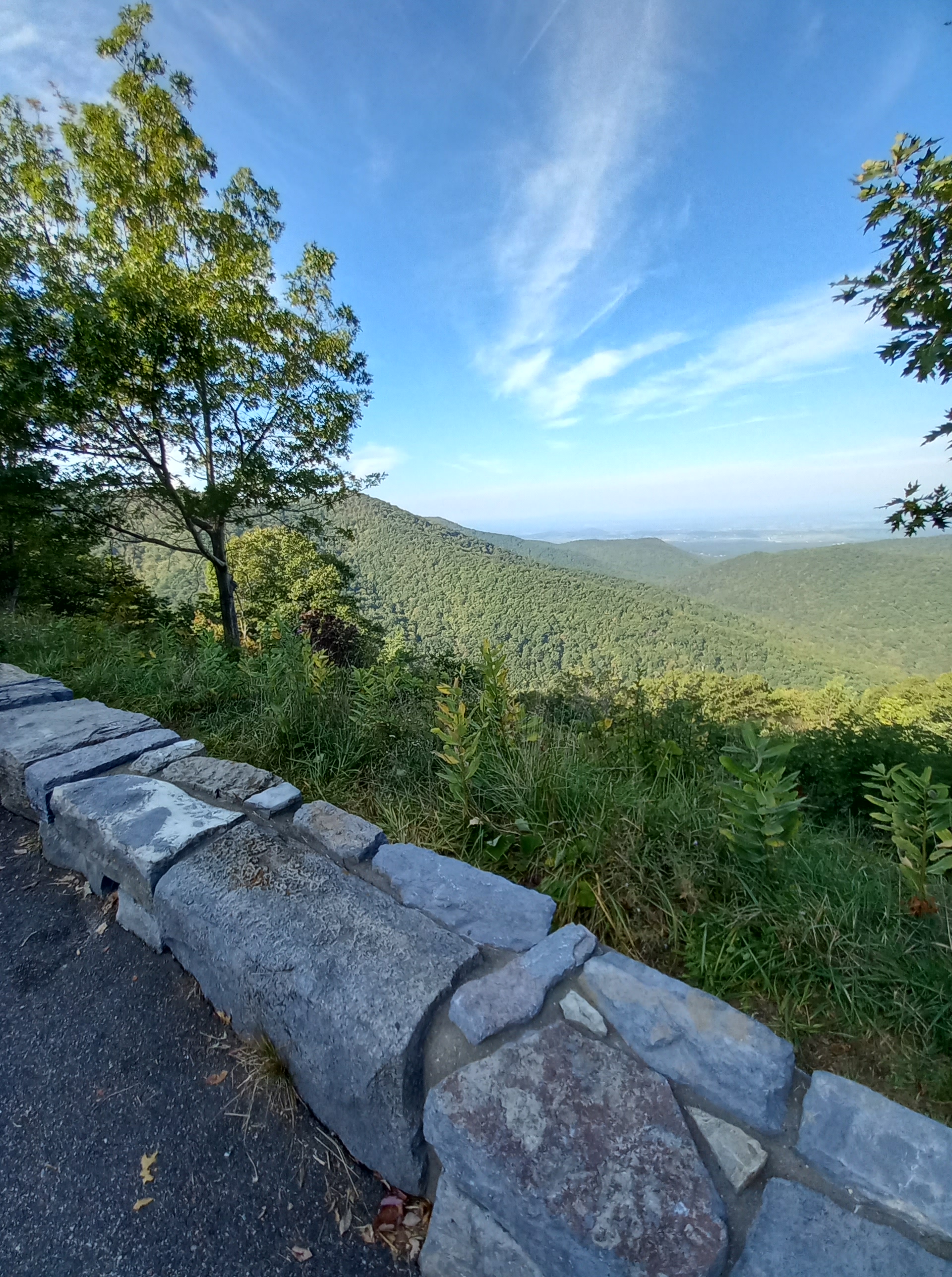
It was a relief upon reaching the park to find that my National Park Pass was still opening doors.  It had been one of the soundest investments in a long time.  The road into the park was called Skyline Drive.  There were leafy trees, oak, chestnut, and ash on both sides of the roads and hardly any traffic.  I leaned into the Mountain Bluebird, making the gentle ascent with ease.  First, I pulled over at the Calf Mountain Overlook, then at Sawmill Run.  When I got to Horsehead Mountain, I stopped the car and got out, finding a stone to sit on and contemplate the sprawling green valley below.

Was I meditating these days or simply just mind traveling?  It was hard to know what to call it, outside of trying to sit still a few moments and practice awareness.  There was a pine tree right in front of me and the ever-present rattle of insects.  Some gnats began to swarm around my face immediately.  This was going to be fun.  A breeze was running through the treetops, making a slight stir on the floor of the valley.  Instead of focusing on that, I mostly just wondered what it would be like to see Jenny again. 

She’d done me a great favor nearly thirty years earlier by leaving me and breaking my heart, the first and last woman ever to do so.  Most of the songs I’d written before then I promptly tore up and started again.  They were too sarcastic and smart-alecky, the product of a cynical youth.  When I got my heart broken, I immediately understood why everyone writes about love.  Songs about love leapt out at me from the radio and reduced me to sobs. 

I’d sat in a bathroom after slashing myself with a razor, crying and bleeding all over a scrap of paper that I’d just written a new song on called My Beautiful Dream.  All the songs that followed sprang from that battered lineage.  Many years had passed since then.  There were no hard feelings by now.  She’d gone on to get married.  I’d rambled the world like I’d always been threatening to do.  What would it be like to see her again?  I could hardly imagine but had no expectations.

The trees below were mostly green, with a little bit of red sprinkled in.  The breeze started whipping around, barely keeping the gnats at bay.  There were purple flowers in the grass in front of me.  The electric outlets of the world were all humming as one.   

By the time I got to the 33, it felt like I might be running late.  I called Jenny to let her know I was still on my way and give an approximate time of arrival.  At Ruckersville I got on the 29 south.  Now I was just thirty minutes away.  I had Karen directing me on Google Maps, not even paying attention to where I was going, just knowing I was getting closer and closer to my destination.  Then I was there, driving through an ordinary-looking neighborhood, and pulling up in front of a brick duplex.  I took a breath and knocked at the door.  Here came Jenny.

We’d met studying in Oxford and been friends before we fell into a relationship.  Now we were old, grizzled veterans of life.  There was nothing to be explained or forgiven.  It was only how is this and how is that.  Her teenage son came down the stairs and met me.  Later, her daughter came down as well and we decided to walk downtown and get some dumplings.  It was a hot afternoon.  The pedestrian mall we sat outside and ate at seemed fairly tame, outside of some gutter punks bunched up at one end of it. 

Later, we went back to the house, and I got out my ukelele.  She’d been my entire audience for a few years, still loving and requesting certain songs that I’d gone on to disown.  If anything was true it’s that I’d never really known what I wanted, just to be free.  I’d had ideas, thousands of ideas, about places I wanted to go and things I wanted to see, but there’d never been a plan.  One time, outside of a cemetery, I’d picked her up on my back and began to leap up and down, so delirious to ramble that I could barely contain myself. 

Jenny had longed for something more stable, a nest of her own, and she’d had it for a while and then lost it.  Now she was trying to build it up again for her kids.  The beautiful thing about being young is that we all still have our dreams.  She asked me to play a song called Jim White and though I’d forgotten half the words, I still played for her and sang as if I’d finally made it to the stage of Carnegie Hall.
pages fly away 52

In the morning, Jenny had to get up early and taken the kids to school.  She was taking the day off so we could go get breakfast before I hit the road again.  I’d crashed out on the couch in the living room, only sleeping for a few hours under a small blanket.  There was about an hour where I had the place to myself. 

The only time we’d lived together was in a tent our first year in Alaska and a camper our second.  I’d crashed off and on at her apartment in Minneapolis a few months before we’d broken up.  Since then, I’d continued my vagabond lifestyle, and the last twelve or thirteen years had been extreme, basically living out of a suitcase all that time.

Now I sat in her living room and waited for her to get home.  I took the time to attempt to meditate or at least process my surroundings.  A fan was spinning and there was a lamp on a nearby table.  The couch I’d slept on was to the right of me, the blanket folded up at the foot of it.  There in a guitar case was her guitar from back in the day.  A dreamcatcher hung from the ceiling, revolving slightly.  On a low table there were some painted rocks.  A bookshelf was collapsing inwards under the weight off all the books stacked on it.  There on the floor was my book of maps, my blue cooler, my ukelele.

The night before Jenny said she’d learned a lot from me about letting go.  How was that, I’d wondered.  She told me there was never a time when I hadn’t reminded her, I had one foot out the door.  True, perhaps, the Ballad of the Rambling Man.  The fact that she’d gotten married to another musician was her own fault, I guess.  I never gave my heart to anything beyond my journey.  Saddled with a job or responsibility, I’d try to satisfy it, but if there was no way out, I’d feel trapped and get anxious, needing to drink until I could at least sit still.  What about this meditation then?  How was that working out?  Well, I was sitting still.  All I was doing was thinking, but I was sitting still.  For five more minutes.

When Jenny got back, she took me out for breakfast.  That had been a rare treat back in the day.  We’d always been broke.  Our finest moment had come after the first salmon season in Alaska, when we’d been flush with a few thousand each.  We’d bought a Ford Mustang for two hundred dollars that pulled so hard to the right it was like I was arm wrestling it.  Then we’d splurged on a hotel in Alaska, Chinese food, cigarettes, weed, beer, magazines.  A million dollars couldn’t have bought us a greater amount of satisfaction, at least for the next few weeks. 

Now it was time to go our separate ways again.  She had her work cut out for her with her classes and her kids.  I had a long way to go to make it back to California in one piece.  I considered driving to Virgina Beach, just to say I’d made it to the Atlantic, but decided to save that for another trip.  I’d have to do a trip about the Revolutionary War and another about the Civil War.  This one had started out about Native Americans but had gone on to incorporate the whole of Western expansion.  I could live with that.

Before leaving Charlottesville, I decided to hit up Monticello, the home of Thomas Jefferson.  Thinking I’d probably revisit it on a later trip, I just parked in the parking lot and visited the gift shop.  Thomas Jefferson had engineered the Louisiana Purchase, acquiring much of the land that became states I’d either passed through, or would be passing through on my way back west.  He’d also been the one who’d appointed Lewis and Clark to explore the Northwest Territory.  So, there was definitely a connection.

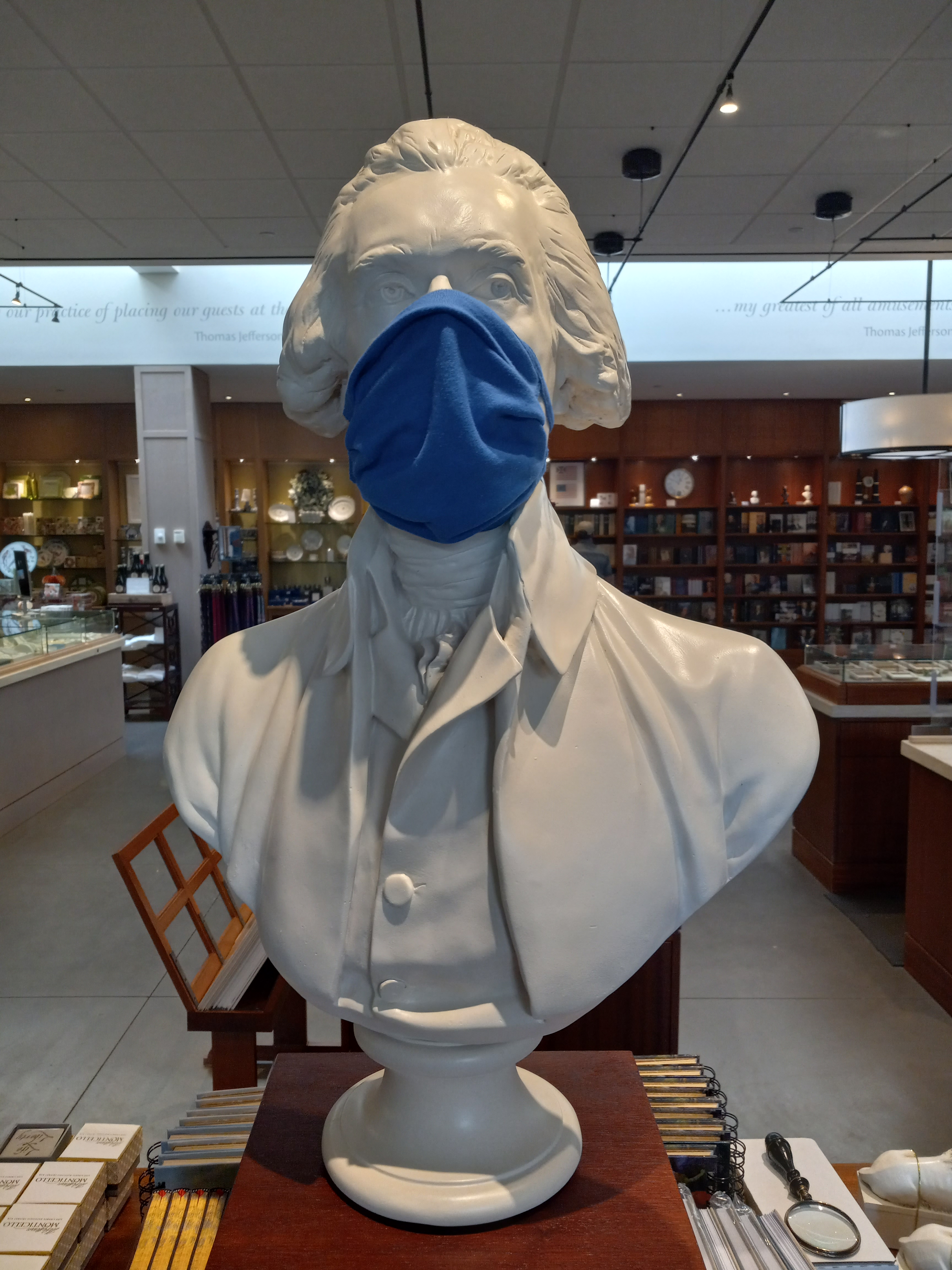
Inside the gift shop, there was a statue of Jefferson wearing a COVID mask.  The other visitors were all wearing COVID masks, and I was too.  Although many of us had never gotten the virus, it had changed our lives forever.  If anything, we now knew that someone out there had the power to lockdown the whole world within the span of one week.  When had that ever been possible before? 

You would hear about things going on in China, or some other country, and be glad it wasn’t happening to you.  Now it was happening everywhere, all at once.  Technology and mass media have made it possible to feel like danger is at the doorstep every second of our lives. When is too safe, not safe at all?  Just stick around.  We may know the answer to that question sooner than we think.

pages fly away 53

It was time to race on now.  I’d put so many miles on the Mountain Bluebird that it hurt my stomach to see the odometer.  It made me laugh out loud, but still hurt my stomach.  I knew they were tracking me, but no one had contacted me yet.  If they did, I could say I was on my way back and it would be the truth.  By the time I left Monticello, it was early afternoon.  The day had gotten away from me.  My idea was to hit up the Great Smoky Mountains, another extension of the Appalachians, and the Cherokee reservation there.

I took the 29 to Lynchburg and then cut over to Roanoke and got on the 77 south, heading towards Charlotte, North Carolina.  It was already late in the day.  There was a campground sign at a place called Lake Norman, but I didn’t see it in time to make the exit, so pulled off on the 150 and did a search on Google.  Karen led me to the Rock Springs Campground, nearly fifteen miles away. 

I had to cross the lake and then pass down a series of country roads to get there.  It was like no other campground I’d ever seen, more a grouping of pioneer cabins and shacks bunched together with a pavilion in the middle for meetings.  It was all closed up.  No one was around.  I considered trying to throw up a tent in the parking lot.  That was a sure sign of desperation.

My best bet, I decided was to backtrack to the Lake Norman Campground.  Now evening was falling fast and it was nearly dark.  When I got there, I had to drive through a tunnel of trees before reaching a gate, that fortunately, was still open.  When I reached the camp site it was a circular loop with mainly RV’s.  I had to go around twice before finding a small lane reserved for tents.  I pulled into the first spot, number 4, and almost collapsed with relief.  The whole trip had been too close for comfort, although comfort doesn’t usually produce too many thrills.  The forest was alive with percussion, the throbbing and clacking of a million insects.

That night I was had to use the bathroom and when I shined the flashlight on the roof of the tent, saw that there were at least two dozen Daddy Long Leg spiders on the mesh below the rain cover.  It was like an alien invasion, crowded together, fumbling around, their long legs all entwined.  I wasn’t worried, but a little freaked out, just by the sheer volume of them.  When I took the tent down in the early dawn, hundreds of them came streaming down the sides.  I had to shake it again and again.  Lord knows how many I’d be transporting across state lines, despite my best efforts to get rid of them.

The plan for the day was to drive to the birthplace of Davy Crockett.  I’d noticed that I could stop by the Carl Sandburg Home National Historic Site, so made that my first destination.  As soon as I got on the road, it started raining.  So far, I’d been lucky.  Bad weather would’ve annihilated my trip.  I passed the outskirts of Charlotte and then got on the 74.  There were about 30 miles of road construction that required a lot of sitting and waiting.  Also, at one point some prick swerved over and nearly sideswiped me.  I had to pull over hard to the side to avoid a collision.  That could not happen on this trip.  It simply wasn’t allowed to happen.

When I arrived at the Carl Sandburg home in Flat Rock it was still raining.  A sign in the parking lot said that the home was closed, due to COVID.  I decided to walk and see what I could see anyway.  Carl Sandburg was a poet and folksinger, who also wrote an extensive biography of Abraham Lincoln.  After his death, in 1967, he was remembered as being the quintessential American.  I knew him mostly from a book of folk songs that he’d compiled.  Most of the songs I write have their base in folk, country, and blues, so I’m always happy to pay my respects given the chance.

No one else was on the grounds, and the rain fell intermittently.  There was a small open enclosure with some black and white photos of Sandburg, a few with his guitar.  He seemed to have been an earthy guy.  There was a lake in front of the house, and a creek you had to cross to reach it, but the house wasn’t open.  I walked up to it, but then returned to find some place to sit beside the creek.  Leaves were scattered all over the walkway and the bridge.

My attempt to meditate didn’t last long.  Voices came from the parking lot.  A group was coming down the trail.  The surface of the water was calm by now, outside of a few isolated drops.  When the visitors got too close, I vacated my seat and allowed them to take over.  Back in the car, I sat and counted my breaths, as quickly as if I’d just run a wind-sprint.  It wasn’t easy at all to focus, knowing that as soon as I left, I was on my way to see Davy Crockett.

pages fly away 54

Davy Crockett was born nearly fifty years after Daniel Boone, but went on to become more famous than him, probably because he became the subject of a hugely popular Disney series in the 1950, starring Fess Parker.  He had his own theme song, which acknowledged him as the King of the Wild Frontier, and coonskin caps became all the rage.  I was a little too young for the series but had picked up a coonskin cap on a horse-riding trip in Colorado, and subsequently got to star as Davy in a school pageant during the bicentennial.  I wrestled a bear and fought two Mexicans, while the rest of the class stood behind me, dressed as trees and singing the chorus.

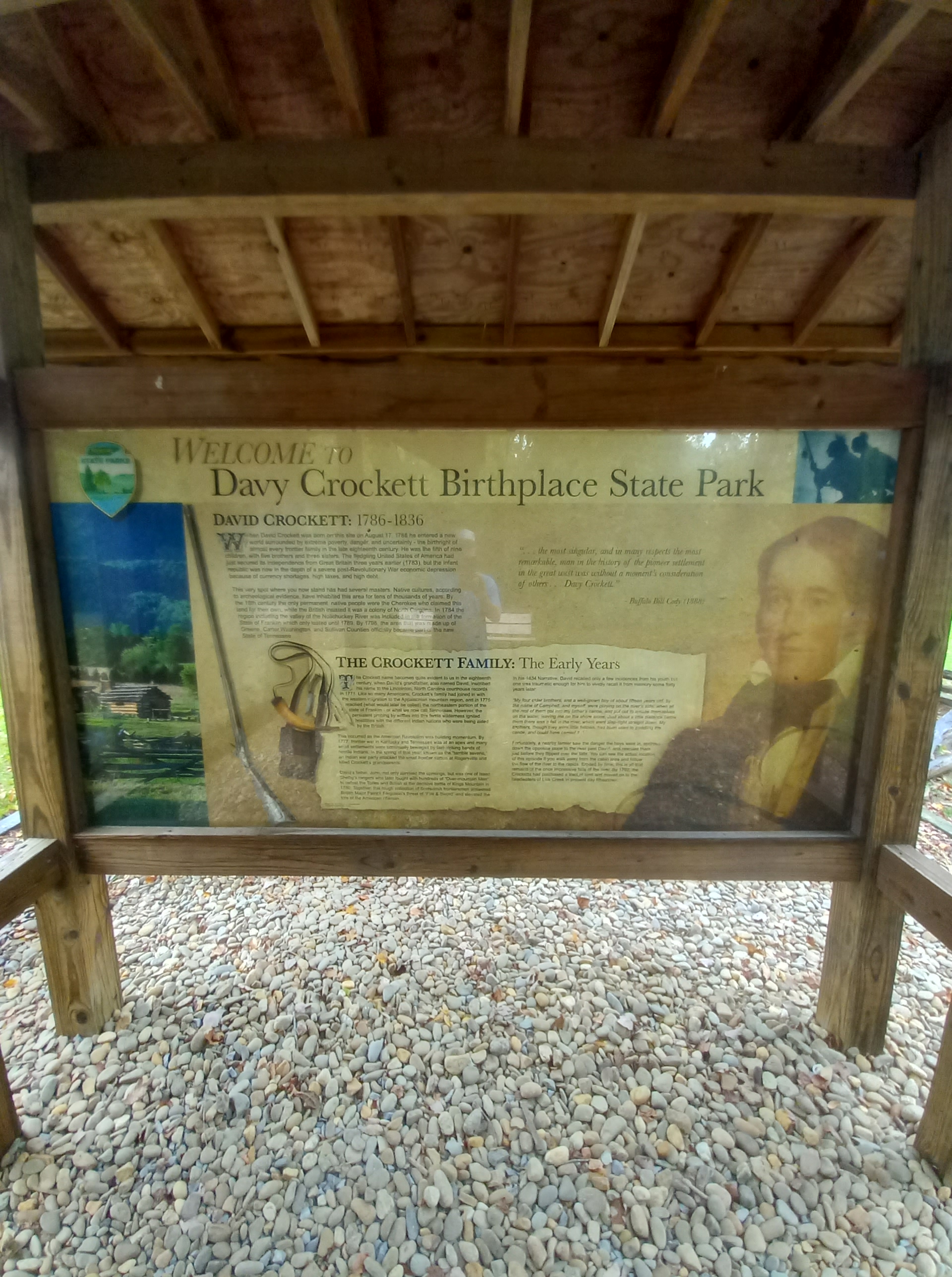
From the Carl Sandburg Home it was two hours north on the 26 to reach the David Crockett Birthplace State Park.  When I reached the town of Erwin, I headed west on the 107.  There was a nice campground there beside the Nolichucky River.  If it hadn’t been so early yet I would have set up camp. 

As with Daniel Boone, and almost every other legend of the American West, it is hard to know where the real-life story of Crockett ends, and the myth begins.  If anything, he was a storyteller.  Tall tales that sprang from his life include him killing a bear when he was three and being charismatic enough to smile a raccoon down from a tree.  He did serve as a scout and in Congress, where his oratory skills set him apart, and he did die at the Alamo, during the Texas Revolution.  That much is true.  Every other fact of his life has been stretched beyond recognition, and that’s what makes him fun.

The cabin and farm that make up the Crockett Homestead have been recreated.  A stone marker testifies that this is the spot where they once resided.  There were pictures of him in his buckskins and coonskin hat, loading the muzzle of a rifle.  Next to that is a picture of an Indian warrior, feathers in his mohawk, his own rifle laid across his knee.  I walked down to the river, taking the opportunity to call my mother and let her know I’d be back in a few weeks.  Had I already been on the road almost a month?  It appeared so, but time is elastic, we all know that.  It modifies itself to fit the occasion.

My plan was to make it to the Great Smoky Mountain Nation Park and camp there that night.  It was just a few hours away to Gatlinburg, the Gateway to the Smokies.  I got back on the 26 to the 40 west.  At one point I had to get over to the 321.  About five miles from the park entrance, it began to resemble an amusement park, sort of like the main drag of Branson.  There was a Space Needle and Sky Lift, lodges, museums, hotels, inns, old-time photos, gift shops, black bears, pumpkins and scarecrows for Halloween, Ripley’s Believe it or Not, mini-golf, waterparks, Ole Smoky Moonshine, Margaritaville.  In nearby Pigeon Forge, there was Dollywood and the Rain Forests Adventure Zoo.

Making it through all that, I was just glad that the park was open and that they accepted my National Park Pass.  I stopped at the visitor center, but there was a lethal combination of tourist mania and COVID paranoia going on.  A masked ranger stood at the door to it, letting visitors in two at a time, once two people had exited.  Meanwhile, back in Gatlinburg they’d been cramming them into the gift shops and restaurants like sardines. 

Where did the true danger lie?  With the virus?  With the black bears that everyone wanted to see?  With the other tourists?  With the government? With the society?  Maybe I was getting closer.  I decided to get away while I still could.

pages fly away 55

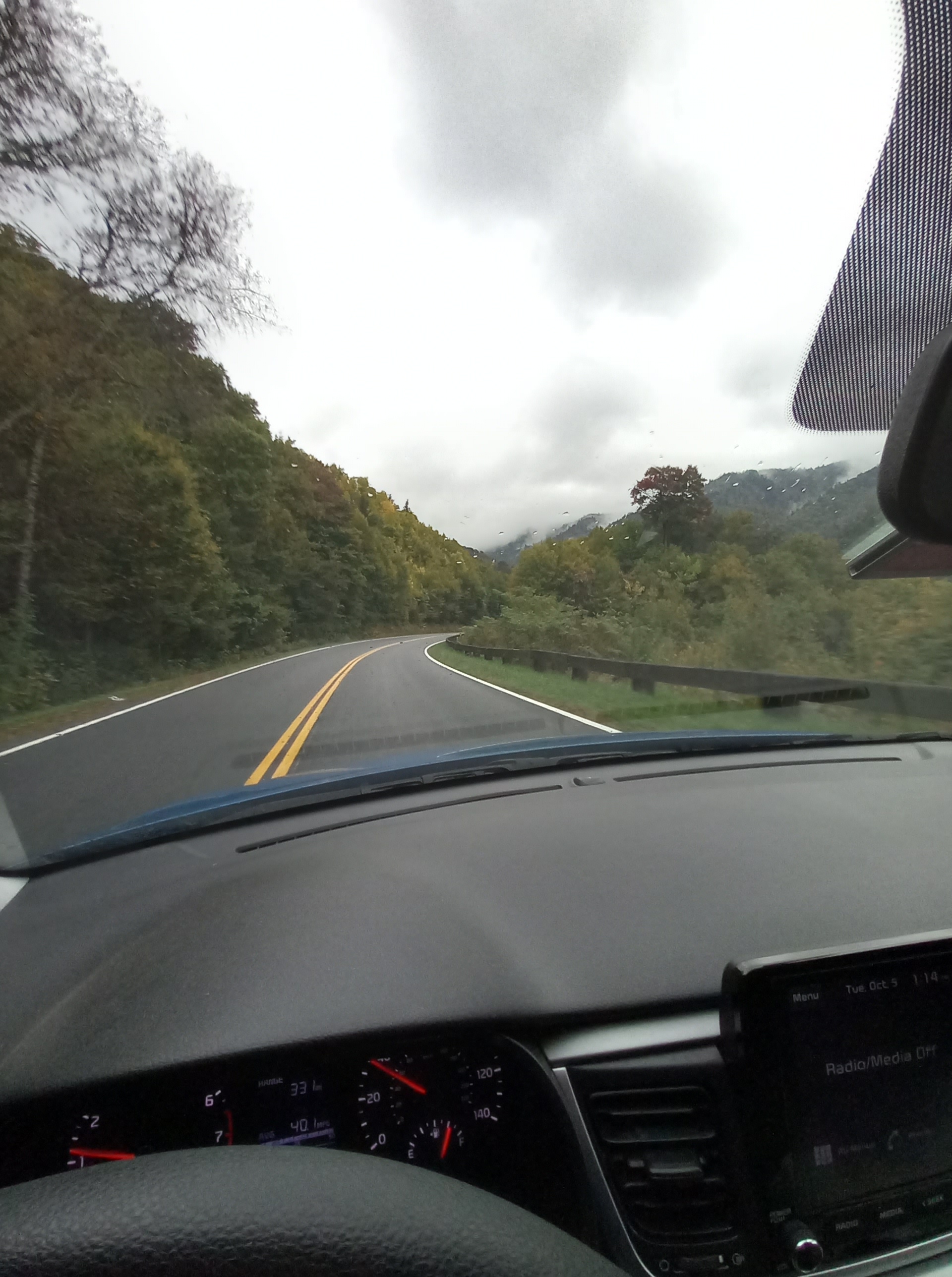
They call them the Great Smoky Mountains because of the perpetual fog that hangs above the ranges.  The Cherokee called them Chaconage, or place of the blue smoke, and considered the hills to be sacred.  Scientists believe the fog to be a mixture of water and hydrocarbons.  On this day there was no mystery behind the haze, as it was cloudy and raining.  Once I got past the visitor center, I tried to escape the horde of other tourists, and sped up the side of the mountain through the rain.  There was a great song by Ronnie Milsap that came out in 1980 called Smoky Mountain Rain.  Like the narrator of the song, I was looking for someone to make these big wheels burn.

I didn’t even get out of the car until I got to the other side of the park.  There was a campground called the Smokemont right by the exit.  I decided to see if they had anything available, even though the rain was coming down pretty hard by now.  There was an RV ahead of me with Canadian license plates.  They appeared to be holding a summit at the window.  It was taking forever.  There were spots available.  As soon as I drove in, the rain let up.  I found a site beneath some trees that was only semi-boggy.  As soon as I got my tent set up, I decided to drive into Cherokee and take a look around.

Cherokee, in North Carolina, is the capital for the Eastern Band of the Cherokee Nation.  Around fifteen thousand tribe members live on the land.  There are many things for tourists to see and do there.  I parked the car and took a footbridge over the Oconaluftee River to visit Chief Saunooke’s Trading Post.  There it was possible to see a gem mine and pan for gold in the pits.  I passed The Leather Place and saw a poster for a powwow that had happened over the summer.  Outside of one shop stood an old wooden Indian.  Outside of another sat a fat grizzly bear.  There were mechanical bull rides and Native Cloud CBD.

I walked across the street, past a painted black bear, and up to the Little Princess Restaurant.  There was a mini-golf across the street with a giant red chief extending his hand in greeting.  Getting back in the car, I drove a little further.  Two totem poles stood sentry outside a gift shop.  In the corner was another statue of a black bear, this one snarling, up on its hindlegs.  There was a mural of a medicine wheel, then the Smoky Mountain Gold and Ruby Mine.  One place offered Indian shows and face painting, and a free gift with the purchase of a pair of moccasins.  There was Bill the Buffalo.

Driving back, I came across many cars that were stopped beside the road, the tourists out with their cameras, as a herd of nearly fifty elk grazed in a nearby pasture.  I was exhausted when I got back.  Jenny had sent a Tupperware with some salmon in it, along with a few pieces of fruit.  I ate those and got into the tent, wet on the outside, mostly dry within.  There was still a group of Daddy Long Leg spiders from Lake Norman, scrambling towards the corners.  I didn’t wish them ill, but did there need to be so many of them? 

It rained pretty hard for a while, but then stopped around two.  I couldn’t sleep anyway, and decided to just break down my camp before it started pouring again.  The spiders all came scrambling out like sailors fleeing a sinking ship.  The ones that didn’t get out, got folded up in the tent and stashed back in the trunk.  It was nice and cool in the car.  I could’ve easily fallen asleep sitting there.  Instead, I tried to meditate.

I put the window down a little and could hear the constant rushing of the stream that ran through the camp.  There was also a breeze running through the trees, shaking raindrops loose that fell on the roof of the car with a ping.  A harder breeze came through and some soggy yellow leaves landed on the hood.  There was a bathroom with a light on, about fifty feet away.  The light it was casting seemed to be reflecting off the low-hanging clouds.  There were no visible stars.  A few times it started to sprinkle, but then stopped again.  It was still pitch-black but time to get moving.  Where I’d end up next, I could hardly wait to see.

pages fly away 56

When I’d left on my big road trip a month earlier, I’d had no idea which direction I might head or how long I would be out there.  I’d rented the car for six weeks, which meant I had two more left.  So far, I’d been all over the place, up the West coast, across the North, right down through the Middle, over to the East.  Why not all the way South?  Why not?  I decided to head for the Mississippi Delta. 

It was three in the morning when I left the Smokemont Campground.  The sun wouldn’t be rising for at least three more hours.  When you have that much adrenaline running through your veins you are either extremely excited or extremely manic.  I was a little of both.  I took the 74 to Chattanooga, and then flew down the 59 freeway to Birmingham.  From there, I got on the 20 west and had just passed Tuscaloosa, when I saw a sign that said Moundville.  Moundville?  I had never heard of it before.  I missed the exit and had to backtrack to get to it.  It was about ten miles south on the 69.

Moundville Archaeological Site was a ceremonial site of the ancient Mississippi culture and is located on the Black Warrior River.  The region of the Mound Building societies was largely in the south and middle of what is now the states.  Many people are probably not even aware the mounds exist.  For some reason they don’t get a lot of publicity.  When I entered the park, a sign pointed me toward the Chieftains Mound.  There were three or four large mounds rising from the green grass in front of me. 

I drove over to the Chieftains Mound, which stands sixty feet tall, and has a flat surface at the top.  Steps lead to a viewing platform and a sign explains that the chief might’ve claimed to have had relationships with supernatural beings, from which he derived his power and authority.  It reminded me of ruins I’ve visited in Mexico and Central America, but without any of the temples or structures.  Only the foundations, or the mounds, remain to testify to the ghost civilizations of the past.

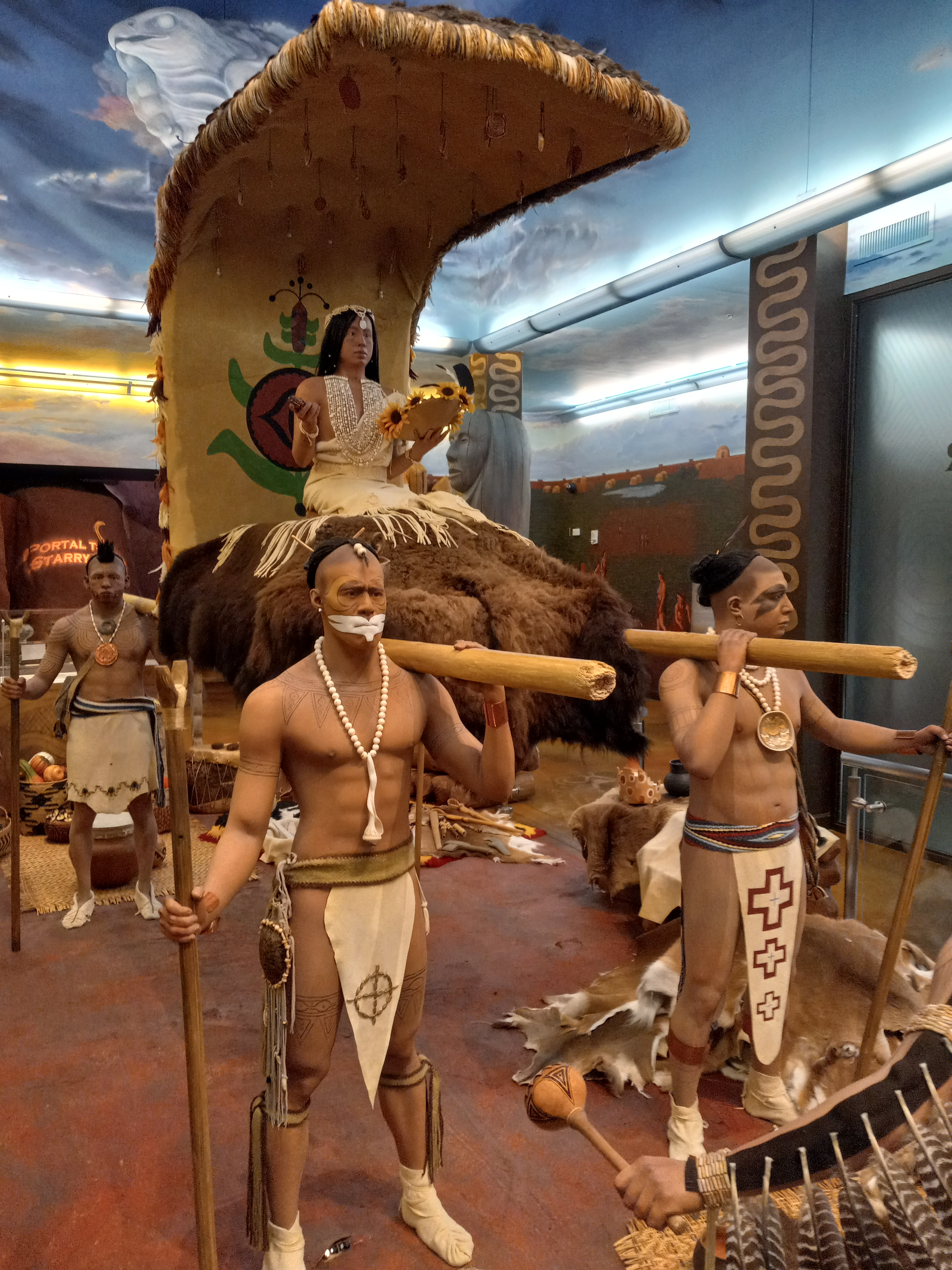
There was a museum, the Jones Archaeological Museum, I went into next, not expecting much.  Four carved birds sat on pillars leading to the entrance.  Inside was an exhibit called Lost Realm of the Black Warrior, which featured ancient artifacts and recreated scenes, with very life-like figures, that were almost futuristic.  They were a mix of Native American and Egyptian, with a little bit of Mad Max thrown in. 

The first was four warriors, wearing loincloths, bare-chested, only necklaces, top-knots, painted faces, carrying a queen on a palanquin.  She had shells around her neck and head, and a tray of sunflowers in her hand.  A medicine man, with plumes in his hair, follows the procession, blowing on a flute.  Another, crouches to the side, feathers under his arms, black crow wings painted on his eyes, holding a rattle and a stone axe.

Another scene showed four figures, three men and a woman, with painted faces, piled high with animal skins.  They seem to be trading or carrying out a business transaction.  With their antenna headdresses and elaborate jewelry, they belong as much to the future as they do the past.

Driving down to the river afterwards, I came upon four huts that housed more primitive exhibits.  Here were figures with less adornment, acting out a day in the life of a villager back in that time.  In one hut two women were weaving while a man was carving a bow.  In the next they were grinding corn and wheat and making fish-traps our of sticks.  In the third they were creating art, stretching, and painting skins, and making pottery.  In the last hut they were burying the dead, sitting around a shallow grave, the corpse surrounded by food and gourds full of provisions for the afterlife.

After leaving Moundville, it was another hour and a half to get to Meridian, Mississippi.  It is the home of Jimmie Rodgers, the singing brakeman, and I’d visited his grave before.  Now I wanted to find it again, but ended up at a museum that was closed.  The sign of the door said it was open, but it wasn’t. 

There were pictures of Rodgers out front, wearing an engineer’s cap and giving two thumbs up, another in a cowboy suit, playing his guitar.  He was famous for his blue yodel and the first musician inducted into the Country Hall of Fame.  One of his greatest hits is called Waiting for a Train.  I could’ve looked harder for his grave but wasn’t waiting for anything.  It was two more hours to Vicksburg and then on to Highway 61.

pages fly away 57

Highway 61, the Blues Highway, runs from New Orleans all the way to Minnesota, and is one of the most fabled stretches of road in the land.  I’d driven through it a few times before, but wanted to see it again.  Although it was only two hours to Vicksburg, I’d already been driving since three in the morning.  I figured I’d probably look for a campground and start driving up Highway 61 in the morning. 

When I got to Vicksburg, it was hot and still too early to stop, however, so after visiting a Civil War Memorial with a view of the Mississippi River, now a sprawling old granddaddy of a river, lazily putzing on a few more miles before giving it up in the Gulf of Mexico, I backtracked five miles and got on the 61 heading north.

The day was clear and bright, with a few scattered clouds in the sky.  The trees on both sides of the road were wreathed in Spanish Moss, interesting by day, potentially spooky by night.  A few of the homes and trailers I passed were decorated for Halloween.  Around one tree someone had placed a circle of black witches.  I didn’t believe it to be related to any hoodoo rituals, but still pulled over to take a look.

My first stop was in Rolling Fork, the home of the great bluesman, Muddy Waters.  Blues is a vital ingredient in my song mix, and that is largely from the shuffle rhythm I learned playing Good Morning Little Schoolgirl off Muddy’s Folk Singer album, at least ten thousand times in my early twenties.  I stood by rivers, waded out into fields and oceans, rode on buses and trains, climbed to the top of the world, playing that rhythm.  I played the same rhythm for over thirty years and in all that time have never written a single straight-up twelve-bar blues.  I rely on the blues for propulsion and feeling, rather than form.  The greats did it their way.  I try to do it mine.

When it comes to American music, Muddy Waters is one of the kings.  When I reached the town of Rolling Fork, it was curious to see that Teddy Roosevelt’s Bear Hunt of 1902, seemed to be as important to the town as Muddy himself.  Apparently, Teddy was in Mississippi to hunt black bears, and refused to shoot a bear that had been clubbed and was unable to defend itself.  A toy shop owner got wind of the story and began producing Teddy Bears.  That’s how those got started.

As far as Muddy, he was a tractor driver who ran a juke joint and was first recorded playing and singing by Alan Lomax for the Library of Congress.  Later, he migrated to Chicago and helped to invent the electric blues.  From that the seeds of early rock and roll were formed.  Muddy, along with other blues heroes, like Howling Wolf and Sonny Boy Williams, were revered by the musicians who made up the British Invasion of the 60s, acts like the Beatles and the Rolling Stones.  Even Pink Floyd, the living definition of prog rock, got their start as a blues cover band.

In the town square I came across a shrine to Muddy, made up of photos, records, art work inspired by him, and tributes.  Across the street was the City Barber Shop and Aces Lounge.  Outside the Sharkey County Library there was a mural featuring, Muddy Waters, Roosevelt, an American Indian, a few black bears, an ear of corn, deer, a mallard duck, a catfish, and a sign for Highway 61. 

In Leland, the home of Kermit the Frog, I came up the Highway 61 Blues Museum, which was temporarily closed.  I read about James “Son” Thomas, a famous musician and sculptor who’d once worked at the hotel that was now the museum.  There was a painting of two men on a farm playing guitars.  A nearby mural depicted local musicians who’d gone on attain some renown.  On one corner there was a sign commemorating Johnny Winter.  I drove further and found one celebrating Bobbie Gentry.

From Leland, it was an hour east to get to the grave of Robert Johnson outside of Greenwood.  I took the 82 to get there.  Although he recorded just twenty-nine songs in his brief career, Johnson is a seminal character in blues mythology, being the one who sold his soul to the devil at the crossroads in order to be able to play the blues.  He achieved such proficiency in such a short span of time, the story seemed almost plausible to some.

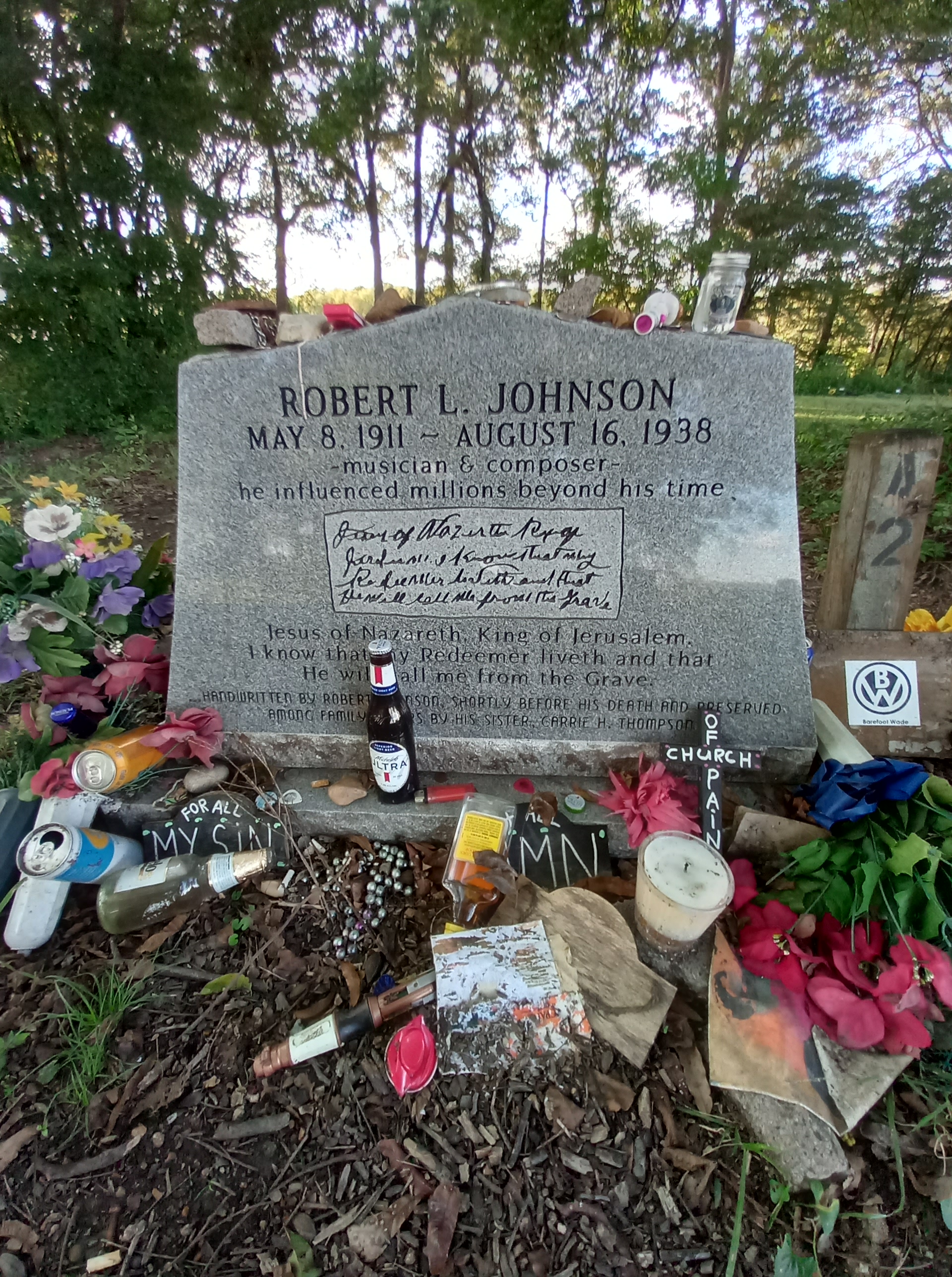
Johnson is believed to be buried in the cemetery of the Little Zion Church.  Rather he resides there or not, his headstone has certainly been turned into a shrine.  It says he was born in 1911 and passed away in 1938, allegedly poisoned by a rival for the affections of a woman.  The grave is covered with flowers, candles, bottles of alcohol, and smaller stones.  The back of the headstone quotes the lyrics to one of his songs, something about going away and coming back with a great story. 

On a whim, I Googled Robert Johnson’s Crossroads, and was given a location, about fifty miles away.  Karen, the voice of Google Maps, had been the trustiest guide an explorer could wish for, outside of the times when my phone signal had dropped out.  Now she directed me to the Crossroads, the Mountain Bluebird obeying every turn of the wheel.  I took the 518 north to the 8 west, then the 49 to Johnson-Claremont Road.  The sun was low in the sky, illuminating a veil of clouds and the fields of cotton I was passing by.

How can Google know where Robert Johnson made his deal with the devil?  I didn’t care.  The place I got taken to was perfect, two trees growing beside some train tracks, near the intersection of two country roads.  It was where the red road meets the black road.  I knew I was standing on holy ground.  I got out and took a picture of the Mountain Bluebird parked right at the intersection, the lights of it glowing as orange as the sun that was setting down behind it.