Category Archives: Travels

pages fly away 79

Trains passed by the Western Hills Motel in Flagstaff all night long.  If you couldn’t hear the whistle and the clacking of the wheels on the rails, you could feel them vibrating through the wall.  I was up at six, not quite ready to give up the comfort of the bed so quickly, now that I was close to home. 

I turned on the TV and the Today Show was on, all the guests facing each other with broad smiles and exaggerated emotions.  In between, were commercials for Botox and various pharmaceutical drugs, the reality of the present world, not the imaginary past that I’d just come traipsing through, or the future, which would probably just get worse.

There wasn’t much connection between people and nature anymore, and very little with other people.  These days everyone is star in their own universe, with their social media and earbuds.  Liking and sharing, two of the kindest actions a human can take have become debased, meaning something more akin to conquest and propaganda.  Were there some hurt feelings involved?  Sure, I’d always hope to get the respect that comes with recognition, but I’d been living in my own personal Siberia for so long, even that didn’t matter anymore.  The only way to escape crushing anxiety was to fly to the moment, expand on it, fill it full of meaning and wonder.  Easy on a road trip, harder back at home.

The news came on.  The anchors and reporters were all polite, earnest, civil people, quick to break into laughter when the opportunity arose, yet able to put on a pained, mournful face when discussing a more somber topic.  They were saying the reported cases of COVID were higher than ever.  How long would this go on, outside of the rest of our lives?  I’d seen little evidence of it on my trip, just museums that were closed instead of gift shops and places where they still required masks.  What they were predicting was a new variant.  How many of those could they spin into eternity, knowing that they’d learned how to shut the whole world down inside of a week?

A light was beginning to show at the window.  I could hear another freight train throttling past and the skimming by of cars out on Route 66.  There were birds that began to chirp, as a commercial came on.  The Cardinals had a home game coming up in Phoenix.  Then there was something regarding the magic of Christmas and a third one plugging the Disneyland Resort in Florida. 

It was an age of miracles we were living in.  It was possible to be happy all the time.  Take your medication, go to the game, buy presents ahead of time, and then go on a big vacation.  What about money?  Well, it didn’t hurt to dream.  Start small.  Get a job.  Open up a savings account.  In the meantime, put it on a credit card.  You could always pay for it later.

There was a fire north of Phoenix a at Tesla Repair Shop.  It was deemed not accidental.  It had accelerated and spread too fast.  They had a dog there wandering through the debris.  The moratorium on evictions had also ended.  Thousands were facing evictions.  Across the country that number was even higher.  Up to fifty-thousand people could soon lose their homes.  And what was this latest breaking news?  The coach and general manager of the Cardinals had just tested positive for COVID.  How would this impact the game? 

The toilet had been running all this time.  I finally had to get up and jiggle the handle, but doing so ruined my concentration.  The whistle of a train blasted so loudly then it seemed like it was in the next room.  I went and opened up the door and was nearly blinded.  It was an immensely bright day. 

Once the car was loaded, I decided to cruise through downtown before hitting the road.  I’d put almost fifteen thousand miles on the car.  It was hard to imagine that going over well when I returned it.  What could I say?  It was bad enough the last time when I’d returned a rental car that reeked like salsa.  The guy had gotten in to check the mileage and come out with his eyes watering. 

This time it would be more like tears of rage, that is if he was in any way invested in the company.  I was hoping that they wouldn’t notice.  Fat chance of that.
pages fly away 80

From Flagstaff it was just thirty miles to Sedona, famous for its red rocks, spires, and pine forests, as well as the New Age seekers that it famously attracts.  I’d been there before and was just passing though.  My real destination was a monument in southern Arizona, and that was a long-ass drive, over four hundred miles. 

It was another beautiful morning.  What could I say?  On this trip those had been a given, only three or four days impacted by rain and no storms strong enough to keep me from staying in a tent with no pegs.  Two nights I’d had to use rocks to weigh down the tent.  That’s the windiest it had ever gotten.  Now I drove south on the 89A, arriving in Sedona to find galleries and boutiques, places for yoga and renewing.  It was so early still almost no one was out, just a few couples out looking for coffee.  On the way out of town I passed a mall, with a statue of an Indian, looking like he’d just put up the sign.  That was telling.

I’d just gotten onto the 17 heading south when I came upon a sign for the Montezuma Castle National Monument.  This ended up being a cliff-dwelling residency, which viewed from underneath resembled the mud nests that swallows build beneath freeways and inside of caves.  The monument was next to the Yavapai Apache Nation Reservation, which housed the Cliff Castle Casino Hotel.  If all went according to plan, I would be driving through the Fort Apache and San Carlos Reservations later that day.

The Apache are a group of tribes from the Southwest that are distantly related to the Navajo.  They have a long history with Mexico, both as foe and friend, and spent their time trading with some villages while raiding others.  They sided with the US in the 1842 war against Mexico, but conflict began when the war was won and they began to be placed on reservations.  Although skilled warriors and strategists in battle, their outsized reputations for blood-thirsty savagery, in many cases were attempts to justify the brutality that was inflicted on them.

Because I wanted to drive through Fort Apache, I took the 260 all the way to Show Low, through the Tonto National Forest, and then headed south of the 60.  The White Mountain Apache populate the reservation, so named because of its use as a military outpost during the Indian Wars. 

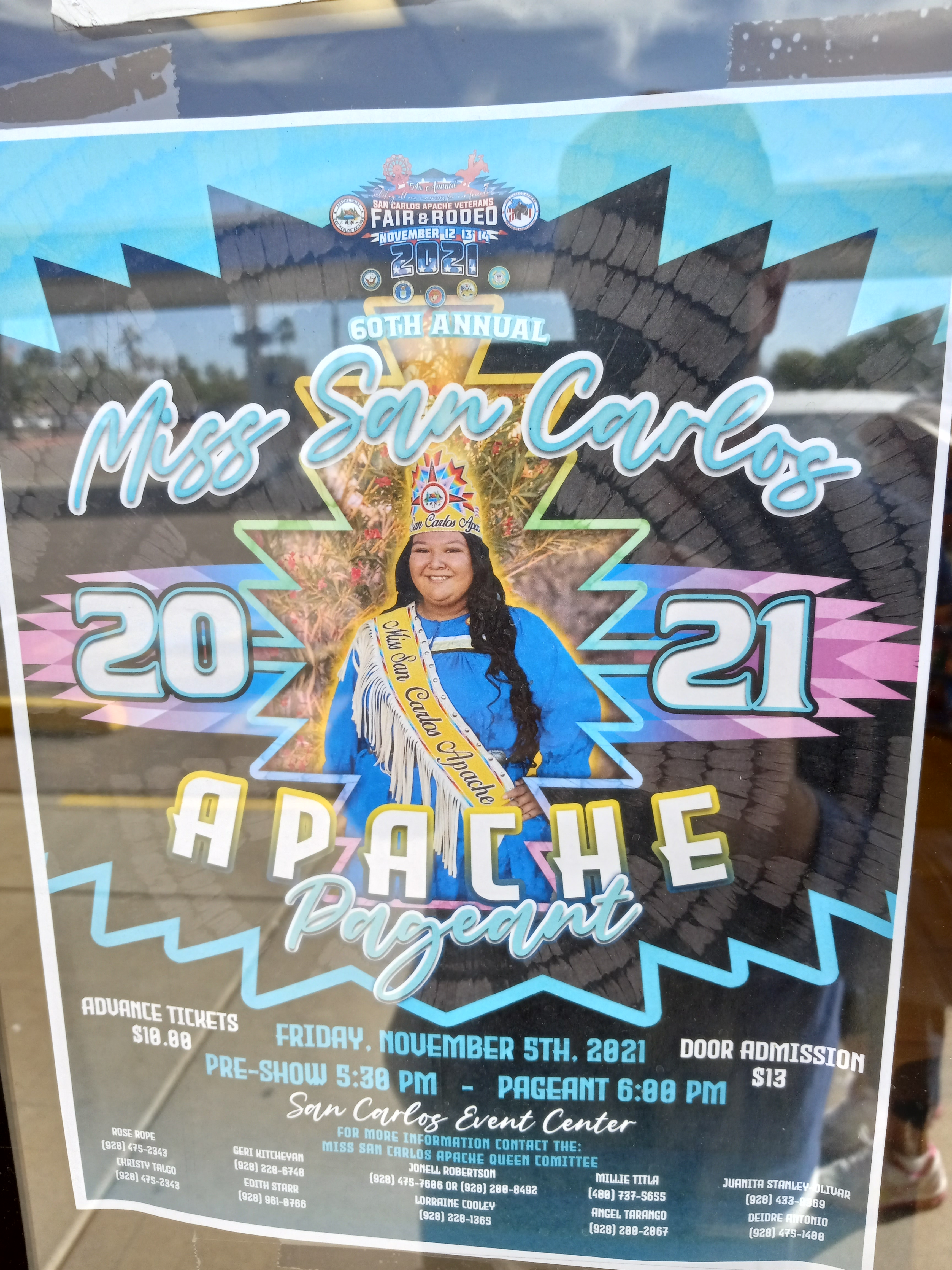
When I got to the 70, I headed east, and soon came across the Apache Gold Casino on the San Carlos Reservation.  Some kind of motorcycle rally was going on in the parking lot.  Once described by an army officer as Hell’s 40 acres, it appeared a few of the visitors were eager to fan the flames and get the fun started.  I got gas and looked at some posters for upcoming events.  It looked like there was an upcoming fair and rodeo, and also a Miss San Carlos Pageant.

By the time I reached the 10 east, I was heavily zoned out.  I’d been driving so long and so hard, it appeared the nerves in my lower back might be permanently pinched.  The highway seemed to go on forever.  At one point I glanced down and saw I was going a hundred miles an hour.

By the time I got to Road Fork, I was back in New Mexico.  I got off on this tiny country road, the 80, and started heading south, still zipping along.  At one point I saw a vehicle parked on the shoulder of the road ahead of me, and thought I should probably slow down.  A little further and I knew I should.  I jammed on the brake a hundred yards from passing a police cruiser.  Then I looked in my rearview mirror and saw it do a U-turn and hit the red lights.  All this driving around the country without an issue.  Why now?  How fast had I been going?

The officer came over and asked for my license and registration.  He’d caught me going sixty-five in a fifty-mile-an-hour zone.  Fifty miles an hour?  What was that all about?  There were tumbleweeds going faster than that.  I slumped and stewed until he came back to me.  He was willing to knock five miles off my recorded speed, making it a slightly less egregious offense.  I could use their website to pay the fine.  He went back to his cruiser and I drove off at a crawl.  Less than five minutes later, I crossed the Arizona state line.

pages fly away 81

Why do people sometimes yell Geronimo when jumping from a great height?  It was a practice that was adopted by some paratroopers in the US Army and may have come from a movie they’d seen or a song that was popular on the radio at the time.  Another origin story of the tall tale variety is that the famous warrior once escaped capture from a posse by jumping his horse off a high cliff and simultaneously calling out his own name. 

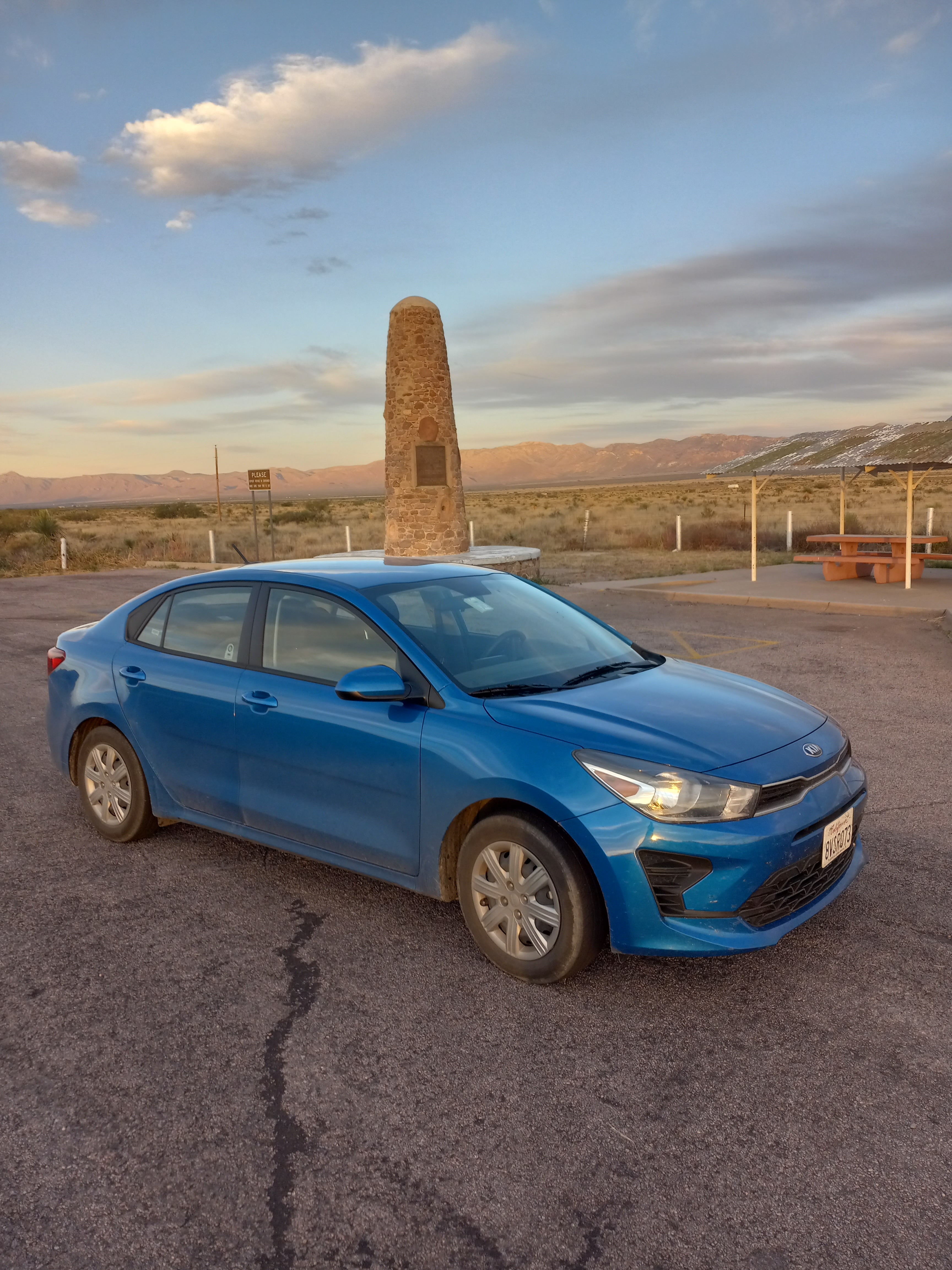
The monument I was about to visit, outside of Skeleton Canyon, is said to mark the spot where Geronimo finally surrendered to General Miles in 1886.  What a place to finally get a speeding ticket, in the twilight of my epic road trip.

Geronimo was a medicine man of the Bedonkohe Apache band who carried out raids in northern Mexico and Arizona and New Mexico.  He was a great leader who sometimes led up to fifty warriors.  The Apache resented the confinement of the reservations and Geronimo escaped from them three times.  After finally surrendering, he was put on display in fairs, exhibits, and parades, about as demeaning as keeping a mountain line in a cage, until he finally died at Fort Sill in Oklahoma in 1909.  Since then, he has gone on to symbolize resistance, being the last of the great Indian warriors to give up the fight.

It was late in the afternoon when I reached the monument, out in the middle of nowhere.  I parked the Mountain Bluebird and got out.  There were concessions I’d made along the way, and others ahead of me.  That is what happens when you grow old.  It would’ve been easier to go out in a thunderbolt of youthful impetuousness, but that wasn’t the hand I’d been dealt.

  How much of the future would involve remembering and embellishing upon old battles rather than waging new ones?  I’d had very little in the way of support and no followers.  I would’ve been happy to jump a horse off a high cliff, but no one had ever been chasing me, outside of my own fears and doubts. 

What was the war that I’d been fighting all these years?  Only this.  That life should mean more than what we’ve made of it.

The sun was setting as I posed for a picture.  Yes.  This would be a good time for a selfie, the dying sun in my eyes, my shadow falling on the scripted pillar at my back.  Now a picture with my great valiant steed, the Mountain Bluebird, parked in front of it.  If it could talk, what tales it would tell, how it had been freed from its little pen in Huntington Beach to roam the country far and wide.  I got back in and started to drive, only the whirring of the tires on the blacktop as my soundtrack.  Clouds came down, first golden, then turning red.  They created a firestorm in the heavens, looking as if they could touch down and scorch the earth to sleep.

I was close to the Mexican border.  The Mexican state of Sonora was just across the other side.  When I got to Douglas there was a wall separating it from Agua Prieta.  I turned right and followed it a half mile.  Then I took another right, saving Mexico for my next journey.  A mile away, I came across a Motel-6.  Fifty-nine dollars a night.  Not great, but I could live with it.  I still had two more long days ahead of me. 

It was just like the good old days, slumming in a Motel-6 on the Mexican border.  I remembered my last extended stay in one, with my front tooth missing and the engine seized up in my pickup truck.  Ah, the glory days.  Don’t get me started.

pages fly away 82

The three most famous Old West gunslinging towns were Deadwood, Dodge City, and Tombstone.  When I set off on my six-week road trip I didn’t think I’d visit one of them, let alone all three, and yet here I was, just an hour away from Tombstone.  I’d been there once before to do some field-recordings and was looking forward to revisiting it.  On the way, I stopped to visit the old mining town of Bisbee, and the nine-hundred-foot Lavendar Pit on the outskirts of town.  When I showed up in Tombstone, I couldn’t have been happier that I’d arrived just in time for their annual celebration, Helldorado Days.

Tombstone is most known for the Shootout at the OK Corral, between US Marshall Virgil Earp, his brothers, Morgan and Wyatt, and Doc Holliday, against cowboys Billy Clairborne, Ike and Billy Clanton, and Tom and Frank McLaury.  Bad blood had been brewing between both parties for some time, and Billy Clanton and the McLaury brothers were killed in what has also been described as a massacre.  Apparently, it was all over in thirty seconds, and when the dust cleared history been made. 

I parked across from the City Hall and wondered past old OK Corral.  Since gunfight reenactments are part of the daily routine in Tombstone, it took me a while to realize that all of the people dressed up as cowboys, saloon girls, and mountain men, were there for the festivities and many would be taking part in a parade down Main Street that was starting in a few hours.  It seemed my luck was still holding out.  Too wired to sit and meditate that day, I decided to do a walking meditation on the boardwalk.

A church bell was tolling as I crossed the street.  A car stopped to let me pass and a cowboy waved me across.  I was standing right next to my own shadow on the ground.  A picture of Billy Clanton and the McLaury brothers in their coffins bore the caption, Three Murdered in Tombstone.  Tom was hit by a shotgun fired by Doc Holliday.  He and Billy both died slowly.  Frank was shot in the head and died instantly.

Across the street was a stand selling sarsaparilla sodas.  A saloon girl rode by on a golf cart.  In the city park was a bounce house for children.  The OK Café was selling real buffalo burgers.  Up ahead on the street was a stagecoach, being drawn by a mule.  A cowboy approached me selling tickets to the gunfight.  I turned on to the boardwalk. 

A leather-clad biker came out of Outlaw Books.  I looked into a shop window.  There was an Indian drum, dreamcatchers, wanted dead or alive posters, an American flag, a Mexican blanket.  There were movie posters.  The Magnificent Seven.  Geronimo.  The Good, the Bad, and the Ugly.  The Unforgiven.  Two cowboys stopped and posed when I asked for a picture.

In another shop window was an Indian head in a headdress, one half of his face painted white.  There was a fox hat.  A kachina doll.  I had to stop a mountain man for a picture, clad in buckskin.  He put his hands on his hips and puffed out his chest.  There were Navajo rugs, pottery, a buffalo-headed medicine man holding up a pipe.  Two Indians danced on a shelf, one with hoops, the other with feathers.  A wooden Indian stood outside the shop. 

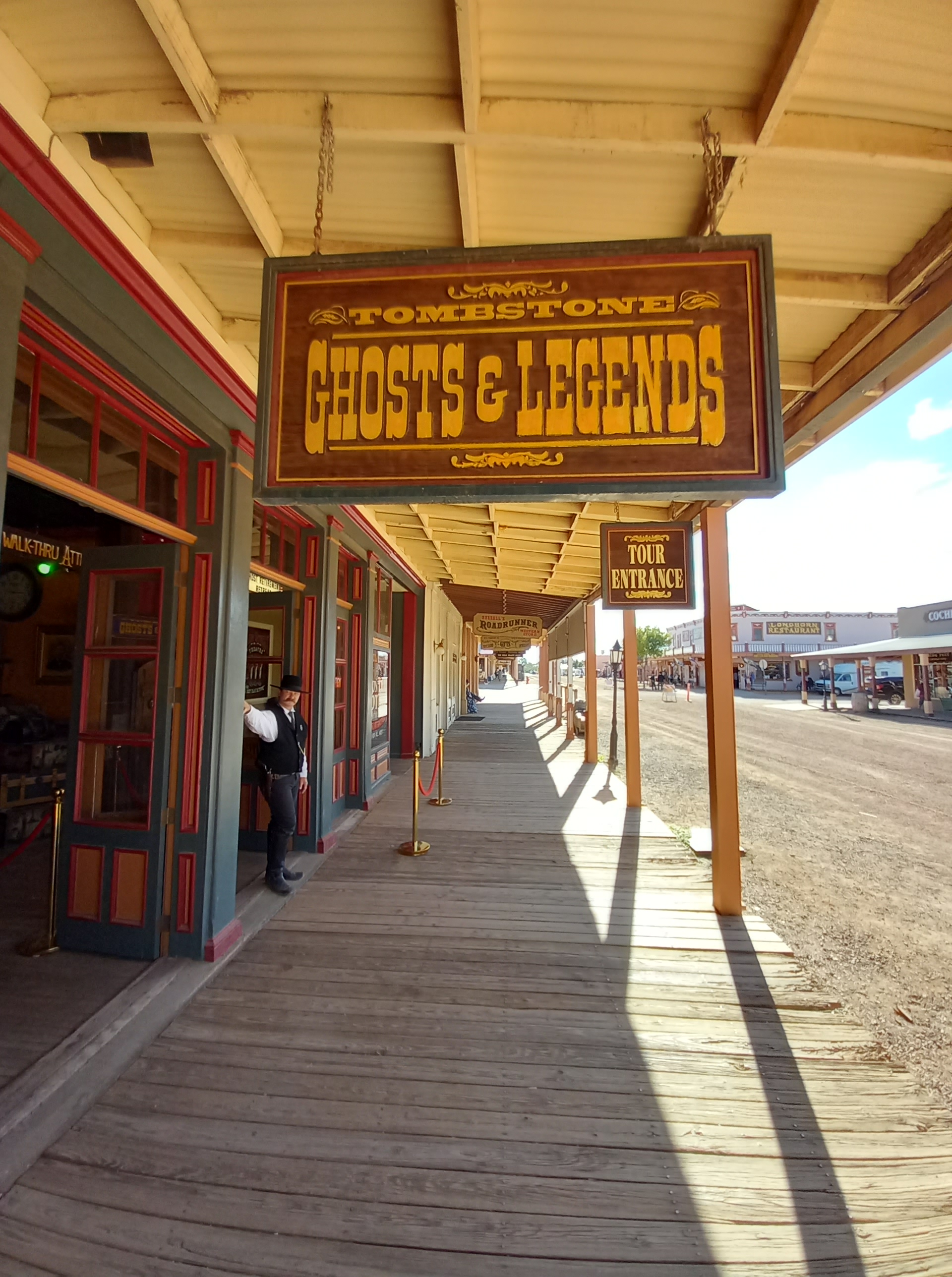
Wyatt Earp looked out the door at me as I approached Tombstone Ghosts and Legends.  I told him he looked like Kurt Russel.  He said he got that a lot.  I passed Ike Clanton’s Haunted Hotel and Russel’s Roadrunner Stetson.  Dwarf Wrestling was coming to town.  Also, How the West was Fun.

The Oriental Saloon featured the kicking legs of showgirls in the window.  You could get a pressed penny souvenir for fifty-one cents, right next to Lilly’s Tombstone Memories.  I looked in a window and saw a coyote howling at the moon, a rattlesnake, a buffalo, and a cactus.  Across the street was the Birdcage Theater. 

Cowboys on horseback were lining up for the parade.  I came down the other side and saw Big Nose Kate’s Saloon.  There was the Dead Man’s Hand, two black aces and two black eights.  Tombstone.  RIP.  Longhorn cattle.  Totem poles.  Handcuffs.  Cap guns.  Racoon hats.  Legends of the West.

Where was I at, outside of lost in time?  From somewhere the National Anthem was being sung.  Spurs were coming up behind me, ringing louder and louder in my ears.  The parade was about to begin.  I found a seat on the boardwalk and sat down to watch the show.

pages fly away 83

One time I got irritated at my nieces, which I don’t often do, when they started to complain about how bored they were at a Fourth of July parade that we’d waited a long time to see.  They wanted to go back to the house and use their tablets and phones.  I’d ended up sounding like an old man when I informed them that back in my day all we had was the parade.  We waited all year for it.  We liked it no matter what.

Now the Helldorado Days Parade was making its way down the street, and I was excited as a boy would be back when I grew up.  What were the chances of randomly rolling into town on the only day of the year they’d be out celebrating?  I knew it was destined to be, but didn’t know why.  Here came the Board of Directors, holding a sign, kick-stepping to the music.  Next was a repertory company, Code of the West.  I knew that mountain man from somewhere. 

Behind him came Wyatt Earp, next to a woman in bloomers swinging a baseball bat.  Who was that behind them?  Another mountain man, this one with a rifle, five cowboys, a US Marshall. 

Next came a coven of witches, one really hot one, twirling brooms.  Then a gang of motorcycle banditos.  Right behind them, John Wayne as Rooster Cogburn, bellowing out a greeting to the crowd.  The Calvary riders came right behind him, then the Shriners in their tiny cars, whizzing around in circles.  Another group of riders brought up the rear.  Wow.  What excitement.

There would be activities all day long, but I’d been there for the best of it.  I went to look for the car and then saw it was over four hundred miles to Joshua Tree.  I wouldn’t be making it that far.  On the outskirts of town was the Boothill Graveyard.  When I saw they were charging an entrance fee I almost blew it off and even got in the car, but then turned back.

All of these people parading down the street.  Me, in the Mountain Bluebird, racing against the wind.  What is our final destination?  Where are we all going?  I got out and began walking past the rock piles, cactus, and wooden headstones.  There were the three cowboys who’d been killed in the Shootout at the OK Corral.  Were they even bones anymore or just dust?  Unlike most of the others buried there, at least they had a story that had outlived them, if that’s any consolation. 

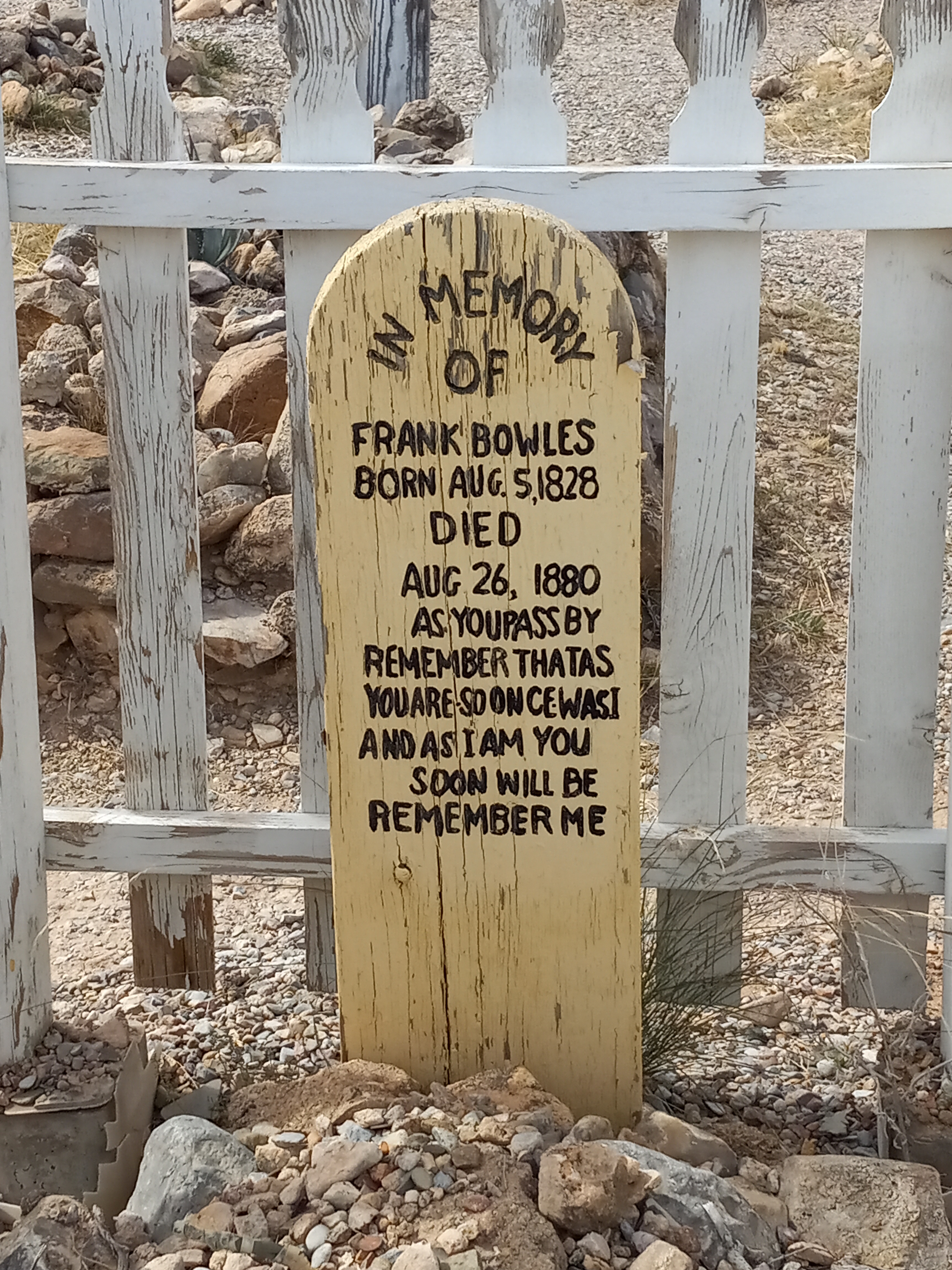
Florentino.  Chas Helm.  Frank Bowles.  George Johnson, who’d been hung by mistake.  Who were they?  Where were they now?

I got back in the car and started to drive.  Most of the fun was over, but what a way to ring things out.  The car was due back in two days.  There was some cleaning up and possibly a little explaining to do.  I took the 80 to the 10 and then passed Tucson on my way to Phoenix.  Some major work on the freeway was underway.  It was entirely shut down. 

If I didn’t have Karen from Google Maps to guide me through the obstructions, I would’ve been lost.  It had taken the three of us to make the trip happen, the car, the phone, and me.  When it comes to technology, you have to take the good with the bad.  We live in different times, there is not as much opportunity for physical exploration on the planet, and yet there is still space, other planets, new heroes, new legends, new dreams.

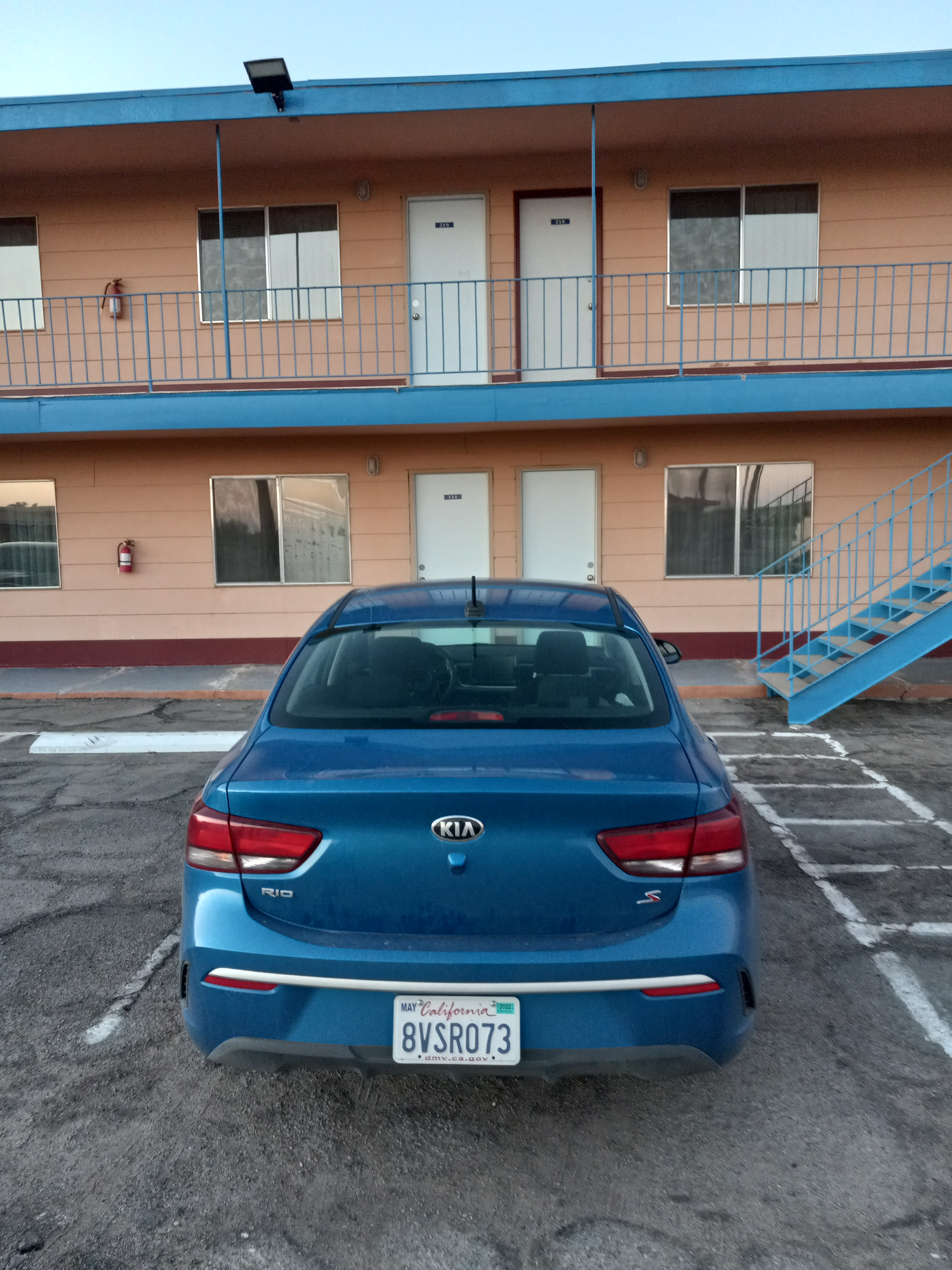
By the time I got to Blythe, it was impossible to drive any further.  The Colorado River seemed like a good place to spend my final night.  Camping?  No way.  Not tonight.  This was a celebration.  I got a room for forty dollars at the Relax Inn, then walked over to Steaks and Cakes to see what else they had on the menu.  Why bother, actually.  Steak and cake were perfect.  The Steelers were playing the Seahawks.  What a way to bring things home.

pages fly away 84

Sometime during the middle of the night, the TV went off, but then came back on close to morning.  This was the day I was supposed to get all the way back to Los Angeles, but I wasn’t ready to quit the trip yet.  I was out in the desert, not far from Parker.  I figured I’d drive up there and then head over to Joshua Tree.  If I went that way, I could pass the Colorado River Indian Reservation.  One more day, one more reservation.  That seemed appropriate.

The Colorado River Indian River Reservation was established in 1865 for the Native Americans who lived in proximity to the river and its tributaries.  These were originally the Mojave and Chemehuevi people, but in 1945 some Hopi and Navajo were relocated to it.  The seal of the reservation shows four banded feathers beneath a rising sun. 

To get there I drove north on County Road 1.  I passed the Water Wheel Resort along the way, and then came to the community of Earp, where Wyatt Earp had staked some copper and gold mines.  There was a minimart with his picture on the wall.

From there I crossed the Colorado River and parked the Mountain Bluebird beside the bridge, beneath an American flag.  That would go on to be the picture that best summed up the trip.  I drove once around town and then headed back across the bridge again.  The idea was to take the 62 west to Joshua Tree, but on the way came across some vagabond art installations. 

First, there were some spray-painted mattresses.  Then some PVC pipe, stuck in the ground with shoes wrapped around it.  Next, a whole fence of discarded shoes.  Someone was sending a message.  When I came to a bush that was covered with COVID masks, it suddenly occurred to me I’d never been to Slab City.  I looked it up and it was three hours away, right next to the Salton Sea.  Man, that was pushing it, but I still had all day.

When I got to the 177, I headed south.  That took me to the 10 and the General Patton Memorial Museum where I got gas.  It was a long drive through the desert from there, on Box Canyon Road, through a series of steep-sided cliffs.  It was a relief to get to the 111.  I was now at the Salton Sea.  The sky was pale and the clouds were thin.  I’d been there many times before.  Now I pulled into Mecca Beach and sat there facing the sea.  It seemed like as good a place as any to try to mediate.  A big bug was splattered right on the windshield in front of me.

When I was in high school my father wanted to take a fishing trip out to the Salton Sea and had enlisted me and my brother as first and second mate.  We had a small fishing boat from the Midwest that we’d hauled out to California when we moved there.  It wasn’t fit to take fishing out west and would almost never start. 

On this trip the wind had been raging, and we’d drifted across the lake while my father yanked on the starter rope.  Eventually, we’d been stranded close to shore, casting into the wind.  When we got back to the car, I’d needed space and run off to the top of a small hill, where I shut my eyes and leaned into the wind, almost daring it to push me back and keep me from falling.  Down below I could see my father and brother loading up the car and looking around for me. 

Now I could smell the stink of dead fish.  The Salton Sea is toxic.  One side, at the very least, is always littered with dead fish.  A train was passing to the east of me.  It must’ve been three miles long.  The whistle went on and on.  Strong gusts of wind pushed and tugged at the car.  After a few minutes, the last boxcar passed and gradually the whistle grew fainter.  Then it was just the wind.

pages fly away 85

Slab city is a makeshift unincorporated community just east of the Salton Sea.  If you’ve ever wanted to escape from society but can’t afford to leave the country, this might be the place for you.  People live an unstructured lifestyle in campers, RVs, and whatever else they can assemble, sometimes just huts made of scrap wood and tarp.  It is a little bit freedom, a little bit anarchy, and a little bit crystal meth, at least that was my first impression.  I had lived in a tent city for two years on the Spit in Homer, Alaska, and that’s what it reminded me of.  Ten people hanging around in a broken-down vehicle, drinking and passing a pipe around.

The cement slabs that are responsible for the name were left over from a military installation that ceded the land to the state after shutting its doors.  I don’t know who the first peaceniks were who thought to occupy it, but the idea spread.  Apparently, it is busiest during the winter when snowbirds come down from the north to escape the cold weather. 

The guard posts for what used to be Fort Dunlop have been painted over and graffitied on.  On the first one I came to there were a few tags and a picture of a vibrator with the accompanying admonition.  Good Vibes Only.  Other cement posts bore messages as well.  Welcome.  The Last Free Place on Earth.  Not all who Wander are Lost

This was my tribe, in spirit at least.  I’d been looking to get off the grid my entire life, but had eventually found it easier to escape to affordable tropical countries, rather than staking my claim in a broken vehicle, out in the middle of nowhere.  Also, whenever you choose to live outside of society, you keep mixed company, sometimes with others who didn’t make that decision voluntarily.  There are allegedly neighborhoods in Slab City, but it was largely deserted the day that I chose to drive though.  Either that or the residents were lying low, watching me through binoculars.

There were a few RVs with cars parked outside a church, an old pickup truck that had become an art installation.  In the center was a compound with a wooden tower and an American flag. It claimed to be the Church of Enlightenment.  One guy crawled out of some wreckage and ran up and got in the back of a pickup truck that was passing by.  They eyed me in defiance, and made a show out of getting all groovy.  What did I care?  I might’ve looked like a federal agent but wasn’t one.

Leaving Slab City, I stopped and got out at Salvation Mountain.  Opening the door, a gust of wind nearly tore the car door off its hinges.  That would’ve been extremely unfortunate, the day before I was set to return it.  Salvation Mountain was the thirty-year project of an artist named Leonard Knight, who used thousands of gallons of latex paint to create a colorful, Biblical shrine in the middle of the desert. 

A cross sits on top of the painted hill, and abandoned vehicles, similarly adorned with paint and scripture, around it, like toy cars in a sandbox.  God is Love.  Love is Universal.  The Holy Bible.  Salvation.  Jesus loves You.  Around a trailer sat hundreds of empty cans.  The artist had gotten his point across.  Salvation Mountain resembles a giant confection, all sugar, and gumdrops, and frosting, like something Hansel and Gretel would’ve broken into looking for candy.

Back on the 111, I drove parallel to another long train for a few miles, relentlessly blowing its horn.  At a curve in the road, it briefly appeared to be circling through the sky.  When I got to the 10, I pulled over at a gas station to get something to drink.  Walking back to the car, I saw a dirty whirlwind making its way toward the lot where I stood.  Just before it hit, it dispersed, bombarding the station with all the debris it had sucked up; plastic bags, paper, Styrofoam cups, weeds.  It was an ugly exhalation, a reminder to keep moving.  Those wild years in Alaska had been ages ago.  Time was no longer on my side.