Category Archives: Travels

art is a war 18

There is a church on top of the highest hill in Cartagena that you can see from all over the city.  The Convento de la Papa was built in 1607 by Augustine monks.  Since I hadn’t been there and had a day to kill, I thought I’d try to make my way there on foot, although I’d read something about thieves who lie in wait beside the road.  When I told Carlos my plan, he had no response.

The convent looked like it might only be a mile and a half from where I was staying, and I just started walking in the general direction of it.  Streets turned into dead ends and dirt paths, however, and I began to sense that maybe I would’ve been better off taking a taxi. I was dripping with sweat and the screen of my phone was steamed over and smudged with grease.   I backtracked to the hostel, and then made my way to the fort, from where I’d seen signs pointing to the convent earlier.  The neighborhood I passed through was full of auto repair shops and men working on motorcycles.  Finally, I came to a sign that pointed uphill, and began to climb the road.

A man started shouting to me from the front of a store, but I just ignored him.  Then another approached me, but it was just to warn me.  I couldn’t walk to the convent.  It was too dangerous.  I should take a moto if I wanted to visit it.  Just then the man from the storefront came zooming up on a motorcycle.  He wanted to charge me for a ride to the top and back.  Now I didn’t know who to trust.  What if he was a thief?  I asked him if he was and he just shook his head and laughed, so I climbed on the back of his bike with some grave misgivings, unable to just overlook the jagged scar that ran down his cheek.

As we began to climb the hill on the small motorbike, I realized that it was a lot longer to the top than it had appeared.  I was glad to be getting the ride if only to avoid suffering a heat-stroke.  We went around a number of curves.  It didn’t seem to be a dangerous neighborhood, but I couldn’t see through the bushes.

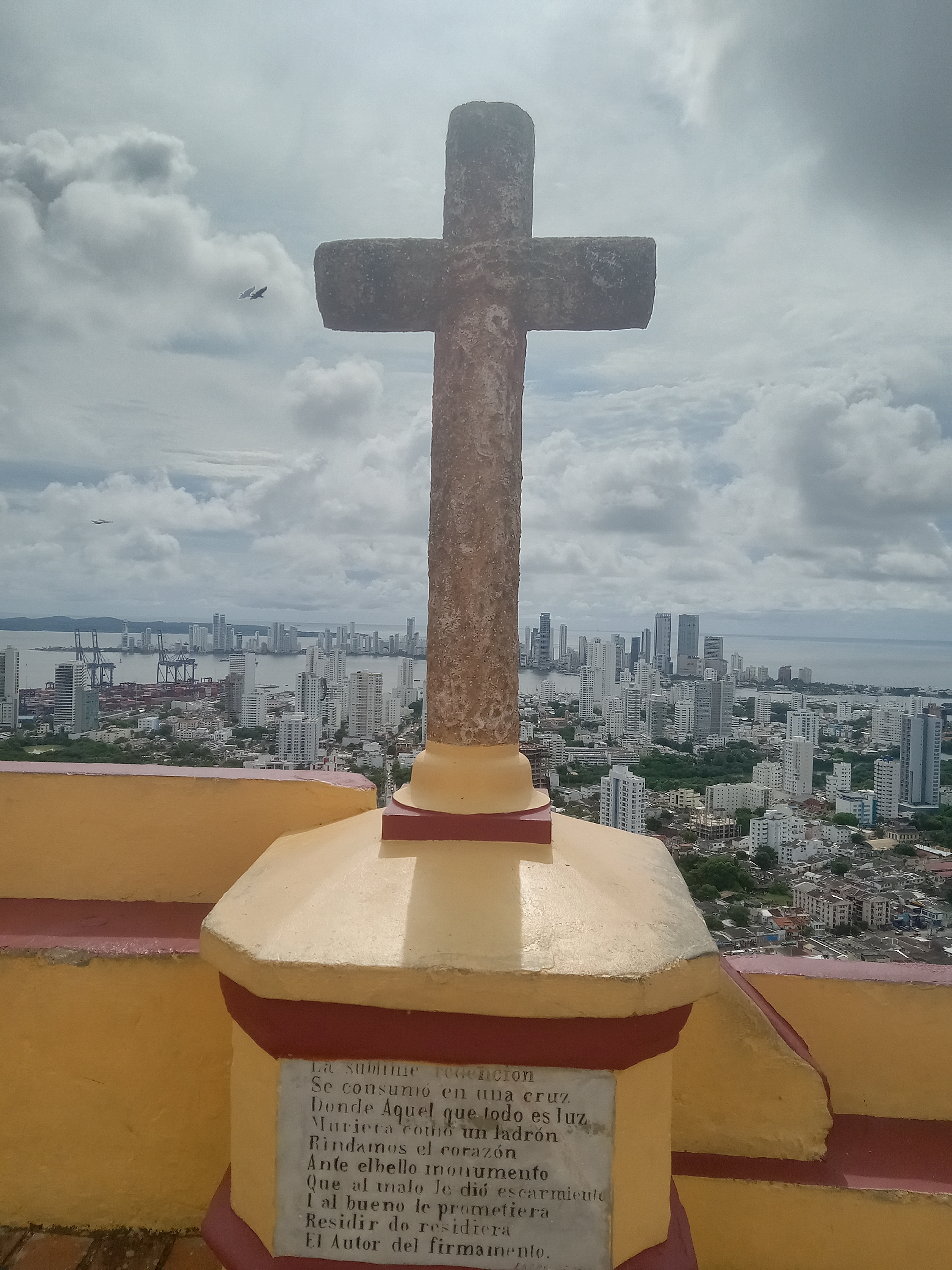
At the top, I paid the small entrance fee, and went up a flight of stairs past a crowned King Jesus, extending his blessing to all who passed.  The first door to the convent was locked, so I went over to the overlook where a Colombian flag was flying.  You could see every quarter of the city.  Once again, it made sense from on high, but when you were on the ground trying to navigate your way through the streets, the city was nothing but a labyrinth. 

Finding an open door, I entered into the convent.  There was sacred artwork on the walls and artifacts in glass cases, but an urgent stomach cramp made it difficult to concentrate.  Although the worst of my sickness had passed, it still felt like I was walking through a lucid nightmare.  When I finally found a toilet, back by the stairs, I sat drenched in sweat.

The driver was waiting for me when I came out, and with his helmet off I could see he was a large teen, not as imposing as when he’d been shouting to me from the storefront.  He offered to take my picture in front of a large cross in the parking lot.  The ride back down only took a few minutes and I paid him twenty thousand pesos, or four dollars for the trip.

I had a joke ready for Carlos when I got back to the monastery.  He asked me about the thieves and I told him there’d been one for sure, meaning the boy who’d talked me into paying him for the ride.  I looked it up later on the internet, however, and read about a guy who’d been recently robbed at gunpoint walking down from the convent, while cars, taxis, and even a tour bus passed him by.  He claimed the thieves had held a gun to his head and waved a knife in his face. 

The loss of the wallet and the phone he could live with, but it was the camera with 32 gigabytes full of pictures and memories from his trip that was really causing him anguish.  He was wondering if someone from the tour bus had happened to witness the robbery and taken any pictures that might help him get his things back.  It was a shot in the dark, but I could understand his desperation.  Someone in the comments section had tried to console him, saying forget about the things.  At least now he had the best party story ever.  Perhaps, but if it had happened to me, it would’ve taken a long time to look at it that way.
art is a war 19

If you ever want to feel like you have a lot of friends, just move all the time.  Often it is only when you are leaving a place that people come forward with their affection.  A false nostalgia sweeps over everyone.  You remember good times that never even happened.  So, it was leaving the Monastery Hostel.  It had been a rough stay and I’d suffered through one of the worst depressions of my life, yet the manager, Carlos, who’d come to regard me as a comic genius, was sorry to see me go, and the sad, long-term residents, the monks, all came out to see me off as I passed through the bars of the front gate one last time.

Walking to the bus station, I passed the school that had been playing the maniacal welcome song every morning.  The nuns had the children standing outside in lines.  They all wore matching blue and white uniforms, and just stood there looking angelic.  Where was all that mad music and screaming now?  It was the first time the school had been silent in a week.  That’s how it goes when you finally leave a place.

At the station for Berlinastur, I got a ticket for the next shuttle, which was leaving in twenty minutes, and bought an empanada and coffee from the snack stand.  There were only four of us aboard once the bus got underway.  We cruised up the coast, along the sea, blasting salsa music, and there was little interruption until we reached Barranquilla, and ran into the attendant traffic of that sprawling city.

From Barranquilla it was two and a half hours to Santa Marta.  Arriving in Santa Marta, the bus pulled over to the side of the street in front of a mall, and that was it.  We were there.  It was ten thousand pesos, two dollars, to take a taxi to the hostel I’d booked.  On this trip, I had to go back and forth between getting enough privacy and dealing with the fact that everything was going on a credit card.  I’d nearly drowned in my privacy in Cartagena, so thought I’d save some money by doing a dorm. 

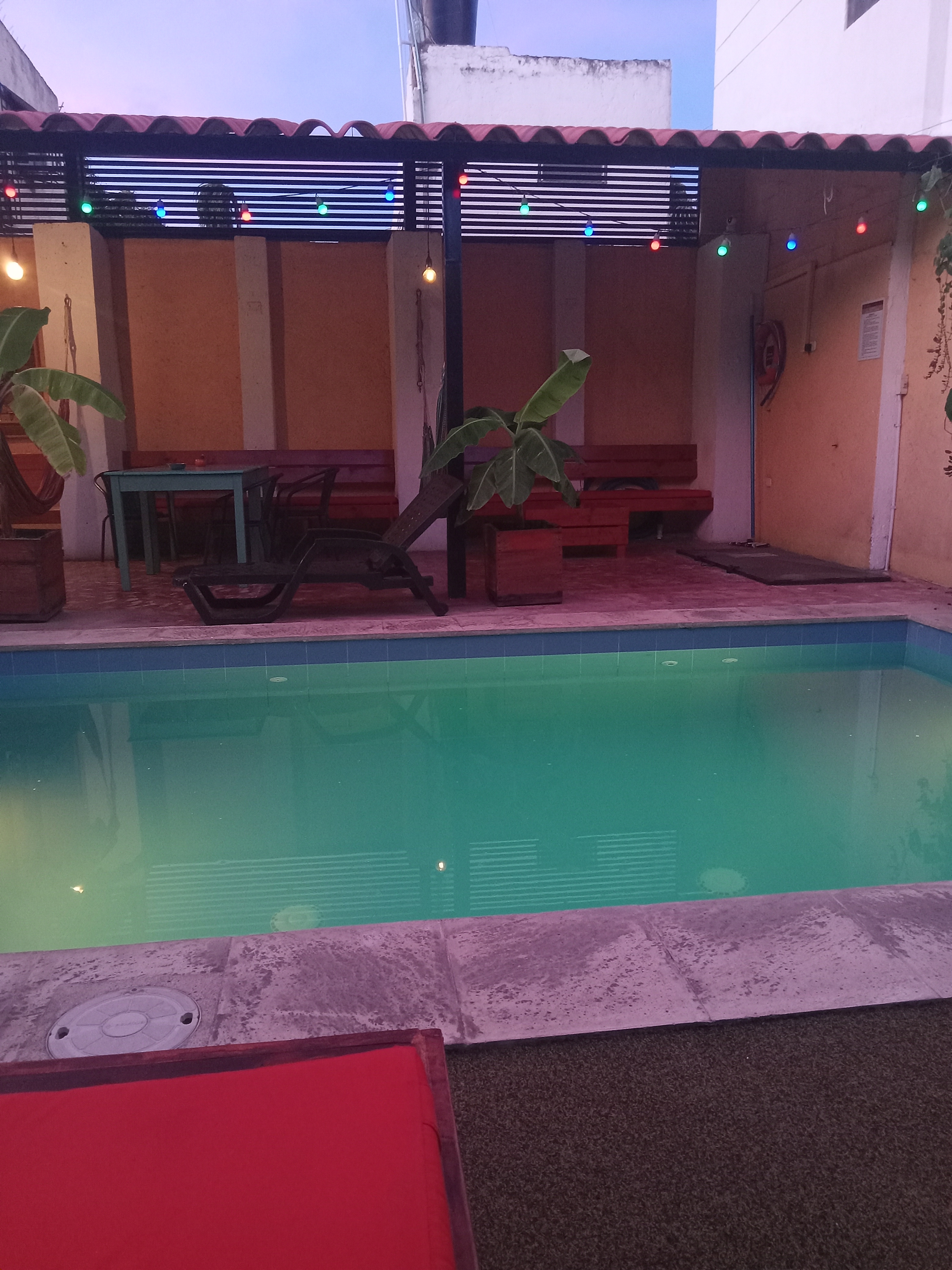
It seemed like a decent place.  There was a lower bunk open with a curtain.  Out back was a pool and a few lounge chairs.  The girl who showed me around was friendly.  I saw that they did laundry, which was necessary.  If I wanted to take a tour, which I didn’t, I could do that through them, as well.

As soon as I’d put my stuff away, I headed out for a walk.  It was another rough neighborhood, but I was told that the center was only five blocks away.  I’d gone about ten blocks before I came across any sign of it, the Catedral Basilica of Santa Marta, a place of historic significance because the remains of the Liberator, Simon Bolivar, who’d died in Santa Marta, had been stored there for twelve years, before being returned to his home town of Caracas. 

Soon after, I reached the pedestrian street, Calle 19, that runs into the Parque de los Novios, and is lined with shops and agencies, advertising the various tours available.  Among the options was a hike to the top of Cerro Kennedy, a visit to the Rio Don Diego, the Kogui Indigenous Village, the Mina Nature Walk, and the famous four-day trek to the Lost City.  I was three hundred dollars shy of the Lost City tour, but had recently been in Los Angeles, so would have to content myself with that for the time being.  The rest of the trips, forget about it.  This was no vacation.  It was exile.

When I got back to the hostel, there was some action taking place in my room.  An old lizard who’d been hanging around the common area in only a pair of shorts, was loudly complaining, claiming that my bed was his, as if I’d invaded a private room he was staying in at the Ritz-Carlton. The girl who’d assigned me the bed was frantically apologetic and asked if I’d mind taking the top bunk for just one night.  Ordinarily, no.  To have to give it up to that old lounging lizard was another matter.

Later that night, my water bottle slipped off the high bed and fell to the floor with a crash. The small croak of alarm it elicited was my only consolation.

art is a war 20

By now I’d managed to match pictures to 160 songs and 212 poems for the galleries that I was building for my website.  What was the point?  I’d previously posted the words, along with links to the recordings on my YouTube channel, and there’d been no takers, I mean, none at all.  I guess I was hoping that someone might look past my rough voice and crude low-fi videos, and see the jewel that’s been shining in my heart all these years.

I decided to go to my Haunted Rock website and start it from scratch, to delete everything I’d posted so far.  If you want to know what it’s like to die on a dead-end street, all alone in the darkness of night, get a WordPress blog.  It is like the parable in the Bible about the rich man who plans an extravagant wedding for his son, only to have none of the invited guests show up.  At the end he’s trying to round up enough beggars off the street to fill his banquet hall.  Even beggars off the street will never visit your website, however, or comment on your latest masterpiece.  You’ll have to pay someone to do that.

When I went to sign into my WordPress site, it suddenly wasn’t recognizing my password.  I went through the whole process of changing it, then went back and tried again.  Rejected once more.  I changed it again.  It didn’t work.  The next time I’d exceeded my sign in attempts limit.  I’d have to wait for a half hour before trying again.  Was there a phone number I could call for assistance?  No.  Was there any way to get help?  No.  My attempts to get through on live chat just kept directing me to the same general information page.  This couldn’t be happening.  Not now.  Putting up these galleries was the only thing keeping me alive.

Eventually, I did a Google search to see if anyone else had ever had the same problem.  What I discovered was simply unbelievable.  There is a wordpress.com and a wordpress.org which are owned by the same company but respond to different passwords.  Once I made sure it was wordpress.com in the address bar, I was able to sign in right away, but what if I’d never found that out?  The welcome screens looked identical.

My last great burst of inspiration had been at the beginning of the pandemic.  I’d used all the time on my hands to redesign my site, and had wanted to add a PayPal button so had been forced to upgrade to their small business plan, which cost three hundred dollars a year.  Previously, I’d been using the free site.  The downside of that is that they litter it with advertisements, so suddenly, between your posts, may be a picture of arthritic feet or a brain tumor, some physical deformity disturbing enough to get you to cough up the money for the premium version.  That’s where I was at now.  Two years of the small business plan had cost me six hundred dollars and I’d gained no followers or gotten any donations, so I’d downgraded to the premium plan, paying just enough to keep the freak show pictures off my site.

It didn’t pain me to delete all my posts.  They’d been like dogs that are born in the pound and die in the pound.   What was my hope for this new crop?  I thought that I might take a more extroverted approach, perhaps start handing out my business cards to other travelers, maybe even break out my ukulele by the pool.  Where to even start?  I figured I’d start with all the songs I had matches for.  Just hang a travel picture on the site, like you would on a gallery wall, and then place the lyrics right beneath it.  Right away I didn’t like the fact that all the songs had been automatically alphabetized in the folder I’d put them in.  I wasn’t sure posting the songs in that order was the best way to go forward.

But then I came to a problem that rendered that objection obsolete.  The pictures stopped uploading from my laptop to the media library.  I hadn’t posted more than twenty-five songs, when the image I was uploading failed to materialize.  There was a ghost of an image, but the image itself was unable to break through.  The wheel that marked the progress of the upload just kept spinning and spinning.  I searched the internet for an hour but could find no solution. Despair fell down hard and heavy.

There was a girl I’d met named Jen, a young girl, out on her first hippie trek.  I liked her because she was friendly and straight-forward with people.  She came out just then and found me there at the desk I’d taken over, like an uncle who’s just discovered that the stock market has crashed and he’s ruined.  What could I tell her about art and life?  This is what happens.  This is the reality of it.  If you have to do it, then you have to do it.  If you can get out of it somehow, run and don’t look back.

art is a war 21

They’d moved me to a lower bunk in another room, so I decided to stay in Santa Marta a few more days.  It was nearly November 1, All Saints Day, tucked right between Halloween and All Souls Day, which I’d claimed as the official launch date for my Haunted Rock enterprise a few years earlier.  The previous year I’d traveled down to Mexico City for the Day of the Dead festivities, and was hoping they’d have something comparable going on in Colombia, but there seemed to be nothing of that magnitude.  People would probably be going to the cemeteries to visit their loved ones, but that was it. 

I’d sent out job inquiries to every teaching job posted on seriousteachers.com by now, but had only heard back from a few schools.  During the summer I’d been offered positions in Myanmar and Vietnam, but had turned them both down, hoping to base myself out of the States again if I could.  There were substitute positions in both Hawaii and California, but I couldn’t live on what they were paying.  I had an interview with a school in China that night.  By now I’d resolved to take almost anything I was offered.  I desperately needed to have some money coming in, no matter where it came from.

My idea was to travel to a town called Mompox next.  From what I’d read the area around the Magdalena River, where it’s based, had inspired the magical realism of Gabriel Garcia Marquez, and his most famous novel, A Hundred Years of Solitude.  Magical Realism is a style of literature that mixes fantasy and reality.  Supernatural occurrences take place amidst the most mundane of circumstances.  Mompox seemed like the perfect place to work on my song and poem galleries.  The problem is that the images were no longer uploading to my website.

I spent a long time searching the internet trying to fix this problem.  One thing that came up was that I might not have enough storage left on my account to add more photos.  That didn’t seem like it would be the case, but I looked into it, discovering that when I’d changed from the Business to the Premium plan on WordPress, my storage had dropped from two hundred to fifteen gigabytes.  I’d used up more than half of that, but there was still space available, so that wasn’t the problem.  Even if I did get the images to start uploading again, however, now I knew that there wasn’t nearly enough storage for the five hundred pictures I wanted to post.  It was a very simple project that should have been easy to execute, yet I was being bedeviled at every turn.

Taking a break from that, I decided to focus on getting to Mompox.  I’d been told that it was very complicated.  You had to take a bus to Barranquilla, then another bus to Magangue, then a motorcycle to the river, then a boat across the river.  Ordinarily, this sort of expedition wouldn’t daunt me, but I was feeling overwhelmed, still under the weather and sick with depression.  I did a number of searches and found that there was one direct bus a day from Santa Marta to Mompox, but when I tried to buy a ticket online the transaction failed to go through on two different websites.  I ended up taking a taxi to the bus station, which was as far away as possible, and took a half hour to get to.  It only took two minutes to buy the ticket and then I had to take a taxi all the way back, but at least it was done.

The best thing about the hostel was the small pool out back.  The climate was so humid I was already getting crotch rot, and a short walk down to the beach and back at midday had drenched me in sweat.  I took a brief swim and tried to just relax and get ready for my interview that night.  A few hours before it, I took a shower and tried to shave.  Halfway through the job, my electric razor seized up, leaving me with half a beard.  That would’ve been perfect if I was auditioning for the lead in Diary of a Madman, the novella by Nikolay Gogol, not the album by Ozzy Osbourne.  I tried charging the battery, then banged it around until it started buzzing again, just long enough to let me finish the job.  Does that count as magical realism?  On some level it must.

I wasn’t nervous about the interview, because I didn’t care much for the job.  It was a Canadian school that had multiple branches in China.  The principal was an American and our conversation was mostly cordial.  It seemed like I could probably be a good fit for them.  When he sent me the follow-up material, however, I saw they were asking me to get a Canadian teaching credential and also looking for a three-year commitment.  That wasn’t going to work.  If I needed to, I’d go back to Saudi Arabia.  In the past I’d gotten offers there based on sending off my resume alone.  If they still wanted me, they could have me.  Anyone who made it easy enough could have me.  My bags were already packed.  I was ready to go.

art is a war 22

Santa Marta was the first Spanish settlement in Colombia and is still an important port and hub for Caribbean travel.  I hadn’t had time to do the trek to the Lost City the first time I was there, and now didn’t have the money for it.  There were day trips I could’ve taken, like to Minca in the mountains or to Tayrona National Park, but it wasn’t really a vacation I was on, as much as a reprieve.  The stress and depression were enough to make me wake up every morning feeling like my chest was caving in on my heart, like an aluminum can being crushed.  It wasn’t easy to be around so many carefree, young travelers, but I kept to myself and tried to avoid dampening anyone’s spirit.

The one place that was close enough to get to on my own was Taganga, a fishing village built around a bay, three kilometers from Santa Marta.  The bus that went there left from the cross-roads of Calle 11 and Carrera 11, about five blocks away from the hostel.  The cities in Colombia are broken into calles, which are streets, and carreras, which are like avenues.  Knowing this can help you navigate through unfamiliar neighborhoods, provided the street signs are posted.  Even then, you quite often run into dead ends and can end up desperately lost if you try to follow your inner compass.

I got to the corner and wasn’t sure if I was in the right place, so asked a policeman who seemed to be eighteen years old.  He told me the bus would be around in five minutes and it was.  It was a mini-bus, with only room to stand.  I couldn’t see out the windows and had no idea how long it would take to get to Taganga or where I needed to get off.  I tried to communicate this to the ayudante, or helper, but he was busy and told me to wait.  The bus started up a hill and began to swerve around treacherous curves.  Those of us who were standing leaned hard into each other and struggled to keep our balance.

Nearly everyone was getting off at Taganga, so it wasn’t difficult to know when we arrived.   It was Sunday so there were a lot of people at the beach.  Children were splashing around in the waves.  Vendors walked back and forth with cold drinks and snacks.  A man was selling bags of pink and purple cotton candy.  Music was playing and families were sitting beneath umbrellas or small structures made of tarp.

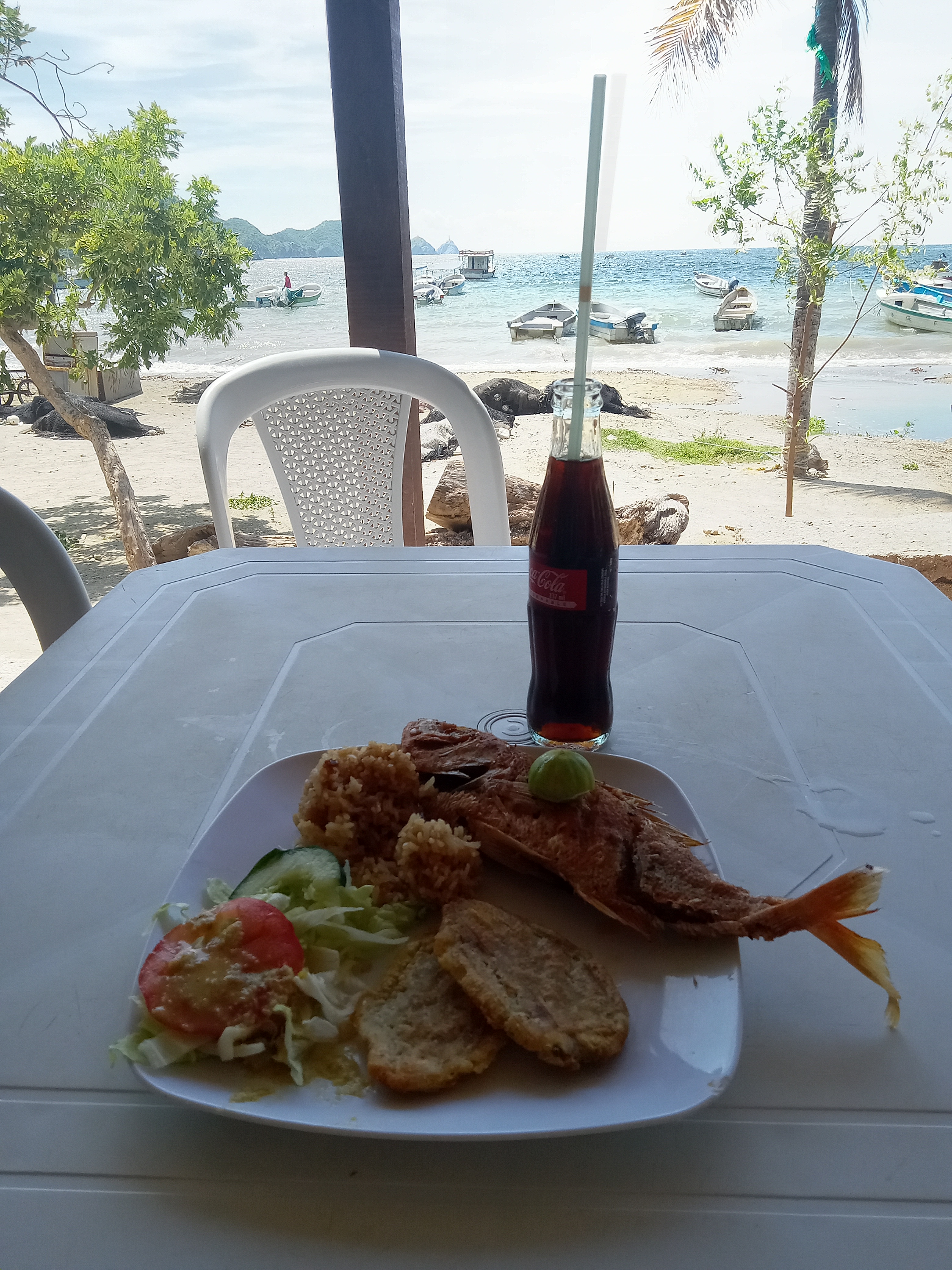
There were boat trips you could take, but I was content to walk.  On the walkway, beneath the shade of a trees, a band was playing for tips, with an accordion, drums, and a singer on the microphone.  At one restaurant I was trying to take a picture of the fish they had on display and got roped into ordering a red snapper.  It was about seven dollars for a plate that came with rice and beans.  I sat at a wooden table by myself, with a stiff breeze blowing in my face.  The fish was OK, but didn’t have much meat on it.   When I’d finished one side and flipped it over, what was left looked better to comb your hair with than to eat.

It had been a long time since I’d felt like I had anything to celebrate.  Even before the pandemic, I’d been aware that time was running out for me.  I’d boxed myself into a tight corner by sticking with my dreams.  Now I’d seen that they weren’t going to come true in the way I’d once hoped, and there was no way to catch up with those who’d kept their shoulder to the wheel all this time.   In many ways I’d been relegated to a wasteland, normally reserved for just the homeless and insane.

At the end of the beach a group of fishermen were sitting in the shade mending their nets, and beyond them a trail wove up the side of a cliff, the only way to access a few secluded coves.  I reached the top, amidst the distinctive San Pedro cactus that line the hills, and could look down on Taganga on one side and the further beaches on the other.  There was a wall there that had become a canvas for street art.  Someone had painted a giant, purple crab.  Four mushrooms spelled out the word LUNA.  A frowning pink cat wore a yellow duckie life raft around its waist.

When I got back to Santa Marta, I went to visit a small restaurant I’d been to before.  The woman there served papas.  Papas are essentially a ball of mashed potato, with either egg, meat, or chicken inside, that is then deep-fried.  Done right, it is one of the best things I’ve ever eaten.  The woman, Juvie, I’d talked to the last time.  She had a braided weave and was nearly bursting out of a tank top.  Glad to see me back, we got to talking again.  When she found out I was traveling alone, she said that she’d like to join me, except that she had to work and take care of the kitchen. 

It had been so long since I’d been with a woman, I practically threw my arm around her when I got up to leave.  Maybe she was just being friendly.  When I came back the next day the place was packed and I didn’t get the same vibe.

art is a war 23

There was nothing in Santa Marta to mark the Day of the Dead like there’d been in Mexico City the year before.  I still wanted to make a celebration of it somehow.  On Halloween I bought a Batman mask and wore it around the hostel for about two minutes.  It was later appropriated by a security guard, who made a much better Batman and got a lot of laughs.

The next day, All Saints Day, and the two-year anniversary of my Haunted Rock startup, I visited the Cementerio San Miguel, wondering if there’d be any services or ceremonies going on.  It was mostly deserted, populated only by homeless men, sitting amidst the tombstones that line the walkway to the chapel. 

As I was leaving the cemetery there was something strange that did happen, however.  I had the oddest sensation that I was my deceased father, that his spirit had come over me for a moment.  There are similarities between us, but I never thought I looked much like him.  For this very short time, not only did I feel just like him, I could almost see myself from the outside, looking like him, with the hard look of disappointment that sometimes crossed his face in his later years.  One time I’d told him all the things I’d planned on accomplishing in my life.  His response had been, what if you do and nobody cares?  It had hurt my feelings at the time, but now I understood why he’d said it.  It had happened to him.

The next day, the actual Day of the Dead, I had no idea what to do, but then heard about Quinta de San Pedro Alejandrino, the former hacienda, now museum, where Bolivar had died, and thought that might be a good place to commemorate the day.  Simon Bolivar, the Liberator, is essentially the George Washington of South America.  He and his armies ended Spanish rule in New Granada, Venezuela, Panama, Ecuador, Peru, and Bolivia, and he was the first president of the Republic of Colombia. 

By the end of his life, Bolivar had either been forced out of or stepped down from the many leadership positions he’d once held, and was determined to go into exile.  He made it as far as Cartagena where he waited for a ship to take him to England.  When the ship failed to arrive and his health began to deteriorate, he was moved to Barranquilla, and then finally to Santa Marta where he passed away from tuberculosis at the age of 47.

The Quinta de San Pedro Alejandrino turned out to be close to the bus station.  The website for the museum had warned that any visitor under the influence of alcohol and psychoactive substances, as well as those not wearing a shirt, would be prohibited from entering.  Good thing I wasn’t traveling with Jim Morrison.

I started off by walking through an area that had once been used to distill sugar cane.  Then I came upon a building that housed oil paintings of some of the leaders in the War of Independence, as well as scenes from the battles they’d fought.  One of the wings held military medals and artifacts.  In the main house there was a statue of Bolivar on his death bed.  A chapel held the remains of the physician who’d waited on him in his final hours.

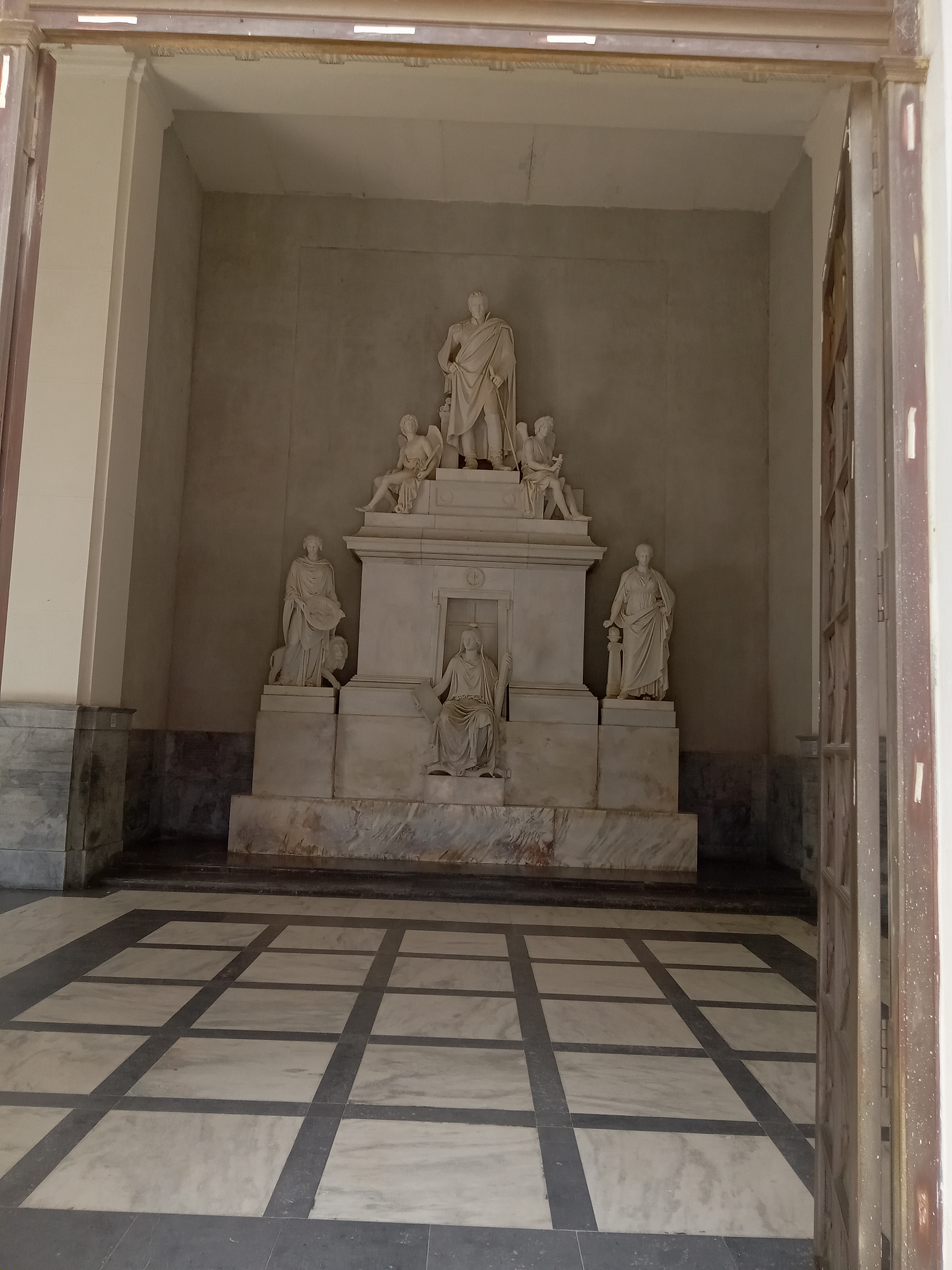
At the end of a long walkway, lined with flags from every nation on the continent, was the enormous Altar de la Patria, where a statue of Bolivar is surrounded by figures from Greek mythology, the hero who brought to life all the virtues and ideals they represent.  A nearby mural recounted all the important events in his life.

After leaving the hacienda, I had a taxi drop me off at the Museo del Oro Tairona, down by the Marina.  I’d probably walked past it four or five times already, so distracted by all the hookers and drug dealers calling to me from Bolivar Park that it had barely registered.  There were some displays of Pre-Columbian pottery and tools, as well as explanations of the indigenous belief systems and practices. 

I read with some interest the legend of the Caiman Man.  It talks of how a boy once became an alligator so he could spy on women bathing in the river.  He had two oils.  One to turn him into an alligator.  The other to turn him back to a boy.  One day he was splashing on the oil to turn him back into a boy and he dropped it.  Only his face and left arm returned to their human form.  The rest of him stayed an alligator.  The picture they used to illustrate this legend showed an old man in an alligator costume, drinking from a bottle of booze, walking through the street, surrounded by children.

Lastly, I returned to the cemetery once more, but nothing that out of the ordinary was happening, only families bringing flowers to the graves and saying prayers for their departed ones.  I passed one tomb where a bicycle had been locked inside.  Either a janitor was using it for a storage closet, or a bicycle enthusiast was looking to come back to earth for one last ride.  Here in Colombia, one more example of magical realism.  Death can’t keep us from what we love.

art is a war 24

Although I’ve always been a lone wolf, I do have two families.  The family that I was born into and the family of travelers I continue to meet on my trips.  We don’t know that much about each other.  We almost never keep in touch.  But whenever we meet up, we always have a lot to say.  Nobody cares about our stories.  We care about our stories.   Most people hate to suffer.  We will suffer if we have to.  If you can tell me how to get to a place I’ve never been, I will sit and listen all night.  If I can save you some time and trouble, I will do it for free.  The young can learn from the old, but the old can also learn from the young. 

It was strange for me to be staying in hostels at the age I was at.  Most of my life had been spent in cheap hotel rooms.  In America, at the moment, it was a necessity.  In Colombia I could spring for a private room from time to time, but if I stayed in a dorm, could get by on ten dollars a day.  What I needed was time to find a job and complete my song and poem galleries.  So far, I hadn’t come close to finding a job, and my website was messing up what should have been an easy project.  It looked like I might spend the rest of my life in a dorm.  Either that or on the street.

The bus to Mompox didn’t leave until two-thirty the next day.  That gave me three hours to kill after checking out of my room.  At this point I’d developed such serious crotch rot from the humidity that I was walking like a barrel rider.  I picked up some cream at a pharmacy, but applying it felt like pouring gasoline on a fire.  I got to the bus station and just stood waiting for an hour, sweat dripping down into my shoes.

The assistant, or ayudante, was standing at attention outside the bus a few minutes before we boarded, and it soon became apparent he was new to the job and eager to please.  The driver seemed to be hazing him.  He had him sit in a little folding seat right next to him, and as we got underway, was trying to teach him the right way to clean the inside of the windshield.  He had a little towel that he liked folded in a very specific way.  Then there were two different cleaning agents to choose from.  You had to know which one was right for the occasion.  The assistant got up and had to stretch so far to reach across the window that his shirt came untucked from his pants.  Apparently, the job he did was just OK.  The driver had him do it again, watching as he folded the towel from scratch.

It got dark early and the air-conditioning was cranked up all the way.  My clothes had gotten damp from sweating so much, and suddenly I was freezing.  For a long while we sat in backed-up traffic, due to construction they were doing, and then, when we reached an intersection at Cuatro Viento, got off the relatively smooth road we were on and began to journey down one that was riddled with potholes.

Right at that moment it started to storm.  Lightning and thunder filled the sky, and rain came pouring down.  The driver had the assistant working as hard on the inside of the windshield as the windshield wipers were working on the outside.  All the time, he was talking on the phone, steering with one hand, never slowing down for anything.

When we reached a town called Banco, everyone got off the bus except me and a teenage boy.  At this point the driver handed the bus over to his assistant.  Mompox was supposed to be an hour away.  It probably took us another two and a half hours to get there.  The assistant got behind the wheel as rigidly as a missionary mounting a blow-up sex doll, and proceeded to drive, his white knuckles tensely gripping the steering wheel.  We got behind a truck that wasn’t going more than thirty miles an hour, but the assistant never mustered up the nerve to pass it.  When it finally pulled off the road and we could speed up, the assistant hit a pothole so hard it nearly buckled the bus in two.  The teenage boy and I went flying and the driver swore in surprise.  This was the teachable moment he’d been waiting for all his life.

The driver produced a headlamp and made the assistant accompany him as they went out and inspected the bus for damage.  We must have sat there for twenty minutes.  I think the assistant would’ve gladly resigned his commission at that point and handed the bus back over to the driver, but the driver made him finish the route.  By the time we crept into Mompox, it was close to midnight.  We pulled over by the side of the road and they told me we’d arrived.  There were no lights, no station, nothing.  I had no idea where my hostel was or how to get there.

Just then a man pulled up on a motorcycle.  The driver talked to him and they called me over.  The man took my suitcase and put it on his handlebars.  I got on behind him, just as it started pouring again.  That is why I travel.  Racing through the rain, holding on for dear life, praying that you’re not being swindled.  We pulled up in front of the hostel just as they were bringing the last chair inside.  Although I didn’t see any horses, the room that they assigned me appeared to be a stall.