Category Archives: Travels

art is a war 32

Now that I’d come up with some kind of itinerary for my trip, and was excited about visiting Putumayo, I went ahead and booked a flight back to Los Angeles from Quito on December 15th, just in time for Christmas.  Even though the challenges waiting for me were greater than ever, it would make my mother happy if the whole family could get together, and I figured I’d just do what I had to when I got there.  When I was at my depressed worst, my wish was to escape by somehow dying before then, but I realized it wasn’t going to happen just by pushing a button.  If I had to take matters into my own hands, it probably wasn’t going to happen at all.  Either I was a coward, or all I really wanted was to get out from under the pain.

The next stop then would be Cali, the capital of salsa music in Colombia.  I was told I could just buy a ticket when I got to the station, which was good to hear since the station was far away and the traffic unimaginably bad.  When I looked at my options it only made sense to take another night bus if I wanted to arrive in Cali during the middle of the day, as opposed to the middle of the night.

The next day then, I stayed in my room until checkout time, and then asked to store my bags with them until that evening.  The guy at the front desk, Chico, was a good guy, an aspiring hippie from Leticia in the Amazon.  If I hadn’t found out about Putumayo, Leticia might have been my next destination, but I’d never had a good feeling about it.  It would’ve been too much money and too much hassle.  I was happy with the lineup I’d stumbled across.  All my projected stops were in the right order and seemed to make sense.

There was one last museum I wanted to visit, the Museo Nacional, and I had all afternoon to get there.  Walking past the Plaza de Bolivar I saw that they were setting up a concert stage for some kind of political rally.  I started walking in the opposite direction of the museum, just to kill time, through a very rough neighborhood, lined with graffiti scrawl and human excrement.  Carrera 10 was a big commercial street with a large market on one side of it.  I did see a mural of Gabriel Garcia Marquez on a high building, above the name of his fictional town of Macondo.

I arrived at the museum already short on attention, ready to be on the road again.  It was once a prison, and that’s almost how I felt, trapped inside, trying to focus on artifacts beneath glass cases.  They do have a great collection, and in a different frame of mind I could’ve spent a few hours there, but needed to walk more than anything and found myself just hurrying through.

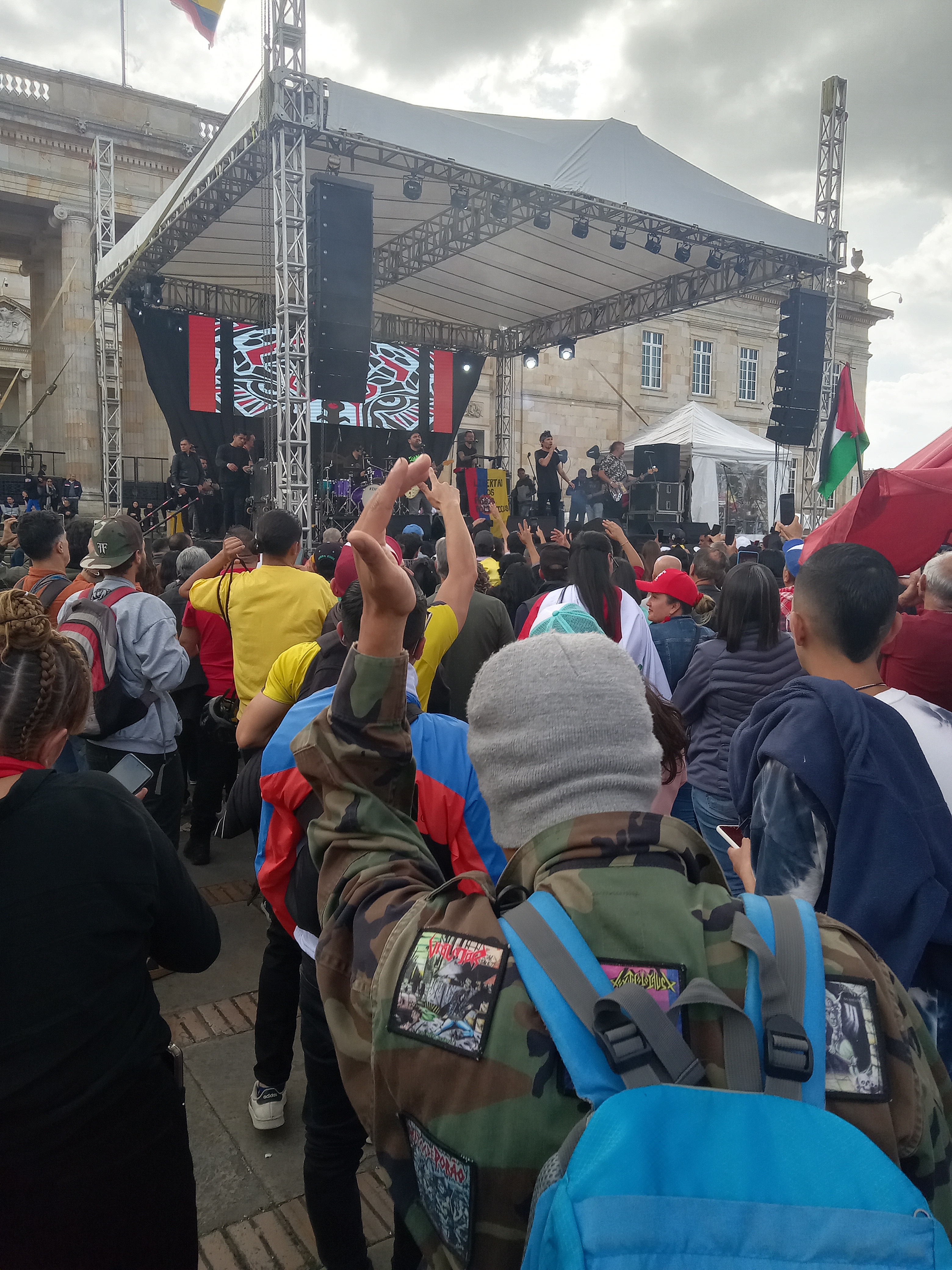
When I got back to the Plaza de Bolivar the concert had started.  That was more in line with my restless mood, but I really just wanted to go.  The rally seemed to be in support of their president, Gustavo Petro, as a big-headed replica of him was making the rounds, giving hugs, and posing for pictures.  I never found out the name of the band, but they must’ve been successful on some level, as everyone in the crowd seemed to know the words to all their songs.  One old man behind me began clanging on a cowbell so enthusiastically I nearly went deaf.

When I got back to the hostel there were still a few more hours before it made sense to head to the station.  I asked about the traffic and Chico told me it was always bad, night and day.  I sat and talked to him while I waited.  His dream was to own his own hostel one day, and build it from bamboo.  There was an architect he admired in Bali who specialized in bamboo constructions, and he hoped to travel there and learn from her. 

Around six, the girl at the desk called a taxi for me and when it arrived, the staff all came out to see me off.  Even the owner emerged from her office, in her winter coat and wool cap, to give me a hug.  She wondered if I’d gotten any information about the yellow fever vaccination for the Amazon.  I told her I was now going to Putumayo, so it didn’t matter.

I got in the taxi, and we just sat there in traffic for over an hour.  When we got to the station, I was worried about how much the fare would be, but it only came to five dollars.  There was a bus leaving in a half hour and in the meantime, I ordered a chicken dinner for just three. 

If I could live like that in America, I’d still travel as often as I could, but wouldn’t worry about returning.  As it turned out, my greatest fear was being in my own country without enough money.  Everyone there would rush to assure me that, yes, it was all my fault, seeing no value whatsoever in the experiences and writing I’d been accumulating my whole life.  That had always been the case and would never change.  Not unless I got very lucky.
art is a war 33

It was raining when the bus left Bogota, and it took two or three hours to get out of town because of all the traffic.  The bus was only half-full.  There was no one next to me, so at one point I tried to lie down, facing the seat with my knees tucked up in a little ball.  Before long, we started downhill at such a steep descent that I was literally hanging from the armrest to keep from falling to the floor.  It took all the strength in my arms just to hold on, and as the bus swerved left and right, was almost like swinging on a jungle gym.  It was a strange way to travel, for sure.

After a while, my arms got too tired and I had to sit up, but now it was like I was standing on a ledge.  By the time we reached the outskirts of Cali, I was cooked.  I’d written down directions for the hostel I’d booked a room at, and it had looked fairly straight-forward.  When I got out of the bus station, however, it was a rough looking neighborhood, and I got wildly lost, lucky to even find my way back.  I asked directions from three people sitting on a curb and they insisted that I take a taxi.  It was that dangerous.

The taxi went the opposite way I’d been walking, and seemed to travel at least two miles before arriving at the hostel.  To think I would’ve found it by following my intuition was just deranged.

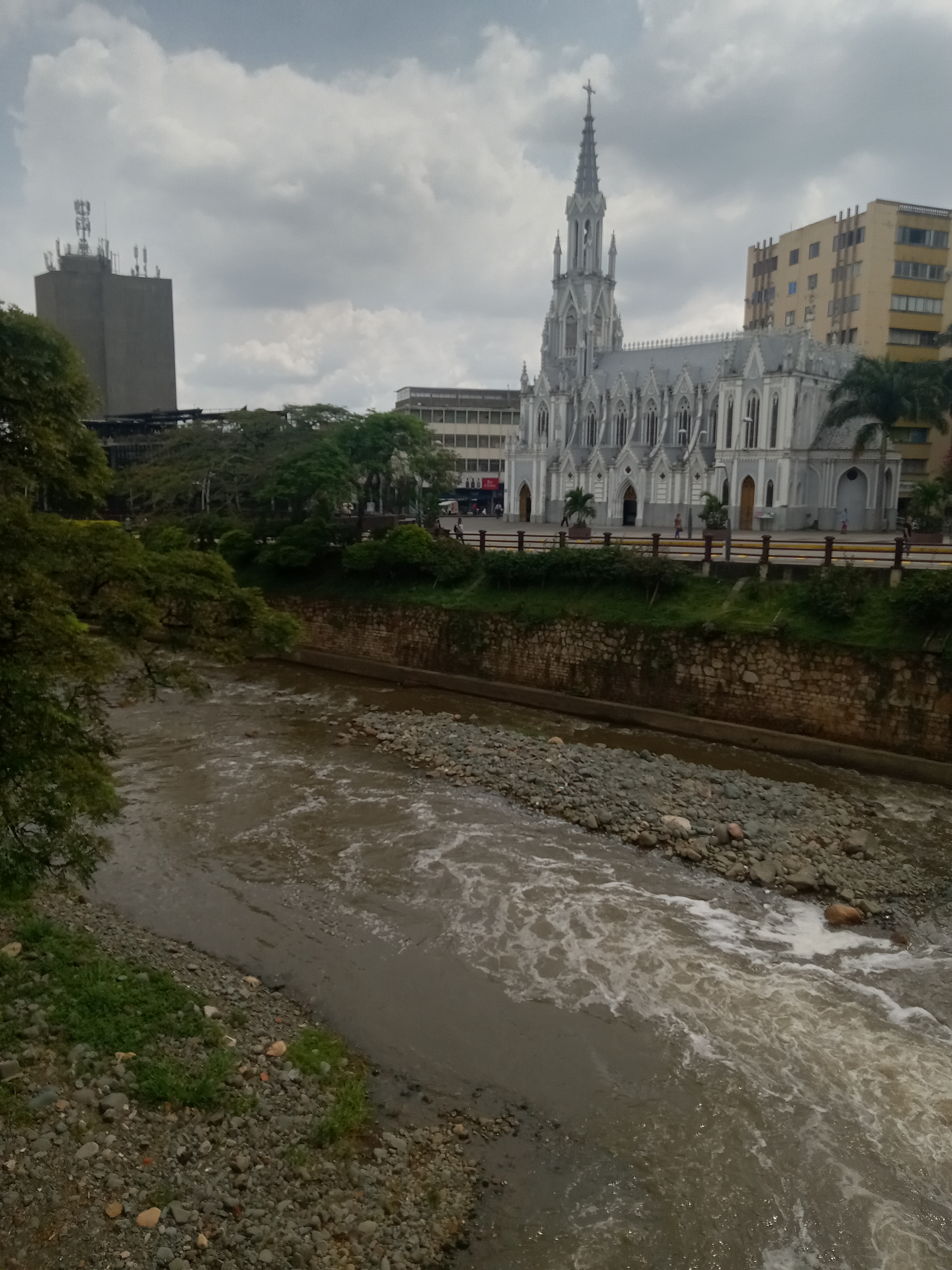
It was way too early to check in, and I knew it.  I sat down on a couch and started dozing off.  That wasn’t going to work.  I’d been in Cali years earlier, and my only memory of the place was women playing folk songs on acoustic guitars beneath some kind of monument.  I went out walking in the direction of the river and found nothing that I recognized.  There was a bridge with a church on the other side of it.  I crossed over and followed the riverwalk, passing a series of cat sculptures.  Then I came to a park with boulders stacked on top of each other.  Someone had tagged them, like a preschooler using crayons on a wall. 

I was too exhausted to function, so returned to the hostel and started sleeping in a hammock, until someone tapped me and let me know my room was ready.  I was splurging on a private with a shared bathroom.  It wasn’t much larger than a closet, but came with a high-power fan.  As soon as I lay down, I was fast asleep.

Cali is the capital of salsa music.  That’s what I was hoping to learn about while I was there.  All I knew about salsa came from a video I’d watched on YouTube about the early days of salsa in New York City and the Fania All Stars, a group that had featured legends like Celia Cruz, Willie Colon, and Hector Laboe.  The guy working at the front desk, Ace, was a dance instructor.  He told me he’d been practicing dance his entire life, but when he performed, people were so cheap, cheap, cheap, he had to supplement his income by working at the hostel.  I’d found a man after my own heart.  I asked him about places to check out salsa.  He said there were clubs all over the city.  I asked about the women who played folk guitar.  Where could I find them?  He told me to head to Bolivar Park, the same place I’d been that morning. 

When I returned to the park, I found no women playing guitar.  For some reason I was obsessed with that memory.  I saw two tourists on a bench eating shaved-ice and asked them what they knew about the city.  They’d just arrived as well.  The shaved-ice, what they call a raspado, looked so good I ordered one.  While the man was making it, mixing real fruit into it, I asked him if he knew about the women guitar players.  He told me to go to Loma de Cruz, adding that it was too far to walk.  I figured I’d look it up when I got back to the hostel.

In 2008 I’d taken a trip to Ecuador and Colombia, where I’d been to many of the places I was visiting now.  I hadn’t been to Medellin, and hadn’t heard of Putumayo then, but had started in Quito and traveled all the way to Cartagena and back.  It had been the final straw.  I couldn’t afford to make records that no one supported anymore and had worked at the same inner-city school so long it was threatening to become my only story.  Once the school year began, I was sitting on a hotel at the Mexican border.  The engine had just seized up in my truck and a front tooth had fallen out of my head.  I only returned to Los Angeles to quit my job, and had been living out of a suitcase ever since. 

A move like that might be a daring one to make in a movie, but has real consequences.  Still, faced with the same options, I’d do it again.  Not knowing what will happen next can cause a lot of anxiety, but leaves room for surprises.  If you know what’s going to happen next, and it’s not what you want, sometimes you need to just jump.  You might end up in an equally bad situation, but at least it will be a different one.

art is a war 34

Salsa music came out of New York City in the 1970s and is based on Cuban music, particularly the son montuno style innovated by Arsenio Rodriguez, which added a horn section to the typical three drum arrangement and call and response choruses.  With additional elements of Puerto Rican vocal stylings and jazz, salsa became a hot ticket, something of a catch-all phrase for Latin music in general.  The Fania label was created to cater to this niche, and in 1971, the Fania All Stars, a supergroup made up of the best-known artists on the label, managed to sell out Yankee Stadium.  Salsa had arrived.

Since that time, the music has developed into a number of subgenres, such as salsa romantica and pop salsa, and has spread to other countries.  Venezuela, Peru, Mexico, Panama, and Colombia all have their own salsa bands and traditions.  I’d heard that Cali is the capital of Salsa, and since I was there, hoped to learn more about it.  A Google search revealed a salsa museum that I wanted to check out.  When I asked Ace about it, his only comment was that it was in a very bad section of town.  I asked about the women folk guitarists I remembered from my last visit, and he confirmed that Loma de Cruz was probably the place to find them.

Since I didn’t have phone service, I scribbled down all the directions I thought I might need and headed out in search of Loma de Cruz, which was a park about two miles away.  Heading in that general direction, I got caught in a labyrinth of street art that eventually deposited me about five blocks south of it.  I’m not sure what I was expecting, but Loma de Cruz, with rows of small huts for artisans and vendors, was largely deserted.  There was a pretty good overlook of the city, but no musicians.

Finding the salsa museum required a lot more determination.  I first had to get through the most congested part of the city, often unsure if I was heading north or south.  Not all of the street signs were posted.  When I thought I was close, I went into a small shop to ask if they knew the museum.  Not only didn’t they know it, they also repeated Ace’s warning that it was in a very dangerous neighborhood.  If I really needed to go there, I should take a taxi.

I ignored their warning and kept going, eventually reaching a section of the city where the streets and parks were full of homeless people.  I kept to the busiest street and as I kept walking, decoded the system they use for addresses.  The first number is the cross street and the second is the house number.  When I reached the right cross street, I headed over a few blocks and found the museum, looking no different than any of the surrounding houses, beyond a small sign above the door.

An old man was standing outside the door, and called to his son to come out and speak to me.  Yes.  They were happy to have me as a guest.  There was a small fee for a tour.  The guide would be a young man, Ramone, who gave dance lessons, but also conducted tours when need be.  I was the only visitor. 

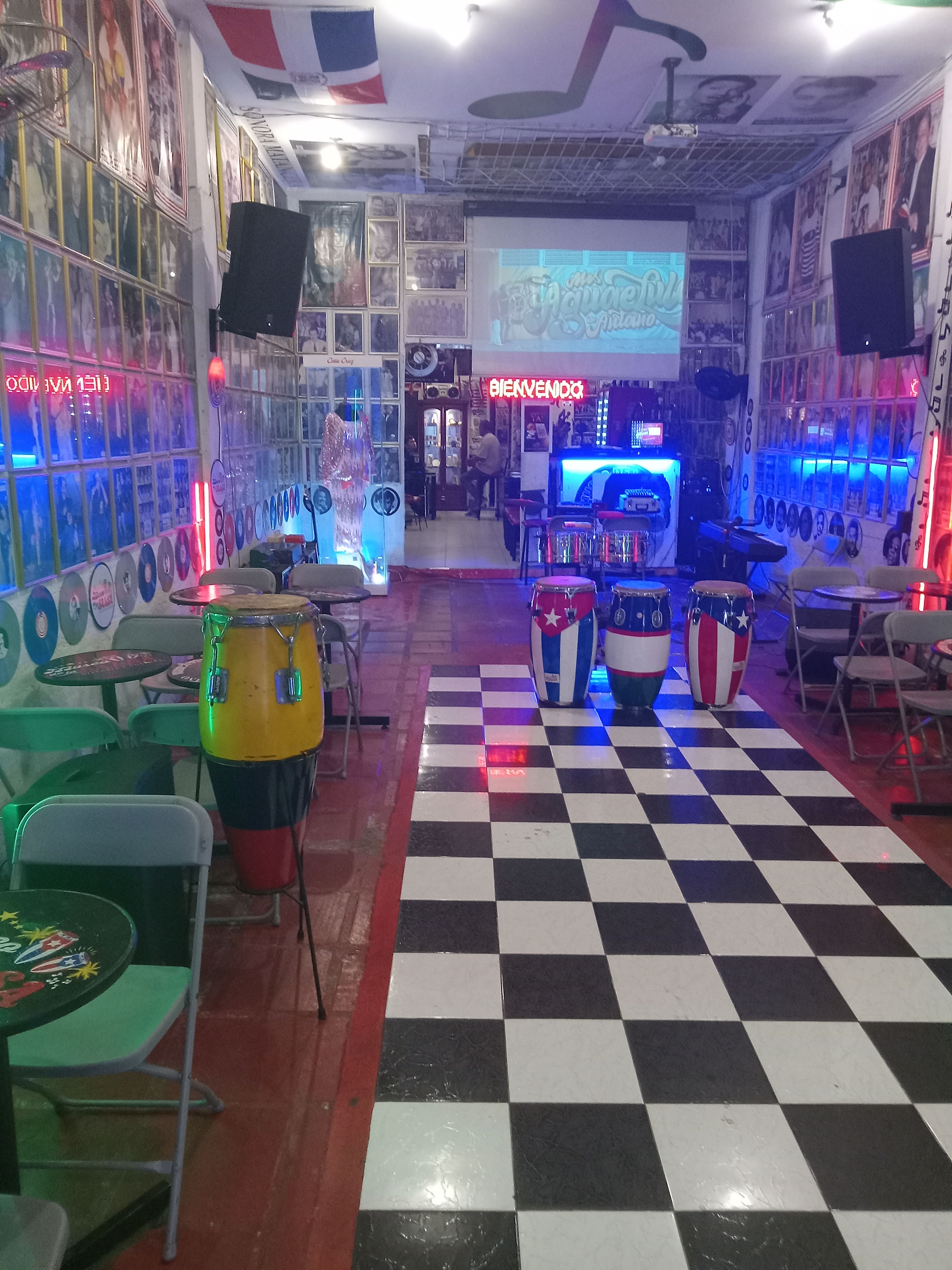
Right away I started to take pictures of all the famous musicians on the wall.  The old man called to Ramone and appeared to be upset, pointing in my direction, and shaking his head.  It turned out he was the owner and had personally taken all of the photos in the museum.  He was concerned about copyright issues.  I was told I could take pictures of everything but the photos.  That was OK, although outside of the photos there wasn’t much to take pictures of, a set of drums, a dress that Celia Cruz had once worn, a few records in glass cases.

Ramone only knew a little bit of English.  My Spanish is just OK.  The way he gave the tour was to speak into his phone and then have me read the translation.  It was a bit like the Cone of Silence on the TV show Get Smart, where to protect secret information two cones come down and cover the speakers’ heads, making it so they have to shout.  It was a tedious way to communicate, especially since I understood about seventy percent of what he was saying.

One bit of history that I may have misunderstood, but prefer to remember that way, involves the reason for Cali’s salsa being so much faster than anyone else’s.  Colombia was very isolated for many years because of the perpetual conflict going on.  When records were imported, the players they had access to spun them at an accelerated speed.  They didn’t know any better, so danced accordingly.  When the outside world finally caught up with them, they were regarded as innovators.  That’s the way it goes with art.  Something is imitated so poorly that it becomes a new style.

When the tour was over, I met all three men at the door and took some of their business cards, promising to leave them at the hostel for other travelers.  The museum is one of those best kept secrets that can languish into eternity.

It had been nearly cloudless when I walked into the museum, but now the sky was dark and threatening.  Lightning flashed and the low growl of thunder filled the air.  I had my umbrella tucked in the waistband of my shorts, thinking when I left the hostel, I probably wouldn’t need it.  In a few minutes it wouldn’t be enough.  Lightning and thunder started crashing all around, like mortars striking the earth.  I hurried to get beneath an awning and reached it right when it started to pour.  It was like standing behind a waterfall and didn’t let up. 

I got tired of standing there and dashed to another awning, soaking my shoes in the process.  Now I was in front of a bar, with a few old men and hookers, looking out apathetically at the rain.  The intersection of the street I was on had become a river, at least two feet deep in places.  Cars risked getting stranded by crossing it.  Motorcyclists were knee deep, trying to push their motorcycles through.  When the rain finally let up, I backtracked and headed to a higher neighborhood, eventually making my way back to the hostel, as wet as could be. I never did find the women with the guitars.

art is a war 35

I had just booked a hostel in Popoyan, when I got a message from a recruiter in China, wondering if I was available for a Voov meeting.  Voov is the Chinese equivalent of Zoom.  I’d downloaded it, at her request, but had never used it.  Now she wanted to do a test run, making sure there were no kinks before scheduling an interview with a principal in Beijing.  I told her just a minute, and ran to put on a dress shirt. 

After a few minutes her face appeared, mostly hidden behind a COVID mask.  There I was, on a smaller screen, looking like a hermit in reading glasses.  Things seemed to be working OK.  We scheduled the interview for two days later.  Hopefully, the internet would be working in Popoyan.

Popoyan was only a few hours away, so the next day I slept in and checked out as late as possible.  In a moment of weakness, perhaps, I went ahead and posted a link on Facebook to the sample song and poem galleries I’d recently created on my website.  I always say if Facebook is your only platform, then you don’t have a platform.  I don’t have a platform.  Within five minutes I had about eight heart emojis.  This from people who could never be bothered to visit my site.  I was sorry that I’d posted the link, and considered taking it down, but decided to hold off and see what happened.  It wound up bothering me all day.  All my dreams are golden until I release them.  Then comes the taint.

When I got to the bus station, I discovered how huge it was.  There were too many bus companies to choose from, so I just went with the one with the biggest sign.  Apparently, what they had going to Popoyan was a minibus that was leaving in five minutes.  As I was considering it, a dwarf appeared beside me, ready to be of assistance.  Once I had my ticket in hand, he raced ahead of me, beckoning for me to follow, as if our real destination was Oz.  He seemed to know everyone who worked at the terminal and shouted out greetings to one and all.

The bus was blue on the outside, and all blue vinyl on the inside.  There was no legroom, so I took a seat in the corner of the back bench.  It was too high to see out the windows.  I felt trapped up there.  Along the way we stopped to pick up anyone by the side of the road who wanted to get on.  Before long the bus was packed, with most of the passengers standing.  A mother and three of her daughters were crammed in next to me.  By the time we arrived, my left hip was seriously distressed.

Popayan is known as the White City because of all of the whitewashed colonial buildings in the historic center.  I’d written out directions once again, thinking I might walk to the hostel, but was glad I didn’t when I saw how long it took the taxi to get there from the station.  I’d booked a private for two nights, this time getting a whole dorm to myself.  There were six beds to choose from and a balcony that overlooked the street.

Right away I went out walking, finding I was only a few blocks from the Parque Caldas.  I knew it wasn’t a big city and had the whole next day to explore, so started walking towards a church on a hill that appeared to be just outside the city limits.  The Iglesia de Belen didn’t look hard to get to, but there was no direct path to it.  I had to follow a road that wound through the hills behind it. 

Near the top, a man on a motorcycle, with a woman behind him, pulled over to warn me that some of the people in the area were not good people.  I should be careful where I walked.  Now I was paranoid.  A group of young people were sitting on a car that was parked between the church and where I was, smoking and having noisy fun.  I decided to chance it and walked past them with my eyes on the ground.  They left me alone.  Service was in session when I got to the church, so I took off my hat and stood in the back, taking pictures when no one was looking.

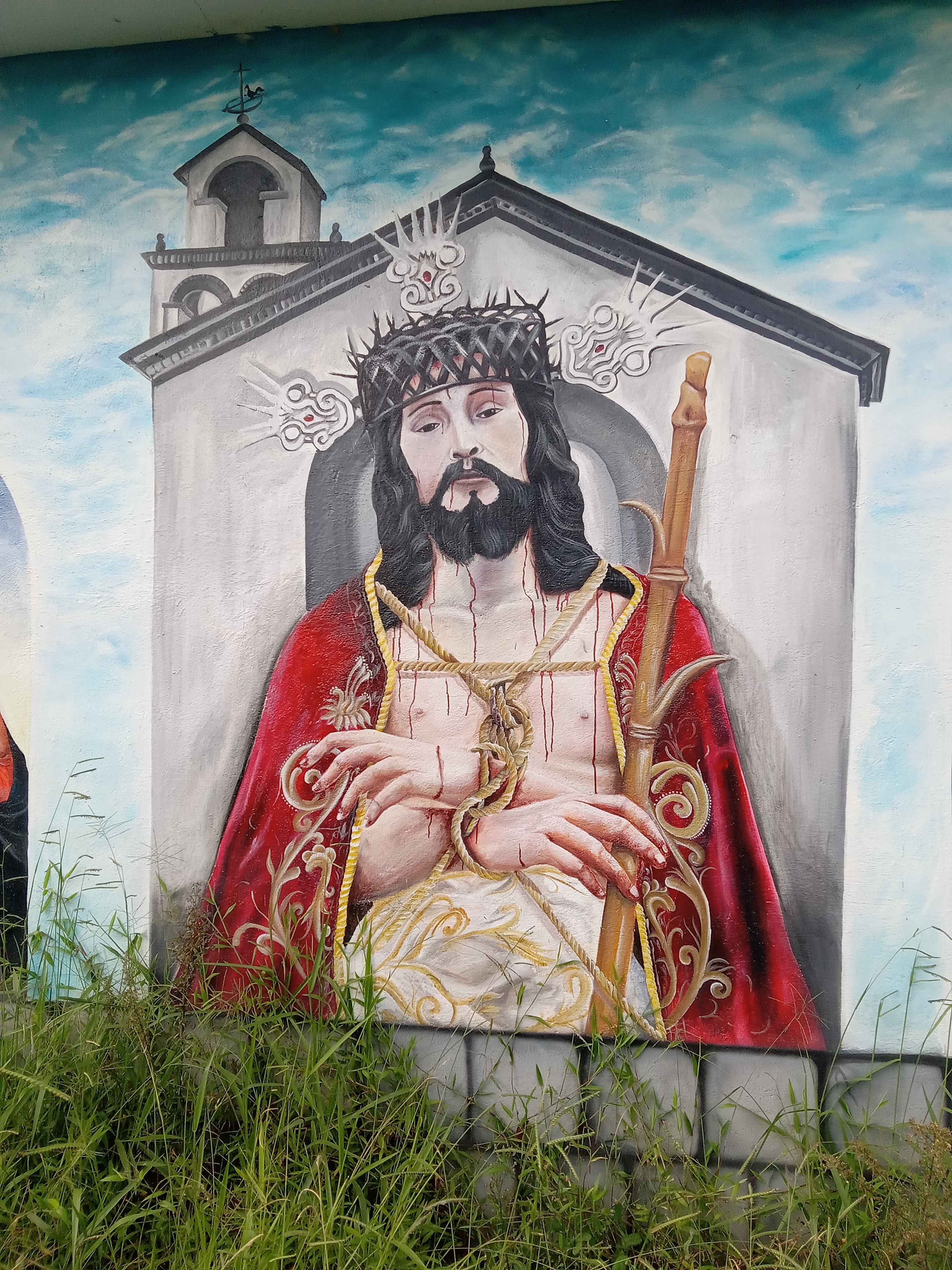
Out front of the church there was a walking trail with a series of statues depicting Jesus Christ’s crucifixion.  It looked like it could be a shortcut back to town.  After a few hundred yards I saw a gang of young guys making their way uphill.  When they noticed me, a few of them seemed to speed up, so I turned and quickly walked back to the church.  They didn’t follow me, and may have been up to nothing, but now I felt anxious and just wanted to get back to my room.

When I did, I saw that my Facebook post about the sample song and poem galleries had gotten only fifteen likes and two comments, one from my mother, and another from a guy seeking attention for his own agenda.  That made my stomach hurt.  I’d come to Colombia with this big project in mind, hoping perhaps that completing it might lead to a change in my fortune.  Now it was clear that no one had the interest or attention span to read even one of my lyrics or poems.  How would making five hundred of them available online ever change anything?

If I could live on one compliment a year, there were still many years I would’ve starved.  I knew better but couldn’t help myself.  At the end of the day, I still wanted to be accepted, and feel like I’d done something of value with my life.  Most of the time, however, I felt like a failure, not just at art, but at everything else, as well.  I couldn’t go on.  I needed help.  What I wouldn’t give for one enthusiastic person in my life, outside of my mother, but there were times when even that seemed to be asking too much. 

art is a war 36

The closer I got to Ecuador, the more the influence of the music and culture came from the Andes, as opposed to the Caribbean.  When I went down to Parque Caldes that evening there was a group dancing in a circle to music that fused folk rhythms and pan flute with a modern techno beat.  There were also three smaller groups of friends, in different corners of the park, playing drums, guitar, and flute, singing melodies I hadn’t been exposed to on the north coast of Colombia, but recognized from Peru.

The next day I visited some of the many churches and cathedrals in Popayan, and had just made it to the top of El Morro de Tulcan, an ancient burial mound on the east side of the city, when dark clouds moved in and it started to rain.  I needed a down day, so didn’t mind much returning to the hostel and getting back in bed, spending the afternoon listening to the thunder and rain.

That night I had an interview with a principal in Beijing, for a job I was going to have a hard time pretending I really wanted.  Still, I needed to do something fast, so had agreed to it and laid out my one dress shirt the previous night, hoping to straighten out the wrinkles.  They wouldn’t be able to see that I was wearing it with a pair of shorts.  The approach was similar to a mullet, which is business up front, party in the back, except this was work on top, vacation on the bottom.  Five minutes before the interview was to take place, I logged onto Voov, and sat there dreading what was about to happen next.

It was the recruiter who came on first.  She then put me through to the principal, who was a young Chinese guy who spoke English without much of an accent.  The first thing he wanted was to get to know me, so asked me to share a little about myself.  I was in the middle of giving him the educator version of my life, when the connection dropped out.  It wasn’t going well.  I felt like an actor who hadn’t bothered to learn his lines before a big performance, and was just up there trying to wing it.  I was only able to reconnect for a few minutes, but it was clear to all of us by then it wasn’t working.   

A few minutes later the recruiter contacted me by email about rescheduling, and I was relieved.  What you need to do to get a work permit in China is a big hassle.  I also had come to understand from a previous interview that working there required a daily COVID test.  That sounded like a nightmare.  It would be a lot of work just to get my hands on a little bit of money, because that’s all it was, barely enough to live on.

The plan was to travel to San Agustin the next day, so I went ahead and booked a hostel for two days.  From there, it was onto Mocoa, in Putumayo, which I had a strange feeling was going to work out just the way it should.  It was like I was being drawn there.  Whatever happened when I got there I was prepared to accept, one way or the other.

It was much colder than it had been the previous night.  I went back to the Parque Caldas to find something to eat, and found that it was all taped off, with police stationed at every corner.  What was this?  A return of the pandemic?  A renewed threat from leftist rebels?  No.  In fact, what they were preparing for was a marathon.  It was unclear if the race was taking place that night, but whenever the runners came through, they’d be ready for them.

art is a war 37

After arriving in Popayan, a woman had approached me at the bus station and sold me a ticket to San Agustin.  I wasn’t sure what to make of it until she led me over to a ticketing window that appeared to be legitimate.  Figuring it would be good to have my ride confirmed, I’d gone ahead and bought a ticket from her, leaving in two days, at eleven-thirty in the morning.  When I got to the station, however, the bus was delayed.  I waited for an hour before the same woman appeared, apologizing, and saying that now the bus wasn’t leaving until three.  That news didn’t make me happy.  She did some searching around and found another company that was willing to drop me off.  I walked over with her and gave my bag to the driver.

The bus that agreed to take me on was half-size and green.  There were only about ten of us onboard.  I was way in back, in a seat ahead of the back bench.  In front of me was a man in a poncho and straw hat.  At one point he threw his hat up in the luggage rack, next to my backpack.  Driving through the mountains and jungle the road was rough, but there was about fifty miles of it that was unpaved and just ridiculous.  Sitting right above the rear axle, I was getting catapulted all over the place.  At one point I tried hanging from the luggage rack to save the wear and tear on my already fractured tailbone. 

Once we hit pavement again, we stopped at a restaurant for a twenty-minute break.  I went to retrieve something from my backpack and saw it sitting on the old man’s hat, which was crushed flat.  I didn’t know if I should say something, but he discovered it on his own and somehow restored it to shape with his hands.

When we arrived in San Agustin, I was met by a man who said he had information on getting to Mocoa.  He hustled me into an agency where a woman tried to sell me a tour to the archaeological park, as well as a few side attractions.  When she understood I wasn’t interested in the tour, she offered to sell me a ticket to Pitalito, where I would need to catch the bus to Mocoa from.  I told her I’d be back later.  I needed to find my hostel before I did anything.

The hostel was a long way off, mostly uphill.  I’d booked a single, for a reasonable price, that included a bathroom.  Since it was late in the day, I headed out right away to see what I could of the town before it got too late.  One guy I’d seen in the hostel passed me on the street.  He was sporting a mess of dreads and I figured he might be someone to talk to about ayahuasca.  As it turned out, I didn’t need to wait to run into him again.

There was a small park in front of the Church of Saint Augustine.  In every corner of it were the same crouching stone creatures you find in the archaeological park.  Some looked human.  Some looked like animals.  A few of them sat perched on another one’s shoulders.  Most of them wore a scowl.  I got a few papas from a vendor and a cup of coffee.  Then I went into the cathedral, which was very dark, only lit by a few candles.

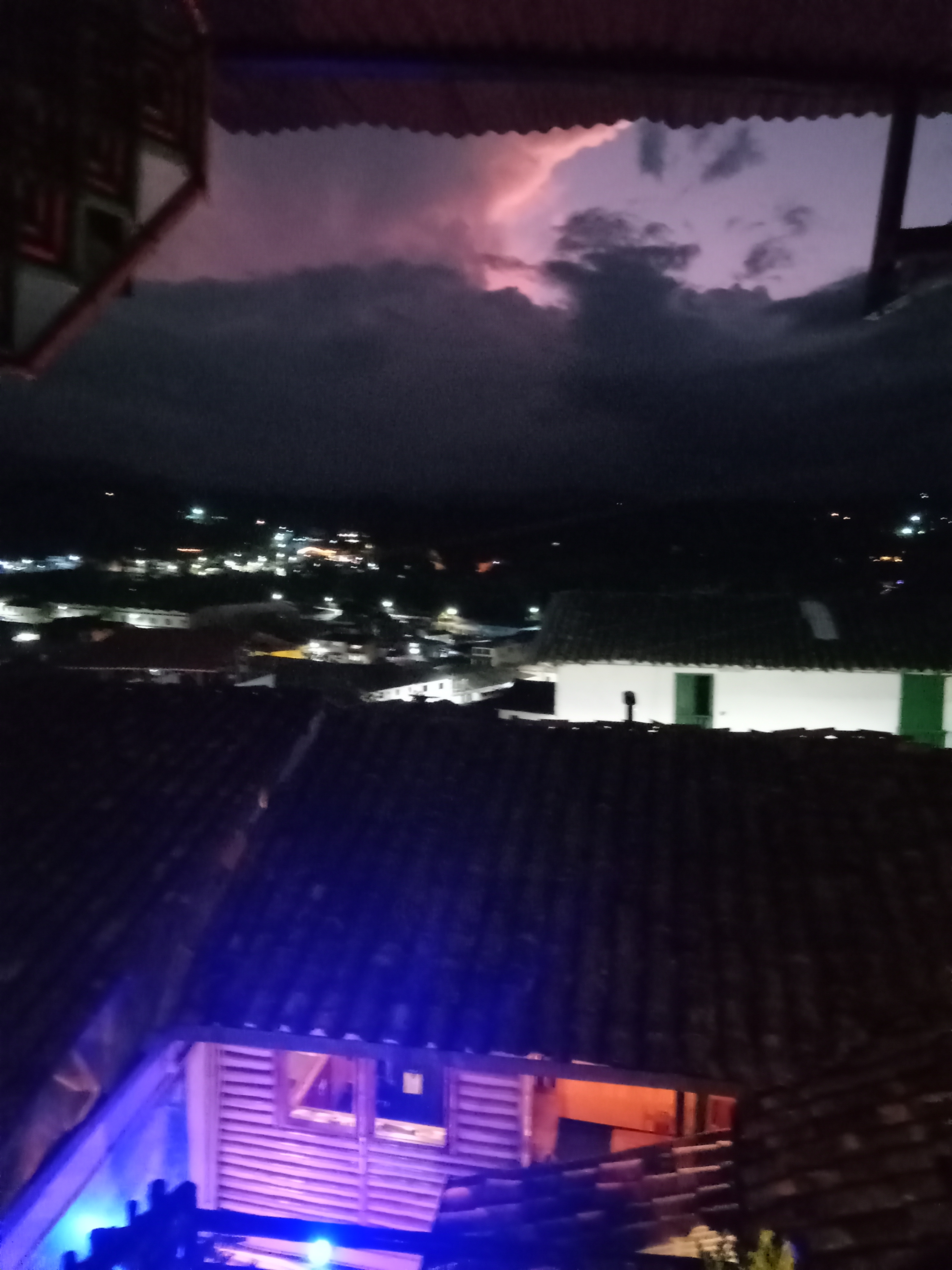
When I got back to the hostel, I went up to the top floor, which was an observation deck with a few hammocks strung up.  The sun had set, but the sky was still blue, with purple clouds, lit up by flashes of lightning.  In one corner were three travelers smoking a joint.  I sat watching the sky for a while, before entering the conversation.  There was a Brit attempting to ride a motorcycle to the tip of Argentina.  An Italian who’d been living in Australia had just arrived in Colombia and was looking for ideas.  Then there was the girl, another Brit, who was on her way to Mocoa the next day.  I didn’t need to ask her about ayahuasca ceremonies.  That’s all she talked about.

When I mentioned my interest, telling her I was planning on just showing up and seeing what happened, she assured me I was going to the right place.  Some of her friends had property there and might be having a ceremony later that week.  She took my email, laughing that I was the only person she’d ever met who used Yahoo for email.  I told her I also had a cool Gmail account, but joked I’d have to know her better before divulging that information.

As soon as we were done talking, I ran down and checked hostels in Mocoa.  There didn’t seem to be many options.  The only one I could find was about seven miles out of town, which didn’t excite me.  As I scrolled through the reviews, however, I found one that slammed them with a one-star review, accusing them of using the hostel to try to start an ayahuasca cult.  I went ahead and booked five nights.

art is a war 38

When I woke up in the morning, there was no electricity.  It was actually a relief when I discovered that it wasn’t just my equipment failing me, as so often has been the case.  My plan was to head straight to the archaeological park while it was still early.

San Agustin is a large funeral site with a number of burial mounds and tombs.  It hosts the largest collection of megalithic sculptures in South America, many of them gods or mythical animals.  I’d been there fourteen years earlier, and it was the last trip I ever took a 35-millimeter camera on, switching over to digital shortly after.  As it was back in those days, you sometimes thought twice before taking a picture, since you needed to not only pay for the film, but also to have it developed.  I’d get back from a big trip with eight to ten rolls of film I’d shot, and that was the entire documentation. 

It wasn’t until I picked up my pictures at the drugstore, that I even knew what I’d captured on the trip.  Most of the pictures were disappointing.  Animals shot from too far away.  Shots from a moving vehicle that were all blurry.  A huge mountain that only looked like a blip on the horizon.  There was the rare surprise, however, the one masterpiece from the trip that you couldn’t have calculated.  My Haunted Rock logo is an example.  It was taken on a trip to Machu Picchu, on the first roll of film I’d shot in over a decade.  Nowadays, I get some good pictures, but the percentages haven’t improved.  Most of what I shoot on a phone is garbage, and until very recently, often doesn’t even get looked at.

Although I could’ve walked to the park, I took a taxi, figuring I’d walk back once I had my bearings.  It was a quiet day when I arrived.  Only a few attendants sat at the ticket booth.  The entrance fee was expensive for Colombia, almost ten dollars, but for that they issued me a small passport that was good for a few other sites in the area. 

There is a small museum and exhibit hall you pass through to get into the park, but they didn’t have electricity either, so it was more like a tunnel, the featured statues resembling shadows.   Outside, the tombs and statues are arranged in three groupings, or mesitas.  The first, and longest, heads downhill and loops through the trees.  The statues are interspersed every thirty yards or so.  These are the guardians of the graves; warriors, jaguars, monkeys, musicians, many strange creatures, all frowning, if any of their features remain.  Many of the stones have been so eroded you can’t tell what they’re supposed to be.

The second mesita is probably the most definitive, as there are actual tombs in a clearing.  Some of them are just pits and piled stones.  The most complete of them have columns and roofs, with sculptures standing sentry at the door.

It is a long walk to get to the third mesita.  It is reached by first passing a series of engraved pools called the lavapatas.  From there it is all uphill, up a long flight of many stairs.  At the top there are only a few tombs and figures, but you have a view of the whole valley and the vast jungle below.  The park, like Colombia itself, is something to behold.

As I was leaving, I passed a vendor selling hand-carved sculptures.  I’d just bought a few refrigerator magnets coming down from the third mesita, and wasn’t inclined to spend any more money.  Still, I took the small statue he handed me and inspected it.  He said it was a jaguar.  This piqued my interest.  I’d once been told that my Mayan astrological sign was the jaguar, and had come away flattered, thinking, well yes, I am kind of like that, an elusive creature of great power and stealth.  Still, for some reason I decided not to invest a measly ten dollars in what was a very fine piece of art.

As soon as I got back to the hostel I regretted it, to the point where I considered taking a taxi all the way back just to grab it.  It was too late, however.  The park was closing in a few minutes.  There were many little tourist shops in town.  I figured that my chances of finding a similar piece were very good.  Instead, every piece I looked at was a kitschy replica of one of the statues, with the name of the park printed on the base. 

I’d almost given up, when I happened to pass a shop that only had four or five items sitting on a shelf.  Four men were sitting there chatting.  I asked if I could look at the pieces, and one of them was a hand-carved sculpture, smaller, but still very similar to what the man at the park had been selling.  It looked like it could be a jaguar, with the bared fangs and claws, but I wanted to be sure.  I asked, and a short man with a limp, jumped up and started telling me the whole story behind the statue.  The word he repeated a few times was simian.  Simian, I thought, means monkey, but it wasn’t until after buying it, and then looking it up on Google that I confirmed this. 

That is how I came into possession of the war monkey.  It wasn’t what I was after, but grew on me over time.  It seems to have a fierce power, all its own.  The next time someone tries to rattle me, I’m going to get it out and warn them.

Don’t mess with the war monkey.