Category Archives: Travels

art is a war 39

The adventure got underway as soon as I left San Agustin for Mocoa.  I got up early and returned to the station where earlier a woman had tried to sell me a tour to the archaeological park.  She’d said there were buses leaving every seven minutes, which didn’t seem possible, but now I saw that what she was referring to was covered pickup trucks, with benches in the back instead of seats. 

As soon as I walked up, someone grabbed my suitcase and began tying it to the roof.  I got in the back across from an old man, and we were off.  Along the way we stopped to pick up a woman, and then another woman and her teenage daughter.  Outside of that, there was probably no time when we were going less than sixty miles an hour, mostly downhill, zigzagging back and forth, passing slower cars and trucks, as if it were a race.

In Pitolito, I had to catch a bus the rest of the way.  The minibus I got on had tinted windows, which made the landscape look reddish-brown, when, in fact, no place on earth could be greener.  It already felt like I was moving through a dream.  Giant ferns grew from the mountains, like survivors of a prehistoric age.  When we got to Mocoa, the bus just pulled over by the side of the road.  There was no sign of a town center.  I asked a taxi driver if he knew the hostel I was staying at, and he said it would be seven dollars to take me there.  When I had him drop me off at a bank first, he raised the price to eight.

We set off down a road, surrounded by mountains and dense jungle.  There were a few restaurants beside the road, but not much of anything else.  We arrived at the hostel.  On the front gate there was painting of a jaguar and two hands offering up a bowl.  The young guy who met me inside was very gentle.  He asked what had brought me to Mocoa.  There was a small poster on the desk that mentioned ayahuasca.  I just picked it up and showed it to him.  He told me they went to meet with a shaman, or taita, twice a week, Tuesday, and Friday.  As it turned out, today was Tuesday, and Friday was my birthday.  He told me they were getting ready to leave in an hour.  I told him to count me in.

The hostel was as basic as could be.  My dorm was a large room with five beds in it.  When I went up to put my stuff away, there was a woman lying in one of the beds, and a young guy in another bed on his phone.  I’d been told to bring water and toilet paper, so I walked up to one of the restaurants, in a state of disbelief.  When I got back, a stout man with bushy hair was getting out of a taxi. 

There were four of us going.  Angelica, who’d been in bed, was a small woman with large glasses who worked as a computer programmer in Houston.  She’d recently gotten on a spiritual path and completed a ten-day meditation retreat.  Her grown kids knew she was doing this, but were apprehensive, for good reason.  Another guy, Rolf, from Germany, had done ayahuasca a number of times and was in the area for a few months.  The guy with the bushy hair was from Spain, and almost impossible to understand.  I only knew him as the Spaniard.

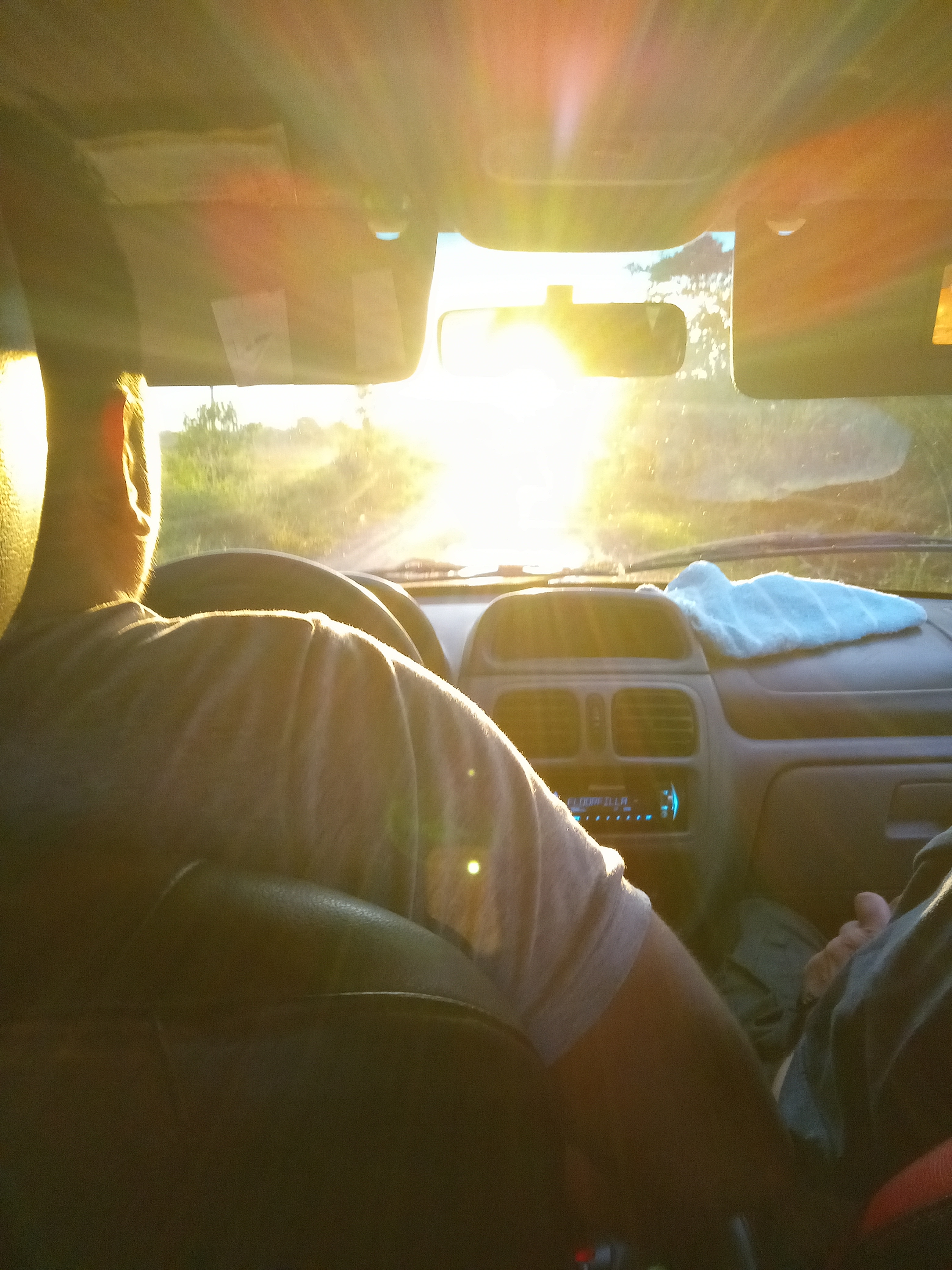
Jose and Jen, the couple who owned the hostel, had their own car but were picking up a few other people along the way, so had arranged for a taxi to take Rolf, the Spaniard, and myself to the ceremony site.  The place where we were going was beyond another town called Villagarzon, and took a half hour to get to.  Just being in the back of the taxi, knowing where I was heading, made me feel like I was already tripping.

Just outside of Villagarzon, we turned down a little dirt road.  At this point, the driver wasn’t sure which house it was.  We pulled into one, but no one was home.  At the next house we came to, a couple were sitting out front.  They waved that this was the right place, and the driver pulled over.  Jose had given us each a hammock and blanket.  We retrieved those from the trunk, and then followed a path that started beside the house and passed a few fish ponds.  In a small stand of trees was a large structure with open sides, a tin roof, and dirt floor.  We were instructed to hang our hammocks from the beams.

A few minutes later, Jose was along to help us with the hammocks.  He and Jen had brought Angelica, as well as a free-lance mystic named Don Diego, and a large dark man with a baseball hat who I was never introduced to.  Don Diego had his own magic kit that he set up in the corner, with candles, his own incense, and a drum.

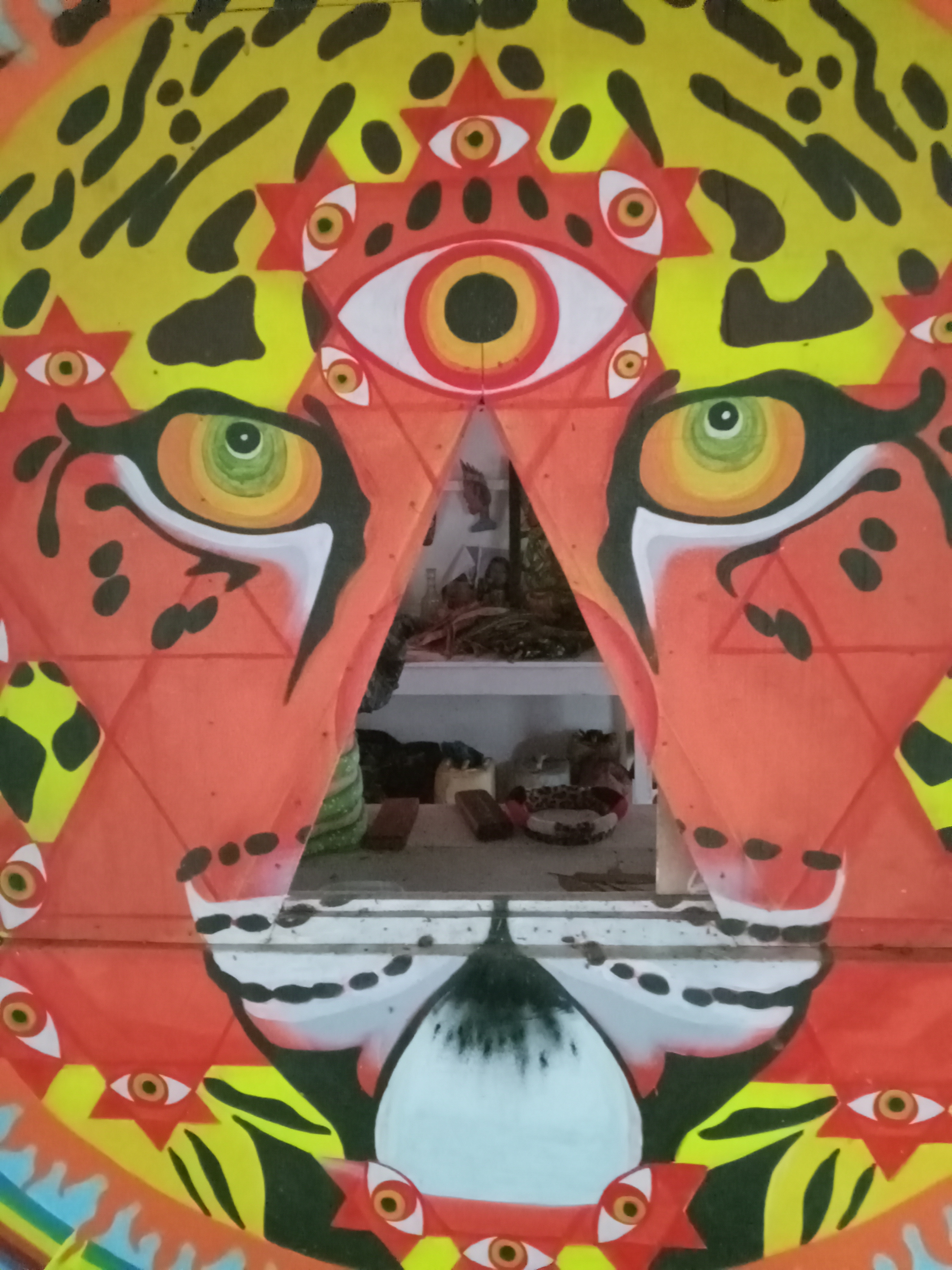
There was a fire pit with a thatched roof and benches about twenty yards away, and a bathroom at the end of a long stone path.  In one corner of the main structure was the taita’s office, so to speak, a small wooden hut with a jaguar on one side of it, and a pyramid, with a window to receive the medicine, on the other.  There were pictures of both him and his mentor on either side of the jaguar.

After we were all set up, we still had hours to wait.  A few other people showed up during that time.  There were also assistants to the taita who would play a role in the ceremony.  It was hard to know who was who or what their function was, especially after it got dark.  We waited on the benches, attempting to get to know each other, but really only thinking about what was ahead of us. 

Jen came over and gave us instructions, first in Spanish, then in English.  We were going to get sick.  That was a given.  We were asked to pick a tree that was far away from camp.  If we had to use the toilet, there was no running water.  There was a barrel of water with a plastic bucket in it.  We were asked to clean up after ourselves.  If we got into a bad place and needed help, that’s what they were there for.  Were there any questions?

There were probably a million questions, but nobody asked any.  Everyone there seemed to accept that this was their fate, and was determined to see it through.  If this was the calm before the storm, it wouldn’t last.  In a few hours, no one there would ever look at things the same way again.  Some of us were lucky just to survive.
art is a war 40

After a long while, there was finally some light coming out of the taita’s headquarters, and soon after that, chanting began to fill the air.  It sounded like there were many voices coming out of the one man.  I thought I heard elements of Mongolian throat-singing weaving through it.

When he was done blessing the medicine, we were called over to stand in line and wait for our turn to receive it.  The ayahuasca, or yage, was served in a cup not bigger than a shot glass.  Before handing it over, he blew hard across the surface of it.

I’d heard it would be bitter, almost impossible to swallow, but it wasn’t much worse than a shot of strong liquor.  Once I drank it and handed back the cup, I didn’t know what to do next.  Jose told us to return to our hammocks and wait for it to kick in.  I did, but for a long time it seemed like there was nothing happening.  Some people claimed that there’d been no effect after taking it.  On the flipside, others spoke of doing permanent damage to their psyche.  I shut my eyes and wondered if the faint geometric shapes beginning to appear were just figments of my imagination.  After a while, I was seeing a candy land of pastel colors, where women sat in candy houses, with signs out, like invitations.  I still felt OK, and thought, at that point, that I probably wouldn’t get sick.

Things began to change when the Spaniard, two hammocks away, gave a frightened shout and fell out of his hammock.  He grabbed it with both hands and used it to pull himself to his feet.  His face had changed into that of an old man with a white beard.  He walked stiffly to the edge of the camp and began to violently puke.  Someone had to help him into the trees where he remained, bellowing like a beast, and crying for help.  At the same time the large, dark man in the hammock next to me, sat up with a groan, like a mountain gorilla, and then dropped to the dirt floor and began writhing around, evidently in the full-throes of some kind of demon possession.  He was to remain there half the night, shouting, cursing, crying, asking over and over, Are you Serious?

I closed my eyes and when I opened them, the bad dream had invaded the world.  I heard Angelica fall to the ground, desperately sick, moaning like she was dying, begging for someone to come and help her.  Just then, I got sick myself.  I jumped up and barely made it to the edge of camp.  Jose came over and helped me to a tree.  I clung to it and retched up everything in my stomach.  Even when it was empty, I couldn’t stop puking. 

Now the woods we were in had become an enchanted forest.  The bathrooms, lit up by a red candle, had become a witch’s hut.  I had to shit, so went back and sat on the toilet, now seeing the faces of women, like an intricate, throbbing mosaic.  They wanted to take me into their world and I didn’t want to go.  The bitter smell of the ayahuasca in my nose was nauseating.  There was a vomit bucket next to me that I couldn’t stop reaching for.

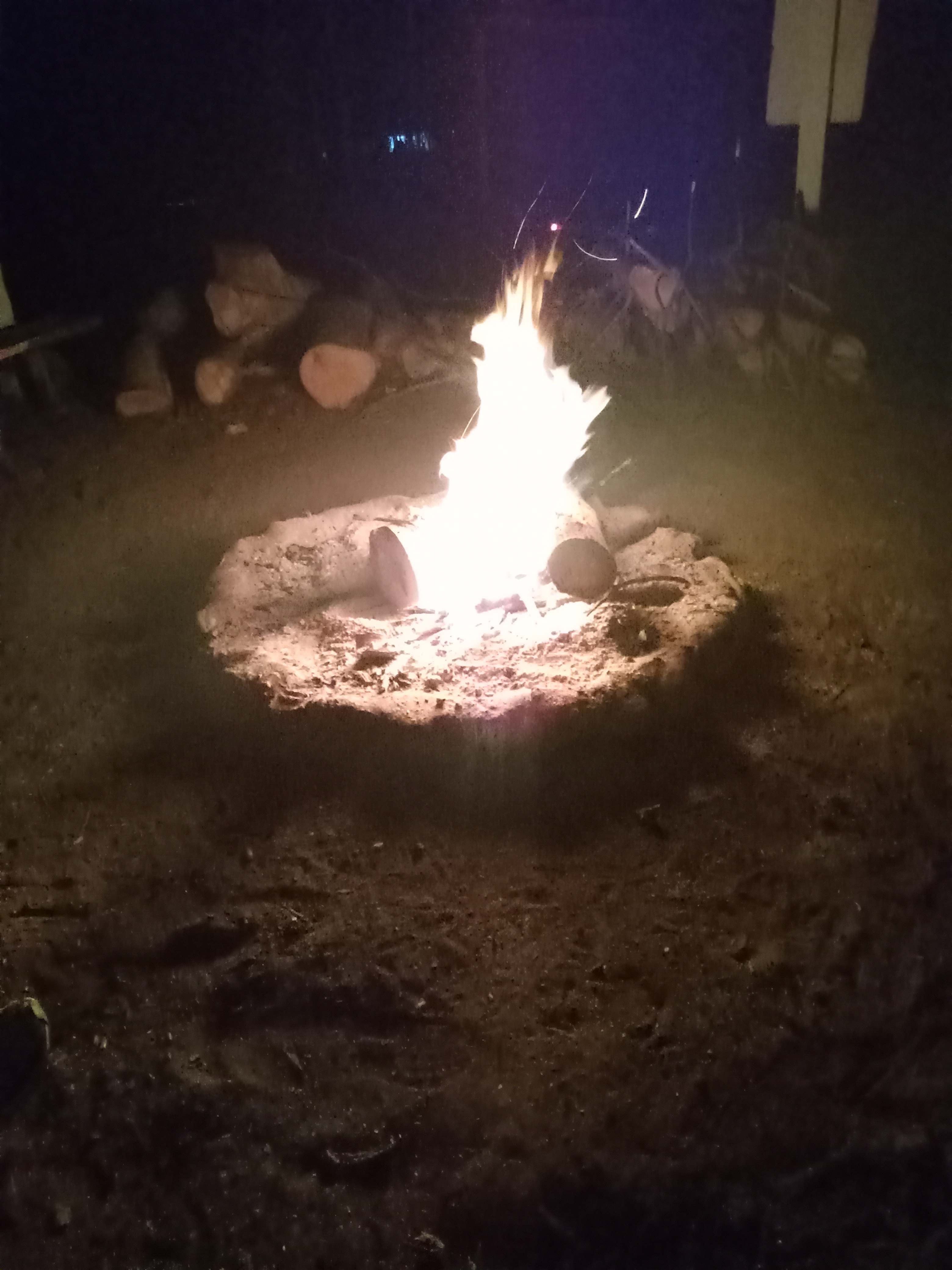
When I finally felt well enough to return to the camp I went over to the fire.  I couldn’t go back to my hammock as the dark man on the ground was still wrestling for his soul and wouldn’t stop shouting.  At the fire, I met Don Diego, tightening the head of his drum over the fire.  He was wearing some sort of ceremonial clothing, but resembled a large clown, and was making the sort of sounds usually reserved for the sea.

After, about a half hour a harmonica started playing, calling us back, and I realized that the worst of it was over.  There’d been a brief period where it had gotten so intense, I’d sworn never to do ayahuasca again.  Then someone started playing the guitar and singing.  There was some Spanish influence to it, but I’d never heard songs like that before.  The Spaniard was back in his hammock by now.  The dark man was still struggling in the dirt, but his cries were becoming fewer and further between.  Somewhere in the darkness, Angelica was moaning.  I was really afraid she wasn’t going to be OK.

The guitar music was coming from one corner of the camp.  I went over and found the taita presiding over it with his wife.  In addition to being a powerful medicine man, he was also a master musician.  He sang songs that I could barely understand, but the themes seemed to be of victory and redemption.  Every once in a while, he sang the name of Jesus Christ, and I realized they were spirituals in their own way.  The assistants accompanied him on rattles, and then took turns playing their own versions of his repertoire.  Someone asked me if I wanted another shot, and emboldened by my recovery and the validation of the music, I asked for a small one.

Immediately, I was terribly sick again, and had to run towards the bathroom.  On the way a wet fart went streaking down my leg.  I collapsed on the toilet, as sick as I’d ever been in my life, and sat there for hours.  Mostly, I just stared out at the darkness and vomited.  Then I saw some small lights flickering in the trees, and realized it was fireflies.  I got up, cleaned myself off, and walked to a clearing, where every star was pulsating in the sky as the fireflies continued to flicker in the trees.  It was the most beautiful thing I’d ever seen in my life.

In the morning, the camp looked like a battlefield, but it appeared everyone had survived.  At one point the dark man next to me had climbed back into his hammock, but didn’t get up as the rest of us were taking ours down.  There was one last rite the tatia performed to wrap up the ceremony, having us take off our shirts and then whipping our backs with a thorny, medicinal plant.  I saw him later talking to the Spaniard, who sat there, his back covered with red welts, looking as if he’d barely survived the Inquisition.

Strangely enough, everyone reported having a positive experience.  The allure of ayahuasca is that it is supposed to help you solve problems you are having in your life.  I have to admit that in my darkest hour, I’d done some soul-searching, and realized I was doing the right thing to go back to California for Christmas and reconnect with my family.  I’d also received a strong affirmation that I was a folk artist, not a pop artist or entertainer, and that the path I’d taken in life was the right one for me, even if I hadn’t attracted much attention or support.

Once the taxi arrived and we were driving back to the hostel, I recounted to the Spaniard how he’d fallen out of his hammock and gone bellowing into the forest like an ox driven mad by terror.  This made him laugh out loud.  He began to blather on about his experience, but I only understood one thing he said.  He claimed that he’d been in another world.

art is a war 41

That Friday was my birthday, and Jose and Jen had another yage session planned with the taita.  As far as I was concerned, I’d had enough and thought I probably understood the gist of the experience.  At the same time, there wasn’t much going on in Mocoa, so I considered returning, just because I’d enjoyed the ambience and the music.  Angelica told me she’d been to hell, but even she was thinking about going back.  Her son urged her not to, telling her she’d had a bad trip.  Rolf had remained in his hammock the whole night.  I’d almost forgotten he was there.  As far as the Spaniard was concerned, he was through with yage, but felt like he’d gotten something out of the experience.

There was an Irishman named John who was in the bed next to me.  He’d been there when I arrived, and was in the middle of a cleanse, so hadn’t joined us, but planned on going out on Friday.  He’d done it before, and for those of us who’d been through it, it was all we wanted to talk about. 

You might’ve heard about the Japanese soldier who’d refused to surrender at the end of World War 2, and had spent the next 29 years hiding on an island in the Philippines.  It had been like that for me.  I’d been out there fighting in the jungle of my mind for years, refusing to admit that the war was over.  I would never surrender either, but instead dreamed of one day breaking through a clearing and finding a whole platoon of soldiers, fighting the same fight as me.  That’s how it felt with the group of travelers I met in Mococa.  We grew instantly close, not just because of the ayahuasca, but also because we’d been out defying the odds in our own way most of our lives.

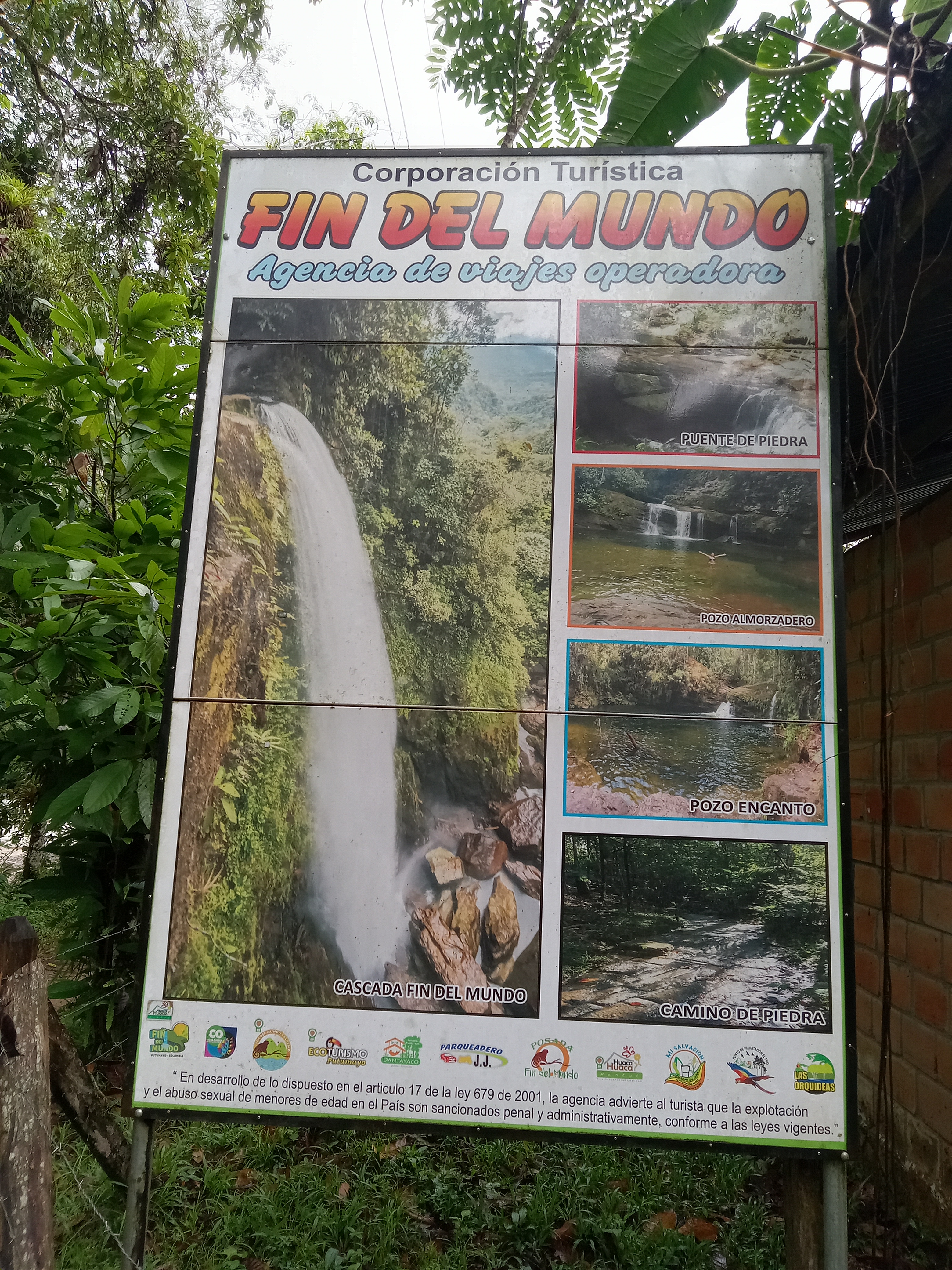
The day of the second ceremony, my plan had been to hike to a waterfall called End of the World, but when I woke up it was pouring rain and the attendant at the front gate told me the river was too high to cross.  I gave it a few for more hours, until after the rain had tapered off a little, but he said there was still a group that had been waiting two hours for the river to go down.  He suggested I visit a nearby animal park instead. 

On paper it sounded like a good idea, since it featured animals native to the Amazon; tapirs, capybaras, monkeys, crocodiles, parrots, and even a black jaguar.  It ended up being the last week of school, however, so the park was packed with kids and their teachers.  The only way to get in was to take a tour with a guide.  By late afternoon we were only half-way through the tour and I was practically convulsing with impatience.  That state of mind was not going to be conducive to a good ayahuasca experience, and I knew it, yet I’d determined to take the medicine once more. 

When I got back, after walking briskly two miles, mostly uphill, afraid that I was going to miss my ride to the ceremony, I found the others still in bed, resting up.  Only John and Angelica were going, as well as a young guy, Miguel who’d just shown up from Cali.  Jose and Jen were picking up people again, so Angelica went with them, and John, Miguel, and I took the taxi.

The energy was totally different from the first night.  It was darker.  The clouds were smothering the sky.  The energy felt tense and somber.  I saw that Don Diego was back, laying out his magic kit and drum, making strange sounds, smelling like a putrid sea.  We sat around the fire, but no one talked.  Angelica looked worried.

It was well after nine when the taita finally got around to his chanting.  There were many assistants there that night, apprentices of the well-respected shaman.  It seemed they made up a majority of the people in line for the medicine, yet it was so dark it was hard to tell who was there or what was going on.  I drank my shot and went and sat beside the fire.  It was so quiet.  A long time passed and I only heard one person get up to vomit.  I wondered if they were serving a less potent brew.  Jose and Jen had conceded that the last batch had been very strong.  Almost everyone had had an extreme reaction.

I was just starting to think the medicine wasn’t working, when my stomach suddenly turned, not wildly, but enough to make me get up and walk over to a tree.  I puked a few times, then took hold of the tree, and puked a little more.  I started rocking back and forth and realized I was about to get really sick.  My goal was to make it to the bathroom, which by now looked miles away, lit only by a small, dim candle.  I wouldn’t make it that far.  All of a sudden, I was tripping harder than I’d ever tripped before.  I was back in the pixelated world of beckoning women and didn’t want to be there.  The buzzing of all the insects in the jungle took on a frightening intensity.

I staggered from tree to tree, falling to my knees, savagely retching.  At the base of each tree, demonic green women were motioning to me, needing to feed on my vomit, wanting me to come and stay with them forever.  I didn’t want to go with them.  They were from a world I didn’t belong to.  If I went with them, I could never return.  I knew that I was on the brink of losing my mind.

When I got up, the green women stood between the trees, blocking the way to the bathroom.  I tried to start back to the camp, but fell on all fours, puking so hard, it was like I was being turned inside out.  A woman with a long green tongue lapped up every drop of it.  I flipped over, and started crab-walking in the direction of the camp, only reaching the perimeter of it, before I had to sit up and puke between my knees.  What a memorable birthday.  I was sure that I would never recover.  One of the assistants came over, looking like a black angel, asking if I was OK.  I wanted to cry out, but found I couldn’t speak.

After he left, I began to pray.  I prayed to Jesus Christ, the son of God, with all my heart and soul and might.  I’d been raised to worship Jesus, been baptized twice, and given my heart to him at least half a dozen times, always taking it back eventually.  Usually when I uttered his name, I was taking it in vain.  Now I cried out loud and prayed that he would save me, forgive me, and deliver me from the hell I was in. 

I also prayed to my father, the preacher, who’d passed away seven years earlier in a sudden and unexpected way.  I prayed to him to intercede for me, to speak up on my behalf.  Why did I think he might have any sway?  Because my father had loved Jesus and followed him through thick and thin.  For much my life I’d considered him the biggest wet blanket in the world, but in this fateful hour, saw clearly that he’d been doing the most important job there is, standing at the crossroads between life and death, helping those about to cross over prepare for the transition. 

Three weeks earlier, on All Saint’s Day, in Santa Marta, I’d had a strange experience, where I’d momentarily felt possessed by my father.  He’d had a difficult, often disappointing ministry, but had stayed the course.  I now saw that he’d been a saint in his own way, caring about others, particularly the homeless, until his dying day.  If he’d been trying to get my attention, now he had it in full.  I sat with my head between my legs, unable to stop puking, knowing that I’d lost my mind, begging him to save me.

art is a war 42

It was my birthday.  I was in Putumayo, in the Upper Amazon of Colombia, sicker than I’d ever been after taking a shot of ayahuasca at a medicine ceremony, praying to Jesus, and my father who’d passed away seven years earlier, to save me.  I’d seen both of them in a new light after reaching that critical juncture.  Perhaps it was too late for me, however.  After there was nothing left in my stomach to purge, I folded my hands across my chest, and lay down on my back on the jungle floor.  I knew that I was in my grave.  Assistants carrying incense passed by to check on me, and it was like I was six feet below the ground.

Lying there, able to look down on my body, I could suddenly see another side of myself.  My whole life I’d felt like a failure.  The only chance for me, or so I thought, had been to keep traveling and writing relentlessly.  I’d made art my religion, infusing my quest with all the attributes normally associated with a pilgrimage.  My life had been a mess, but I’d always treated my work as sacred. 

Now I saw that all the journeying I’d done, the entire process, had been my real work of art.  The songs and poems were only souvenirs, things that you wake up from a dream and find clutched in the palm of your hand.  I could feel how sad people were that I was gone, not because I’d been so successful, but because I’d struggled so hard to keep it real and kept on fighting the fight.  Tears began to pour down my cheeks.

After a while, the harmonica began to play.  It was calling us back to life.  There was another chance for me, but I couldn’t bring myself to rise.  The taita began to chant, and I knew that he was the only one with the power to break the spell.  It was the same authority my father had earned in the spiritual world.  On this black night, any other ability paled in comparison.

Eventually, I made my way to a sitting position.  When I walked back through the camp, everyone was cocooned away in their hammocks.  The guitar music had begun, and I wondered over to the corner where the musicians were and found an empty seat.  It felt like I’d stumbled across a juke-joint in Mississippi, and that the taita was demonstrating the hoodoo power of a true bluesman.  The apprentices sat around him, waiting their turn.  They would be there, week in and week out, practicing their chops, no matter who was there to witness them.  I would have to do the same.

Around dusk I finally made it to my hammock.  John got up and puked, which seemed like a late reaction to the medicine.  I later learned he’d drank three glasses of it, which was hard to imagine.   Miguel was up and wanting to talk.  It seemed the yage had had no effect on him.  One of the assistants came over and they got into a lengthy discourse.  I went to use the bathroom, grateful just to have survived the night, and saw that the clouds had parted and there was a small pod of stars in the sky.

Just as the day was breaking, a small storm broke through.  Wind, from out of nowhere, rushed through the camp, sending loose objects flying and empty hammocks spinning.  Rain hammered down on the roof like machine gun fire.  It seemed like something out of the New Testament, a moving of the spirit across the land.  John was awake in the next hammock and we just looked at each other and shook our heads.  It only went on for a few minutes before the calm returned, leaving just a light drizzle of rain.

It was my last day in Mocoa and final chance to make it to the End of the World waterfall.  When we got back to the hostel, I set out right away.  It was still sprinkling, but the attendant said it would be possible to make it to the top.  He showed me a map that was nothing like what I ended up encountering.  It was all uphill, a steep, muddy trail, sometimes traversing through shallow streams that were raging torrents just the day before.  As sweat began to pour from me, the stench of ayahuasca filled my nose, and it started to feel like I was being pulled back into the bad trip.  I stumbled up the trail like the survivor of a plane wreck.

At the entrance to the falls, there was still a long way to go.  There were two river crossings that required me to take off my shoes.  At the second one, I left them there along with my phone, suspecting I was about to get very wet.  A guard appeared and tried helping me across.  The stink of my T-shirt nearly knocked him off his feet.

Finally, I arrived at the End of the World, from the backside of it.  The river plummeted two hundred feet, straight over the edge.  I was warned not to get too close, but couldn’t resist hanging from the branch of a tree to get a view.  When I returned, I jumped into one of the rock pools with all my clothes on.  The smell of my own sweat was making me sick.

On the way back down, I was approached by two blonde dogs I’d seen at the entrance.  My father had always loved dogs in the same way he’d loved men, indiscriminately.  Some of the dogs that he’d brought home over the years had purely been charity cases.  They would never respond to training, and only be loved by him.

The dogs seemed to be waiting for me, and began to accompany me down the trail, walking a few feet ahead, periodically glancing back to see that I was still there.  For a moment I wondered if this wasn’t the work of my father, asking God to send down two angels to see me out of the jungle and safely on my way.  If I was writing magic realism, perhaps the two dogs would’ve seen me all the way to the road.  Instead, as soon as we met a couple on the trail, they turned and started following them, back in the direction of the falls.

art is a war 43

My plan was to make it to Sibundoy the next day.  Sibundoy is a small village a few hours from Mocoa.   A German traveler had told me about it.  He said that the population is mostly Indigenous, and that there are many famous taitas living in the area.   It is supposed to be a good place to attend a yage ceremony, but I was through with that, at least for the foreseeable future.  I’d gotten everything out of the two ceremonies I needed, and a change in perspective that was perhaps the best birthday gift I could’ve received.

Angelica was up making breakfast when I went down to the kitchen.  Her second experience with ayahuasca had not been so eventful, which was a good thing.  We got to talking and she brought up a series of books for children she’d begun writing that dealt with world religions.  That led me to suggest that a website might be a good start.  It gives you the chance to develop your format and put some feelers out there. 

Why I was telling her this, after all the frustration I’d just gone through with my own website, I don’t really know.  I gave her one of my cards, so she could check out my site for reference, and she looked it up right away on her phone.  For once, everything seemed to be in working order.  The small sample galleries I’d recently put up looked pretty good.  The pictures were eye-catching and the words meant something, not posts to just scroll through, but to spend a few minutes on and absorb, if you could make the time.

There was a bus to town that periodically stopped by the hostel.  When I was all packed, I went down and stood beside the road.  At the last minute, Angelica decided to join me, as there were a few things she needed to take care of in town.  Along the way, we passed a funeral procession, a black hearse, followed by at least fifty motorcycles and scooters.  I thought the driver wasn’t passing them out of respect, but when enough space finally opened up, he blasted around.

I didn’t know it at the time, but the road from Mocoa to Sibundoy is one of the most dangerous in South America, and is referred to as The Trampoline of Death.  At the bus station I was approached by a woman who sold me a ticket to ride in the back of a pickup.  Just behind the cab, a bench seat had been bolted down in front of the luggage space.  A tarp covered the top.  The side I was sitting on was wide open.

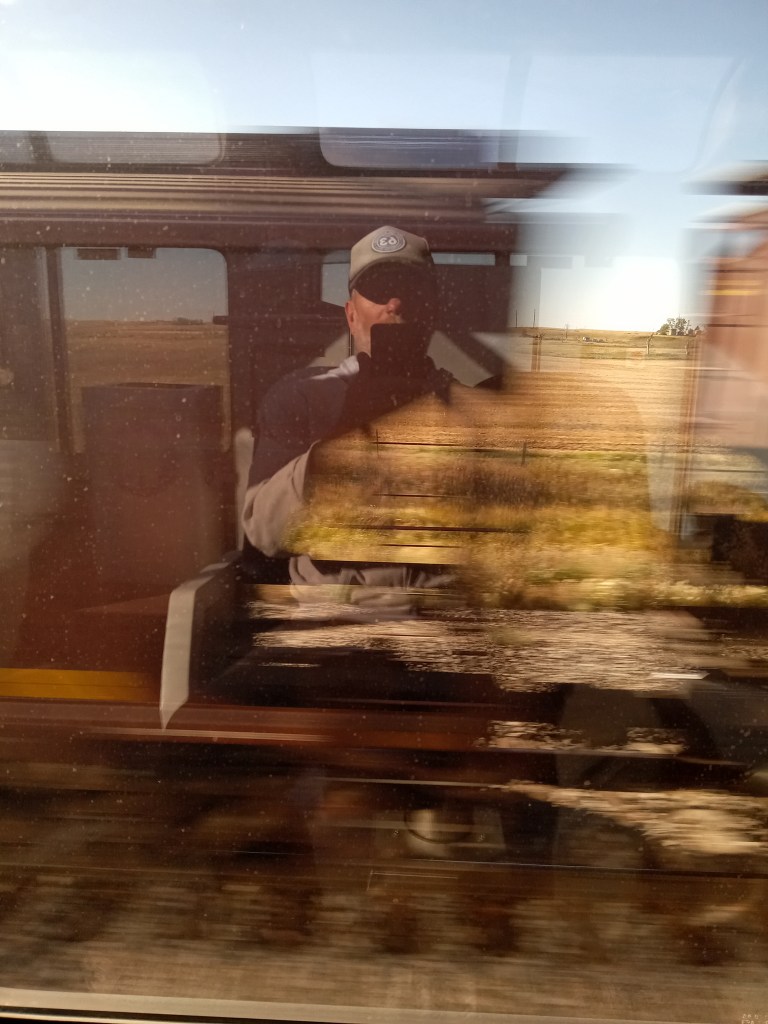
It didn’t take long to discover how the road had earned its name.  It was straight uphill, around a series of deadly curves and devastating potholes.  There was a man and woman next to me.  We were getting tossed all over the place.  I was afraid to take pictures.  Every time I got out the phone, the screen settings would jump all around.  Instead of pictures of the spectacular mountain scenery, I wound up with a dozen blurry selfies, all grimaces, and gritted teeth.

When we got to Sibundoy, the truck stopped just outside of town.  I walked down the road towards a cluster of buildings, and booked a room at the first hotel I came to.  There was a poster above the reception desk of some colorful statues, and the guy working there told me the pictures were taken at a park only two blocks away.  As soon as I put my things away, I went to check it out.

I was back to taking pictures of street art, which was fine by me.  All around the park were paintings and statues of medicine men and women, hummingbirds, jaguars, magical animals, musicians.  Now I understood where the artists had gotten their inspiration.  At the peak of my trip, the green forest demons had wanted to take me to see their art, and I’d resisted.  When I was finally laying down on the jungle floor to die, I’d seen a giant beetle on a wall, like a big screen TV.  His body turned electric blue and then began to pulsate into a million blinding colors.  It was way more than that, but as hard to describe as a dream.  All we can do as artists, is make clumsy replicas of things that can never be fully conveyed.  Still, they sometimes end up possessing a rare beauty of their own.

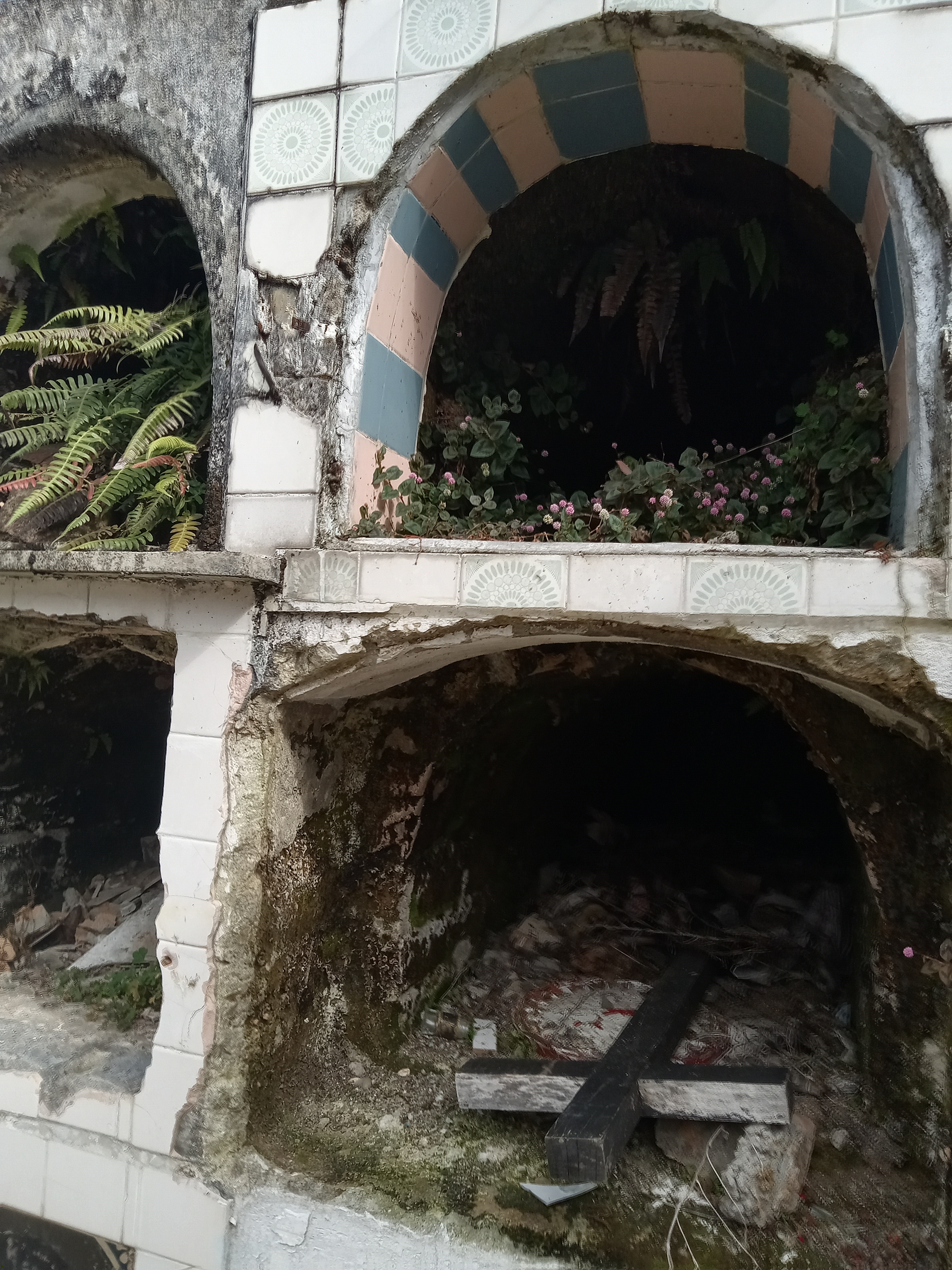
I next went into the cathedral.  Here was Jesus clutching his sacred heart.  Mary holding her infant son.  Behind the church there was a cemetery.  A cement path in the middle of it led uphill to an altar.  On either side, the tombs were stacked four high, some with painted inscriptions, others with flowers and photos.  A few were given headstones.  Some had crosses and angels.  I thought about what it would be like to be lying in one of them.  Given my experience the previous night, I could picture it very clearly.  Beyond the altar was a set of older tombs.  Some of these had either been broken into or were falling apart.  There were wildflowers and ferns growing out of them.

You might have heard of me, the traveler who didn’t know that the war was over, and went on fighting for the rest of his life.  You won’t see me on television, or on the cover of magazines, but if you ever fall through the cracks, or reach the end of your rope, you might meet me, and perhaps I can be of some assistance.  I’m not trying to save the world, or even change it, but I’ve written a few songs and poems, and of course, there’s the stories.  If your heart is broken, or things didn’t work out quite as planned, we just might have something to talk about.

When I got back to the hostel, Angelica had written, saying my website was awesome and I should definitely keep it up.  Keeping it up is all I do, but it was nice to hear from someone, besides my mother, who really cared.

riding the rails 1

It was the first day of fall and things were already falling apart.  The first Uber driver I called totally ghosted me.  That had never happened before.  He was within a half mile of my pickup location when the driver rating and tip page suddenly flashed on my phone, as if his mission had been accomplished simply by driving past me.  There was still time to call another driver, but if anxiety had already been gnawing at my stomach all morning, it was now devouring it.  A trip of the magnitude of the one I was embarking on should’ve been thought out and researched for months.  Instead, I was winging it, knowing full well that the price of failure could be disastrous.  If you’re going to strand yourself anywhere with a shortage of cash, don’t let it be America. 

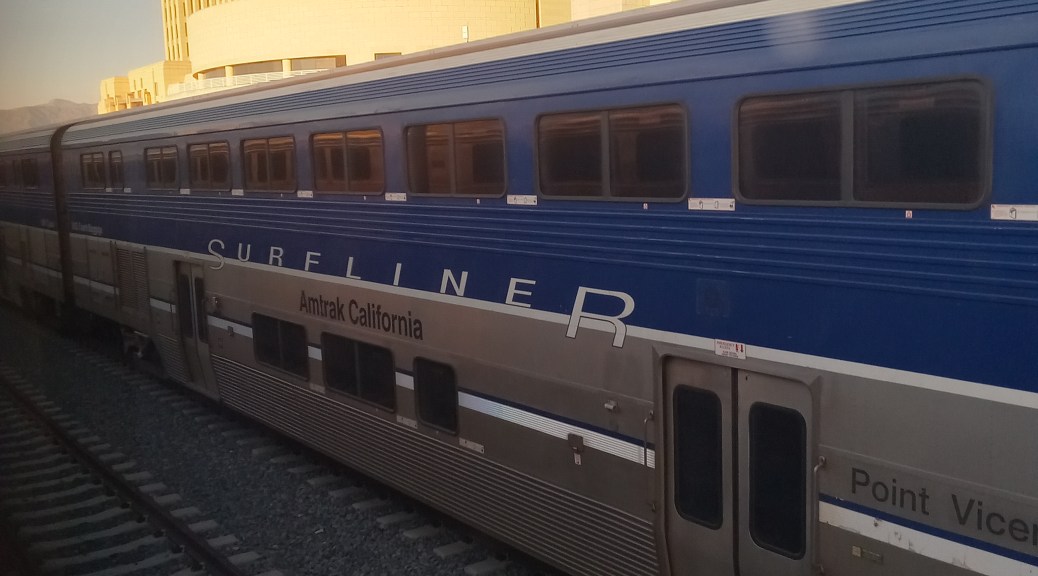
My vague idea if nothing worked out was to take the Pacific Surfliner down to San Diego, and from there catch the Blue Line to San Ysidro, where I could cross the border into Tijuana, but I’d just come from Mexico and knew there was little escape to be found down there at the moment.  What I wanted was to ride trains around the country.  It was September.  Everyone had wrapped up their vacations.  The kids were back in school.  The weather would still be decent everywhere, not too cold yet.  The trees in the north would still have their leaves, only now beginning to change to yellow, red, and orange.  I knew it could be done.  I’d traveled on a USA Rail Pass three times in the past and had always gotten my money’s worth.  The problem this time is that I hadn’t checked into anything, hadn’t made any inquiries or reservations, and was hoping I could just show up in Santa Ana and be on a train to Chicago within a few hours.  Turns out it was going to be a little more complicated than that.

The second driver I contacted showed up in an electric car and quietly whisked me off to Santa Ana without any drama.  He told me to reach out to Uber and let them know what had happened.  They would take care of the nine-dollar charge that had just appeared on my account for a ride to Lake Park, a distance of about five blocks from where I was supposed to have been picked up.  He may have been right, but as he pulled up in front of the Regional Transportation Center and I got out with my bags, which suddenly seemed ten times heavier than when I’d packed them that morning, I was sick with dread. 

There was no one at the Amtrak window, but it was immediately evident that things were going haywire there as well.  A message kept repeating over and over that the twelve o’clock train I’d been planning to take to Union Station in Los Angeles was running an hour late.  They were blaming the delay on vandalism.  Someone was out there getting back at the man by messing with the signals.  Metrolink was being similarly impacted.  There weren’t many passengers waiting, but the unfortunate ones who were there were sunken deep into the benches in dismay.

At one point I spotted some movement in the office, as if someone were hiding in the back room and only peeking to check if it was safe to come out.  He had no choice but to come out now, but took his time doing so, with a pained expression on his face, as if I was an intruder tromping mud across the floor, as opposed to a customer looking to do business with the beleaguered railway line he was supposed to be working for. 

Would I be able to catch the Southwest Chief to Chicago that evening?  No, in fact, it was sold out.  How about the Sunset Limited to New Orleans?  That only ran three days a week.  The Coast Starlight?  Not until Saturday.  What about a USA Rail Pass?  Could I get one of those? It would probably be better to know where I was going first.  What about Los Angeles?  Could I head up there and figure things out at Union Station? That was possible, but the train was running late.  Now an hour and a half late.  Fine.  I bought a one-way ticket to Los Angeles for seventeen dollars.  That wasn’t going on the Rail Pass.  The Rail Pass is good for ten sections.  If it isn’t reserved for long-hauls, for example, from Los Angeles to Chicago, or New York City to Miami, it isn’t worth it.

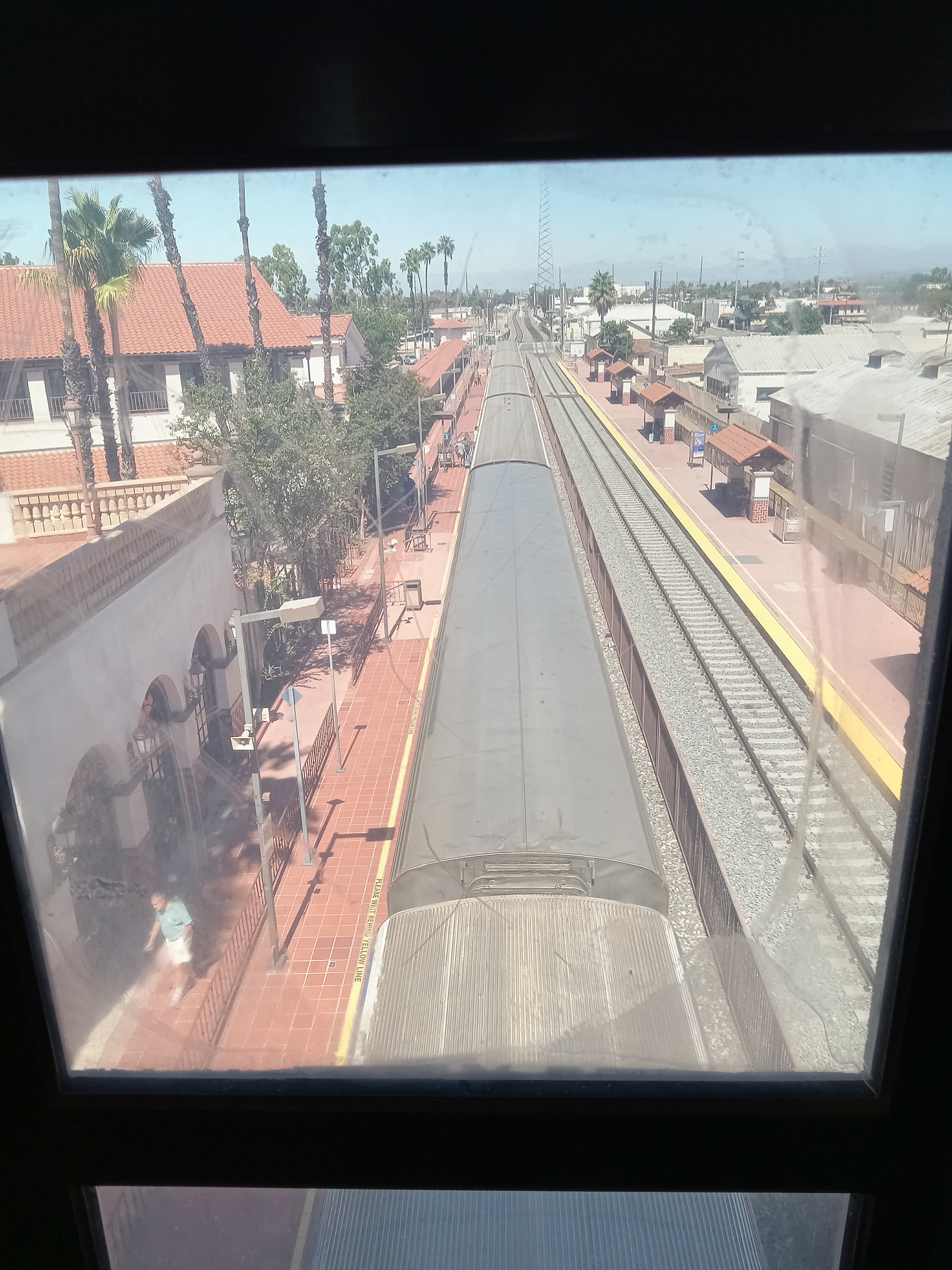
Now I had a one-way ticket to Los Angeles, easily one of the most intimidating and expensive places in the country, with no idea what I’d do when I got there, especially since there seemed to be no availability on any of the outbound trains that day.  The anxiety that had been eating up my stomach now extended into my skull and made it tingle in terror.  I couldn’t sit still, so went out to pace beside the tracks.  There was a high bridge to cross in order to get over to the tracks that run north, so I dragged my bags up the stairs and stood there staring down into the empty haze of the day.

There were a few passengers huddled beneath a shelter that I went over to join, setting my things on one side of it, and sitting down cross-legged in a narrow strip of shade.  My idea had been that maybe I could calm myself a little by meditating, or at least counting my breaths, but within a minute I was joined by another man with a little plastic suitcase and lunch-pail, who sat down cross-legged beside me and began to read a book about relativity, while simultaneously speaking into a recorder, as if he were preparing for a debate on the merits of critical-thinking.  At first, I thought he was questioning me.

Do you just believe what they want you to believe?

I looked over and saw him staring down into his recorder in victory, as if he’d just delivered a death blow to an unseen rival, which, fortunately, wasn’t me.  At least not yet.  Just then, a bell began to clang and I was delivered.  The Pacific Surfliner was arriving from Irvine, way behind schedule.  In only a few weeks, it wouldn’t be running at all, due to the unstable, shifting ground between Los Angeles and San Diego.  Perhaps, I was just getting out by the skin of my teeth.

There were a lot of seats open on the train.  I put my suitcase and backpack next to the luggage rack and took one that was facing backwards.  Soon we were passing Angel Stadium in Anaheim and then making a brief stop at the Fullerton station.  Things got industrial as we got closer to Los Angeles.  Concrete riverbeds with streams of polluted green wastewater.  Warehouses.  Enormous freight yards and lots full of shipping containers.  Graffiti splashed across the walls that faced the tracks like long, violent animated clips.  Perched beneath some of the underpasses were homeless encampments, a mixture of tents and trash, the worst mutation of the camping experience the world has ever seen.  We entered into a long tunnel before emerging at Union Station.  I got out with my bags, as if my destination were death row, instead of a transportation hub, and made my way to the ticket office.  If there wasn’t a train leaving the next day, my plan was to jump back on the Pacific Surfliner and head to Mexico.  If there was a train the next day, I still had no idea what I’d do that night.

At the ticket window, I took a moment to gather all the diplomacy I could muster, before asking about the Southwest Chief, hoping to get a different answer than the one I’d gotten in Santa Ana.  Actually, there was one seat left on the train I was told.  Really?  That was fantastic.  When I asked about the Rail Pass, however, I was told it didn’t apply to the seat they had available.  OK.  What about the next day?  Yes.  There were some seats open the next day.  I bought the pass and made the reservation.  The train wasn’t leaving until six the following evening.  Seeing that it was only two-thirty in the afternoon, that gave me a long time to kill.

Having lived in downtown Los Angeles for a few years, I knew what my options were, and they weren’t good.  I knew all the crack hotels on Skid Row from back in the day, and even those aren’t cheap.  One in particular, the Cecil, had recently been featured in a Netflix documentary when a tourist went missing and turned up floating in the water tank on the roof.  I figured I’d go check it out, and just pay what I had to pay.

It had gotten to the point, where winding up in a water tank on the roof of the Cecil wasn’t the worst thing I could imagine.  To be getting old in America, with no job or plan for the future, was way more frightening than that.  Riding trains around the county wouldn’t solve anything, but it was all I could think to do.  It felt like I was running for my life.