Category Archives: Travels

back to the jewel 35

To get to the North Shore I had to first travel to the shopping mall at Ala Moana and transfer on to the 60 from there.  Ala Moana was the place where we would go to window-shop back during the money-less days when I was growing up in Hawaii.  There were big koi ponds and a Japanese department store with a life-sized statue of our favorite superhero, Kikaida.  We might have gotten an Orange Julius on occasions, but our trips there were strictly for looking.  The only time we bought something was when my brother rolled a model Volkswagen Bug, made for holding shot glasses, down a flight of stairs.

There was a drunk man sitting on the bench when I walked up to the corner of Kapahulu and Kuhio.  He was yelling at the cars passing by, but left me alone.  After arriving outside of Ala Moana, it was only a few minutes before the 60 came pulling up.  We traveled over the Pali Highway and passed through Kaneohe.  The windward side of the island looked drab and muddy on this day. 

A homeless man was hanging from one of the handrails, trying to stretch out the muscles in his back.  A transient woman was in the seat next to me, drawing pictures on the dirty window.  We stopped at the Polynesian Culture Center and I could see large tikis of Ku, Lono, Kane, and Kanaloa, in the parking lot.

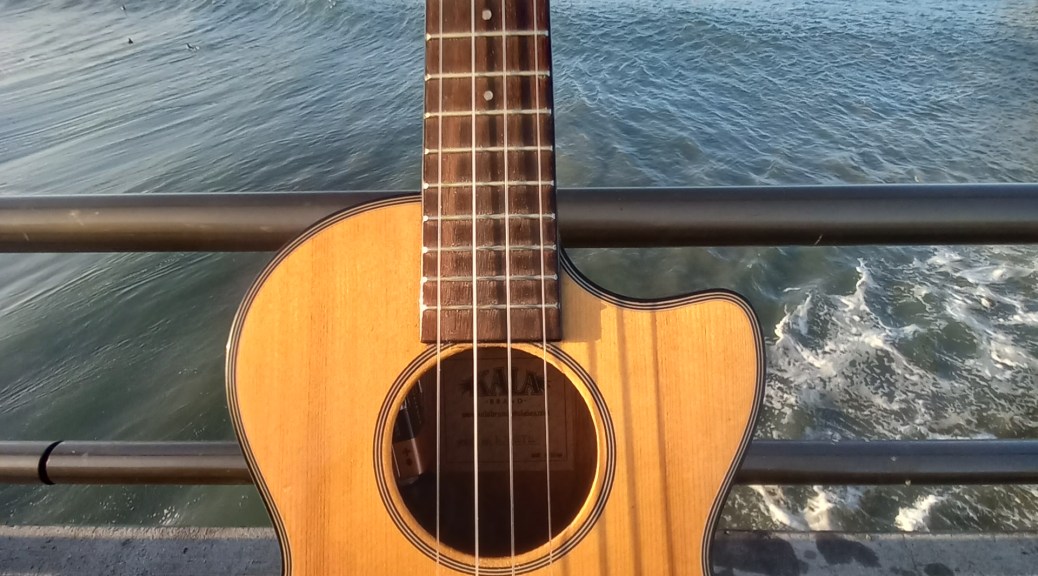
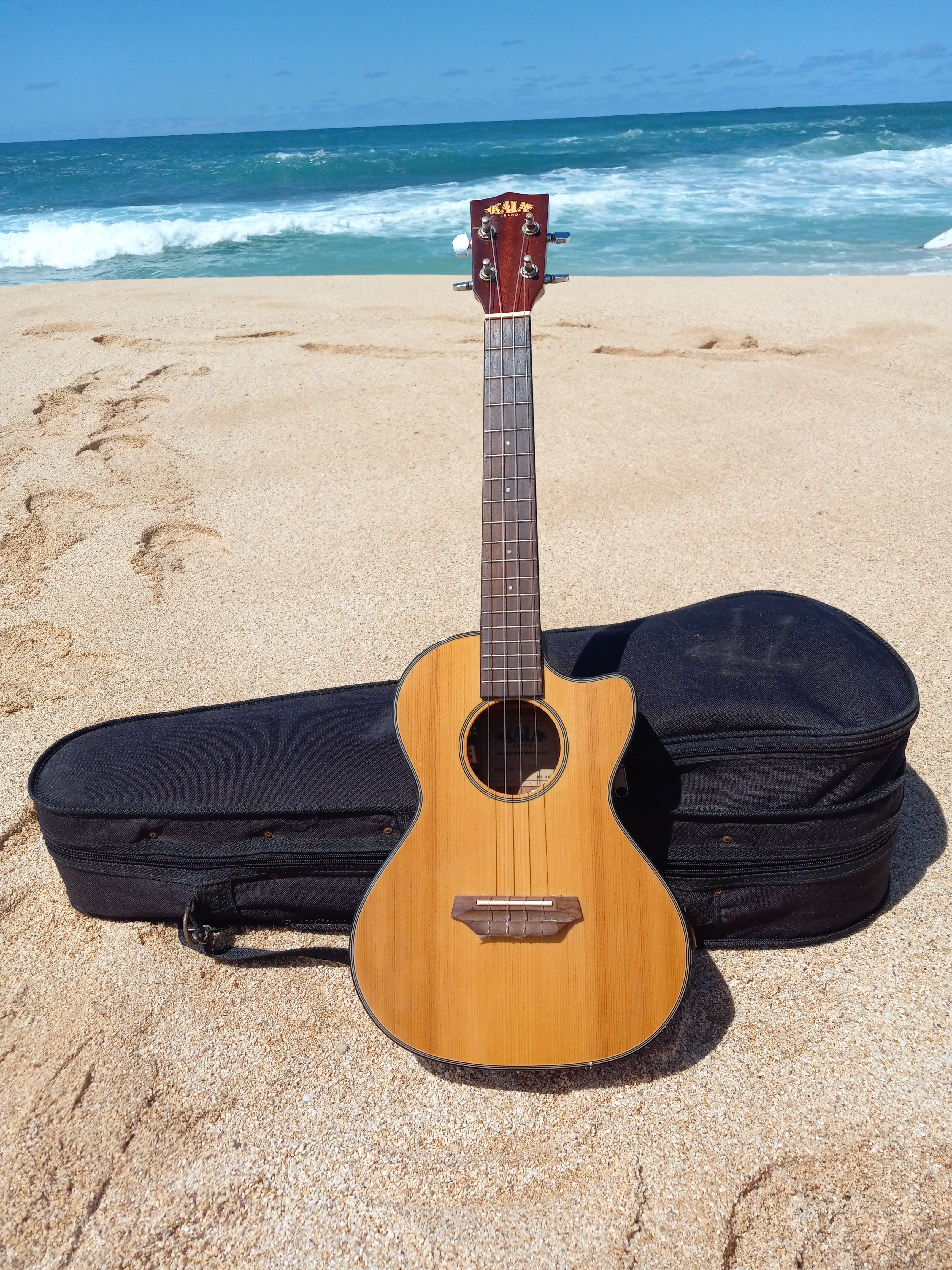
The North Shore of Oahu is the most famous surfing destination in the world, known for its massive waves during the winter season.  Around the bend from Turtle Bay is Sunset Beach and just past that is the Banzai Pipeline.  I got out at Sunset Beach with my ukelele.  The waves had recently been as high as fifteen feet, but on this day were closer to nine.  Large sections of tide were sweeping back and forth between the shore and the break.  There was no way I’d ever paddle out into that, yet I got out my ukelele and pitched it in the sand like a board.

This day would be the culmination of my trip.  I sat in the sand and played with the heart of a big wave surfer.  There was one song that I’d been working on the entire time I’d been in Hawaii, just that one rhythm and melody.  I’d sent thousands of words toppling over the falls but only some of them had stuck, enough to have a structure.  The chorus and first verse were finished.  The second verse echoed some of the situations in the first verse.  Nothing at All is about a man who chases a dream so far that he can never get back to reality.  From what I’d seen of reality on this trip, I wasn’t sure it was worth getting back to.

After an hour I got up and walked down to the Banzai Pipeline, one of the greatest places for tube riding in the world.   Here the notes flew down the neck of my ukelele like they were the ones getting tubed.   From there I journeyed down to Shark’s Cove and took a lunch break at Foodland.  I got a half a rotisserie chicken and iced tea and went and sat down in the shade of the pine trees across the road.  I sat down on a bed of leaves and pine needles and enjoyed my own little luau, before picking up the ukelele and working some more on my song.

When I walked up to the bus stop, there was a man walking down the highway wearing a robe, Chinese mask, and long black wig.  It was hard to know if he was involved in a theatrical production or out practicing magic as a free-lancer.  He rode all the way to Haleiwa and then got off and continued walking down the road.  In the meantime, there were about four of us waiting for the 52 to take us to Honolulu down the center of the island.

When I got back to Waikiki there was a guy yelling at a fire hydrant.  That made about as much sense as anything, certainly as much as playing music for the sea.  There are spirits in everything, some of them good, some of them bad.  We abuse some.  We seduce the others.  What does it all really mean at the end of the day?
back to the jewel 36

Even though Hawaii is full of homeless people, there were still less of them in Waikiki than there’d been in 2012 when I’d lived there.  They’d passed laws from people sitting and lying around on the ground.  I knew that.  Then I learned that everything had been locked down so tightly during COVID that no one had been allowed in the park.  There was a five thousand dollar fine for being caught there.  That put things into perspective.  Hawaii was only now beginning to relax the regulations.  It had been a hassle to fly over.

Looking on the internet, I found a flight to Guatemala City that was leaving from Los Angeles the same day I got back.  It was just over two hundred dollars for a roundtrip ticket, so I went ahead and booked it.  I was not ready to show up at my mother’s so soon and start riding my bike around Huntington Beach again. 

I had just enough money to pull off three or four months in Central America.  That would give me time to sort through my collected works and look for a job that started in the summer.  If I couldn’t achieve things, I could at least avoid them.  Some of my happiest days had been spent avoiding what everyone else referred to as reality.

That day I was heading out to Mahaka on the west side of the island.  It has the highest concentration of Native Hawaiians and also a high rate of homelessness.  I’d been out there before and seen big tent cities on the beach.  I’d lately been reading about attempts to create a permanent homeless for residents of a big homeless settlement at the Waianae Boat Harbor.  There were apparently two hundred and fifty people living in it. 

With all the open land in America it makes sense to me that they could create reservations for homeless people, where they could at least get the basic necessities.  Allowing citizens to sleep on the street and forage garbage cans for food is a sure sign that a society is on the wrong path and that dark days lie ahead.  For someone who has spent his life hopping and jumping from place to place it sure would be a relief to know that I had somewhere to go to when I grow old.  I’ve just had bad luck.  It can happen to anyone.

It took two hours to get to Makaha on the number 2 bus.  I got off at the end of the line and walked back to a beach that said the Makaha Surf Club.  There was a sign specifying it was for locals only.  As I walked up with my ukelele I heard someone comment about the haole boy.  I could’ve been back in elementary school again, a shy, white child among the natives.  There was a picnic table that I sat down and started to play on.  For some reason, I wasn’t feeling the vibe.  The strings seemed too loose and were buzzing on the neck.  I moved locations a few times, but never once got comfortable.

When the return bus showed up, I went and got back on it, only having spent an hour or two in Makaha.  It only traveled about two miles before the driver pulled over for a half hour lunch break.  When we started up again, I was riding on the side of the bus that faced the sea.  I could see all of the tents and encampments wedged into the bluffs. 

When I got back to the hostel, there was a guy moving into the bunk above me.  He was from Ohio, but claimed to have spent a lot of time in Honolulu.  Now he was testing the waters again to see what it would be like to try to live there.  The problem was the cost of living.  Many people need to work two or three jobs to afford living in Hawaii.  They say that’s the price of living in paradise.  I say if that’s the price, then it isn’t paradise.  Guatemala was starting to sound like the Garden of Eden.

back to the jewel 37

A kupua in Hawaiian mythology in a hero, like Hercules, who is born of a god and a mortal.  Sometimes they are part animal, based on an animal ancestor that entered into the child at birth.  A battle between two kupuas would be interesting to watch, as they are shapeshifters and would constantly be changing to gain the upper hand.  Even if they are just human, a kupua might be recognized by supernatural strength or a special skill.  They roam the countryside, ridding the land of unjust rulers and are proficient in weapons such as the spear, sling, axe, and club.

Kupua leave their mark on the land as they are passing through and certain landforms are sometimes attributed to one of their adventures.  Like figures of folklore, stories about them are meant to be fictional and fun.  Humor is incorporated into the retelling of their exaggerated exploits. 

The story about the lives of the kupua follows a predictable pattern.  They are born in a nonhuman form and discarded, but then rescued by the grandparents.  The child grows up to be wild and mischievous, and after a while begins to demonstrate traits that set them apart.  At one point they may be recruited by a prominent chief to perform deeds that no other can do.  The reward is often the hand of a daughter in marriage.

My father believed he had a special calling in his life.  He used to tell a story about being a boy at Bible camp, afraid that God would call him to be a preacher.  Indeed, that’s what happened when he came to Hawaii.  He started out as an English teacher but was recognized as a man of God and sent off to seminary.  When he returned, he had new powers.  He aspired to heal the sick, cast out demons, and gather souls for Christ.  Miracles did occur.  People were saved.  Signs of God’s presence appeared everywhere my parents turned in those days.

It was never the same after we moved back to the mainland in 1976.  I often told my parents that their wild years had been my only years.  I’d lived in a haunted mansion, been baptized in the ocean, spoken in tongues, been exposed to exotic dances, learned to perform spiritual music.  The concerns of other children would never be my concern.  I’d made a heroic quest out of my own life as well, but nowadays it seemed like the magic was gone.

There were only two days before my flight left for Los Angeles.  I’d decided I’d had enough hostel living for now and knew I’d have to either find a sponsor or come up with some major bucks if I wanted to spend any length of time in my birthplace.  It was Sunday and I had the day to kill.  I walked up Kalakaua Avenue, all the way to Ala Moana and then started walking back through the park.  They were doing construction.  The canal was choked with garbage.  Ugly mutant fish were stacked on top of each other, being asphyxiated by a lack of oxygen in the water. 

The park was full of Hawaiian families having picnics.  I felt very alone and strange now, a modern Rip Van Winkle who fell asleep in the mountains for twenty years, in my case forty-five, and woke up to find that the world had changed, and he was an old man with a white beard.  There had been nothing concrete in all those years, only changing environments, new explorations. 

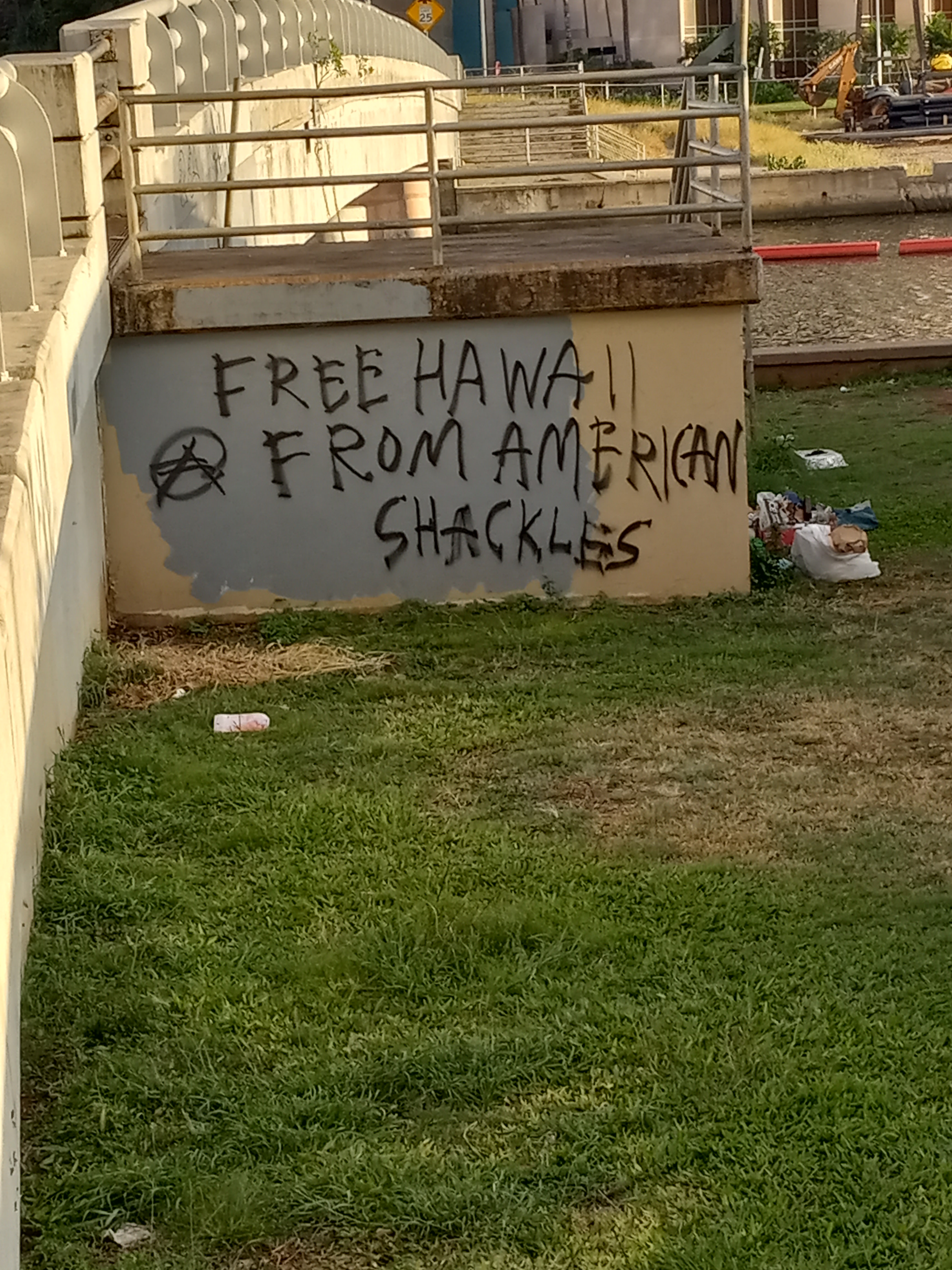
I’d always thought that I would return from my wanderings with a gift for mankind, perhaps something as simple as a song that could make people smile.  There were no people to return to, however.  There had never been a community.  The country was a collection of strangers all fighting for the same piece of the pie.  I saw a blue tarp stretched over a homeless camp and a bridge where someone had scrawled, Free Hawaii from American Shackles.  It wasn’t that simple.  Everything had changed.  There was no going back.

back to the jewel 38

Although I ended up reading the whole book on Hawaiian mythology there were only certain passages and stories that stuck with me, often because they reminded me of a theme or series of events that I’d read about in another story.  One of the last chapters in the book was called the Voyage to the Land of the Gods.  The narrator points out that these kinds of stories usually follow the same format.  A kupua is admitted to an overcrowded ship.  He wards off dangers along the way.  He sends the crew home with a gift which they lose because they refuse to follow instructions.

One of the examples given was the story of the great voyager, Waha-nui.  Waha-nui makes a vow to visit three gods and sails from Hawaii to Lanai.  The three gods are Kane, Kanaloa, and Kane-apua.  Kane-apua has angered the other ones by urinating in their fresh spring.  They become birds and fly away, leaving him stranded on the island.  When Waha-nui passes by, Kane-apua raises a storm that causes him to land.  He then takes refuge on the vessel.

There are many dangers that they encounter at sea and Kane-apua protects them.  He saves them from the dog of Hina, guides them through the black and white cliffs, which are famous for smashing canoes, keeps their boat together by mending it with ropes made from the intestines of a goddess, then he quiets his own dog when they get to Kahiki.  There he shows Waha-nui where to find Kane and Kanaloa, joined by another god, Mauli, who are lying with their faces turned upwards. 

Waha-nui begins to worship Kane-apua after his return and is gifted a double-bodied creature called a pilikua.  He is warned not to show anyone until he gets back to Hawaii, but can’t resist showing it off to a chief on Kauai.  The chief murders him and his men.  Only one of them escapes and returns home with the news.  Later, the chief and his people are lured to Hawaii and all of them are killed in retaliation.

The story about the voyage to the land of the gods reminded me of certain aspects of the Odyssey and also the adventures of Jason and the Argonauts who went in search of the golden fleece and were guided by Athena.  I had one last place to visit and that was Sandy Beach and Blowhole.  I would have to take the 23 bus the next morning and do a lot of walking to get there.  If possible, I would’ve also visited Hanauma Bay, but no buses went there.

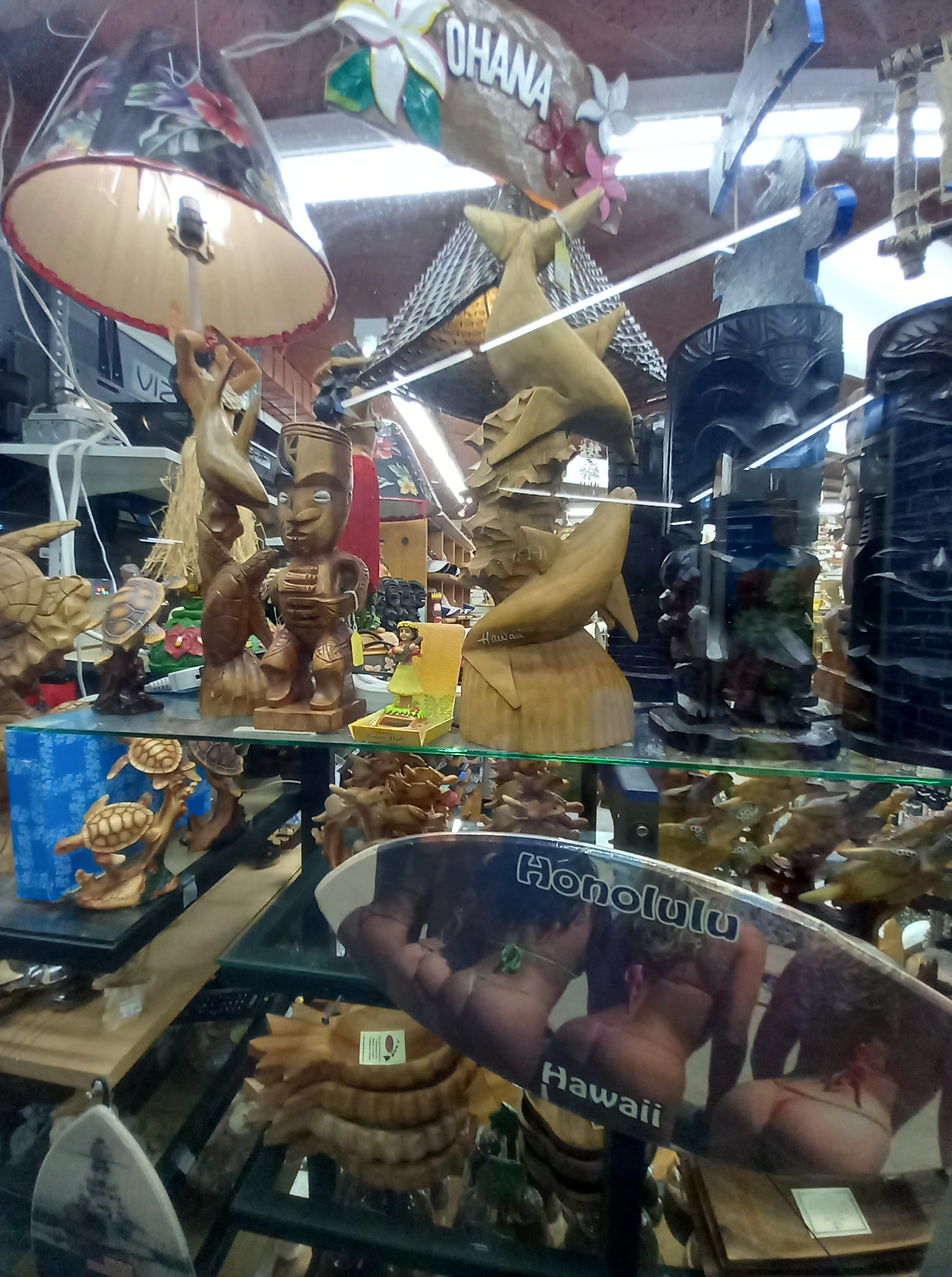
That evening I walked back to Lewers Street, the sight of Our Redeemer Lutheran back in the day, when it was the only tall building in Waikiki and you could toss a paper airplane from the balcony and have it reach Manoa if it hit the right trade winds.  Now the site of the church was a squat, black commercial building.  There were souvenir shops across the street with tikis, leis, and Hawaiian outfits for men and women.  Down the street was an Irish bar.  I walked up Kalakaua Avenue with my ukelele strapped to my back.  There were street performers on every corner.  My purpose was not to entertain.  There was a graffitied bench in Kapiolani Park that I wanted to sit and play on. 

My soul was not at ease.  I needed to make an adjustment.  I am rarely at peace anywhere I go, but can sit in Kapiolani Park and play ukelele for hours.  Maybe Kane and Kanaloa would be lying in the grass, facing upward.  My new song was finished and ready to be tested.  If they liked it, maybe they’d take me with them the next time they went searching for awa.  If they didn’t like it, what could they do?  I never claimed to be a professional.

back to the jewel 39

The next day I set out on the bus to Sandy Beach.  It left from the corner of Kapahulu and Kalakaua.  A couple were hoping it would take them to Hanauma Bay, but since I’d just researched it the day before, could assure them that it wouldn’t.  The bus traveled up to Diamond Head and passed the Kahala Mall, places I’d recently revisited on the trip.  It took the 72 to Hawaii Kai and then made a long circuitous route through a series of housing tracts, past the neighborhood where I’d stayed with my parents on our last trip to Hawaii together.  It dropped me off down the road from Sandy Beach, and I walked the rest of the way.

Sandy Beach, with its pounding shore break, is one of the of most dangerous beaches in Hawaii.  It is also known as Broke Neck Beach, as many people have been paralyzed and drowned while bodysurfing there.  Although my father never learned to surf, he did go bodysurfing at Sandy Beach when I was a kid.  One time I got pulled out by the current and he ran and snatched me out of the water.  I probably would have drowned. 

Later, I pulled a little kid out of the water when our class was on a field trip to Waikiki.  It doesn’t take a hero to pull someone out of the sea.  It’s just what we do.  Let them die slowly on a sidewalk, however, and that’s a different matter.

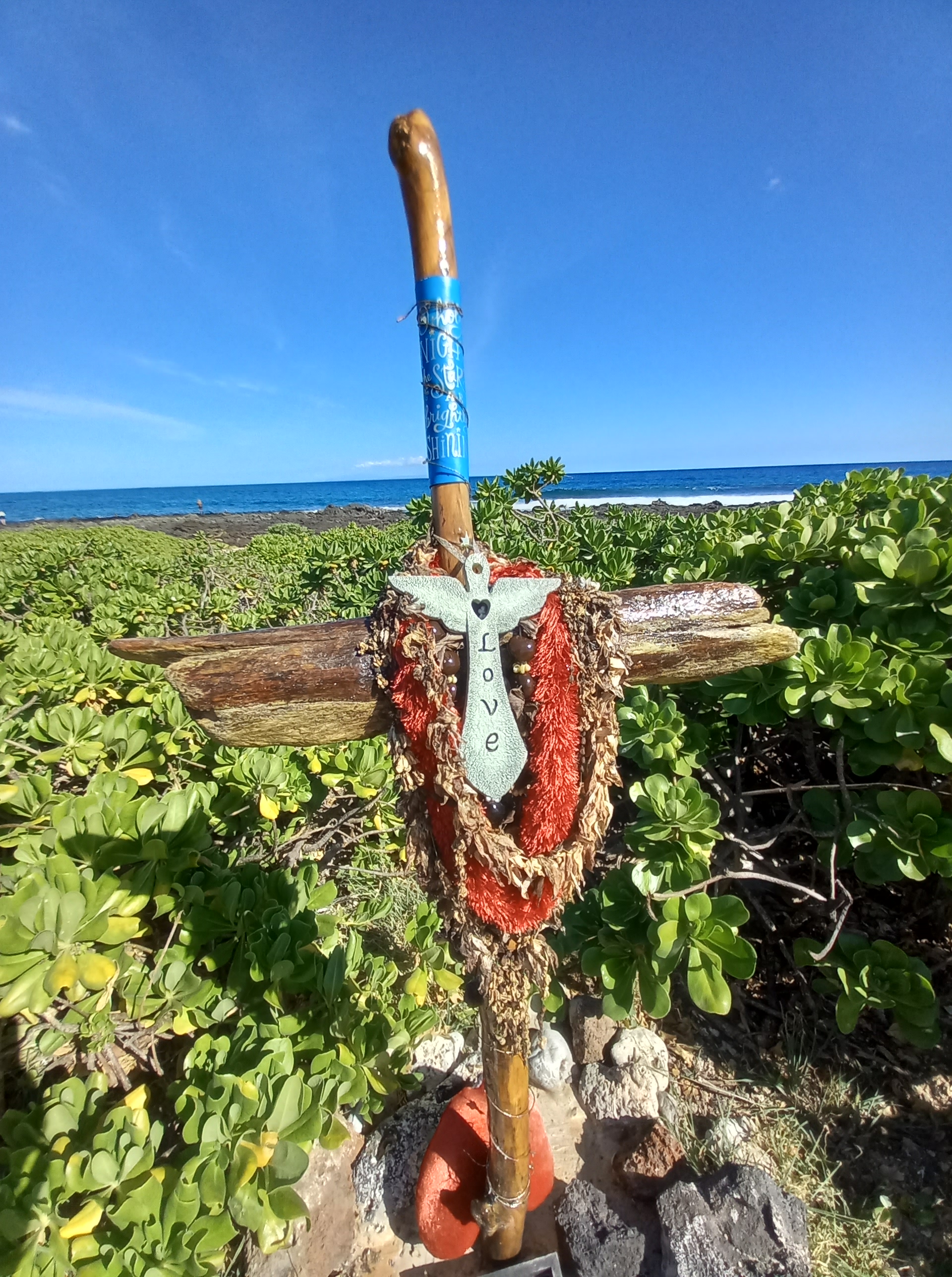
There were bright murals on the restrooms at Sandy Beach, a local in a red shirt and hat against a backdrop of fish, a woman with long flowing black hair and a flower tucked behind her ear, Ernie Cruz, playing his Aloha guitar, Duke with a pair of shades on, three tikis behind him, dolphins, a whale, and a sea turtle, all swimming out to sea.  There was a cross on the shore that said love.  I found a bench to sit and play my ukelele on.

Later, I started walking up towards the Halona Blowhole Lookout.  The blowhole was probably my greatest single memory of our early years living in Hawaii.  When the tide is high, the ocean breeze sends the waves through rock tunnels.  One of them acts like a geyser, shooting a stream of water thirty feet into the air.  We used to wait for it when we were children, never failing to get excited when it finally blew.  I was still excited to see it blow.  Someone had balanced rocks on top of each other, down by the water’s edge.

Then I remembered Umi Mamori Jizo, the Japanese shrine to drowned fisherman, a little way up the highway.  It was still there, honoring Boddhisatva Jizo, the patron saint of children, women, and travelers.  Someone had placed an offering of two oranges and some flowers in front of it.  I was walking a lot and not drinking much water.  I’d also been taking antidepressants like tic-tacs, popping a few here and there when my mood got too low to stand.  Now I was dizzy, and the world was careening at my feet.  I decided to call my mother, just to let her know that my trip hadn’t really worked out and I was on my way to Guatemala.

Just when she answered, however, I was momentarily distracted by another blowhole, off on the horizon, then a second and a third.  It was humpback whales, migrating along the coast, just in time for me to tell my mother all about it.  Now my disappointing trip suddenly seemed like a rare and exciting adventure.  The presence of whales always has a way of dramatically altering any story line.

In Hawaiian mythology whales represent Kanaloa, the god of the sea, and are also seen as aumakua, or guardian spirits.  It was the right time for them to make their presence known.  Consider how much time a whale spends below the surface of the sea.  Eventually, it needs to surface to breathe again and go on living.  I’d been down a long time, but change was always around the bend. 

My mother didn’t need to hear about my struggles and depression, not when there were whales breaching right beneath me.  It was a good way to close out the trip.  It left me believing that good things might happen in their time.

back to the jewel 40

I had one last day to kill in Hawaii.  My flight didn’t leave until eleven that night.  I’d barely interacted with anyone during the whole trip, but the night before a young guy had asked me about my Hawaiian Mythology book and thought it was pretty cool when I told him I’d been studying it.  It wasn’t that cool, I let him know.  Everyone else was partying and hooking up. 

Here I was with my reading glasses, more at home in front of a university chalkboard then at a youth hostel, yet not at home there either since I didn’t have a PhD.  I finished the last page of the book that morning and donated it to their small library.

In one month, I hadn’t made any real connections.  If I was to stay any longer, I’d have to remain at the hostel since it was all I could afford.  The woman working the front desk told me about a staffing agency that was hiring substitutes, but by now I had one foot out the door.

It was a cloudy cool day.  I imagined that I’d rent a surfboard for one last session, and yet resisted when the time came.  I’d only been in the ocean once since arriving.  It turned out that I liked everything about Hawaii except the reality of being there.

I’m not sure how it happened.  My father had been an independent evangelist for five years after resigning from the Lutheran Church, and had made his living off donations, preaching anywhere people would have him.  He was thought to have a special connection to God and some folks even considered him a prophet. 

Then one day he came home and told us that we were leaving Hawaii and going back to the mainland.  Some elders had gotten together and banished him from preaching on the islands.  I don’t know the details of the story or where they got their authority from.  According to someone who was there at the assembly, when my father was called before them his face was shining like the sun.  A few months later we sold all of our belonging and moved into a little shed behind my grandparents’ house in Denver.

We were strangers when we lived in Hawaii, and it is as a stranger that I return to it every time.  As bad as it gets, however, I will never stop loving Hawaii.  If you’ve been born there, or just live on the islands for any length of time, you might discover just how deeply you can fall in love with a place.  When we left Hawaii for the mainland in 1976, my mother said it felt like a chunk of her heart was breaking off.

There were no chunks breaking off my heart now.  They were breaking off of my brain.  Paradise is a state of mind.  All I could do was keep looking.