Category Archives: Travels

ghost on the roam 1

At 5:45, the pulse of the day was already beginning to press against the thin canvas walls of the camper.  A few planes passed overhead.  There were none of the usual sounds associated with the morning:  the chirping of birds, the random cawing of a few crows, the German neighbor waxing his surfboard in the alley for twenty-five minutes before strapping it to his ten-speed bike.  On this morning, no one had locked their dog in the garage and allowed it to bark for the next five hours.  All was mostly still.

There’d been a dream involving a colleague from a past job.  He’d angered me to the point where I went pushing my way through a desk drawer to get at him, but now I couldn’t remember why.   Anxiety pushed me into a sitting position and I cursed.  It was like the first few days of the pandemic all over again.  I was desperate to escape, but getting away was no longer an option.  Huntington Beach had become my haunt.  I sat twenty-five yards from my mother’s cottage, next to the plum tree that had been planted over my father’s ashes.

My phone had stopped charging the night before and I hadn’t been able to transfer any photos to my laptop.  That was just wonderful.  After restarting it six or seven times it started charging again, but the laptop still wasn’t recognizing the phone.  I’d have to pick up another cable and hope that did the trick. 

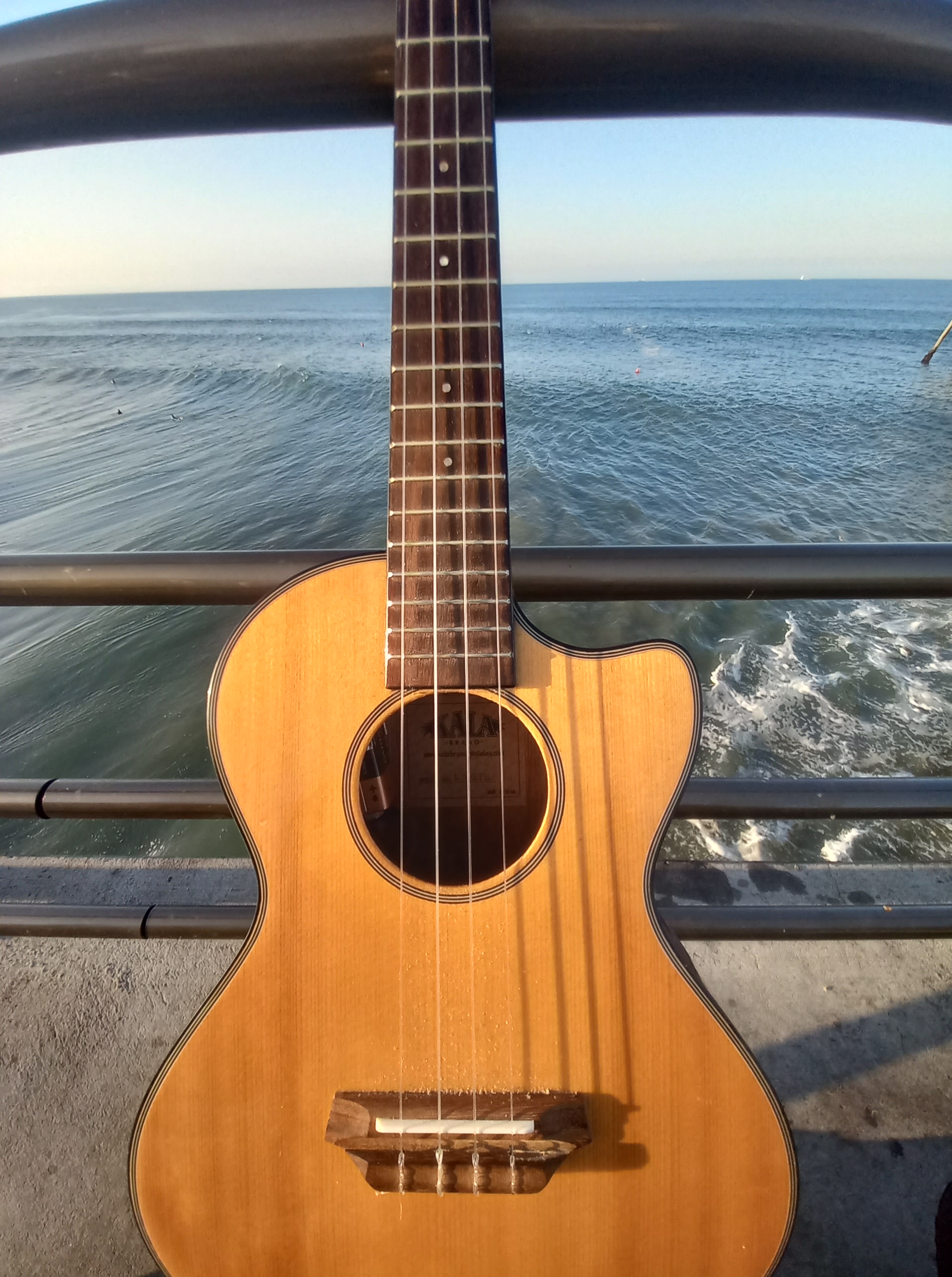
On the camper table sat my father’s old ukulele.  The pouch on the case was big enough to stuff all my postcards, signs, a notebook, and an Anker Bluetooth speaker that I thought I might broadcast some of my quiet songs over, if the phone didn’t fail to charge and die before I even got the chance.   Things were not going particularly well, but when had they?  My first record, Ghost on the Roam, had sold zero copies and only led to poverty and disappointment when I’d released it twenty-five years ago, and here I was, getting ready to go out and celebrate that fact.

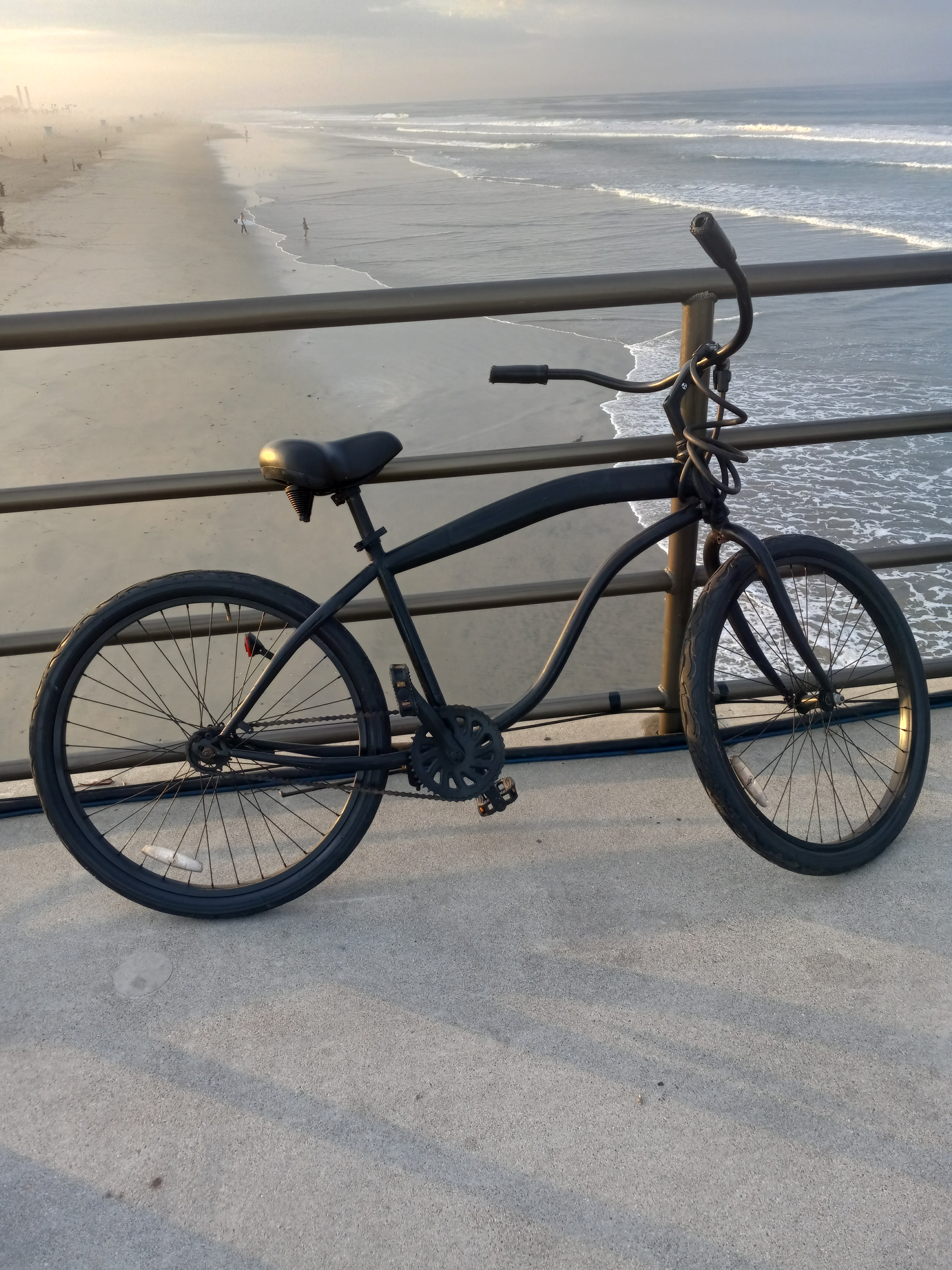
If there was one bright spot on the already unpromising day, it was that I had a new bike to ride down to the pier, a black cruiser, the Cruiser, if you will, that I’d spotted outside of Huntington Beach Pawn a few days earlier.  It was my fourth bike in the past two years and the timing could not have been better.  Only a week earlier, a spoke had sprung on the rear tire of the Muley, the Huffy bike which serves to tote my longboard around, and when I went to get it fixed, the cable to the gear shifter snapped, leaving it stuck in seventh gear.  

No bike is safe this close to the beach.  They all become living monuments to rust.  The Cruiser was still spotless and well-oiled, however, the right bike at the right time, about to have its own little moment in history.   I couldn’t wait to sail it into the day.

Not many people notice me, but the cashier at 7-Eleven, Hilda, from Guatemala, has been greeting me and calling me teacher for the past two years.  I’ve been unemployed for so long she assumes I’m retired.  She let me know that the new coffee cups were in and didn’t need sleeves.  They were done stocking sleeves.

Outside the store I saw two poltergeists I recognized from the pier, sizing up a bike that was locked to a street sign.  Ghost culture is bike culture at the beach.  Ghosts deal in bikes like cowboys deal in cattle.  They sell them, trade them, steal them, brand them.  I’d have to be extra careful with the Cruiser.  When the Muley had been brand-new someone had come along and stolen the seat, leaving their destroyed seat next to it, with the gel spilling out all over the sand.  At first, I thought it had just been vandalized, yet the seat post no longer fit the bike.   That took a long time to figure out.

With my coffee in one hand, I went cruising down Main Street, spotting another poltergeist I knew hiding out in front of Rocking Fig’s, facing the shop window, muttering incantations to himself.  During the pandemic they’d allowed some of the restaurants to put tables and doors outside, and now one block of Main Street remains a pedestrian zone, prohibiting bikes and skateboards.  I dragged a flip-flop to slow my bike to a crawl.

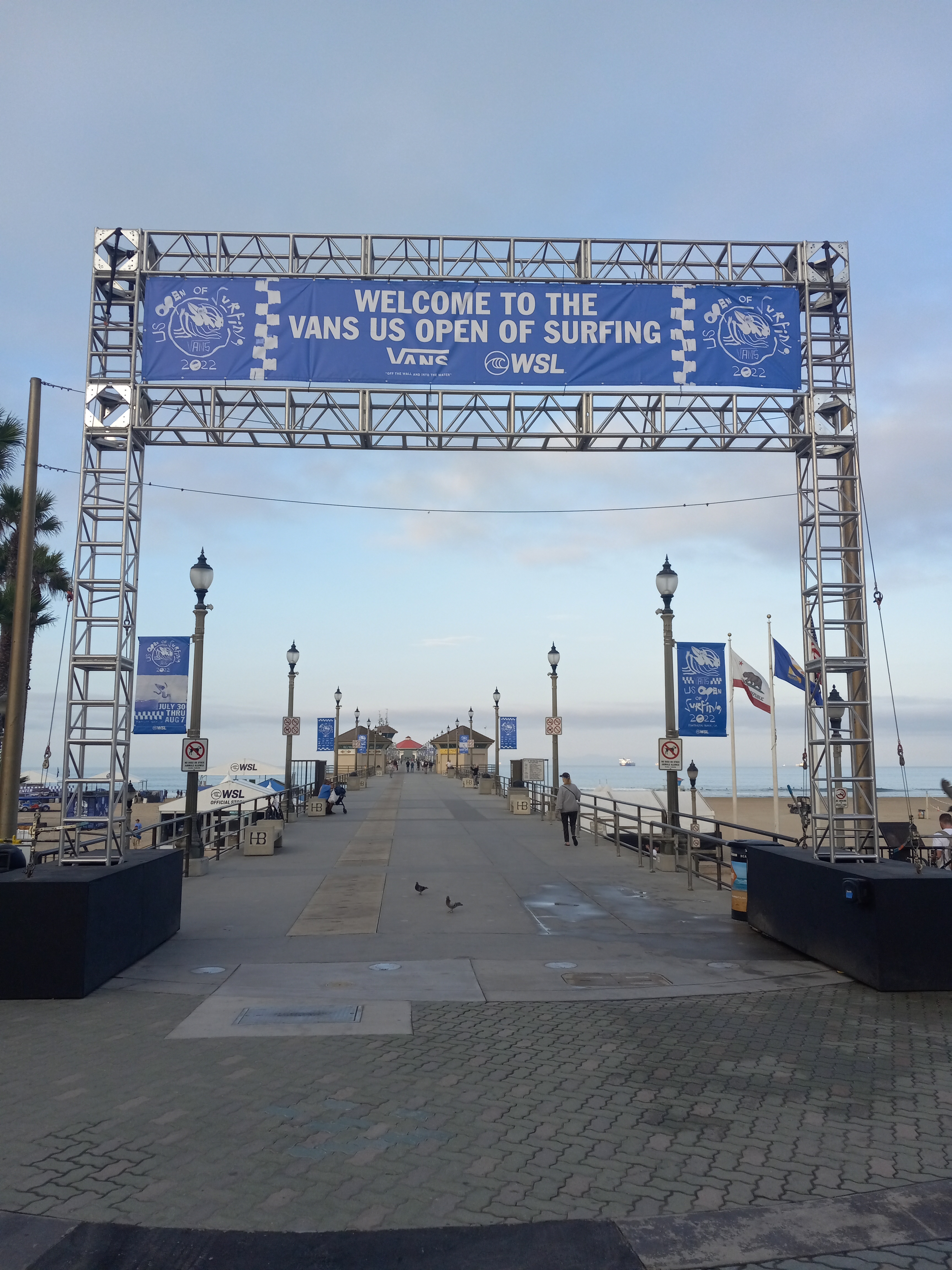
Sitting at the stoplight on PCH, I could see a blue welcome sign at the entrance of the pier.  Blue banners were strung up on the light poles, all the way to the end.  The sun was just now rising in the east, and outside of a few photographers, bustling to stake out the best positions on the south side of the pier, the morning was quiet and calm.  It wouldn’t stay that way for long.  It was the first day of the Van’s US Open of Surfing. 

My plan was to place myself right in the middle of the action.

ghost on the roam 2

Considering it was the first day of the Open, the lineup was pretty sparse when I reached the outside break, which was barely crumbling at that point.  The forecast for the weekend was small, 2 to 3 feet waves, with some heavy surf picking up on Monday and lasting the rest of the week, thanks to Hurricane Frank, which was presently marauding past the Panama Canal. 

I picked out a bench on the north side of the pier and then reached for my ukulele, deciding not to get out my signs or postcards, or even attempt to sing any songs that first day.  Rather, I would sit there and quietly pluck the uke, a more fitting tribute, perhaps, to a record that had attracted almost no attention, as well as a life that had mostly been spent in the shadows.

It was hard to believe it had been twenty-five years since we’d driven up to downtown Los Angeles to record Ghost on the Roam.  Although the producer had been in my graduating class at El Rancho High, I hadn’t known him or anyone else back then, since my family had only recently moved to California from North Dakota.  I’d never met the musicians he’d recruited to play on my record either.  The bass player was in a punk band from Newport Beach and the drummer played in a surf band from Fullerton.

We’d only had a few days to lay down the basic tracks and then nothing happened on the record for a long, long time.  At one point I’d been so desperate to see it finished that I’d snuck into the producer’s apartment complex and cornered him in his laundry room.  When it came time to master the project we weren’t even speaking, so I got ahold of the DAT tapes and put the artwork together on my own.

El Rancho High School is in Costa Mesa, close to Newport Beach.  That’s where all the popular, preppy kids went to party and hang out.  Since I didn’t understand any of them, and was full of anger and depression, Huntington was always the beach I headed to when I was looking to escape for the day.  I’d load up a backpack with four or five warm beers, a can of Skoal, and a few cassettes to crank up on my Walkman.  Then I’d jump on my orange Schwinn and get on the bike trail at Moon Park, invariably heading straight into the wind, the whole five miles to the sea.

At the river jetty, I’d head north and pedal, somehow still straight into the wind, until I reached the pier.  I knew nothing about Huntington Beach and its importance to the world of surfing.  It just seemed like a mellow place to hang out, with an arcade under the pier and a scattering of vans in the parking lot, smoke billowing from their tinted windows.  I’d sit drinking my beer on the beach, a rebel among rebels, beginning to bask in defiance and grandiosity, then go whooping down to the ocean, regardless of the season, for an unhinged session of redneck wave-stomping.

When it came time to shoot the album art for Ghost on the Roam, my brother Luke was living in Huntington, with a couple buddies at a house on Twelfth and Olive.  I’d brought along a white sheet with eye holes cut out of it, as well as a cowboy hat and my guitar case.  We shot a few rolls of me, walking up and down the beach in the sheet, but when it came time to select a picture for the front of the album, I chose one without it, just a black profile in the cowboy hat, with the sea in the background.

Since the producer and I had fallen out, I had no idea what to do with the CDs once I’d ordered a thousand of them and went to pick them up in ten big, heavy boxes.  This was in the days before the internet.  The only contact information in the CD jacket was for a mailbox in Costa Mesa, across from the Mesa Verde Center.  My summer job back then was driving big rigs in the San Joaquin Valley, so before heading back to Yuba City, I embarked on a West Coast tour for my record.

I remember getting a ten-dollar tip in Portland and setting up to play on the street a few blocks from the Pike Street Market in Seattle, but without any contacts or real gigs I was lucky to even have a few postcards waiting for me when I went to check my mailbox after the trip. 

When the truck driving season was over, I returned to downtown Los Angeles and moved into a hotel above a bar called the Rock and Roll Hole that I never would’ve known about if we hadn’t cut the record across the street.   There I met a bunch of musicians and, like most of them, considered myself lucky to get any gig I could, even if it meant playing for free in front of nobody.

The most memorable performance during that time was probably the midnight slot at Banana Crushers on the Sunset Strip on a Sunday night.  The only ones left after a long night of singer/songwriters were the soundman and the bartender, and when I decided to wrap up my set after a few songs so we could all get out of there early, received the only standing ovation of the night.

The fact is I never made a dime off of the record or any of the gigs, and to add insult to injury, still had about 850 CDs of that unloved record to cart around with me wherever I went.  Eventually, most of them ended up in a landfill. 

I’d come up with the title Ghost on the Roam, based on the nomadic lifestyle I’d been living in the ten years leading up to it, just me and my guitar, driving off in search of freedom in a five-hundred-dollar pickup truck, roaming the pine forests of the northwest alone, riding trains and buses across the country, heading up to Alaska to work the salmon season, moving as much and as often as possible, and if not possible, just bouncing off the walls. 

I was hoping when I made the record that it would give me a license to roam.  My idea was to try to get on the folk music circuit where I could travel, meet people, and make music as a way of life.  Instead, the world ignored that record and all the ones that came after it.  My response was to travel and just keep traveling.  I tore down fences and escaped from cages.  I left Los Angeles.  I left the United States.  I spent years in foreign countries, crossing oceans, on distant mountaintops, in humid jungles, and dark hotel rooms, gathering my powers. 

Perhaps, music had never been my destiny, but no one could keep me from wandering.  By now I truly was that ghost on the roam I’d once only sung about, that was a fact, but it wasn’t until I’d been totally broken and humiliated to the core by the pandemic that I discovered I wasn’t quite as alone, or unique, as I’d always felt.

ghost on the roam 3

A French couple walked past me, but didn’t glance over.  They were assessing the condition of the waves and it seemed safe to assume that either one or both of them were surfing in the preliminaries that weekend.  I didn’t have my signs or postcards out and wasn’t even going to pretend to be looking for tips.  No.  I just sat there and plucked a little tune about a man who returns to a city where the houses are the same but the faces have changed.  Did it matter that people couldn’t hear me or understand what I was trying to communicate?  Not one bit.  I just sat and played for the ocean and the sky.

Eventually, a face floated into focus, however, that recognized me and was coming towards me, smiling, all teeth, the top lip gone, shredded years ago, after colliding into the barnacles on a piling, possibly the one right below the bench I sat on.  I knew Jiminy from the Gathering.  His accident had made national news in 2016.  His friends had tramped a giant peace sign in the sand and filled his van with flowers, remembering him as a true innocent.  Even in his present dislocation, he seems able to maintain a permanent stoke.

I asked him how surf contests are judged, so I could follow along and make some sense out of the next nine days.  He explained that every surfer gets judged on their best two waves.  The top score on a wave is ten so the highest score possible is twenty.   The heats at the beginning are four surfers and the top two advance.  As they get closer to the finals, it’s just two surfers going head-to-head in a heat.  On the last day, only one remains.

A few minutes after Jiminy had stumbled off I spotted Lydia, also from the Gathering, in her black track suit, her fingernails clenched into her palms, her smile a determined grimace.  The rumor about her is that her son and some friends had decided to make a midnight swim around the pier a few years ago and, with his head down, he’d kept going when they reached the end of it, never to be seen again.  She’d been keeping her nightly vigil, tersely walking the graveyard shift, looking for clues.  Another morning had arrived and still no answers.

These days, it may seem like I know a lot of people in Huntington Beach, but the truth is almost everyone I know is a ghost.  I can only speculate why that might be, but am sure it has something to do with the seizure I experienced after arriving back from Vietnam during the height of the pandemic.  One moment I was talking on the phone with my sister, the next I was in the back of an ambulance.

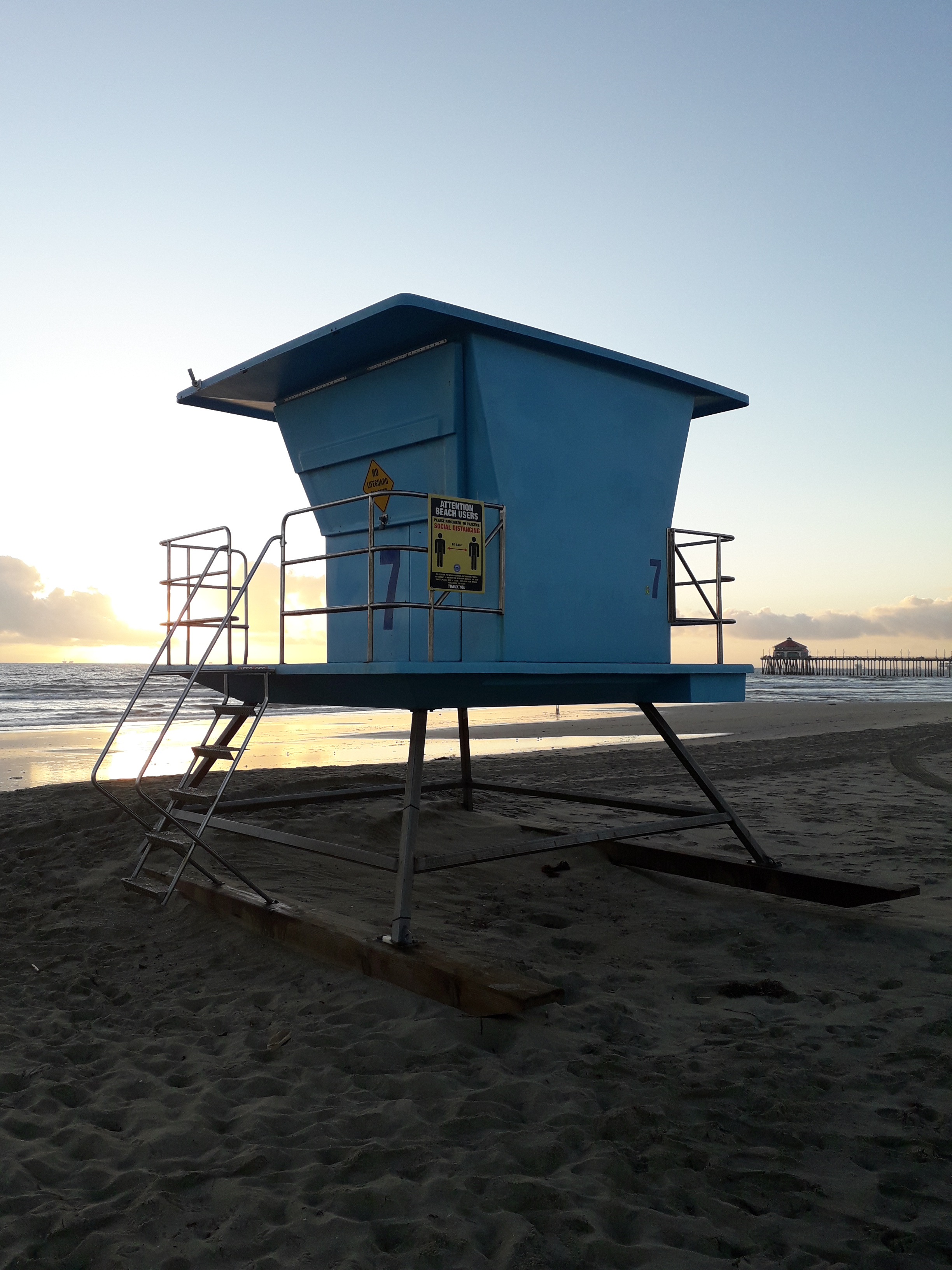
Since then, things haven’t been the same.  My family set up a camper in my mother’s backyard that I’ve been staying in, but it would be hard to claim I’ve had much of a life.  All I do is surf, somehow never getting any better, ride a bike against the wind all day long, and go to the Gathering every morning at Tower 7.

After getting out of the hospital, I stayed in the camper for a long time, afraid that the neighbors would see me, afraid someone would accuse me of being a COVID super-spreader, since I’d been all over Indochina at the time the pandemic broke out.  The days were sixteen hours long and the crows would start cawing at five-thirty.  My nerves were shot.  Eventually, I started sneaking out the back gate at the first light of dawn and going for long walks, usually as far as the river jetty at Newport and back.

Although the beaches were largely deserted, as most of the country was under lockdown orders, there was one group I kept seeing at the base of Tower 7.  They would sit in a circle and seemed to be taking turns telling stories.  A few of them were getting a lot of laughs.  I was dying to know who they were and what they were up to, but was too disoriented and shy to approach them.

One morning, however, I reached the pier at the same time they were disbanding.  I hastened forward and was able to catch a few of them crossing the bike path.  They seemed to recognize me and were surprised I’d never met them.  How could I not have heard about the Gathering?  They’d been meeting for a few months now.  Did I think I was the only one of my kind?  Of course not.  I was right where I belonged.  They invited me to join them the next morning.

This morning I was going to be late.  The Open didn’t kick off until 7:35, and I wanted to be there to watch the first surfer catch the first wave of the contest.  Sitting on the bench, vacantly strumming, I was suddenly approached by an old man in a Hawaiian shirt, some kind of ukulele enthusiast wondering if I knew anything about the ukulele group that used to meet on the plaza every summer.  Funny he should ask.

The ukulele I was holding had once belonged to my father.  The summer after his stroke I’d gone with him to a ukulele class at the Senior Center.  The teacher, Big Island Bill, had recommended a ukulele shop on Gothard called Island Bizarre that we’d gone to check out.  My father bought me a ukulele and we began attending a Hawaiian music night together.  That was the same group that regularly met on the pier until the pandemic forced them to take a two-year hiatus.

Right before my father passed away, he’d given me his ukulele.  It had never really served him well, as his fingers were too thick to fit easily on the fretboard.  There’d been a magical connection when I’d picked it up, however, and in a short while it had become my main instrument.  The old man liked that story.

While we’d been talking, the southside of the pier had cleared out, leaving just four contestants in colored jerseys.  The announcer came over the PA, welcoming the world to beautiful Huntington Beach and first day of the Van’s US Open. 

Then it was 5..4..3..2..1.. and the contest was on.

ghost on the roam 4

The first morning that I attended the Gathering at Tower 7, I had no idea what to expect.  Some of the participants had asked me to join them so I did, although still unsure what our connection might be.  As soon as they’d gone around the circle, introducing themselves and identifying as ghosts, I understood right away.  Things had not been the same since the seizure three weeks earlier. 

Still, the more I sat and listened to the other ghosts share, the more I realized that my condition preempted the recent medical emergency, that in fact it was possibly the result of a trauma that had occurred years earlier.  Some of the ghosts had died physical deaths, while others, due to an extreme aversion to pain, had been too stunted, emotionally, or mentally, to ever lay claim to the lives they might have led, and had retreated to the shadows.

It made me think back to that night beneath the bridge at Moon Park, not long after my family had moved to Southern California, one of the many moves we’d made as a codependent clan of perpetual outsiders.  There was a dance at El Rancho High that night and everyone else was going, but I’d managed to score a twelve-pack of Mickey’s Big Mouths, and was slamming the empty bottles on the concrete riverbed beneath the freeway, shaking my fist at a blood-red moon, like a new super-villain taking an oath against all mankind.

At the beginning of the pandemic, when everyone had been locked down and the beaches were empty, all you saw were ghosts, like wild animals, cautiously reestablishing their boundaries once the cities emptied out.  I may have met three hundred ghosts that first year and felt a sense of unity I’d never experienced anywhere.  At the Gathering, most of the ghosts are trying to get back their humanity, believing that it is only humans that are capable of salvation.  I’d started out the same way, working through the steps and following the principles that they advocated.  For a while it felt like I was making real progress. 

Lately the distance has begun to set back in, however, and some days I’m no longer sure that I even want to be saved. 

Pulling up in front of Tower 7, I saw Rudy standing in the parking lot, his right leg shorn off at the knee.  Depending on where you meet him, he’ll tell you a different story about losing his leg.  He’d told me it was a shark attack, but I’ve also heard it may have been a motorcycle accident, sniper attack, or pro football injury that was to blame. 

Rudy said he’d seen Jason and Buddy paddling out at Tower 5 earlier, but that no longer hurt my feelings.  Our surf crew, the Gallows, because someone was always dropping in on someone else, had only hung together at Tower 7 for a few short glorious months.  Over time, Jason and Buddy had become more selective, going wherever the waves were best.  Doc and Oscar had migrated back inland.  Ezra was off in his van somewhere.  Sometimes I’d see the other guys around, here and there.

With my unreliable string of bikes, I’d never been as mobile as the rest of them, and stayed loyal to Tower 7 for a long time, bringing my board to every Gathering.  Eventually, when no one was showing up anymore, I began heading up to the Cliffs by myself.  There I stood less of a chance of being pitched over the falls every time I tried to get to my feet.

The meeting was about to wrap, so I perched on a wall and listened to the last ghosts tell their tales.  It was a much smaller crowd than it had been a few years ago.  A lot of ghosts had gotten antsy when the lockdown orders ended and the summer crowds began returning to the beach.  What remained was largely a skeleton crew of regulars. 

Roy and Betsy came over and sat down next to me once everyone began to disperse.  They asked about the ukulele, so I showed it off, recounting how I’d recently been to Hawaii, loading it up with mana energy on Oahu and the Big Island.  Then it had been up the entire Pacific Coast of Mexico, wading out knee deep in the surf, keeping time with the waves.  All that to prepare for my debut performance at the US Open.

Really?

Yes, it was true.  I’d be kicking off the proceedings every morning on the pier.

ghost on the roam 5

If it wasn’t for my father I may have never been to Hawaii or Huntington Beach, let alone the planet Earth.  He was the one who found the teaching job in Hawaii in the 1960s and the budget beach cottage in Huntington Beach twenty-five years ago, in what has now become a million-dollar neighborhood.  I just tagged along.  Although we had our differences, and his confrontational attitude and unstable ministry left me largely rootless by the time I was a teenager, I can’t deny I owe a lot to the man.

In addition to the ukulele, I also have one of his bikes, an Electra three speed that he only rode once.  The design, black numbers on a white frame, give it a cow-like appearance, and it was my main ride for years.  After returning from Vietnam, it had been destroyed by rust, however, the chain brittle and orange, and the brake calipers clamped down like vise grips on the tires.  The bike shops were taking months to do repairs and there were no affordable bikes anywhere.

Around this time, my mother spotted a bike locked to a street sign that was for sale.  The Blue Bike wasn’t worth what they were asking, but I was desperate for a ride and made do with it for a few months.  It went on to get a flat tire every other week, which didn’t seem possible, and led me to believe that it was cursed. 

It did buy me time to get father’s old bike into JAX for a tune-up, however, and after picking that up and mounting a surf rack on it, I dubbed it the Holstein Charger. It was a valiant ride, and we did about eight months of hardcore surf patrol together before the same problems began to set in.  Any bike with handbrakes doesn’t stand a chance at the beach.

Needing a backup, I came across a Huffy at Walmart, which finally had some bikes in stock.  It was a bike with no pretense, unlike the other bikes, with their knobby tires, fake shock absorbers and shiny reflectors.  I dubbed it the Mule, or Muley, and when the Holstein Charger reached the point where it could no longer be resuscitated, I yanked the surf rack off it and commissioned Muley for surf patrol.  Now Muley is failing, stuck in seventh gear, the front brake completely disengaged.  To get going on it I almost have to push it down a hill.

Thank God for my latest acquisition, the Cruiser.  My survival depends upon having a working bike.

After leaving Betsy and Roy, I made my daily run down to Balboa.  From the Huntington Pier to the Balboa Pier and back is roughly twenty miles.  If you leave early enough in the day, you may be able to escape the wind.  By afternoon, however, it is usually blowing so strongly in one direction, sometimes both, that the trip becomes a parody, a pantomime of someone trying to ride a bike through an electric fence.   Going the other way, to Bolsa Chica, or Blowsa Chica, can be twice as bad. 

There are days when the only thing worse than making the ride is not making the ride.  I would be eaten alive by my demons if I didn’t.  Either I find a way to beat them down or they are going to beat me down.  It’s as simple as that.  It may not be a permanent solution to anything, but in the wake of the pandemic, and the purgatory I wake up to every morning, riding a bike, even if it is straight into the wind, is usually the best thing I can do.

ghost on the roam 6

Hawaiians are generally credited with inventing surfing, or wave sliding, and it was a Hawaiian, George Freeth, who introduced it to Huntington Beach.  In 1914, he put on a demonstration of surf riding at the dedication of the new pier, which at the time was the longest pleasure pier in the States.  Another Hawaiian, Duke Kahanamoku, considered the father of modern surfing, inspired a few Huntington Beach lifeguards to make their own boards a few years later, which at the time were carved out of redwood and weighed over a hundred pounds.

The first West Coast Surfing Championship was held in 1959.  In the 1980s that evolved into the OP Pro, which then became the US Open, which for the last ten years has been sponsored by Van’s, the shoe company most closely associated with surfers, skaters, BMX riders, alternative rockers, and Southern California in general.  By chance, I graduated from El Rancho with one of the family members, but had just moved from North Dakota and knew no one but the other wrestlers on the wrestling team.

Over the years I’d always walked down to check out the contest if I was in town, but didn’t pay much attention to what was going on.   I’d just stand with the crowds on the pier and make a short ramble through the village, and that was that.  This year, however, I was determined to get to the heart of it, with my ukulele on my back, soaking up the energy and trying to participate, in whatever small way I could muster.

When I got back from Balboa, I saw that riders were warming up for the BMX Waffle Cup, so I locked up my bike and went to watch them practice.  I’d been told that there was a free barbecue at noon so went over to check that out, only to run into Jason and Buddy, coming down the steps from the VIP section. 

Jason was the only one from our surf crew, the Gallows, who could really surf.  The story was that he’d been a star in high school, and then later in the courtroom, and that there’d been an accident on PCH that left his Maserati totaled.  His involvement in helping the rest of us learn to surf can only be described as an act of charity.

From what I understood about Buddy, he’d been a running back for the Oklahoma Sooners, who on a crucial third and goal had had his head driven further back into his shoulders than the ball had advanced downfield.  He was crazy to surf, but the day I first met him looked like he’d never been on a board before.  I wasn’t any better. 

From the beginning, we competed in our own kook Olympics, perfecting such maneuvers as the stunt man left, stunt man right, the pearl jam, the hang zero, the Niagara plunge, and the Malachi crunch.  All in all, the Gallows was a sight to behold.  Dignity?  We had none to spare.  We’d paddle out under any conditions, to see who could get destroyed in the most brutal and ridiculous fashion, and then all laugh about it later.

Eventually, a few of us improved and started getting expectations.  I didn’t begrudge Buddy for sticking with Jason and going off in search of greener pastures.  He’d worked harder and was making more progress.  I was still flopping and floundering most of the time, chasing waves I couldn’t catch, then getting caught too far inside when the rest of the set came through.  I could never seem to find the sweet spot.  We were all still friends though.

On this particular day they had a surprise for me.  Jason had managed to finagle some VIP passes from a secret source, and though they’d already made their rounds, they had an extra wristband they gladly handed over.  One minute I was waiting in line for a hotdog, the next I was upstairs at the Waffle Cup, watching the BMX riders and eating fish and chicken tacos, right next to the mayor of Huntington Beach. 

Later, I went over to watch the surfing in another reserved section, where there were fruit plates, bowls of peanut M&Ms, and a cooler stocked with Red Bulls.

My idea had been to immerse myself in the US Open, and now, only four hours into it, I was sitting in the VIP sections with an all-access wristband.  That was incredible, for sure, but things had gotten way too good, way too fast.  I’d need to get a flat tire on my bike on the way home in order to restore balance to the universe.

ghost on the roam 7

It is believed that ghosts exist, and continue to haunt the physical world, because of a situation that they were unable to resolve as humans.  Perhaps, it was something that was done to them, or something they did to others, but it is this unfinished business that prevents them from ever resting in peace. 

The group of ghosts at the Gathering, consider themselves to be in recovery, and have a program and steps they follow in an attempt to make their amends and finally break free from the past.  When I discovered that there were other ghosts out there, and that I’d been one for most, if not all, of my life, everything made total sense.  I was willing to do anything to alleviate the all-consuming anxiety at that point, so I got a guide and began following his recommendations.

I didn’t have much experience living as a human, so that took some getting used to.  I began by making my bed every morning and eventually got to the point where I was paying weekly visits to the grocery store, even returning the shopping cart to the designated collection spot afterwards.  Mind you, this was happening during the pandemic, so what was normal wasn’t all that normal.  The next step would be to get a job, but I couldn’t risk exposing my mother to the virus so that would have to wait.

On some days it felt like I was making progress, but just as often I felt trapped and longed to have my old freedom back.  On the second morning of the contest, I was up at sunrise and went to 7-eleven for a coffee.  There were two poltergeists sitting out front, different from the morning before, one in a pirate hat, the other with feet so swollen it seemed unbelievable that he was able to slip a pair of flip-flops over them.  They were noisily arguing and didn’t look over when I passed.

Poltergeists are part of the same family, but unlike the ghosts at the Gathering, who all have been poltergeists at one point or another, are either unaware that they are ghosts or don’t care.  In Asia they are known as hungry ghosts and are often depicted as having enormous stomachs and only thin, needle-like throats, so they can never get enough.  They can be actively disruptive and even aggressive when they’re not getting what they need.  They shout, swear, scream, bang garbage cans, and frighten tourists, giving us all a bad reputation in the process.  They are not evil as much as driven mad by pain.

It was these worlds I now found myself trapped between, in a purgatory that seemed to have no end in sight.  I was neither fully human, nor was I the same unabashed hell-raiser I once reveled in being.  If I thought about the past I was consumed by regret.  If I started worrying about the future, I would be overcome by terror.  Everyone had advised me to stay in the moment.  It wasn’t easy, but at least I had the surf contest to distract me from my problems for another week.   After that, I’d just do what I had to do.