back to the jewel 7

There were two times my family lived in Hawaii, before my father became a pastor, and after he’d been ordained.  My parents moved there in 1966, fresh out of college from Peru State College in Nebraska because my father had been recruited as an English teacher at Aiea Intermediate School.  I was born there later that year.  Then he was accepted into seminary in Saint Paul, Minnesota, and we lived there until he accepted a call at a Lutheran church, back in Waikiki.  The second time we stayed in Hawaii five years, from the time I started kindergarten until the end of fourth grade.

After my grandmother passed away in Lincoln, we got a huge box of her old correspondence that no one had bothered to go through until I did, right before my trip to Hawaii.  It was a good thing I did, because I found the addresses on envelopes of almost all of the places we had ever lived at or stayed in Hawaii, and now, through the magic of Google Maps, it was my goal to track them down.

Outside of one brief stay in a commune on the Big Island, we’d spent all of our time in the Honolulu area.  After doing some research, I discovered that what I suspected was true, that I could hit up all the places we’d lived in one day, so went over to what used to be the headquarters of the Family Hostel, now Island Style Rentals, and rented a ten-speed bike.  It was an awkward ride.  The seat seemed more designed to skewer someone then accommodate their ass, and I had to hunch over to reach the handlebars.

According to my calculations, the closest place to visit was the first place we lived after my father had accepted the position at Our Redeemer in 1971.  It was only fifteen minutes away by bike, on the north side of Diamond Head.  The address that I had for it was Maunaloa Avenue.  I rode around the zoo to Monsarrat Avenue, then took that to Diamond Head Road and took a left on 18th Avenue, coasting downhill past Kapi’olani Community College.  A few blocks later and I reached the intersection.

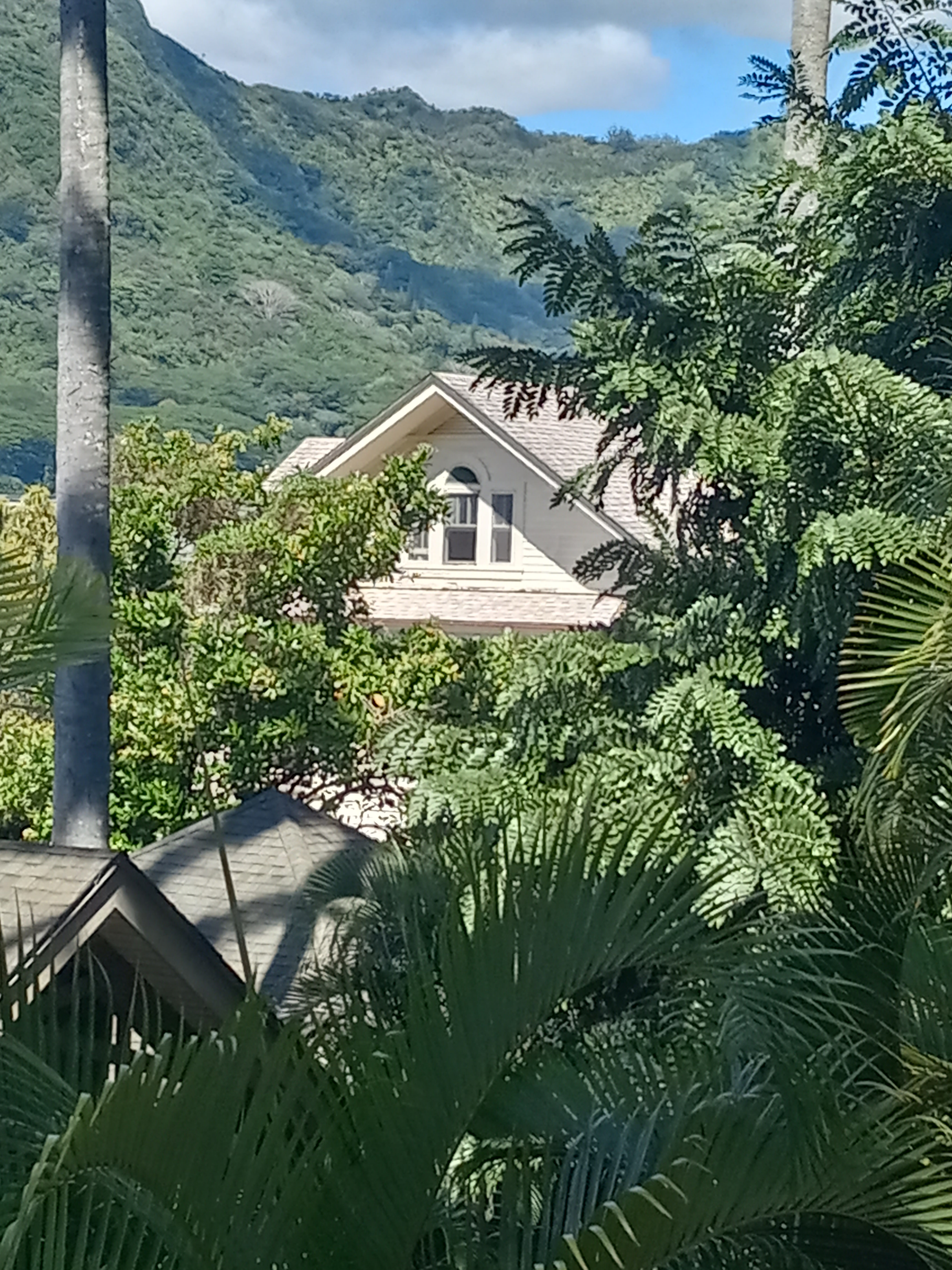
What I remembered was a little pink house with a lychee tree in front.  The property was very different by now, however, with a clean rectangular house, yellow with white trim, fronted by two palm trees and tight hedges.  Some of my greatest dreaming had been done in that yard, rarely wandering far from the street outside, stepping out on the black tar, the grass full of stickers.  Your feet got tough growing up in Hawaii.  That was just a fact.  My brother John and my greatest concern was sneaking lychees from the tree.  That was just as prohibited as the Tree of the Knowledge of Good and Evil in the Bible.  If any adults found out we were eating them we would’ve gotten a spanking.

Next door was the home of an old Hawaiian couple, Frank and Malu, devout Christians who went out of their way to help us the whole time we lived in Hawaii.  They had a ministry of giving and at one time paid our rent for a year.  Their house looked a lot different as well.  The address in my hand told me that I was at the right place, but there was almost zero recognition of the houses and the street.

The place that made sense to track down next was Kaimuki Christian School, which I’d attended all the years we were in Hawaii.  It was just a mile away from the house on Maunaloa.  I went down to 19th Avenue, took a right, and then took a left on Harding Avenue.  There it was on the intersection of Koko Head Avenue.  They’d built the church up, but what was amazing was how much had stayed the same in the past fifty years.  The lot was the same size.  The classrooms were still in the same location.  The businesses on the street didn’t look that different.

I stood beside my bike, just remembering, the first day of school, arriving with my shirt buttoned to the top and a Dr. Seuss lunchbox, all the strange kids, most of them Asian or Hawaiian.  I was one of the few haoles, or white kids in my class.  The pattern was set going that far back, being shy and perceiving myself as an outsider. 

Most of the time I had just sat there, watching everyone and everything that was going on.  Every once in a while, I’d make a connection, often a humorous one, and just blurt it out, amusing my classmates and frustrating the teachers.  They had old-fashioned methods of getting you to pay attention back then, smacks with sticks, pulling your hair, sometimes taping your mouth shut.  I only had a few friends.  Some kid would invite me over.  Then another kid would ask me to do something.  I never took any initiative.  I would hang out with someone until we stopped hanging out.

When I learned how to play Kikaida on the ukelele that raised my game for a little while.  The coolest kid, who studied kung-fu and knew a lot about Bruce Lee, invited me to vacation with his family at an expensive hotel with a golf course.  Then right before we moved, I saved a toddler from drowning at a class field trip, so left on a good note. 

Most of the time I just stayed to myself, caught up in the drama of my father’s free-lance ministry and our frequent moves.  Though we were only in Hawaii five or six years, I still had nine more addresses to look up.

back to the jewel 8

Even as a young child, I was possessed by dark fears and deep insecurities.  I frequently had lucid nightmares and would wake up crying and go and sleep at the foot of my parents’ bed.  Stories from the Bible, and the idea that there was a Devil running around out there frightened me terribly.  I was full of jealousy and lust for the sensual world and thought I really must be one of the worst sinners of all time, so the idea that there was some God up there looking down on me from heaven worried me as well.  The Jesus Freaks my parents were associating with didn’t give me much faith in mankind either.  In short, I trusted no one.

Although I tended to stick to the yard and street out front when we lived on Maunaloa, I had one memory, perhaps a partly invented one, about my brother John receiving a little Flintstone dining set on some occasion.  Angered that I hadn’t received anything, I’d taken the cup and bowl out and smashed them to pieces with a log.  Right then I looked up and saw my mother looking out the window at me, so I started to run.  I remember running all the way to a department store and then running and hiding in a rack of clothes.  A few moments later there were some feet, and when the clothes on the rack were pushed aside, there was my mother in a rare fit of fury, with a wooden spoon in her hand.

That was the direction that I headed now on my rented bike, making my way towards the next rental property we’d lived at nearly fifty years ago.  It was a condominium complex called Tropic Gardens that we’d stayed in for a year back when Frank and Malou were paying our rent.  On my way there, riding down Waialae Avenue, I reached the Kahala Mall, right next to the H1 Freeway.  That was during the last year we lived in Hawaii, and I remember my father walking my brother and I down to get us on the bus to school, from under the freeway overpass.

Tropic Gardens was still there.  There were many apartment buildings and two divisions of the complex.  I managed to find the unit we’d lived in, my parents, my brother John and new brother Luke, a Filipina girl named Kathy who stayed with us, and a parakeet named Sonny.  The greatest thing about living there had been the swimming pool, which John and I swam in so much our hair had turned green from the chlorine.  Incredibly, the pool was still there, looking very much like it did back in the day. 

I remembered going to the park across the street, the Wilson Community Park, and seeing kids blowing off fireworks on Chinese New Year.  In many ways the world was the same as it had always been, but the people were all different.  I still felt like a kid but was well on my way to becoming an old man.

From Tropic Gardens, I made my way to my next destination, which was in Palolo.  I had to follow Waialae Avenue back to 10th Avenue and then take a right.  As I approached the Mau’umae Ridge, I began to have flashbacks.  The hills were peaked, the color of jade, like something out of a Chinese painting.  There was the ballpark where my little league had practiced.  There was the hill where my mother had crashed the Volkswagen Bug, driving down to pick me up from practice.  There was the spot where my brother had got his foot caught in the chain of a bicycle.  What a mess that had been. 

By the time I reached Yvonne Place I was pushing the bike.  The road was that steep.  Then, there it was, the house where my brother Luke had been born.  The house was still there, as well as the one next door, where our friend Jeanie had lived with her family.  She’d been a few years older than me and had used my brother and I as human guinea pigs in her experiments, coaxing us into conjuring up the spirit of Bloody Mary in the bathroom, goading us into hiking up to an insane asylum that she claimed was on top of the hill.

It was still all jungle in back of the house, secret caves, vines that swung on their own volition.  The world had been a frightening place back then.  It was even worse now.  I used to cling to the thought of Jesus, like a talisman, and sleep with my back to the mountain, where all the bad dreams came from.  Now there was no place to escape from those nightmares.  They’d all come to life in the real world and here I was, still trying to navigate my way through them, looking for the light on the other side.

back to the jewel 9

The next destination on my itinerary was the greatest enigma of my existence.  God’s House was the haunted mansion that we’d moved into after my father had quit his assistant pastor job at Our Redeemer Lutheran in downtown Waikiki and joined up with the Jesus People.  The Jesus People is a movement that sprung up in California and Hawaii at the end of the 60s, where hippies looking for a spiritual high became Born Again Christians, modeling their lives after the examples of the apostles in the New Testament.  Their beliefs included being born again, praying for healing, the casting out of demons, being filled with the spirit, and speaking in tongues.

Hawaii at that point was a backwater of lost souls who’d come over looking for paradise, only to freak out on drugs and get decimated by bad hygiene and poor nutrition.  My father had met his people through a Thursday night prayer meeting he was overseeing.  After quitting the church, they all went looking for a place where they could live communally, and came across God’s House, a mansion that had been built by a physician.  The rent was so cheap because it was reportedly haunted.  Before we moved in a local newspaper had offered a hundred dollars to anyone who could last one night in the house.

My father and some of the other men from the movement went up and claimed the house for Christ, anointing the doors with Olive Oil.  They built a cross in the front yard with a sign that said God’s House on it. 

There was still something way off about the place.  There had been ti leaves wrapped around the wooden banister on the stairway to ward off malevolent spirits.  Tiki gods were stashed in secret cupboards in the kitchen.  The people we were living with were prone to psychosis and drama.  One woman walked through a sliding glass door one day and had to be rushed to the hospital.

Upstairs there was a library where the group would meet and have prayer meetings.  It was that library I was trying to get to in a dream when a snake came out of the jungle and chased me across the slippery patio, whispering in my ear.  I’d woken up and run into the library where the group was meeting.  They’d laid hands on me and prayed for the baptism of the Holy Spirit.  I began to speak in tongues and the next day was baptized in the ocean.

Now it was incredible to think that the house even existed.  I’d done a search for it on Google and come up with a news story about a monster house in Manoa that seemed to match my memories.  When I tracked down the address on an envelope, it turned out to be the same place.  To get there I took 9th Avenue down to Dole Street and then cut across the University of Hawaii, where my mother had gotten her Bachelor of Fine Arts.  The bike I was riding made the trip down memory lane even more improbable than it already was, as its more rightful designation would’ve been an instrument of torture.  There was no seat to speak of, only the head of a spear to balance on.

When I got past the university, I began to experience flashbacks once again, basic scenes that I would’ve seen over fifty years ago, driving to the house and back.  At one point I’d had a birthday party in the house that had been interrupted by a doctor visit that had been scheduled at the same time.  What the parents who dropped off the kids at the party thought about all the hippies milling around, I’ll never know.  We were always the outsiders, wherever we went.

When I got to Paty Drive, I had to get off and walk the bike again.  There had rarely been a time I’d felt as much suspense approaching any destination.  Then I was there and could see the top of the house breaching the trees.  To reach it I needed to descend a long curving driveway.  On that same driveway I’d once placed my brother John on the handlebars when I was just learning to ride a bike and ended up catapulting him into a brick wall.  Now someone was coming up it with a garbage bag. 

I retreated and waited a few minutes then started back down again.  It was private property so I couldn’t go much further.  I only saw the front of the house, but that was enough to prove that it had all been real.  We’d lived in the house for less than a year, but it had lived in me since then.  I frequently dreamed about it, rummaging through it, lost in a maze of claustrophobic rooms.  If there’d ever been dark spirits living in the house, I’d been carrying them around since the day we moved out.  It was time to set them free.

back to the jewel 10

Although I’d considered taking my rented 10 speed as far as the Bishop Museum, by the time I made it up to God’s House, way up on the Wa’ahila Ridge, my body was shot, and my ass had been tenderized by the sadistic seat.  I decided to just coast back down to Waikiki and look for my parents’ first apartment, where they’d been living when I was born, and the original site of Our Redeemer Lutheran. 

I backtracked through the University of Hawaii, then took University Avenue to Date Street and took a left.  Their apartment was a few blocks down and looked pretty rough.  There was a small homeless encampment in front of it as well as a few stray shopping carts in the parking lot.  I took a picture, but my lens had gotten sweaty and greasy, and the shot came out blurry.

From there, I continued down Date Street until I came to Rainbow Drive-Inn where I decided to stop and have a Hawaiian lunch.  That meant a chili plate, two scoops of rice, topped by chili, and a scoop of macaroni salad.  It took a little while for a table to open up.  Now that I was on the verge of returning the bike, I wanted it right next to me. 

After lunch, I rode along the Ala Wai Canal, in search of Lewers Street, where Our Redeemer Church had once been located.  In my mind, what I imagined was a skyscraper, tall enough for the crosswinds to go rushing through the top floors and make a ghostly wail in the stairwells.  Once I arrived, however, I discovered that the old building had been torn down, and all that remained was a squat, black one-story fortress, a heiau to capitalism.

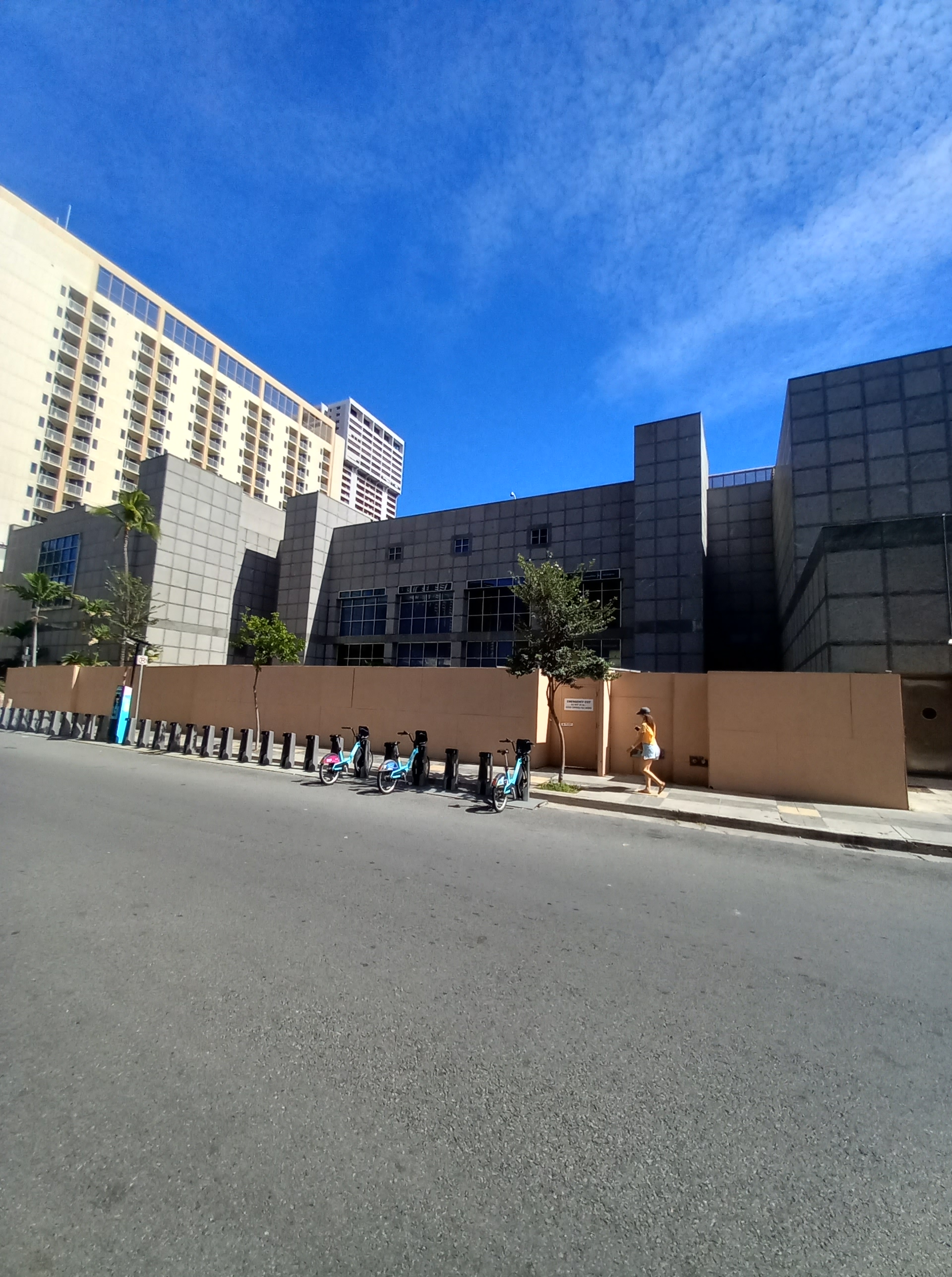
Riding a little further, I came to the present-day location of Our Redeemer, in a retail space close to the Double Tree Hilton Hotel.  It was closed and I knew that the pastor, my only connection, had recently retired, so I just looked into the back window at some seats stacked against it, pretty typical of my trip so far, on the outside looking in.

That night I didn’t sleep well.  Jerry up above me was flopping from side to side like a fish in a pan.  He was a good guy, with good intentions, to show love to all people.  In return he’d gotten beat up and was now being shunned.  He should’ve paid closer attention to what happened to Christ and his disciples, but perhaps that’s what he was looking for, to go out as a martyr.

In the morning I saw another middle-aged misfit get up and make a move on the shower.  He’d done the same thing the day before, got up early and used all the hot water.  When I left the room, he was blocking the hallways, getting something out of his locker.  It was a twelve pack of PBR.  He was ready to get the party started.

back to the jewel 11

If you look up the major tiki gods of Hawaii, you will find that the big four are Ku, the god of war, Lono, the god of peace and fertility, Kane, the god of life and light, and Kanaloa, the god of the sea.  I looked up some of the carvings to see if I could identify which god was which.  All four had similar squat bodies and scowls.  Ku has a headdress that extends to his feet.  Lono has a narrower headdress that rises to three points.  Kane is a broader, more aggressive version of Lono.  Kanaloa has more of a human, or octopus face, with a rectangular headpiece.

I’d brought along Hawaiian Mythology by Martha Beckwith, and she had written a chapter on each of the gods.  I started with Ku, the male ancestral god who is married to Hina.  He represents the sunrise and rising up in the East, while she represents the sunset, or leaning down in the West.  Between them they represent the whole earth and all the generations of mankind.  Ku reigns over all of the male spirits and Hina presides over the female ones.

There are many subordinate gods, such as Ku-mauna or Ku of the mountain, or Ku-kaili-moku, Ku snatcher of land.  Similarly, Hina-ulu-ohia, would be Hina of the growing ohia tree.  Every situation and form in the natural world is assigned either a male or female form of divinity.

When James Cook arrived on the islands in 1778, he found that the priests assigned to the worship of Ku were responsible for deciding where the heiaus, or altars to the god, should be built.  They were in charge of both the sacred locations, and also knowing if an altar needed to be replaced or just repaired.  A typical offering to Ku might be pigs, coconuts, red fish, white cloth, and quite often a human.  Ceremonies might last up to ten days.

My goal for the day was to climb to the top of Diamond Head.  I knew it got hot in the crater in the afternoon, so set out while the day was still early.  It was two and a half miles to get to the trail head and there was an electronic ticketing booth that only accepted credit cards to get in.  I learned this the hard way a few days earlier, after showing up with only money and getting turned away at the gate.  The world was changing every day, rarely for the better. 

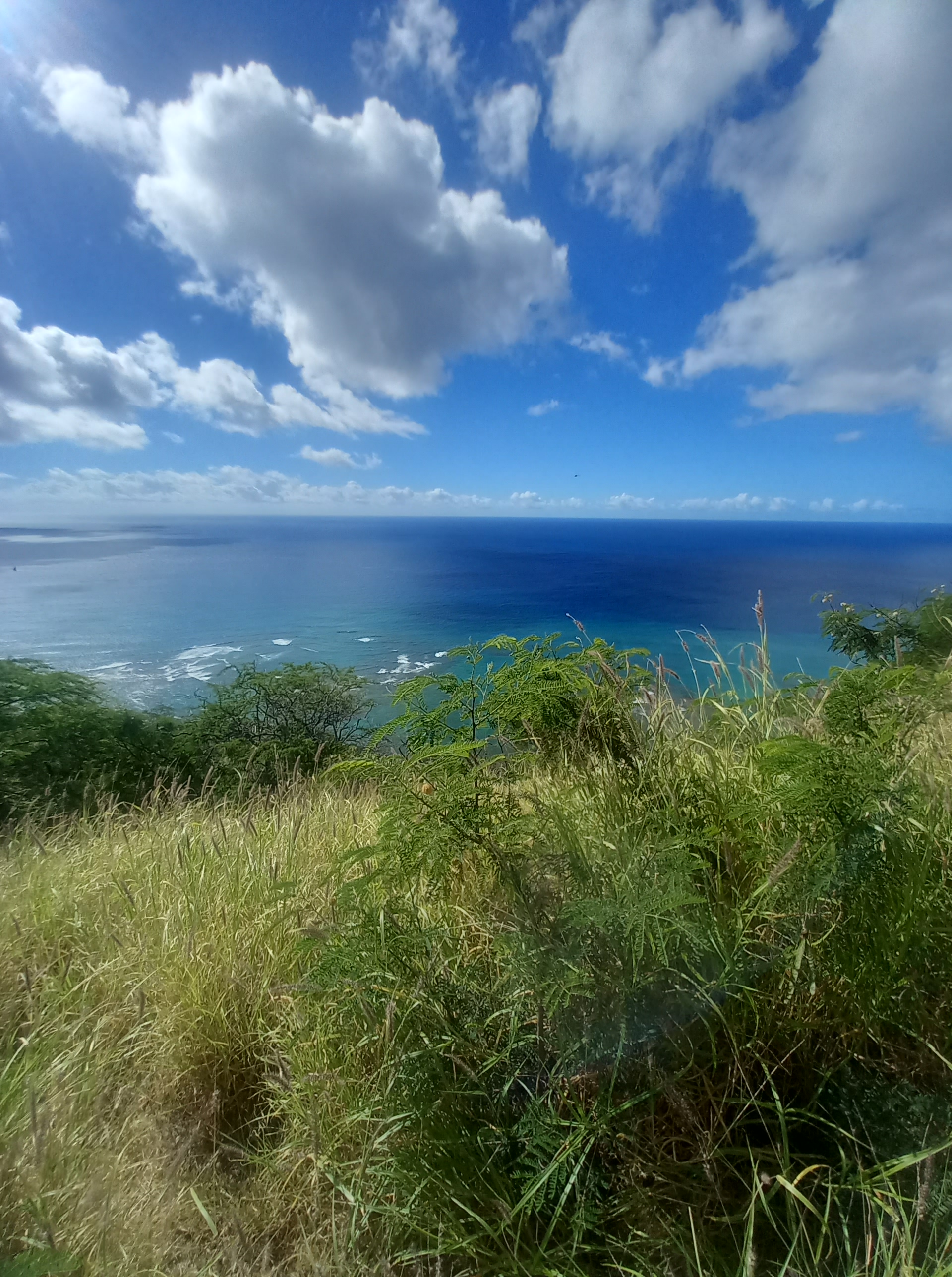
The hike to the summit of Diamond Head is nearly a mile and ascends 560 feet, up a steep flight of stairs and through a dark tunnel.  There were many tourists out hiking that day.  A strong breeze was tugging at the tall grass beside the trail and white clouds, like the sails of ships unfurled across the sky.  My legs started to get wobbly near the top.  I climbed into one of the bunkers carved inside of the mountain, and sweat began to pour. 

Pushing my way to the overlook at the very top I saw the guy from the hostel with the 12 pack of PBR in his locker, now taking pictures with a giant zoom lens.  They might have been worth something.  The view was amazing, all shifting green grass, blue sea, blue sky, the clouds contracting and rearranging, like the thought patterns of some great ancestor.

On my way back from Diamond Head, I decided to stop by the zoo.  It remained a favorite memory from childhood, seeing the flamingos, monkeys, and elephants, afterwards getting a shave ice with ice cream.  Now I was returning as a borderline homeless man, his shirt soaked in sweat, hoping there was still some innocent enjoyment left in the world.  The flamingos were still there. The elephants were still there.  I tracked down an orangutang who sat beating the ground with a spoon.  On this day I passed on the shave ice, having already spent twenty dollars just to get in.

Some folks complain about how animals are treated in a zoo, but people often get treated worse.  At least animals in a zoo don’t need to worry about where their next meal is coming from.  Back out on Kalakaua Avenue I saw a guy digging through the trash, looking for something to eat.  With kind of freedom is that?

back to the jewel 12

Lono is the god of clouds and storms.  His signs are thunder, lightning, earthquake, rain, rainbows, and the wind.  He may be related to a Tahitian god that was considered to be the messenger of the gods.  The high priests prayed to Lono for rain and the protection of the crops, as well as good health.

Lono figured prominently in the Makahiki festival, which was held during the rainy season each year, from October to February.  During this time the tapu regulations were relaxed and athletic contests were held.  Father Lono, or the Long God, was created from a straight wooden pole, ten inches around and ten to fifteen feet long.  At the top was the figure of a bird and a crosspiece that was adorned with white streamers.  It was then carried around the coast in a clockwise direction, and required up to twenty days to make the circuit.  At each village they came to, the carriers were fed and the chief attached an ivory tooth ornament to the pole.

The return of Lono marked a time of celebration, hula dancing, singing, feasting, surfing, and wrestling.  Riddles were also told as a way of challenging the mind.  In the legend of Lono, he falls in love with a beautiful maiden who becomes a goddess.  She then makes love to a chief and he beats her to death.  Overcome with remorse, he makes his mad journey around the island, challenging every man he meets to a wrestling match.  He then builds the largest canoe that has ever been seen and sails off alone.  He promises that he will return, not in a boat, but on a floating island.

This ancient prophecy led to some confusion when Captain James Cook arrived in Hawaii during the Makahiki season of 1778.  No one had ever seen a white man, or the size of the ship he showed up in, so many took it to be the return of Lono, and he was feted accordingly.  When he left and then returned, however, the festival season was over and the magic spell was broken.  At one point the natives stole one of his lifeboats.  In retaliation, Cook attempted to take one of their chiefs hostage.  A struggle broke out and he was killed.

It was Super Bowl Sunday.  The game was starting around one o’clock, but the television wasn’t working in the hostel.  I went out that morning, scouting for some place to watch it.  All of the bars and restaurants were charging expensive covers to get in.  Although I wasn’t a huge Rams fan, they were the closest team I had to root for and I’d been following the playoffs up until then. 

The closest bar to the hostel was Minnie’s.  There was a sign in front of the back steps, telling people to go around to the other side.  I snuck up them and then got in the back door when someone stepped out for a smoke.  The place was packed and everyone who’d gone in the front were wearing wrist bands.  I lurked around the bathrooms with my arms crossed for the entire game, from the National Anthem to the closing drive.

The Rams were playing the Bengals.  All year they’d been playing well, building up a lead, and then letting it erode away.  In the second quarter they were winning by ten, but by the third they were losing by a touchdown.  There were some Bengals fans that were very loud and happy about this.  I wanted to go over and knock them out, but didn’t want to be discovered and evicted, right at the end of the game.  Good thing I kept my composure.  The Rams came back to win with a minute left, even though it was largely due to penalties, which always feels like a cheap way to go out.  Still, a win was a win.

After the game, I fetched my ukelele and went to sit on a sea wall in Kapiolani Park, playing until the sun went down.  It felt like I’d always been playing there, and always would be.  Right before it set the sun got enormous, just a blazing white hole that seemed capable of incinerating the planet.  Then it began to shrink and grow gold.  The waves carried that golden light towards where I sat and cast it on the sand beneath me.  Things had been difficult.  My situation was desperate.  In that moment, though, everything was calm.  My fingers knew the right notes to play.

back to the jewel 13

In the morning, I lay in bed later than usual.  I felt the bed shaking and knew that Jerry was climbing down from his perch.  There was a couple that were just moving into the room.  It was their first time in Hawaii, and they were on their way to pick up a rental car.  Jerry started giving them advice on places to visit, and soon I heard him volunteering to come with them and drive the car for them, since he knew his way around Oahu.  This led to an incredibly long pause and then a series of stammering thank yous and apologies, as they struggled to come up with excuses for why that wouldn’t work.

My plan was to visit the Bishop Museum, but first I needed to read another chapter about Hawaiian mythology.  No one was using the hammocks in the kitchen, so I sat down and got busy.  When American missionaries first came to Hawaii in 1820, they found that Kane, the god of procreation and the ancestor of the chiefs, was the leading god.  He, in conjunction with Ku and Lono, founded the three worlds, the upper heaven of the gods, the lower heaven of earth, and then earth itself, as a garden for men.

The story of creation is very similar to the one in the Bible, probably due to the influence of the missionaries over time.  First, there is only darkness, no heaven or earth.  Then the three gods create light and fashion the earth and everything in it.  Next, they create man and woman.  Finally, man breaks the law.  Kane goes to heaven alone and people stay on the earth.

An altar to Kane is usually a single conical stone, often in the shape of a phallus.  It may be one to eight feet high and is usually surrounded by ti plants.  Here families came to pray to their aumakua, or family god, praying for forgiveness and protection.  The stone would often be covered with a bark cloth and sprinkled with coconut oil.

Prayers were offered as chants.  A scaffolding and three stages were erected at the temple, or heiau.  The three stages were meant to represent the earth, the heavens, and some far-off place.  Only the high priest and chief had access to this highest of stages.  The whole structure was covered with a white cloth and prayers were offered at each step going up.

Like Ku, there are a host of lesser gods that share the name of Kane.  Kane-i-ke-ao would be Kane of the dawn.  Kane-i-ka-ua would be Kane of the rain.  There is Kane of the whirlwind, Kane of the rainbow, Kane of the cloud above, Kane of the heavenly star, different Kanes for different clouds, different stars, different elements, and situations.  God was in everything to the Hawaiian people.

The Bishop Museum was founded in 1889 and has the largest collection of Polynesian artifacts in the world.  To get there, I first went to the ABC store and bought a five-dollar bus pass.  Then I walked up to Kuhio Avenue and took the number 2 bus, across the Ala Wai Canal and over to downtown, turning left on King Street.  We passed Iolani Palace and the Hawaii State Capitol, then voyaged through China Town.  From Liliha Street we took a left on North School Street, and soon after arrived at the museum.

Although there is also a Science Center and a Planetarium on the grounds, my interest was mostly in mythology and history, so I headed for the Hawaiian Hall.  The three floors here are divided in a similar way to native cosmology, with the first floor, Kai Akea, representing Hawaiian gods, legends, and beliefs, the second, Woa Kanaka, being the realm where people live and work, and the third, Wao Lani, reserved for history. 

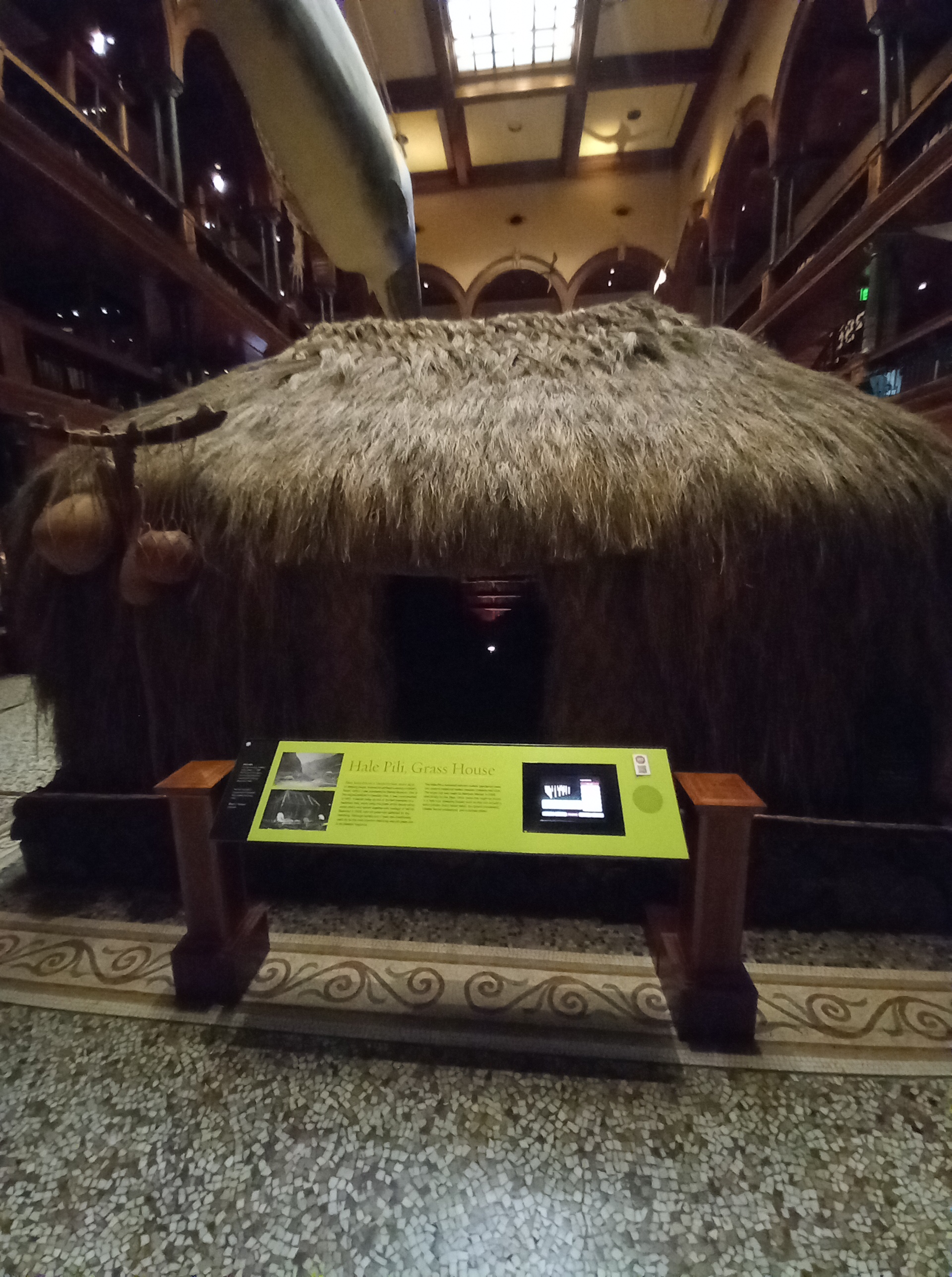
I went around to the exhibits and read up on Kane, the life giver, Ku, the protector, Lono, the people’s god, and Kanaloa, the god of the sea.  The representations of the gods went beyond the typical tikis.  There were black dolls with wide-eyes in loin cloths, stone heads like those of Easter Island, erect phalluses, rough wooden masks, long poles, intricate carvings of family guardians, goddesses with pointed breasts.  In the center of the room was a grass house with gourds out front.  There was a model of a temple and a large great white shark, suspended by strings. 

On the next floors were exhibits on folk healing, hula, and melee, or songs.  There was a guitar that had belonged to Liliuokalani, the last Hawaiian monarch and composer of Aloha Oe.  There were also the red and yellow feathered cloaks and hats that had been worn by royalty, and in the Kahili Room, the feather staffs of the royal family accompanied by oil paintings of the nobles in the Kamehameha family tree. 

To be a Hawaiian back in the day, meant knowing what class you were assigned to and what was expected of you.  It was a far cry from my situation, not knowing where I belonged or what to do next.  On the bus on the way back to the hostel, I was behind some old drifter, who sat with his head collapsed in his hands as we whisked past chain-link fences and trash. 

Outside of a gas station, beneath two coconut trees, was an enormous homeless residence, a plastic structure stretched over an abandoned mattress, two shopping carts and a baby stroller, loaded with junk outside.  On the corner was another makeshift structure, cardboard, and tarp, one shopping cart, two bicycles locked to a fence.  A woman lay on a cardboard box.  A man sat hunched over at the bus stop, with a jacket over his head and his belonging sprawled on the sidewalk in front of him.