back to the jewel 14

Even though I was born in Honolulu and moved to Southern California at the end of high school, I did most of my schooling in the Midwest so never learned to surf.  My father body surfed in Hawaii, so I did that, and both my brothers grew up surfing, so sometimes they’d drag me along, but I didn’t start hitting the waves with any consistency until I was grounded in Huntington Beach during the pandemic, already in my fifties.  That’s a shame, because I probably could’ve gotten pretty good if I’d started earlier.  As it goes, I miss more waves than I catch.

The hostel I was staying at had longboards for rent.  I’d been caught up playing ukelele and studying mythology, but was leaving for the Big Island the next day and couldn’t move on without paddling out at Waikiki even once.  I grabbed a ten-foot board and walked down to the Waikiki Wall where it wasn’t very crowded.  The break on the left side of the wall is called Publics.  It was a long paddle to get out there and there were some areas where the reef jutted above the surface of the water.  What made it more dangerous was that it was predominantly locals surfing out there and I didn’t want to get in their way.

Looking down into the water as I paddled, I could see a movement of tropical fish flickering in the sunlight.  The fourth god of the Big Four when it comes to the Hawaiian Tiki gods is Kanaloa, the god of the sea.  Kane and Kanaloa are often mentioned in the same breath.  They complete each other.  Kanaloa is often depicted as being the Devil to Kane’s God.  Kanaloa leads a band of rebellious spirits who are cast out of heaven to rule the underworld.  Both Kane and Kanaloa make the figure of a man.  Kane’s lives.  Kanaloa’s remains stone.  He becomes jealous and seduces the wife of the first man, cursing them both to die, similar overtones, once again, to the origins story of the Bible.

Kane is stocky, with dark, curly hair, and Kanaloa is taller and pale.  They are both awa drinkers and water finders, who came traveling on the surface of the sea, causing plants to grow.  Awa, or kava, is their main food and they must find water to mix it with.  The Awa-iku are good spirits that ward off evil and help to manage the wind and the rain.  Kane and Kanaloa roam across the land, finding springs of clean water and opening fish ponds.

Now I was in the domain of Kanaloa, the evil-smelling squid, looking down at the underworld that is the sea.  I would need protection, that was for sure, as some of the jagged coral tops were sharp enough to cut paper with.  The waves were not big, two to three feet tops, and they broke in a gentle manner, but I had problems judging them when I got out there, either paddling too early or too late to be in the sweet spot when they broke.

There was a French girl working at the hostel that I shared a room with.  She stayed on the other side of the lockers and had constructed a canopy out of a bottom bunk.  We’d talked just a little, not enough that she would know me in the water.  A few local guys were giving her tips and all of them were getting a lot of rides.  No one was overly hostile when I came paddling out, but they didn’t go out of their way to welcome me either.  I drifted into a spot that was hardly breaking, and just got to my feet a few times.  Finally, a larger set came in and I went left on the first wave.  I went skimming over the surface of the sea, the reef only a few inches below.  When I wiped out, I was lucky not to be cut to shreds.  That was as good as the day would get.

That night the guy keeping the PBR twelve pack in his locker, the one who’d been taking pictures at the top of Diamond Head, staked a claim on a bed at the foot of mine.  He took off his shoes and the room immediately reeked.  Meanwhile, Jerry was up in his bed, sunk into his mattress like a flounder buried in the sand. 

If Kane, Ku, and Lono were a triumvirate to be reckoned with, we were one to be avoided, three old men with nothing better to do once it got dark than go to bed.  It hadn’t always been this way.  Once I’d been a great consumer of awa and romancer of women, waking up in a new bed every morning.  Now I clung to my rented bunk, like my life depended on it.  Time humbles all of us, some more than others.
back to the jewel 15

In Hawaiian mythology, the gods Kane and Kanaloa are seen as living in the bodies of men in an earthly paradise, something like a floating land of clouds, where they drink awa and live off the fruits of a garden that never fails.  This paradise is often thought to be located on one of twelve sacred islands that have been lost or are hidden.  They may lie under the sea and can often be seen on the horizon at sunset or sunrise.  Here, the two gods live with other spirits, in a world that neither knows labor nor death.  In extreme old age they return to earth in the bodies of men.

There are some who believe that the Big Island may still retain a few vestiges of this ancient aloha, that there is something still unconquered about it that may allow a few spirits to roam free.  I am not convinced that any such place still exists in America, but in my travels across the states and to Hawaii, there was something exotic and secretive about the rainy side of the Big Island, Hilo, in particular, that continued to warrant investigation. 

After a few disastrous outings on Oahu, I’d made a hangout of Hilo the last few times I’d been in Hawaii, and wondered about setting up a base there.  On the morning of my flight, I called an Uber and went out to stood on Lemon Road with my things, about the same time as the other travelers were beginning to start their day.  I didn’t see the old evangelist, Jerry, but it looked like he was packed up, ready to head back to Ohio.  How many souls had been saved on his watch?  At least he didn’t get beat up this time around.  Not that I knew of.

The Uber driver who picked me up confused me for a local.  That didn’t hurt my feelings, although there is a world of difference between being born on the islands and brought up on them.  I was looking for a place that didn’t exist, the lost island of the gods.  Memories of my distant childhood had gotten mixed into my escapist fantasies.  No place on earth could measure up to the ideal, so I’d been moving around for years.  Oahu hadn’t been great, so now it was off to Hilo, and if that didn’t work out, then Guatemala.  Where would it end?

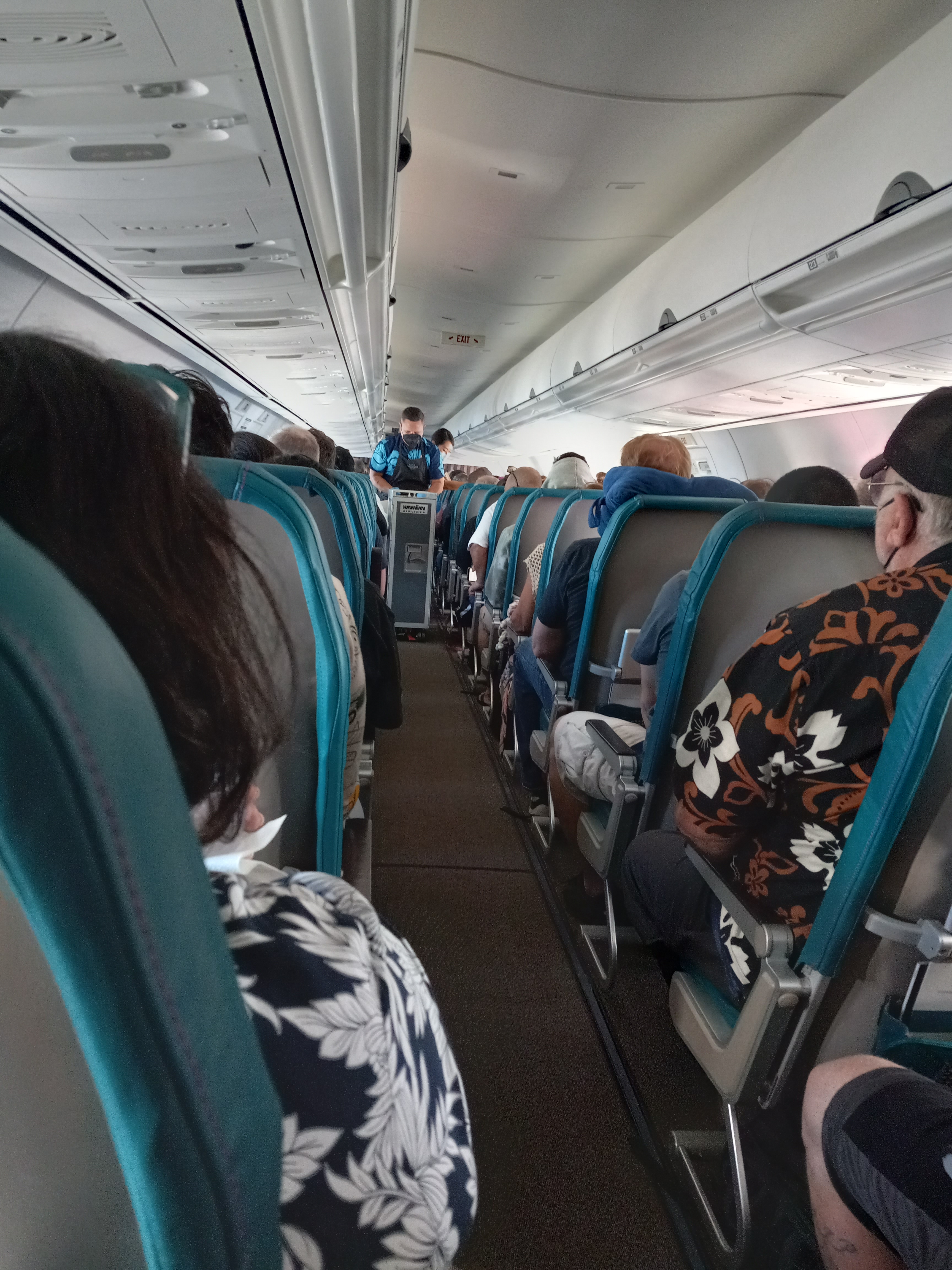
On previous flights to the Big Island, I’d sat by the window and seen the heads of the twin volcanos, Mauna Kea, and Mauna Loa, breaking through the clouds, like Kane and Kanaloa, or islands in a turning gray sea.  This time, however, I was in an aisle seat in the last row, looking at nothing but the back of the seat in front of me and a sarcastic companion next to me who spent the whole flight complaining about a guy who’d passed off one of his check-in bags as a carry-on, then held us all up for a few minutes as he struggled to stash it.  That was some real kook behavior, in his estimation.

The Hilo International Airport is a downhome transit hub.  When we arrived there and had walked from the tarmac to the terminal, there was no one working at the information counter and no taxis out front.  I went to wait for a bus that would possibly be arriving sometime in the next hour, before deciding to go with an Uber.  The driver had been living in Hilo for a dozen years and wasn’t a fan of all the rain, although it was always possible to drive to the other side of the island if you needed a respite.

Just then, as if to illustrate the driver’s point, it started to pour rain.  He drove me into town and pulled up in front of the Downtowner, where I leapt out with my bags.  I’d stayed there three or four times in the past and felt comfortable there.  On this occasion, there was new ownership and staff members, but the layout was essentially the same.  A hippie kid named Seth checked me in, while the other employee, Joe, was doing laundry.  They had a lower bunk reserved for me in a room with two bunks, but a rollaway had also been setup right next to my bed.

After moving in, I took my umbrella and went out walking in the rain.  Hilo feels like a town, with all the historic buildings from the early 1900s, and that’s what I like about it.  I made my way down Keawe Street, past the Big Head Tavern, then cut over to Haili Street and the Palace Theater, before turning right onto Kamehameha Avenue.  This is the main tourist strip with a majority of the gift shops and boutiques.  The windows reflect the sky, coconut trees, and ocean across the street, and there was a small army of homeless folks sitting in the doorways, staying out of the rain.  Two of them had made a fortress of umbrellas and seemed to be living inside it.

I walked along the Russel Carrol Park until I got to a Shell Station where I bought a bag of trail mix and a can of Monster Energy Drink.  While I was fumbling with my umbrella, I set the drink on a newspaper stand, only to have it roll off and fall to the ground where it punctured and began to spin like a rabid sprinkler.  I had to grab it and shotgun it while there was still anything left in the can.

It was a wet and lonesome day to just show up.  What I was looking for exactly, I wasn’t sure, possibly someone with a sign, welcoming me to town.  Instead, I was just another transient.  At least I had a bed to lie down in.  A lot of folks would be sleeping in the rain that night.

back to the jewel 16

It rained hard and the wind blew all night long.  The two younger guys who were sharing the dorm room with me had gone out drinking together.  One of them passed out right away, but the one in the bunk above me spent a few hours loitering around the bathroom, brushing his teeth.  I got up to use the bathroom and he was brushing his teeth.  I got up a few hours later, and he was leaning against the mirror with his eyes closed, still brushing his teeth. 

That morning I got up early and went out to drink coffee in the main room.  Seth and Joe were sitting there, the two of them switching off shifts, working every day of the week.  A Samoan woman who seemed to be living in the hostel was eating a bowl of oatmeal.  I went down the backstairs to where there were a few smaller rooms that could be rented by the month.  If there were any vacancies, I would’ve moved right in. 

One guy who was cooking at a restaurant came out and started talking to me.  He said that the first time he ever tried surfing he got tubed.  He might’ve meant he got rolled over and over by the waves.  That was a possibility.  Then he added that the first time he ever went golfing, he got a hole in one.  Now I knew what I was dealing with.  Perhaps, he’d started on the practice putting green.

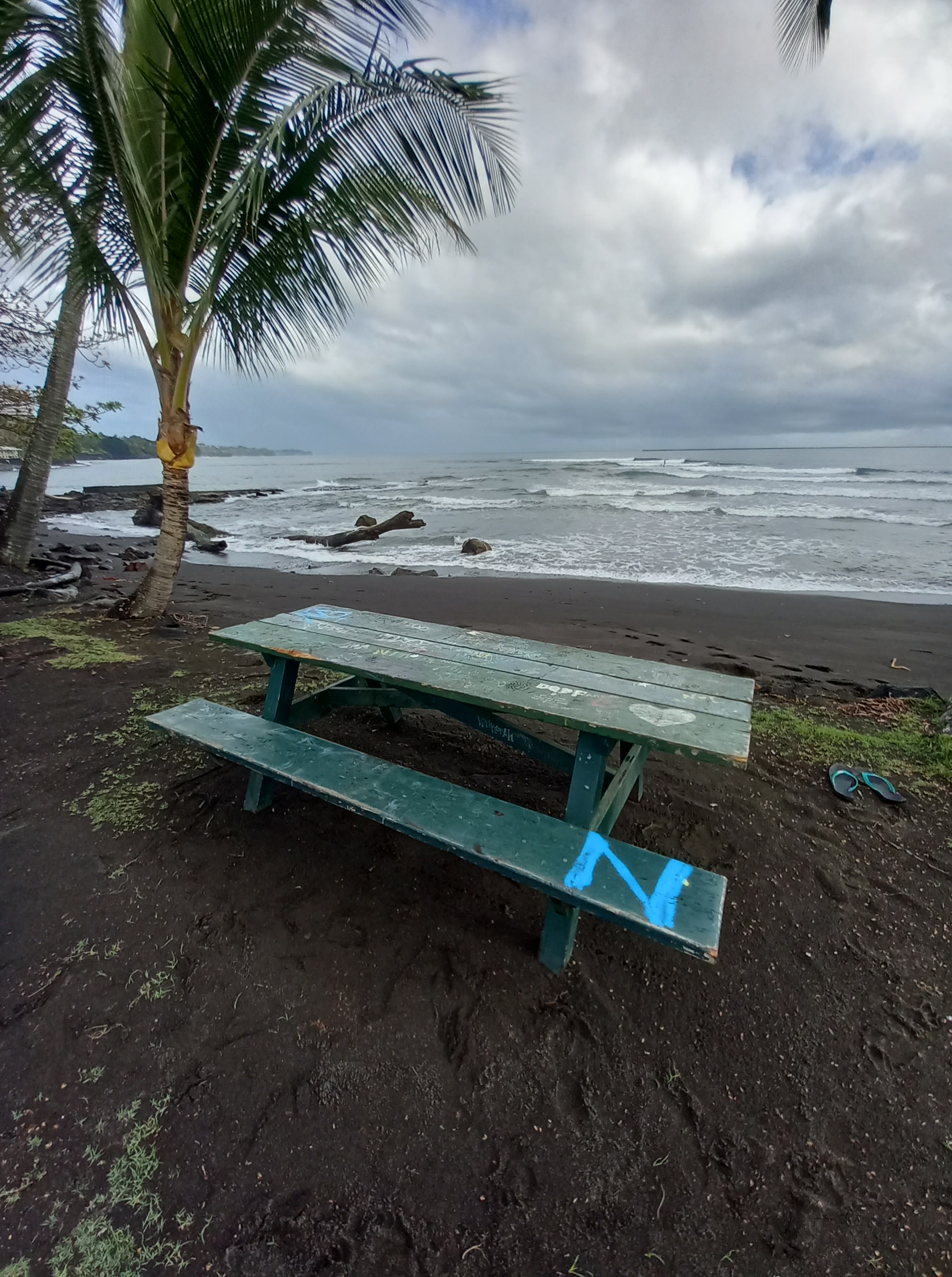
I took my ukelele and walked towards the sea.  The rain had let up but the clouds were black and turbulent overhead.  There was a black sand beach with a homeless encampment surrounding a small lighthouse.  One picnic table was open but when I went over and sat down on it, it felt like I was squatting in someone’s yard.  A woman came out of a tent and started showering about fifteen feet away from me in all of her clothes.  I kept my eyes fixed on the choppy water and churned out a rhythm on my ukelele.  This is why I’d come to Hawaii, to sit and play my father’s old ukelele to the spirits, to try to fill up the instrument, and subsequently my life, with positive mana energy. 

Just north of me the Wailuku River ran into the ocean.  Next to it some people were loitering around.  It was hard to say what drugs were responsible for the scourge of hard-bitten homelessness that I’d already witnessed in my travels across the States.  Meth?  Opioids?  Heroin?  Probably all of those and more. 

It hadn’t been that bad when I’d been growing up.  Kids had started drinking in junior high and high school, and when we moved to California, I found out about weed, but I didn’t know anyone that died of drug addiction.  Now people were dropping left and right, and the aggressive, schizophrenic, behavior the new drugs were causing was upsetting to see.  They are the modern-day demons that are possessing the nation.  The country is warring against itself, preying on the vulnerabilities of its weakest citizens.

I followed the Belt Line Road around Hilo Bay, sometimes stopping on a stretch of wall to work out a new song I’d started in Waikiki.  Being in Hawaii as dispossessed as I was made me frantic with anxiety, and the only place to put that energy was into my instrument.  I was temporarily able to find solace from my troubles as my mind struggled to put the right words in the right order.

Eventually, I came to the Liluokalani Gardens, which I visit every time I’m in Hilo.  It is the largest Japanese ornamental garden, built in 1917 to honor the immigrants who worked in the sugar cane fields.  On this day, there were large puddles on the footpath, and the bridge to the teahouse was inaccessible, but I wandered past the fishponds, through the rock gardens and around the stone lanterns.  Two little yellow birds, saffron finches, hopped along the trail ahead of me.  Pinpricks of rain began to poke at the pond.

Continuing on, I made my way across the footbridge to Coconut Island, or Moku Ola, or healing island, which once house an enormous heiau, or temple.  The legend is that anyone who swam around the island would be cured of any illness or bad feeling.  If that were true, I’d have to swim around the island a dozen times.  My afflictions and insecurities that day seemed too numerous to count.

back to the jewel 17

In addition to the four primary gods; Ku, Lono, Kane, and Kanaloa, the Hawaiians believed in whole pantheons of lesser gods.  There were the four gods, the four thousand gods, the forty thousand gods, and so on, and so on.  Martha Beckwith makes an analogy to a tree, the trunk of the tree, the branches, the twigs, the leaves, the cells within the leaves.  There were the primary gods that made the heavens and earth, and then a numberless body of spirits, the spirits of the air, or uhane lewa, and the spirits of the dead, which have become aumakua, or guardian spirits, for their relatives on earth.

Every physical form on the planet is seen as a manifestation of spiritual forces.  Since every object has a spirit that may either do harm or be of help, every object is to be worshipped.  Each object or animal has a guardian spirit, which is something of an archetype for that variety of being.  The rocks are gods, the birds are gods, the rainbows are gods, every natural force and phenomenon contains some trace of divinity.  In short, all creation is sacred.

There is a diving tower on Coconut Island that was built for sailors to practice their dives.  One of the launching pads is from ten feet and the other is from twenty.  On this blustery day, I climbed to the top and sat dangling my legs over the edge, playing my ukelele songs to the sea, to the banyan trees, to the dark clouds, to the flowers, to fish, to the stone lanterns in the Japanese garden, until a family of tourists showed up who weren’t there to hear a concert.  They were there to visit the tower.

It was too stormy for anyone to jump in the water or swim around the island, but I knew the kids wouldn’t be satisfied if they didn’t get a chance to scramble up, so I ceded my position and began walking back towards Hilo.  On the way I stopped for a plate lunch at a fish market, and as soon as I sat down to eat my loco moco, it started to rain, as hard as it is capable of raining, anywhere, at any time.   I continued to have small luck, luck that I didn’t get poured on, luck that I got the lower bunk at the hostel, luck that I should be in Hawaii at all, not big luck, like having enough money or getting someone to cover my songs.

As soon as I finished eating, it stopped raining.  I walked across the highway to the park at Waiakea Pond.  The buildings and houses that had once been built on the land had been wiped out by a tsunami in 1960, so they’d created the park, with a few whimsical rolling bridges.  As hard as it had been raining, it was now that calm.  I walked over one bridge, like I was moving through a dream land, and saw the heavy blue and grey clouds reflected in the green water. 

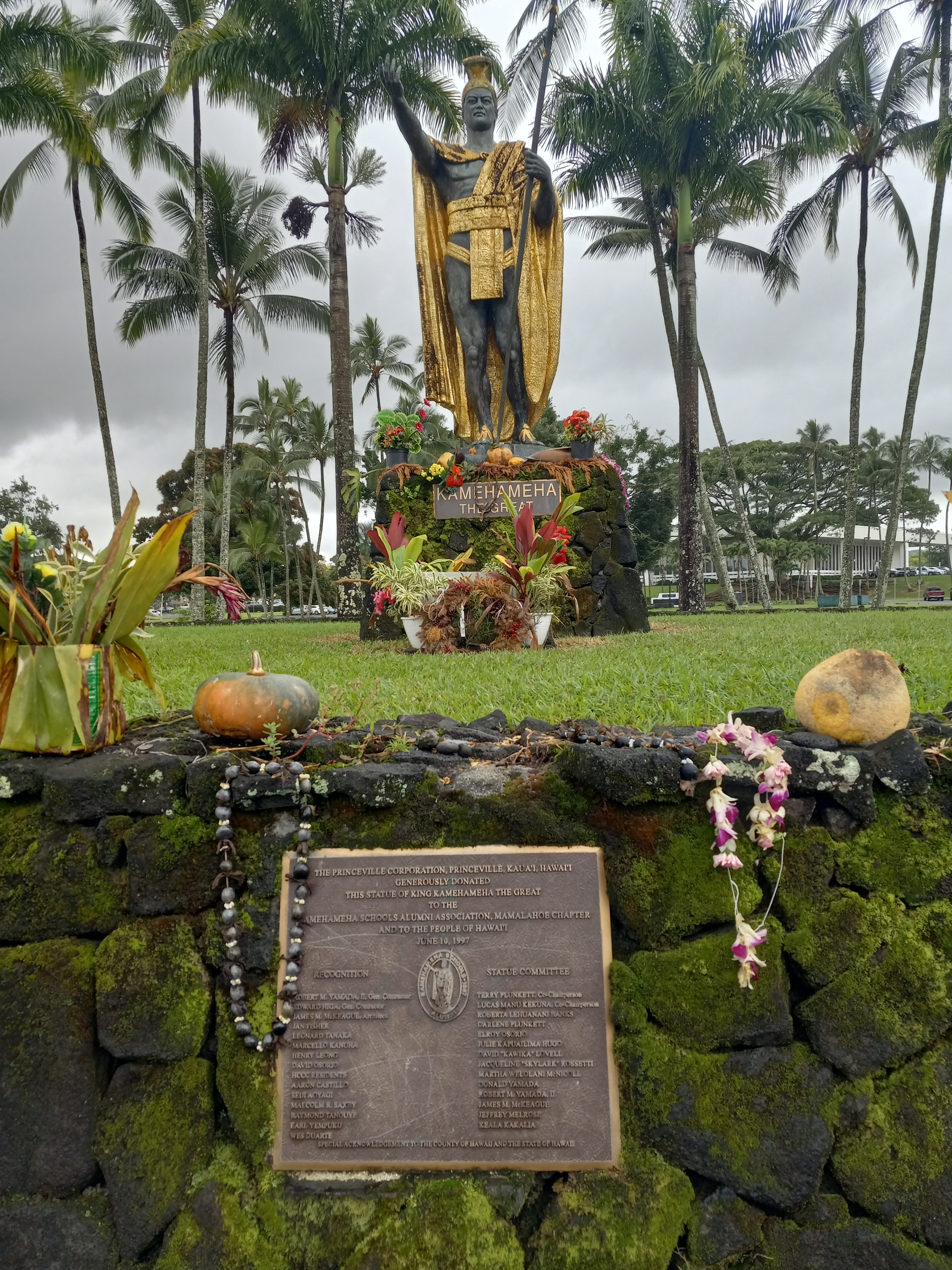
It was not far from there to the statue of King Kamehameha, the first conqueror and ruler of the Kingdom of Hawaii.  Hilo had been an important place to him, his first official capitol after unifying the Hawaiian Islands and also where he built his fleet of war canoes.  The statue is fourteen feet tall.  Kamehameha wears a gold helmet and robe and clutches a spear in his left hand.  His right hand is reaching out in front of him.  There were offerings in front of him, leis, shells, gourds, flowers in vases. 

Walking back along the beach I came across a homeless encampment, where someone had pushed a shopping cart out onto the black sand.  They’d cleared a space to sleep in, in a confinement as narrow as a coffin, and had a tarp to pull over them.  It was only early afternoon and the black clouds were rolling in again.  I hurried back to the park close to the hostel where I’d started from. 

There I noticed I sign warning that a shark had recently been spotted in the water.  It also said no camping.  It was hard to call what the people on the beach were doing camping.  The danger they were in didn’t come from any shark.

back to the jewel 19

At seven-thirty in the morning, I sat up straight in bed, stricken by a wave of anxiety.  I was on the Big Island of Hawaii and my money was running out.  I had enough to last me for a few months if I headed to some place less expensive, like Central America, but here it was nearly fifty dollars a night, just for a bunkbed, and I wasn’t making the connections I’d hoped to, but when had I?  The world was full of extroverts, running around crashing each other’s parties, and I’d always been a spectator.

I looked into what it would take to rent a car for a few days, but since the pandemic rental prices had been through the roof.  That wasn’t going to be an option on this trip.  Then I looked into hostels in Kona and booked a room for four days.  I would take a bus there when the time came.

Going out into the lobby, I sat and talked to a woman, Jolene, a friend of Joe’s, originally from Washington state, who’d been living in a tent in Puna for a year and getting around on bike.  I was looking for something inexpensive, but had also been living in a pop-up camper for two years and wasn’t interested in going anymore primitive than that.  She mentioned the rental rooms downstairs, but I already knew about them and knew there was no vacancy.  If there were any openings I would’ve moved in that afternoon.

Jolene was a latter-day hippie, my kind of people.  I’d crossed swords with that tribe in the Pacific Northwest, Alaska, Northern California, in my travels through Latin America and Southeast Asia.  We were all looking for a simple life that didn’t really exist in America anymore.  Some of the last great opportunities had been for my parents’ generation, the baby boomers. 

Ever since I’d been out on my own, I’d encountered a society that was deficient when it came to basic trust issues.  Everything was overpriced.  Everything required a security deposit.  When it came to finding a job, you needed a resume for every position.  It was a country of strangers competing against each other.  The blood of life had been strangled dry through multiple rules and regulations.  There were few places to even park a car for a few hours without getting a ticket.  As an aspiring free-bird I’d been terrorized in my twenties, hopping from place to place, always worried sick about money.

On this day I needed to go for a hike.  There were two waterfalls I knew about that were in close proximity.  I’d been to Akaka Falls the last time I was in Hilo, a four-hundred-foot drop with a wooden walkway.  It might be one of the most scenic falls in the world, but was also over ten miles away.  Rainbow Falls was closer.  It is eighty feet and wonderful in its own way, especially when the conditions are right and rainbows appear above the basin.  It was not hard to walk there, so I strapped my ukelele to my back and set off.

It had been raining the whole time I’d been in Hilo.  Even though the rain had tapered off, the road was wet and thick mud stuck to the bottom of my shoes.  There was a road crew, men in green vests, that was ripping up sections of the road at the same time, creating a real quagmire. 

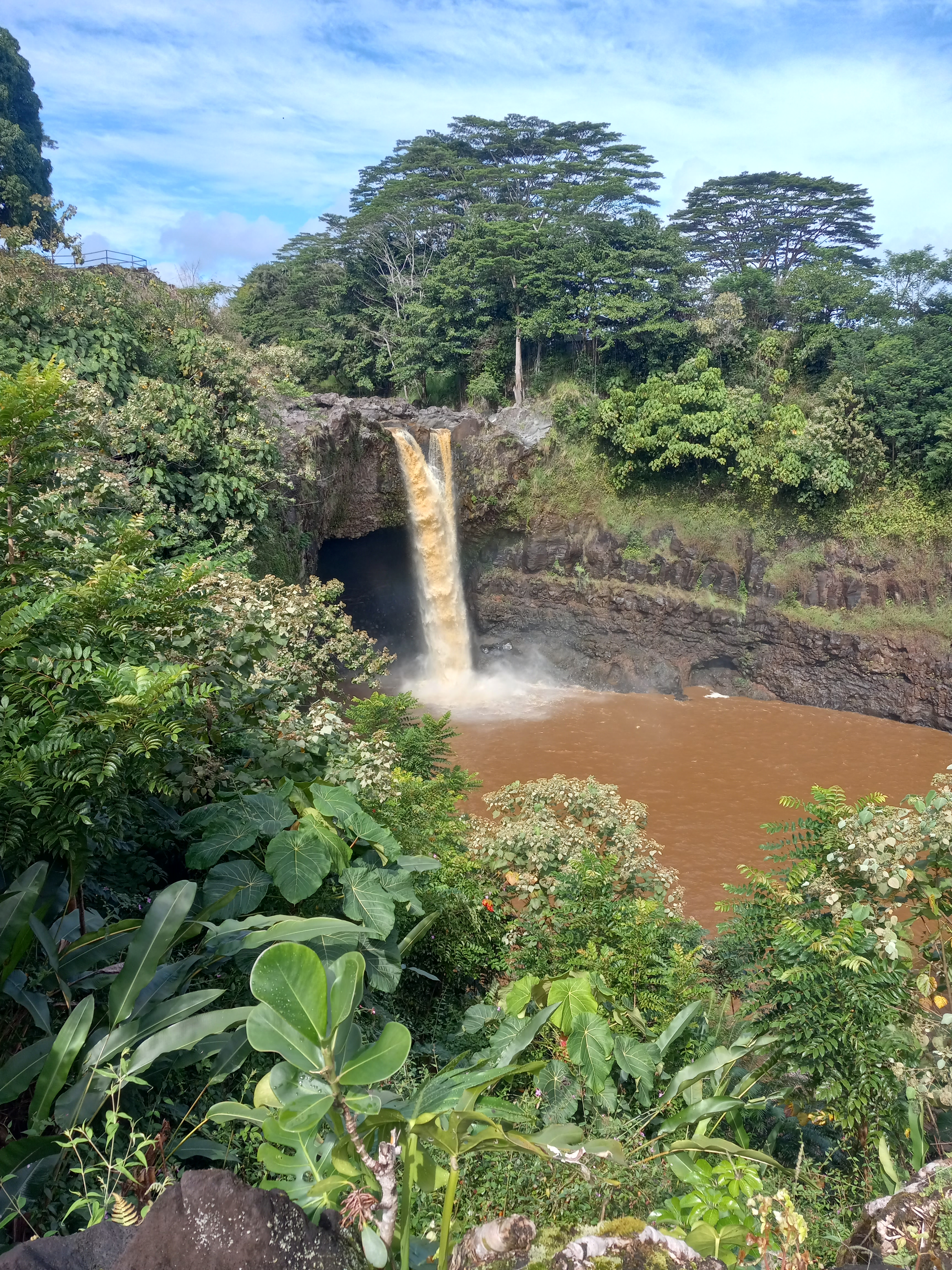
When I got to the falls there was an enormous volume of water gushing over the edge, but it was as brown as the mud that was sticking to my feet.  The stairs to the top section were closed off and a sign warned about the danger of flash floods.  Even though there was yellow tape sectioning off the forest, I still waded into the trees, thinking I’d stick to my original idea and play my uke beside the falls.  It was a dismal reality, sitting beneath gray skies, the falls roaring like a beast in the background.

Eventually, I started back towards town and found a spot along the Wailuku River, just past the Puueo Bridge.  The strings on my ukelele seemed too loose on this day, and made a tuneless buzzing sound.  I looked into the cloudy water and saw a sea turtle that was tumbling end over end.  That is how I felt, disoriented, lonely, confused. 

The town was full of homeless folks.  My ex-roommate at the hostel was now one of them.  I longed to have a place to unpack my bag and structure enough to keep me engaged and connected with a community.  Instead, I tumbled from place to place like the sea turtle, just fighting to keep afloat.

back to the jewel 20

Sorcery is using spirits to gain power over people or situations.  It played a central role in the lives and dynamics of the Native Hawaiians.  When Kamehameha was consolidating his power in the islands it was important that he secured all the sorcery gods that were worshipped by the ruling chiefs and set up god houses and keepers for them. 

Sorcery was practiced through a fetcher, which was an image that was thought to be possessed by the spirit of an ancestor or some force of nature.  The bones of a dead family member might be used in the same way.  The goal was to bring the energy of the god to the keeper of the talisman.  A body might be dedicated to a god or animal and then take on that shape.  It would then go on to serve as an aumakua, or protective guardian, to the family.  An aumakua would punish the enemies of the family it served and bring good things to them, but they also had to remember not to neglect its worship or it might rain vengeance upon them.

Spirits could also inhabit a living person.  When this happened, the person was referred to as an akua noho, or sitting god, and was treated as a god during the time of their possession.  When the spirit was sent out to inflict injury on others that’s when the sorcery began.  Bits of a body or chips off a wooden image were prized as still possessing mana, or energy.  Laws were passed forbidding sorcery, but the secrecy it was then practiced in only increased the intrigue and fear it generated.

Related to the schools of sorcery, were those the healers, or herb doctors.  Many of these doctors believed that diseases were caused by sorcery.  Lono-puha was the first to practice healing through medicinal herbs.  The kahunas who came after him learned to diagnose illness by laying out pebbles in the outline of a man.  They matched up the afflicted body parts with the corresponding pebbles and offered prayers to the aumakua of healing.

Jolene, who was living in the tent in Puna, told me about a craft fair that was happening across the street that night.  Her and one of the residents of the hostel, a retired teacher named Virginia, were going.  It had not been a very social trip so far, basically just me alone, looking for uncluttered stretches of beach to play the ukelele on.  This night, then, I thought I’d join them, so made my way across the street when the band was scheduled to play.  They were late.

About a half hour after the music was supposed to begin, a car pulled up and a man with long hair and sunglasses shaped like two little stars got out.  The soundman was frustrated and let him know if the rest of the band wasn’t right behind him, they wouldn’t be getting on the stage that night.  One by one the other band members began to appear, lugging their instruments with them.  It was a pretty informal affair.  The music was Jah-waiian, a mixture of Hawaiian and reggae.

Hilo is not a big place.  I’d been there enough times to recognize a few of the characters who make up the counterculture.  One guy passed by on a skateboard.  I knew he had his own recording studio and performing arts spot.  Another guy, a comedian, I’d seen at a few open mics in the past.  He called himself the California Raisin because he is so bald, wrinkled, and brown.  I’d played at one of the open mics he was at and it had not gone well at all.  All you could hear were big drops of his sweat hitting the floor.

After looking at some of the art and hitting up a kava bar, I wandered over to the Big Head Tavern, where someone told me they were having Hawaiian music.  The two guys playing there were also operating on island time, meaning running a half hour late.  Once they got started, they were just two local boys playing slack key, needing to jump up and high-five each other after every song. 

Sitting there watching them play, made wish we never would’ve moved from Hawaii, that I’d grown up surfing and playing the ukelele.  I could’ve been playing in a band and married to a hula girl by now.  Could that still happen?  Maybe.  I’d need to gather up a ton of mana energy and still get lucky on top of that.  It would also help if I didn’t look so homeless.  That might be a good start.