back to the jewel 21

That night when I got back to the hostel there was an old man lying in the rollaway bed next to me, looking like a mummy that had been unwrapped from his bandages.  There were snores pouring out of his mouth like ancient curses.  At the same time, some local street buskers had set up shop right beneath the window and were making as much commotion as the Bremen Musicians, that odd assembly of a donkey, dog, rooster, and cat, who struck out to make it as musicians and had frightened a houseful of robbers, leaving them with a fortune in gold to divide between them. 

The musicians beneath our window may have divided a fortune of meth, what with all the caterwauling, but nothing more than that.  My hope was that at least they’d wake up the old man, but he kept right on accompanying them on his buzzsaw. 

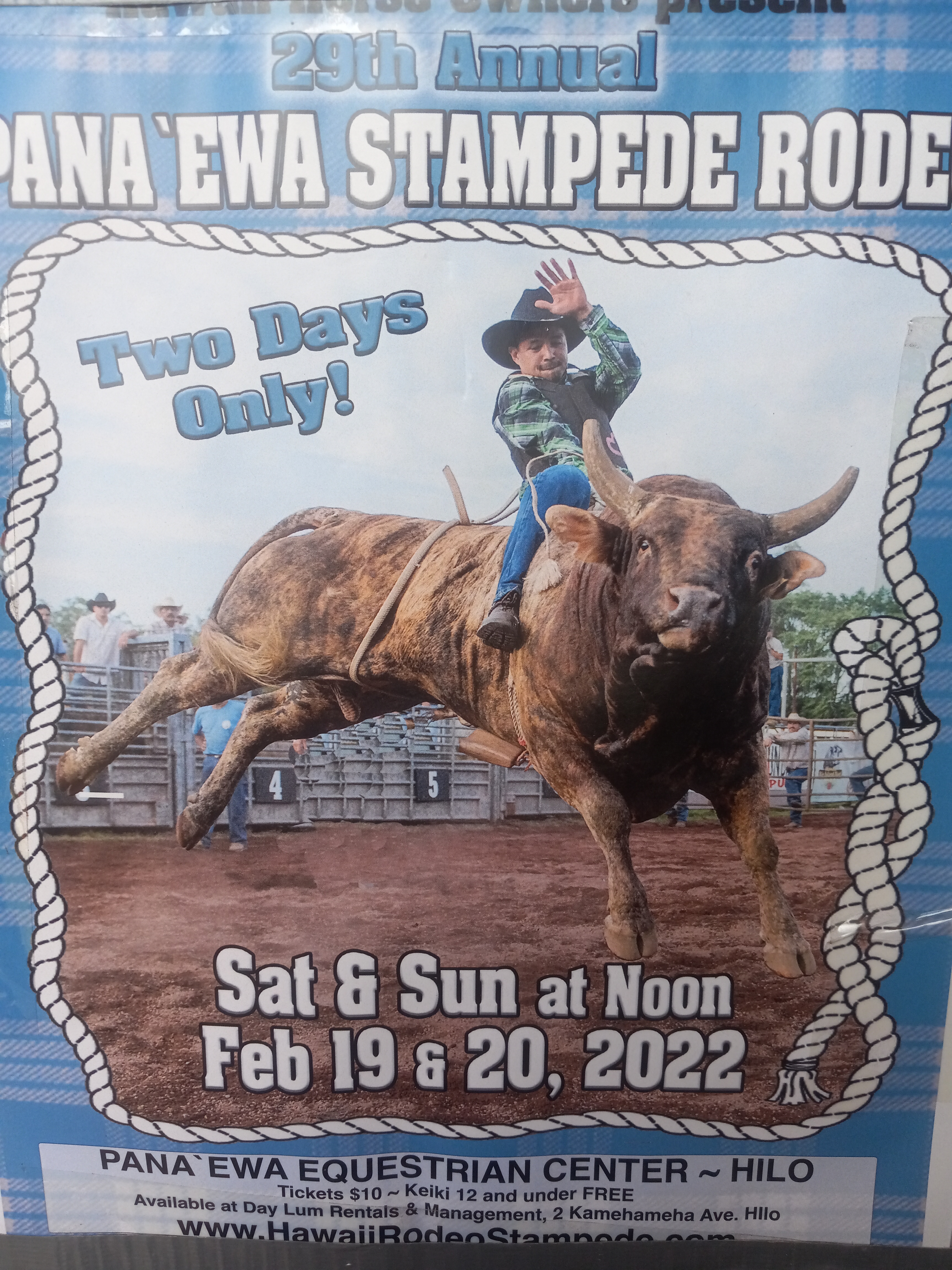
That was a bad day to wind up so tired because there was a rodeo that I was planning on attending, the Panawea Stampede.  The first vaqueros, or cowboys, were brought from Mexico to the Big Island in 1823.  They were called Espanoles, from Spanish, which later became paniolos, or Hawaiian cowboys.  Earlier, an English officer had gifted King Kamehameha with six cows and a bull, and over time their descendants ran amok, destroying crops and damaging villages.  The cowboys were brought over to bring the population of wild cattle under control and help usher in the beef industry.

Paniolos developed their own unique heritage, a mixture of Hawaiian, European, Latin American, and Asian cultures.  In 1908, three paniolos competed in the American rodeo championships in Wyoming, and one of them, Ikua Purdy, became the champion steer roper of the world.  Paniolos were also responsible for the slack-key guitar style, coming up with different tunings on the guitars that were brought over by the vaqueros, and embellishing on falsetto voicings to create something uniquely Hawaiian.

When I announced my intention to walk to the rodeo that day Joe and Seth were impressed by my resolve, seeing that it was over six miles one way.  Both of them had been in Hilo for years and hadn’t made it there yet.  The old man, Ryan, was sitting there with orange juice and donuts.  He hadn’t been to the rodeo either but he had been in the Armed Forces.  He started talking nonstop, just like he’d been snoring that night, but then he flashed me a toothless smile and I saw that he was kind.  Later, I learned his wife was in the hospital and grew to like him.

To get to the rodeo, I took Kilauea Avenue past the pond and the university, past the golf course, and finally onto the 11, where I walked beside the freeway another mile.  Another half mile and I came to cars and trucks parked beside the road and people walking to the rodeo grounds.  It was ten dollars to get in and they were requiring COVID masks.  I put one on, like a black bandana, and went to sit down on a grassy mound where a group of keikis, or kids, in cowboy hats were making their own tug of war contest with a rope.

There were bleacher seats that were mostly full, so after resting up a bit, I got to my feet and walked around.  They had some kids come out and do some dummy roping, and then there was barrel racing.  After that was an event unique to the Hawaiian rodeo, double mugging, where one cowboy on a horse ropes a steer, and another on foot wrestles it to the ground and ties its legs.  A few times the roper missed and they ended up chasing it clear to the other end of the arena.  By that time the runner would be all tired out and have difficulty lifting the cow off its feet.

It would’ve been a perfect day to be with some family or friends.  Watching the children running around cavorting in their cowboy hats made me realize how much I’d missed out in life, chasing a dream that really hadn’t come true.  The days had all been long, but the years had gone by fast.  They called for an hour intermission, but while I was standing in line for a chili bowl, I saw that black clouds were welling up on the horizon.  If I left early, I’d miss the bull riding, but if I stayed, I risked getting stranded and soaked.  In the end, I started walking again, just because I was so lonely.

By now, my feet were killing me.  After following the 11 Highway back to Kilauea, I had to be careful because it was a narrow, one-way road for a short stretch and the cars wouldn’t be expecting a pedestrian.  By the time I made it back to town, I was limping like I’d been bucked off by one of the bulls, when all I’d really done is walked thirteen miles.  They say growing old isn’t for the faint of heart.  Not like that it isn’t.  Not like that.
back to the jewel 22

In Hawaiian sorcery the corpse of a deceased family member would sometimes be dedicated to become a guardian spirit that might take the form of an owl, a type of lizard called a mo’o, or a shark.  These guardian spirits or gods were called aumakua.  Owls were some of the most famous family protectors.  They could give life back to souls that were lost on the plains and were allies in war and battle.  It was said of them that they belong to both the heaven and earth, and there are many tales of warriors taking their signs from the flight of an owl.

The mo’o were gigantic reptiles that were said to inhabit fishponds.  They were said to grow up to thirty feet long and were as black as the night.  There are many instances of female goddesses that take on the form of a mo’o, such as Kalamainu’u, to whom bodies were dedicated.  Some mo’o goddesses are able to take on a human form to foretell a disaster.  They are able to bring great fish to the fishponds and ward off disease, but may also punish the owners if they do not show charity to the poor.

The most common kind of aumakua, or guardian spirit, is that of the shark.  Offering a corpse to the dedication this protective deity may be a drawn-out ceremony.  The kahuna presiding over it should be able to identify markings on the shark to correspond to characteristics or the clothing of the family member.  Such a shark became a type of pet to the family.  It was fed and would sometimes help to drive fish into their nets.  They could also be used as a fetcher to kill an enemy, but their use was largely beneficent.  Ku-hai-moana, the King Shark, was said to grow up to two hundred feet long, with a mouth as large as a house.

I could’ve used a guardian spirit on this trip, but those seemed to be in short supply, for me and a number of other folks.  A kid had moved into my room who spent every minute in bed looking at his phone.  Then there was old Ryan, snoring all night and talking all day.  There were days where I would’ve liked to lay in bed for ten hours, to do some reading or catch up on some sleep, but eventually the need for privacy would drive me out and I’d head off with my ukelele.  Whenever I go to Hawaii, I am immediately intoxicated by the beauty of it, but over time start feeling dispossessed and lonely.

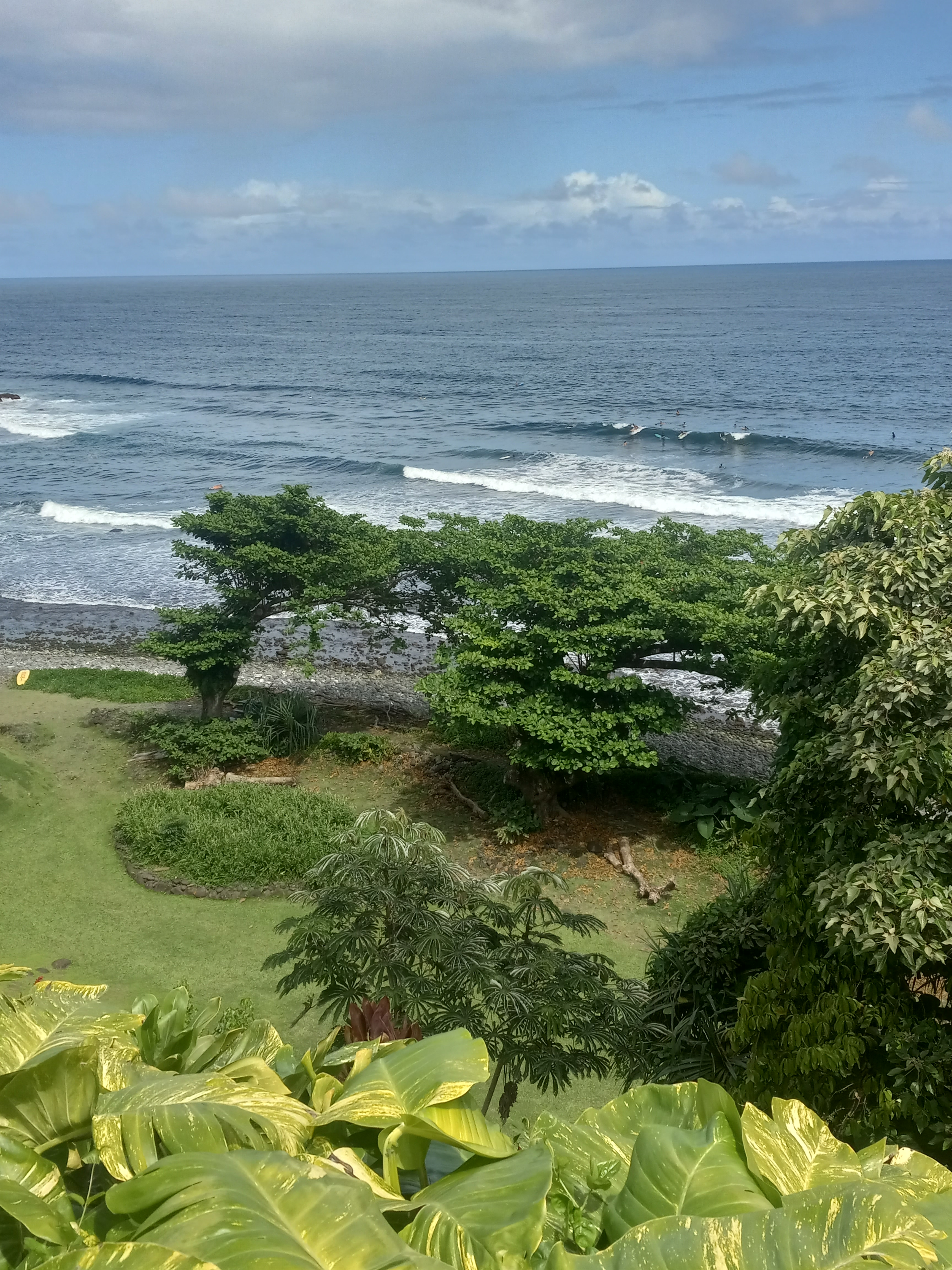
A group of homeless folks were taking up the picnic table when I wandered down to the lighthouse to play music.  They were indifferent to me.  I walked across the river, looking for a place where I could sit and play by myself, and came to a scenic outlook.  There was a couple ahead of me that were dragging a shopping cart downhill to an encampment that they’d set up in a cove.  They were modern primitives. 

People dream about getting away from it all and living off the land, but it’s not so fun when it starts raining and blowing and you get a toothache.  Living in a car is about as extreme as I’d gone in my quest for freedom.  At the end of the day, I still wanted a door to shut out the rest of the world.

I watched the couple below me unload the shopping cart and then start bickering.  I had to move down the coast a little further to find some peace.  Finally, I came to a quiet green grove with a perch looking down on nothing but waves.  I was just about to sit down on a log there when I looked down and saw a bunch of empty syringes strewn across the grass.  That took the wind out of my song.  I decided to walk up to the Japanese garden and had a stalk of sugar cane that a retired teacher at the hostel had given me that I was using as a walking stick. 

As I walked along the highway, back over the bridge, I passed another man with a walking stick.  He was wearing a baseball hat, a dirty T-shirt, sweatpants, and tennis shoes.  The only difference between us was that I had a ukelele on my back and he had a backpack.  He was probably heading up to the scenic outlook.  It was one more day in paradise.

back to the jewel 23

The Hawaiians call the spirit or soul uhane and the body is kino.  They believe that the spirit has a very independent life away from the body.  It may leave permanently, in which case the body is dead, or it may just wander off for a while, leaving the person asleep or tired.  They believe that the spirit escapes the body this way by exiting through an inner angle of the eye called lua-uhane.  In this case, a kahuna, or priest, may be called in to put a stop to the wandering spirit with the aid of a wreath that is placed on the head of the person.

Only the kahuna can see the uhane, but anyone might possibly see the lapu, or ghost, of a dead person, which has the same human shape and speaks in the same voice.  They live in great fear of this.  It cannot change shapes, but can change sizes, and may enter small objects just as bones or food.  The Hawaiians have two ways of testing if they are dealing with a spirit or a living person.  The first is to lay down leaves.  Ghosts will leave no trace when they cross them.  The second is to look for the reflection in a bowl of water.  Only people have reflections.

A soul that has left the body may often be spotted fluttering over it.  It may have traveled further and joined the spirits of the underworld.  If caught in time, it may be possible to restore it to the body.  This involves pushing it back up through the feet.  Fragrant plants are wrapped around the body.  Chants are also part of the procedure.  The last step is a purifying bath. Successful resuscitation of a departed soul is called kupaku.

Death to the body does not mean death to the spirit.  The spirit will voyage to an underworld or place of the dead, and be led by their guardian spirit, or aumakua, to a leaping place, which is quite often a tree.  A spirit that is abandoned by their aumakua becomes a kuewa, or wandering spirit, and may end up in a barren place feeding on insects.  These malicious spirits are to be feared and often take great delight in leading travelers astray.

The bones of chiefs were preserved in heiaus, or temples, or distributed to the family members as sources of great mana energy.  Common people were bound in a sitting position and cast into deep pits.  The Hawaiians believed in a place of darkness, called Milu, and one of light, called Wakea.  Over the years, their beliefs were largely influenced by Christian conceptions of original sin and heaven and hell. 

One thing I read that I like to believe is that there is a spirit world called Po, which is like a great sea, out of which the lower forms are born.  It relates more to the cycle of life than any definite beginnings and endings.  Humans are born out of the spirit world.  In old age they return to the safe waters again.  At that point they are guarded until they are ready to take a form again, either as a human or some other force of nature.  This is something like reincarnation without the judgement attached to it.

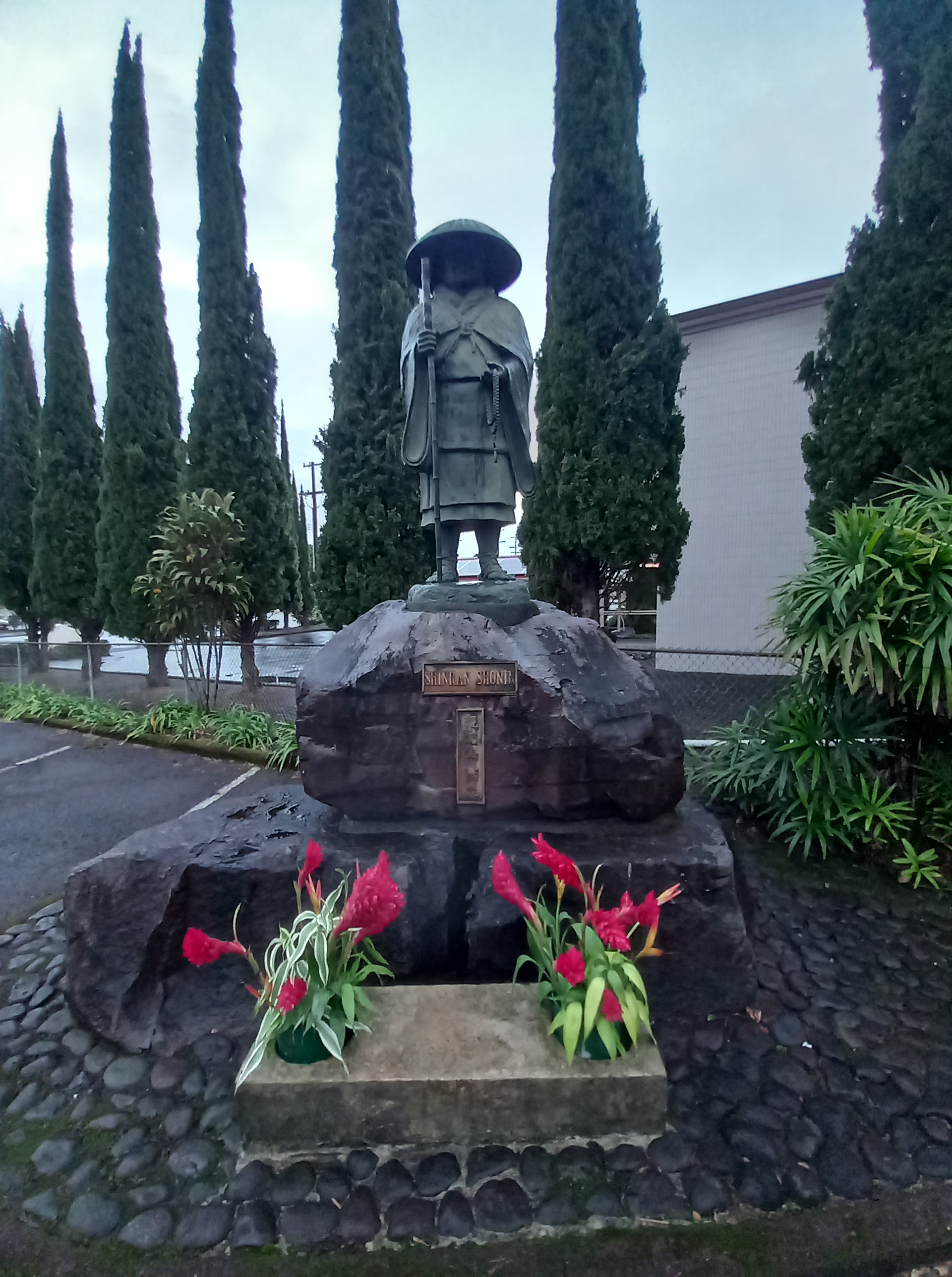
There was an open mic I’d been considering hitting up at a studio called The Jazz Workshop, but when the night came, I was too depressed to want to be around people.  I wandered over to it and saw the comedian, The California Raisin, walk in, looking for an open stage.  In the end, I just wandered over to the Jodo Shinshu Buddhist Mission and stood in front of the statue of the founder, Shinran Shonin, a Japanese monk who helped pioneer the Pure Land belief that salvation is possible to all creatures by believing in the supremely compassionate Amida Buddha.

Leaving there I was accosted by a street hustler, a kuewa, or wandering spirit, of sorts, who first came up and asked me if I’d seen his phone lying around, then took it further and basically accused me of taking it, on a night when I really wasn’t in the mood for it.  I turned and told him firmly to leave me alone, but he kept following on my heels, calling Sir… sir … sir.  Is that my phone?  Can I see it?  Like I was just going to hand it over.

There was music at a place called Pineapple’s and I stopped there to shake the guy, but he moved across the street and waited for me there.  When I started walking again, he began cutting across the street towards me, then stopped in his tracks, seeing the grim look on my face.  There were easier ways to get a free phone than to mess with me.

back to the jewel 24

Old Ryan was snoring as if he were communicating in a primitive language, a series of grunts, snorts, moans, sighs, and deep breaths, that could almost be decoded based on inflection alone.  Then, right at daybreak, he sat up on the edge of his bed and began talking to no one.  I lay on one side, grimacing in resentment after he left the room.  Twenty minutes later he walked back in and shook me awake.  He had cooked breakfast, pancakes, and Portuguese sausage for the two of us.  I knew he was in a lot of pain, his wife being in the hospital and all.

As we ate, I did manage to get a few words in edgewise, basically complaining about my lot in life.  As he saw it, if I hadn’t made all the choices that I had, we never would’ve met.  That was an interesting way to look at it.

It was President’s Day.  That meant little to me, having every day off for years.  That hadn’t always been the plan.  After so many years out of the country, seeing what people did in America just to stay afloat didn’t seem like a very good deal.  You had to pay for everything, even things you didn’t want.  All I needed was a room with a bed, desk, and fan.  Those kinds of situations existed, but even they weren’t cheap.  Prices were out of control.

I decided to walk up to Honoli’I Beach Park, a surf beach a few miles north of town.  It was the same direction as the scenic outlook, over the bridge, right across from the Alae Cemetery.  There were steps to get down to the beach and signs warning of the strong current and dangerous shorebreak.  The waves were a few feet high, and it looked like a good day to paddle out, but fun wasn’t in my vocabulary on this trip.  I was in Hawaii because I needed some place to turn, some sign that since I was born there, I would be welcome there.  Instead, I felt violently dislocated, not just in Hawaii, but everywhere.

There was a fallen tree that I sat down on.  I got my ukelele out of the case and laid it across my knee, but then a wave of depression and fatigue crashed over me, and I put the ukelele down and rested my face in my hands, wanting to cry but empty of tears.  You can only keep hope alive so long before it wears thin.  You need a fresh surge of it, an unexpected smile, a friendly stranger, a compliment that takes you by surprise. 

Eventually, I picked up the ukelele again and started working on my new song.  The melody had come to me on my first day in Kapiolani Park, but the words were taking some time.  It was about someone who takes their freedom too far and ends up wild and deranged, strung out at the end of their rope. 

That night I walked up to the jam at the Jazz Workshop.  I’d met the owner a few times on past visits, but he never seemed to remember my face.  This time he assured me I wouldn’t need to wear the COVID mask I had in my hand.  The scamdemic was over, he let me know.  The good guys had won.  It was hard to know where I might be expected to still wear a mask.  It had been a tedious process to get into Hawaii this time around, with a whole list of requirements that had to be checked off on a website before I was given a wristband at the airport.  Perhaps because of lingering concerns about the virus, it was a small crowd that night.  I took a seat up in the loft and listened to the band play a Bossa Nova number.

Walking back to the hostel after the show, I saw that on this night the open mic was at the Big Head Tavern.  It was some of the same talent I’d seen at the craft fair and Jazz Workshop in the past.  The California Raisin was there.  One guy was wearing a WWE belt.  It was a good crowd, a small crowd. 

I like Hilo, even though I’d bombed at that same open mic a few years back.  I don’t know quite what went wrong.  All I knew was that it wasn’t sounding good, and people stopped listening midway through the first number.  It happens.  You never know how good, or bad, you are until you get up and perform in front of others.  You might get your feelings hurt but it’s better than fooling yourself.  On this night I was content just to listen.

back to the jewel 25

After the open mic at the Big Head Tavern, I went back to my room and found Ryan watching a movie on his phone, and this kid, Sergio, lying in bed listening to music. I got my book about Hawaiian mythology and went to sit in the common room.  It ended up being a crazy night.  A German woman had just missed a flight and was on the phone for a few hours.  Then there were some loud voices outside.  It ended up being a drunk Filipina woman that I’d seen at the open mic, trying to sneak a stranger up to her room. 

She couldn’t remember the key code.  I walked down and cracked the door open, but they didn’t come in right away and ended up slamming it shut.  This brought Seth and Joe from their rooms, wiping the sleep from their eyes.  Ryan also came out to investigate.  There wasn’t much of a story to tell.  They wanted to know if she’d brought the guy up to her room.  I told them no.  They hadn’t made it that far.

I thought about going and lying down but the kid was still listening to loud music.  Instead of cussing out loud, I took the book back out and cracked it open.  One hundred and sixty-four pages down.  Three hundred and eighty to go.  What kind of messed up vacation was this?  Who goes to Hawaii to study mythology?  I was sick.

The next chapter was on the Pele Myth.  Pele is the goddess who governs the volcanos and lava flows.  She is believed to live in the volcano at Kilauea with her family.  Other family members include a brother named Moho who is a kahuna, another brother, a humpback, named Kamakaua, and a sister, who she carries under her arm like an egg, Hi’iaka.  Many stories involve Pele’s migration from a distant land and her attempt to dig out a cool pit for her family once she reached Hawaii.  There are also stories about her falling in love with a handsome chief from Kauai.

Pele’s sister, Hi’iaka is seen as an expert in sorcery and is the supreme patroness of hula.  Many of the stories involving Pele and Hi’iaka are recreated in the dances.  The songs are not composed, rather they are taught by spirits to the worshippers of Pele.  Those who learn the dance are thought to be possessed by the goddess.  Those who wish to master sorcery and hula often stay at a volcano for more than a year to sacrifice and dream a chant. 

Many legends speak of the fate of those who dare to offend Pele.  She does not suffer braggarts gladly.  Rivals in love made be transformed into lava formations.  Competitors in sport, such as sled racing, may be reduced to cinders. 

Many temples to Pele are built beside lava streams and at the edge of craters.  Bodies are offered to the goddess in the hopes that their spirits will live again in a beautiful home that lies beneath the burning pit.  Pele was not worshipped by the priests.  It is only those who bear her name who follow her. 

There was supposed to be a bus that went to Kilauea from Hilo.  I looked it up on the internet and found that Bus 11 traveled there five times a day.  It cost fifteen dollars to get into the Volcano National Park and you could just pay the driver.  That would be a good plan for the next day.

When I went back to my room, Ryan was sleeping with his movie playing and the kid was still listening to music.  After a while, Ryan’s phone shut off and his snoring began.  The kid’s music kept playing, however, and I was right at the point of saying something rude when I realized that it was coming through the wall from the room next door.  Someone was passed out with their music on full blast.  I was relieved not to have strangled the kid, but still sorry to be sleeping in a hostel.  How much humility is finally enough?  I was ready to start winning for a change.

back to the jewel 26

Myth is much larger than a story we just tell to amuse yourselves.  The legend regarding the migration of Pele, for example, and the way she traveled across the sea, digging pits to make a home for her family is quite similar to how the Hawaiian Islands were formed by volcanic activity.  The six major islands were created as a tectonic plate slid over plumes of lava and punctured the earth’s crust.  Each island is home to at least one dominant volcano.  The youngest island is the Big Island, with volcanic activity still occurring at Kilauea. 

When I was about five or six, we spent one long summer living in a commune in Kona called the House of David.  The last commune we’d lived in, God’s House, in Manoa, had disbanded when the landlord refused to renew our lease.  We were on the Big Island because we didn’t have anywhere else to go, but it is hard to imagine my father staying anywhere for any length of time if he couldn’t be in charge. 

As it was, our stay did turn out to be short, but one thing I’ll always remember is getting up in the middle of the night and riding in the back of a pickup to witness Kilauea erupting.  This was during the Maunaulu eruption, which lasted for 1,774 days and produced 460 million cubic yards of lava. It is easy to get lost in our mundane routines and overlook the cosmic collisions responsible for our very existence.  Life, and the creation of it, should be anything but boring.

Yet, here I sat in the dining room of the Downtowner Hostel, listen to my new friend Ryan eulogize the good old days in Hilo.  Once again, he had snored all night and was talking all day.  He was a native Hawaiian, however, born in Hilo, so I was interested to hear his story.  Like many Hawaiians he’d been forced to migrate to the mainland for much of his life and had spent time in Oregon and Washington.  He and his wife had returned to the Big Island when she got sick, and now he was staying at the hostel, which was close enough to the hospital for him to walk and visit.

Ryan told me how much people’s expectations of aloha had changed.  When he was a boy, it was available to everyone for free.  Now people wondered how much it was going to cost them.  Everything had become a business transaction.  Businessmen with enough money can buy whole islands if they wish, like Lanai, owned by Larry Ellison, while the people who actually live on the island may not have a roof over their head.

That day I was taking the bus to the volcano so I set out for the station before ten.  The night before an odd, intrusive traveler from Britain, in a safari hat, had checked in and had been loudly inquiring about the bus.  I was glad not to see him, mostly because I didn’t feel like talking to anyone.  There was a fire ambulance and ambulance sitting outside the station when I arrived, but I never learned what they were there for.  The last time I’d been in Hilo I’d seen two people have seizures on the street.  For the second one, the guy woke up right as they were loading him into the back of the ambulance and tried to escape.  They crammed him in the back anyways.  He probably didn’t have health insurance and knew he was screwed.  I could relate.

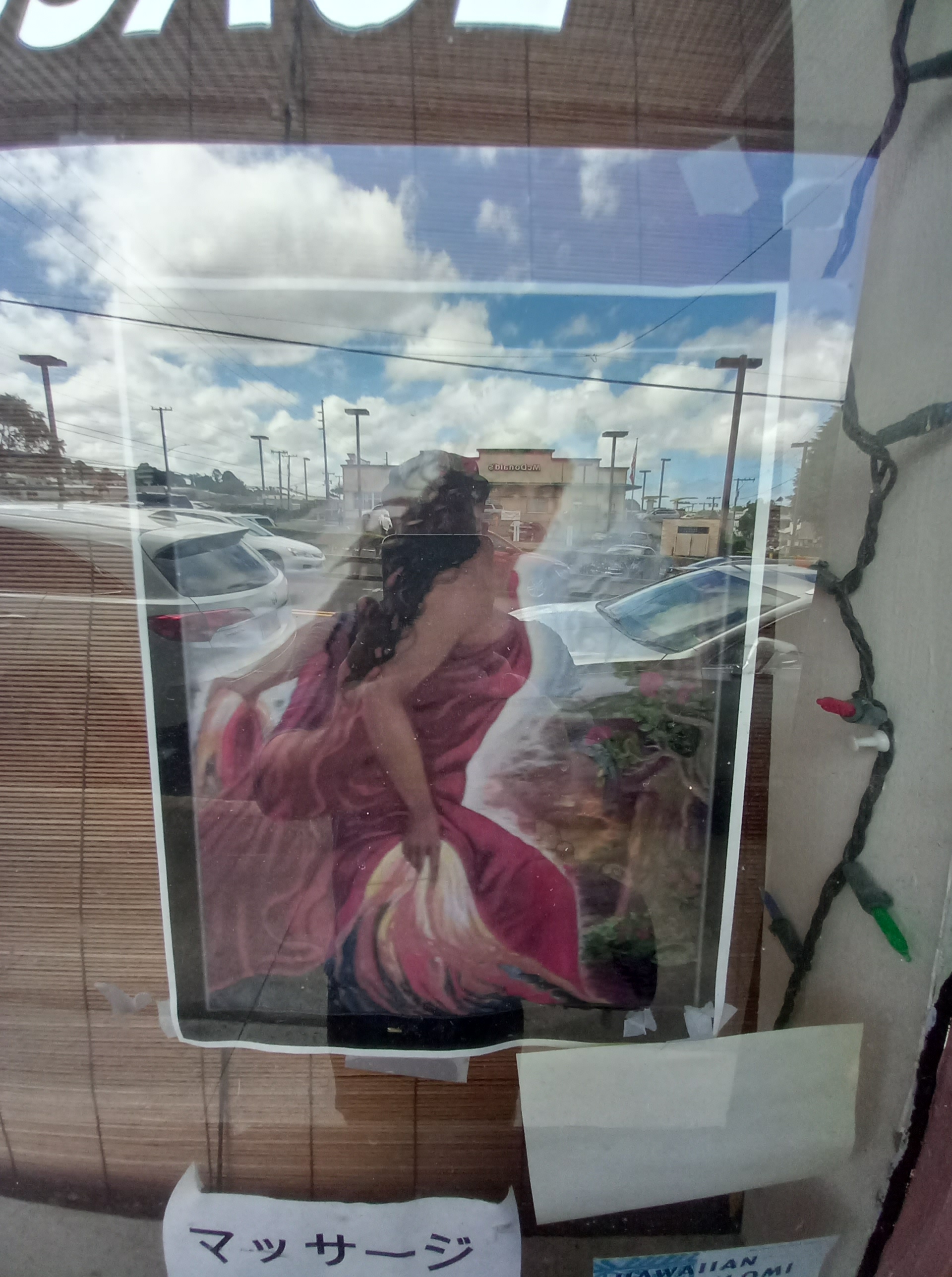
When the bus arrived, there were only a few of us on it.  It traveled through downtown and passed a business district, with a Walmart and Target, that could’ve been anywhere in America, before traveling up into tropical rainforest that was singular.  We passed the Volcano Village and then reached the front gate of the park, where I was able to use a National Park Pass to get in.  It had been a good investment.   Outside of the Visitor Center there was a painting of Pele in a flowing red-dress, a garland of red flowers around her long, black hair, lava flowing from her fingertips.

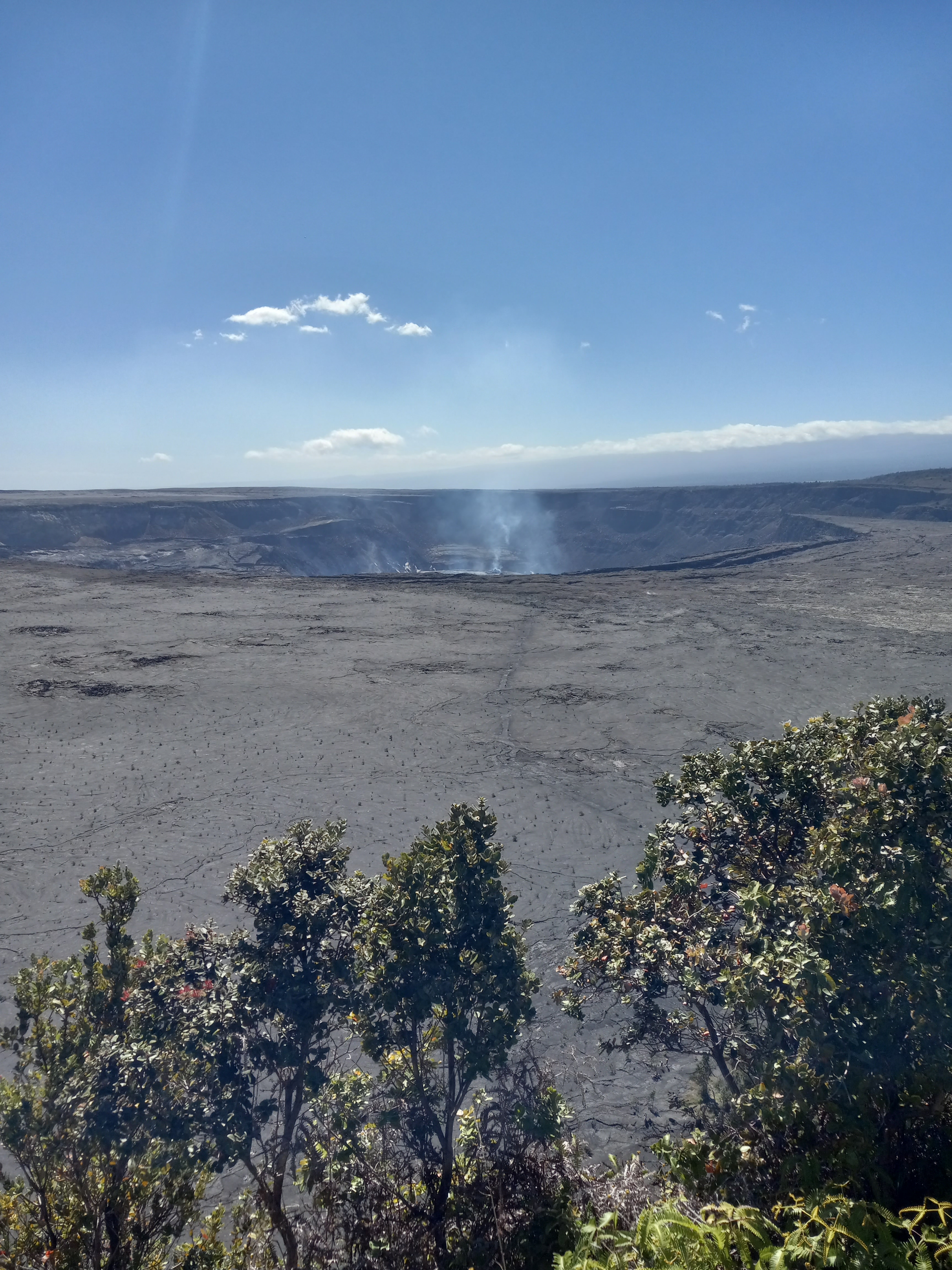
The section of the Kilauea Caldera that I chose to walk ran from the Visitor Center, behind the Lava House, and down to the Lava Tubes, a few miles each way.  There was a longer hike that took you closer to the rim, but I was worried about catching the bus back to Hilo in time.  I passed through a tunnel of ferns before reaching an overlook.  The volcano sat puffing away like the site of a recently exploded bomb, but there were no eruptions happening.  There were a lot of tourists on the trail and in the parking lots. 

When I reached the Lava Tubes, I got caught behind a family from India who were documenting every step of their journey.  What I was looking for, I didn’t know, only some kind of peace that was beyond my capacity.  Because it had been raining so much, I’d brought an umbrella along and had been carrying it under my arm the whole time.  Not only didn’t it rain, on this day the sky was nearly cloudless. On my way back to the Tourist Center, I stopped at the Lava House and bought a soda and bag of Doritos. 

Then, the bus arrived and the umbrella was nowhere in sight.  There were fifteen minutes before the bus left so I ran back to the Lava House.  The cashier remembered me with the umbrella under my arm, but it was gone, not in the gift shop, not in the bathroom, not on the ground.  It had mysteriously vanished.

As soon as we got back to town, I had the bus drop me off at Long’s Drug Store.  As far as I’m concerned, few things in life are a necessity, but to be in Hilo without an umbrella is insanity.  All they had was a little pink one, which I wasn’t crazy about, but I was going to need something.  It never rained again.

back to the jewel 27

t was my last day in Hilo.  If the hostel would’ve had a long-term room available or I met the right person, I probably would’ve stayed longer, but I was tired of sleeping in a dorm room full of snores and late-night mutterings.  Also, if I would’ve found a job it would’ve given me something to do with my time, instead of rambling endlessly from one side of the town to the next.  I still liked Hilo and would consider making a base there, but no doorways had opened on this trip.

There was one last thing I wanted to accomplish and that was to search for the Naha Stone.  The Naha Stone is a large volcanic rock that originally came from Kauai and was transported by canoe to the Big Island.  It came to symbolize a powerful clan known as the Naha.  When a boy was born, he was placed on the stone.  If he remained silent, he was accepted in the clan.  If he cried, he was tossed out. 

The legend behind the stone is that the man capable of turning it over would have the strength to unify all of the islands.  The one who came along who was finally able to do so was King Kamehameha.  It is similar to the story of King Arthur and the sword in the stone, testifying to the destiny of one ruler.

There was a guy from Oahu named Lee who was staying at the hostel.  He was visiting his daughter in Hilo and was enjoying the quiet side of Hawaii.  He considered Oahu to be a real paradise lost and spent most of his time complaining about the prices and the traffic.  On this morning he was sitting in the common area and I sat with him for a while.  We got on the subject of retirement and I told him that I had nothing, not even a plan for it.  He started questioning me to the point where I got anxious and upset.  I went and grabbed my ukelele and headed for the sea wall.

There were no bright songs bubbling up in me now.  I faced the gray waves in a panic and tried to exorcise the anxiety from my system.  The ukelele had never sounded like this before, a charging war canoe.  What comes before creation is destruction.  I had to break away from everything that had come before.  Hawaii was never going to be the innocent place that I left behind in my childhood.  It had never been an innocent place.  That had been a portion of my youth and inexperience.  I needed to let the idyllic memories go and stand strong in the here and now.  The journey is like a dream.  You might wake up one day and find it means nothing at all.

It wasn’t far to get to the Naha Stone.  In fact, it was sitting right in front of the Hilo Library, only a few blocks from the hostel.  I didn’t even know I’d found it when I got there, as it was lying on its side and resembled a bench.  Who could lift a stone like that?  I was struggling just to lift the weight of the past.  Is there anyone who could unify Hawaii anymore.  Most of the leaders in the country were specializing in division.  If you don’t create fair conditions for people, you are never going to arrive at a happy family.

I considered walking up to Rainbow Falls one last time, but only made it as far as Kozmic Cones across the street.  For most of the trip I’d been living on spam musubi, which is spam on top of a square of rice, and could be bought for a few dollars at most gas stations and convenience stores.  I decided to indulge and get a hamburger combo.  The dining area was closed, however.  I took my food and sat on a post beside the road.  There was so much panic in my throat it was hard to swallow.

Walking back towards the hostel, I saw that a few homeless people had broken into an abandoned restaurant and were squatting on the floor, amidst the rubbish and broken glass.  When I got to Kalakaua Park, a lost tribe of them were spread out on the grass, beneath the ceremonial banyan tree and statue of King David Kalakaua.  It appeared to me that a plague had fallen on the land.  The choice was to either get tough or get out.  I was running out of places to hide.