riding the rails 5

Sometime during the middle of the night, not long after passing through Needles, the train stopped dead on the tracks and just sat there for a long time.  I knew they had to yield the tracks to freight trains from time to time, and hoped that it was that and not a mechanical issue.  Behind me a Mexican with a baseball hat was leaning back in his seat with his mouth wide open, snoring as if he’d swallowed a rattlesnake and was trying to choke it back up.  Behind him the guy who’d been on the phone all night, talking to women from foreign countries, promising to send them money, took the opportunity to call another one.

Habibi, I heard him greet her.  You know I’m not wealthy.  Rich.  I’m not rich.  But I will send you something.  I also heard him complain about the guy, right behind him, who couldn’t keep his mouth shut and had been pacing the aisles all night.  It’s the drugs, I heard him explain to her.  In America we’ve got a lot of people hooked on drugs.

Once we got underway again, I bent over and tried to sleep.  I’d pulled out the leg rests on both of the seats and could just cram into a horizontal position with my knees drawn up against my chest and a thin sweatshirt between my head and the headrest.  The train managed to rock me to sleep, over and over again, but I kept waking up in fear.  Why had I lived this long?  I’d missed my chance to go out with any dignity fifteen years earlier, when I’d still been in Los Angeles, wrapping up my final record.  Since then, I’d wandered the world like a hungry ghost, inventing new ways to suffer. 

The guy two seats back got on the phone with another woman.  How’s my little monkey, I heard him ask.

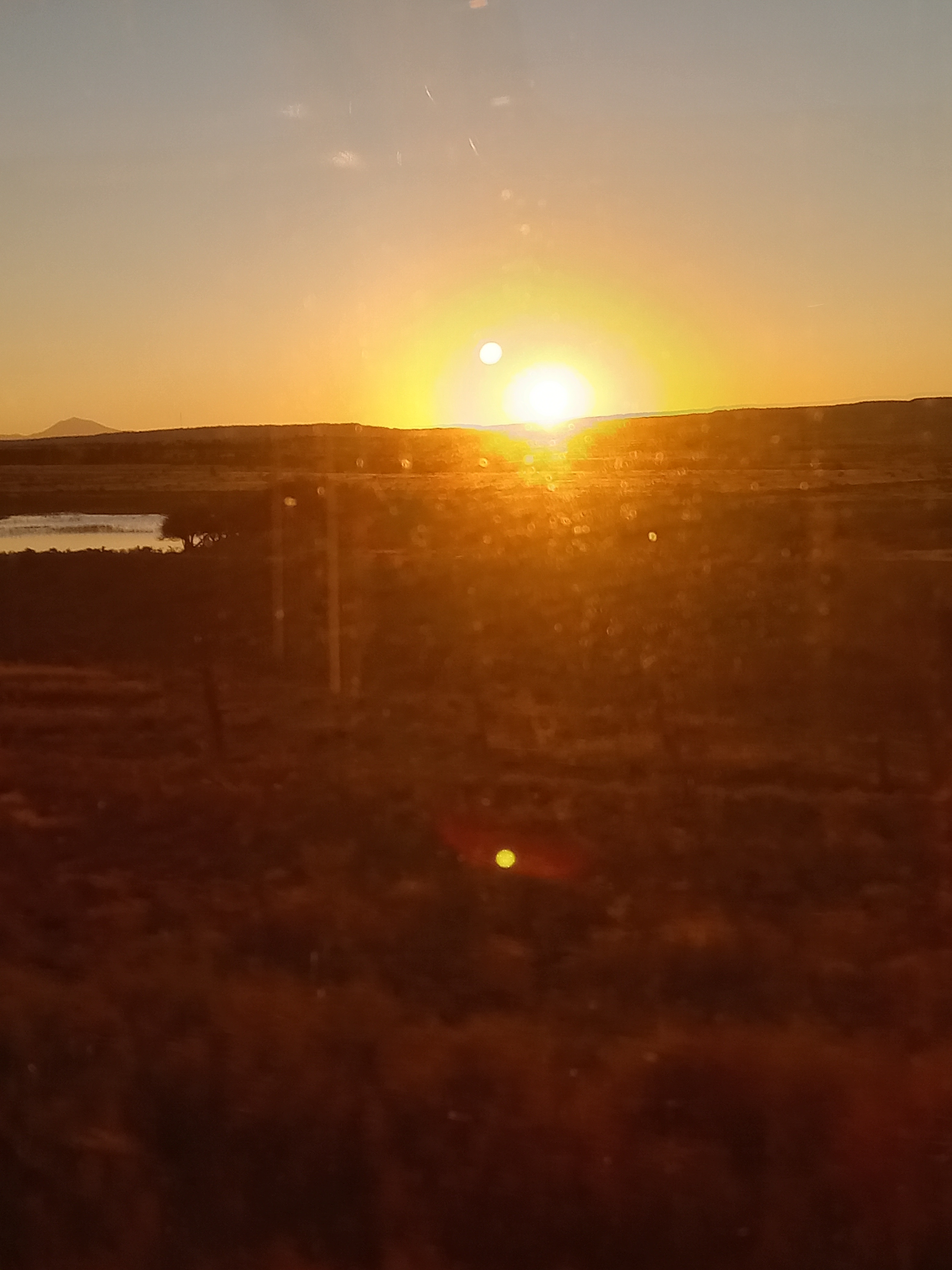
I passed out and woke up to a pink and purple sky.  The sun was beginning to rise over the desert.  A yellow crown appeared and was reflected in a narrow stretch of water that had gathered beside the tracks.  In the distance, beyond the scrub brush, were a series of flat-top mountains.  By now we’d already passed Flagstaff.

Around eight, I went to get a cup of coffee at the café and sat drinking it in the observation car as we pulled into Gallup, New Mexico.  I’d been through Gallup the year before and recognized some of the Zuni trading posts.  Waiting to board the train was a young guy in a blue suit jacket and black sunglasses, looking like he was on his way to audition for a Blues Brothers cover band.  The train was heading to Chicago, after all.  When I went to my seat to grab my charger, I saw he’d been given the seat next to mine.

Back in the observation car, I noticed another musical type, now sitting at the far end with a guitar on his lap.  As we pulled out of the station, he began to serenade us with fingerpicking music that was the perfect soundtrack for a journey across the high plain.  When he took a break, I complimented him and found out that he was a songwriter from Pasadena on his way to try his luck in New York.  We talked about the music scene in Los Angeles and how difficult it is to gather any momentum.  It used to be that there were very few entertainment options available and a huge audience for them.  Nowadays, with the internet, social media, and streaming, there is endless content and if an audience exists at all, it is one with a diminished attention span.  Mark, as he introduced himself, was hoping to make a record anyway.

Just then there was a call for emergency services from the dining car.  They were looking for a doctor or nurse, anyone with a medical background.  A few minutes later, young homey emerged, trailed by a concerned crew member.  Apparently, he could speak coherently when required to, and was insisting that he was all right.  My hope was that they’d kick him off the train before long.  We still had over thirty hours before we got to Chicago.

At a nearby table there was another guy who might require an intervention at some point, already starting in on his third whiskey coke of the morning.  He’d intruded on a couple, the guy in a paisley sweatshirt, the woman tattooed and looking recently beat up.  He was angry about the no smoking policy.  What he really wanted to do was get high and wondered if he could smoke his vape in the bathroom.

It was time to try to book my next leg of the trip.  I’d studied all the schedules and what seemed to make sense was to head to Miami straight away, as it was the one place I really wanted to see.  Years earlier, I’d traveled from Miami to Washington DC on the Silver Star, but didn’t recall much, since my condition at the time had been close to that of the guy looking to get high in the bathroom.  Florida seemed like the most exotic place I could get to on the train, something different.  All the other places, I’d been to many times before.

With a Rail Pass, all you need to reserve the next section of your trip is call 1 800 USA RAIL.  As soon as I was able to interject myself into the menu, I asked to speak to a representative.  After ten minutes on hold, I got to talk to a real, live person.  She was able to get me on the Capitol Limited the day after my arrival, with a direct connection to Miami from DC.  I’d have to spend one night in Chicago.  The next step then, was to find a hostel.  Looking on Hostelworld, I found one a mile from the station that would work.  It was forty dollars for a shared room with six bunks in it.

Now that I had the next few days straightened out, it felt like a could relax a little and enjoy the view.  The range outside the window looked like one a cowboy would go galloping across in a Western.  There were herds of cattle grazing on the bleached grass.   Mark sat at the end of the observation car playing a plaintive ballad that sounded like something Sergio Leone would’ve come up with.  When I asked him about it, he admitted it was a song by Madonna he’d been trying to learn.  I never would’ve guessed.
riding the rails 6

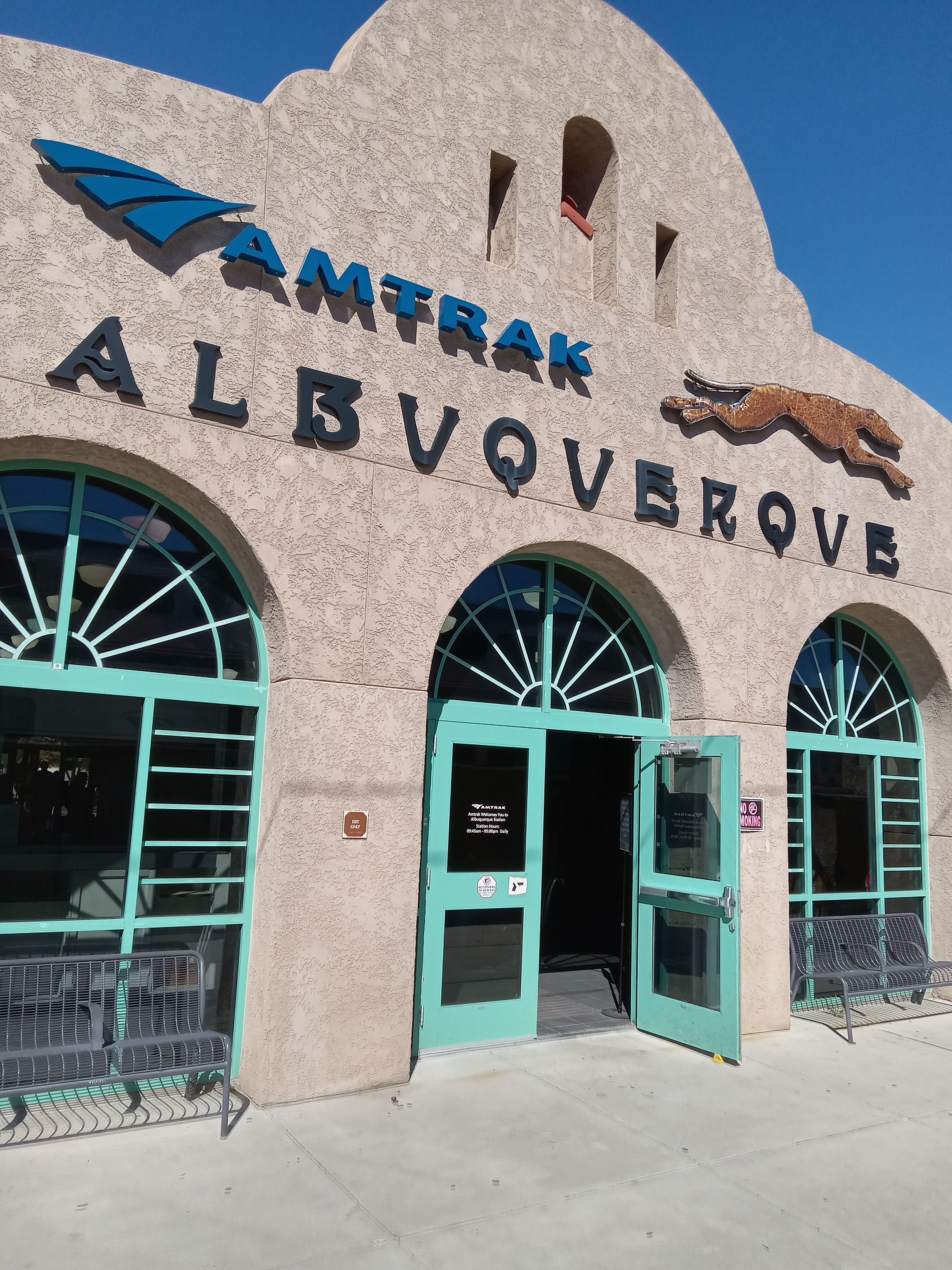
There was an hour layover in Albuquerque and the guy in the café was suggesting that everyone hit up a market right outside the terminal if they wanted to save some money on lunch.  Maybe he was running low on turkey and cheddar sandwiches.  A few Native women had tables set up on the platform and were selling blankets, jewelry, and baskets.  I made my way through the station and over to the market where the special of the day in the deli section was the Frito Bowl, basically a bowl of chili and a bag of Fritos, not bad but why not just call it chili.  I bought an Arizona Iced Tea to drink and went down to sit down and eat on a wall outside the terminal. 

On a bench, not far away, I saw my seatmate, the Blues Brother, who I hadn’t gotten a chance to talk to yet, looking like he was waiting on a special assignment.  After about fifteen minutes an old man pulled up and he walked over and got into the car with him.  Apparently, his mission had either been aborted or completed and he was going home with his dad. 

Back on the train, I returned to the observation car.  The guy who’d gotten an early start on the whiskey cokes, who was wearing a Thug for Life T-shirt, was sitting at a table with the guy in the paisley sweatshirt, jamming his jam real loud for everyone to hear.  At a table next to them sat four Amish folks sat playing cards, looking like they could’ve just arrived on the Mayflower, so out of touch with modern times had they remained.  At first one of them appeared to be giving Thug for Life the evil eye, until I walked past and realized there was no eyeball in the socket.

After a short stop in Lamy, we passed through pine mountains before reaching Las Vegas, New Mexico.  From there, it was largely blue skies and yellow plains.  Small groupings of pronghorn antelopes stood in the grass and watched the train pass.  Beneath a distant windmill, a herd of cattle grazed contentedly, no thought of the past or future, suspended in the eternal now.  A river flowed beside the tracks.  Yellow wildflowers appeared in thick bunches.

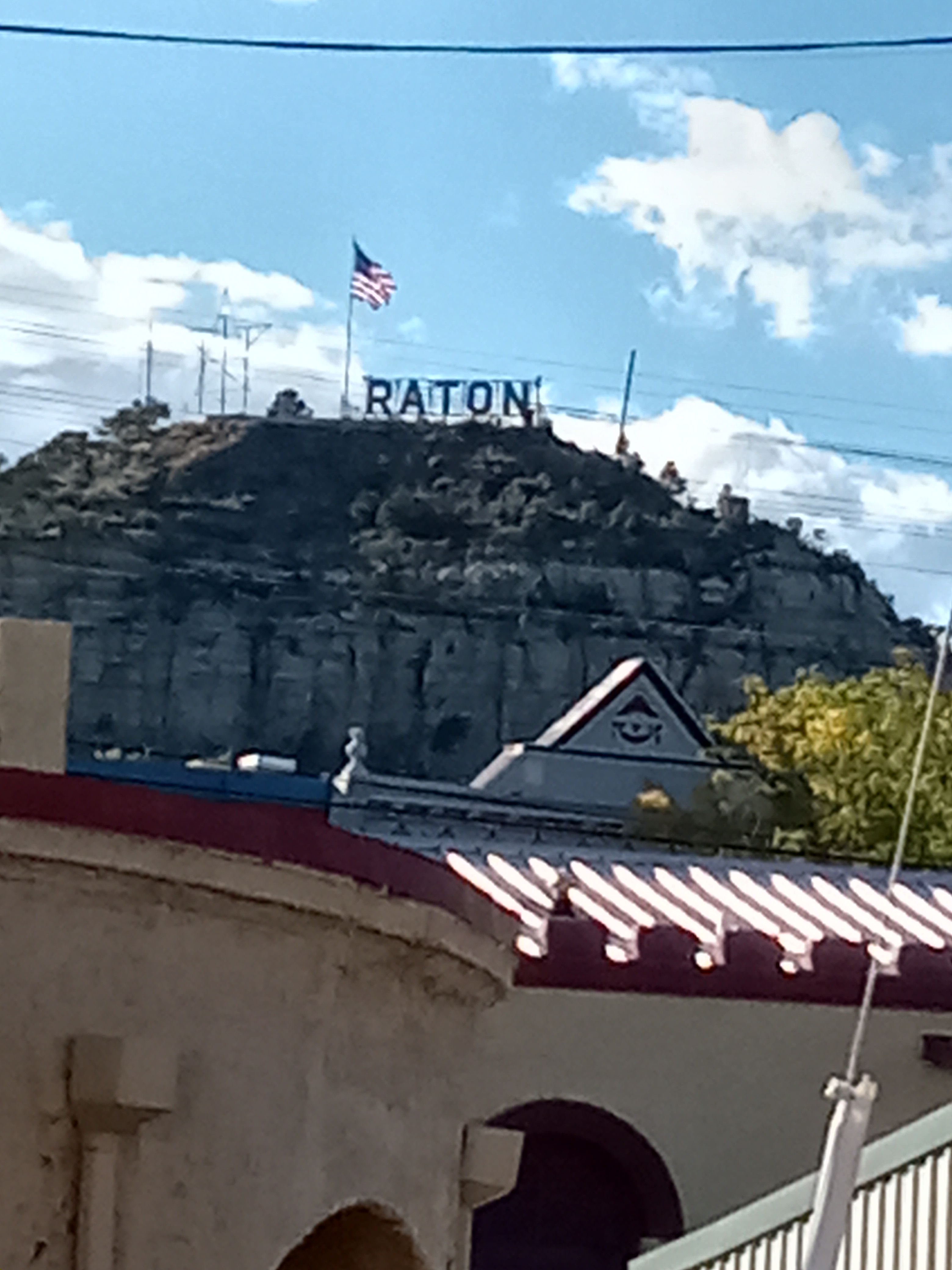
Around 4:30 we pulled into Raton and were given a ten-minute smoke break.  I’d been through Raton on the train before but only remembered it because Townes Van Zandt had written a song about it snowing there.  Townes was a songwriter who’d had a big impact on me as a young guy, and I’d done my best to become the kind of traveling troubadour he’d been, going so far as to emulate all the self-destructive habits that destroyed him by his early fifties.  What I’d discovered about tortured artists is that their suffering can seem romantic from afar.  When it happens to you, however, there’s absolutely nothing to recommend it and you can be sure there’s no one standing around applauding.  I still love Townes Van Zandt, but realize now that it’s too late that I should’ve chosen my role models more carefully.

Just outside of Trinidad, as we were beginning to enter a mountainous, forested region, the conductor announced that he’d seen a lot of black bear activity in the area lately, and that if we kept our eyes open, we might get lucky and spot one.  I sat at the window scanning the hillside intently, but saw no bears, only a lone bull elk with an enormous rack, bugling with its head tilted back. 

I got a cheeseburger and coke in the café and returned upstairs to look for more wildlife.  Deer and antelope were everywhere, and it struck me that this was the proverbial home on the range.  There were no buffalo roaming, but all the other elements were in place.  It was the very opposite of the downtown Los Angeles scene I’d just left, and what you might call home on the street – tents on sidewalks and under freeways, toxic rivers, rats, and cockroaches – the place that had driven me out of my mind and onto the road, with no end in sight. 

Just then, young homey appeared over my shoulder.  He pointed to the seat next to me and picked up an ipad, asking if it was mine.  When I shook my head no, he went looking for the conductor so he could turn it in.  It wasn’t what I expected from him.  He wasn’t that bad, just crazy.  If that were a crime, most of us would be locked up for life.

The sun had already set by the time we pulled into La Junta, Colorado.  Three women who were traveling together took the seats behind me.  The one who was right behind me had a mask on and was sniffling and wheezing from the get go.  It was around then that I looked on my phone and saw a news report about a hurricane that was forming in the Caribbean and making its way towards Cuba.  They were predicting that it would continue to gather strength and hit Florida the exact day that I was scheduled to arrive. 

We made our way across southern Colorado and the sound of the train whistle felt like that of my own pain and disappointment, pouring out of my open mouth and bellowing into eternity.  What were the chances of a hurricane striking Florida on the one day I was going to be traveling through?   If I could ride the train straight into the hurricane and get ripped off the tracks and blown into smithereens, I gladly would have, but that’s not how it would go down.  Instead, I’d get to DC, find out the Silver Star line had been suspended, and then be stranded there too late in the day to come up with a backup plan.

Eventually, I slumped over and got back into my sleeping position, bunched up on the two seats, with my knees tucked into my chest.  In the middle of the night, I woke up and my throat felt itchy.  I thought of the woman behind me who’d been sneezing and blowing her nose all night, and couldn’t even go there.  To get sick right now, probably with COVID, would make this the most ridiculously bad trip I’d ever been on, at a time in my life when I could least afford to take it.  The train whistle kept blowing and blowing, almost like it was sobbing, and the darkness at the window seemed like it would never dissipate.

riding the rails 7

One of the most enduring images to come out of the Great Depression is that of the hobo hopping a freight train to get from one end of the country to the other.  Even though many of those who did so had been driven to it by economic desperation, for many young travelers the idea of hopping a train remains the ultimate symbol of breaking free.  I doubt they’d much enjoy it. 

For one, back during the Depression there was a sense of solidarity between the dispossessed that is sorely lacking now.  Two, the men and women riding those trains were often heading towards the promise of employment, so there was some measure of hope in their hard travels.  Where can you hop off a train and find opportunity now?  Nowhere.  Third, they were doing it out of necessity, not as an adventurous stunt.  Jump on a train and cling to it all night long, only to be arrested in the morning.  It might make for a good story, but is no way to live.

All night long I tossed and turned, groaning aloud every time I thought about the hurricane heading for Florida.  We approached Kansas City right as the sun was rising, but only had a few minutes to stretch our legs on the platform once we arrived.  The women behind me were getting off there.  By now I’d determined that I wasn’t sick, sick with depression, yes, but not sick with a cold or COVID, at least not yet.

A whole bunch of riders were getting on in Kansas City.  From here on out the train would be full all the way to Chicago.  A family coming from a wedding occupied the seats all around me, and the adult son who was taking charge of everyone’s seat assignments and luggage sat down next to me.  We rode for twenty minutes without talking, but when I asked to get by him to get to the café car, he was extremely courteous, almost leaping up to let me pass.

In the observation car, with a cup of coffee in my hand, I looked out at the passing farmland, the cornfields, barns, and grain silos, that were familiar to me, having spent most of my upbringing in the Midwest.  The way the sun was splashing through the window led me to try meditating, thinking it might have a calming effect on the anxiety that was surging through me.  Instead, the yellow light just flashed across my eyelids, and I could almost sense the size and shape of objects the train was passing, as if by radar.

The guitar player from Pasadena, Mark, sat down a few seats away without his guitar, complaining of the rough night he’d had.  As we passed through the small farm towns, he talked about another dream he had, that of investing in some property in the country and working the land.  Even though he didn’t strike me as the outdoorsy type, that seemed more reasonable than spending all his money to make a record.  If I’d done the same at least I’d have a place to live, as opposed to boxes of unsold CDs that had just ended up in a landfill.

Back in my seat, I got to talking to the guy who was coming from the wedding with his family.  Turns out he actually worked for Amtrak as a mechanic.  Both of us had noticed that the conductor who’d gotten on the train in Kansas City had started off that morning with a full British accent, but that it was gradually slipping away as the day wore on.  By the time he got to us to ask us for our tickets there was no trace of it.  The mechanic confirmed it, saying yep, he’s a Chicago guy.  My thought was that if he wasn’t auditioning for a part in Murder on the Orient Express at his local repertory theater then what was up with that?

When we reached Fort Madison, Iowa, we passed a replica of the fort that was one of the first established in the Upper Mississippi, and later abandoned and burned to the ground by the troops after a siege by the Sauk Indian leader, Black Hawk, during the War of 1812.  It was here we crossed the Mississippi River and reached Illinois on the opposite banks.

A few hours later, the conductor, his British accent now only a distant memory, announced that we were arriving in Mendota, and not long after we were approaching the outskirts of Chicago.  The mechanic sitting next to me pointed out the neighborhood where he grew up, the street where he went to high school, and even the garage where he worked, once we got into the railyards.  The skyline was one I knew well, made prominent by the Sears Tower, which for a while was the tallest building in the world, and now, according to the mechanic is known as the Willis Tower.

At Union Station, we pulled into the subterranean platform area and the Southwest Chief came to a quiet halt.  The first leg of my journey was up, and what lay ahead looked to be chaos, thanks to a hurricane that had formed in the Caribbean and was making its way towards my next destination, which was supposed to be Miami.  At least I’d booked a place to stay for the night.  When I got there, I’d try to figure out what to do next.  There are always options, even if you don’t like any of them.  Sometimes you need to decide what the least terrible thing is and just go for that.

riding the rails 8

Chicago is the hub of the Amtrak network, so if you can’t find a long-haul train leaving from there on short notice, you probably can’t find one anywhere.  As I dragged my suitcase towards the Great Hall, passing the various gates with their prerecorded arrival and departure times all playing at the same time, like an unsynchronized symphony of androids, my sense of dislocation was only heightened.  It was hard to know which street to exit to in order to reach the hostel I’d booked the day before.  Climbing up a staircase and walking out the first door I came to, I discovered that the sky was overcast and it was beginning to drizzle.

Until very recently, I’d had no experience with google maps, but by now I had a hard time living without it.  It began directing me towards my hostel, but was difficult to make out as I needed to clutch the phone to my chest in order to protect it from the cold rain.  The street it wanted to take me down was closed due to construction, so I was detoured a block north, and then over the 91 freeway.  The area I found myself in was a Greek section of town.

Check-in was fairly simple, but the room I was assigned to wouldn’t open at first.  I went back down to ask about it at the desk and was told to push harder.  When I did, I was met with a blast of hot, stale air, perhaps the same that greeted the workmen that blasted Al Capone’s vault open thirty-five years earlier during a televised special that Geraldo Rivera had hyped as equal in importance to the excavation of King Tut’s tomb.  Outside of the stale air, all they’d discovered was dirt, rubble, and two empty bottles.  The only way Geraldo could’ve justified his extravagant hoax at that point would’ve been comparing it to the American Dream, mostly hype and empty promises.

The room I was staying in had twelve beds in it.  Fortunately, there was a bottom one open.  There were also lockers available, but I’d need to provide my own lock, so I took a walk to a Walgreen’s on the corner to pick one up.  It had stopped raining, but was still cloudy and cold. After locking up my things, I walked back in the direction of Union Station and found a pizza place that was showing the Monday Night Football game between the Packers and Buccaneers, a highly anticipated match-up between Aaron Rodgers and Tom Brady, which came down to the last second and justified my buying a second piece of pizza so I could sit there until it was over.

Back at the hostel, I sat in the stuffy common area for a few hours, watching back-to-back episodes of NCIS, nothing I would’ve considered under different circumstances.  Most of the odd characters I observed charging their phones and checking their facebook accounts ended up in the same dorm room as me.  By the time I went up there at ten o’clock, half the beds were full and two guys on top bunks by the window were already snoring.  I lay down, but was never going to sleep.  The snoring was beyond intrusive.  One old guy with a white beard was lying flat on his back, like a corpse come back to life, trying to blow the lid off his coffin.  A younger, bearded apprentice in the bed next to him sounded like he was releasing the air from a whoopie cushion, one rattling blast at a time.  Between the two of them, they’d been tasked with gathering all the stagnant winds of the universe and releasing them into the already putrid air of the crypt we were in.

After a few hours I was rigid with fury.  A few times I leapt to my feet and shook their beds in frustration.  They would rearrange themselves, it would get quiet for a moment, and then as soon as I lay back down it would start up again.  One guy got up with his blanket and pillow and disappeared.  A short while later I went down to the common room and found him sprawled out on the couch.

As soon as daylight appeared at the window, a chorus of alarms began ringing like the chirping of birds.  The two snorers were the first ones up, now wanting to smile and wish everyone a good morning.  Good morning.  How did you sleep?  My anxiety was at peak levels.  I’d hadn’t slept at all and in ten hours was scheduled to be on a train heading towards Miami.  All signs now indicated that Hurricane Ian was going to be a real thing, perhaps the most destructive storm to hit Florida in years.

I knew something needed to be done, but wasn’t sure what.  I’d have to figure it out fast.  Maybe New Orleans.  That might be a good place to lay low for a few days.  Jumping out of bed, I snatched my computer and travel documents out of the locker and hurried down to the common room to see what I could do.

riding the rails 9

Hurricane Ian was bearing down on the west coast of Florida and was supposed to hit on the very day I was going to be traveling through on a train.  Although Miami was expected to be spared from the storm, the tracks pass through Tampa Bay, where sandbagging was already underway.  A number of evacuation orders had also been issued.  Although no one from Amtrak had contacted me yet, I knew the Silver Star line was going to be cancelled and had to come up with an alternative plan fast. 

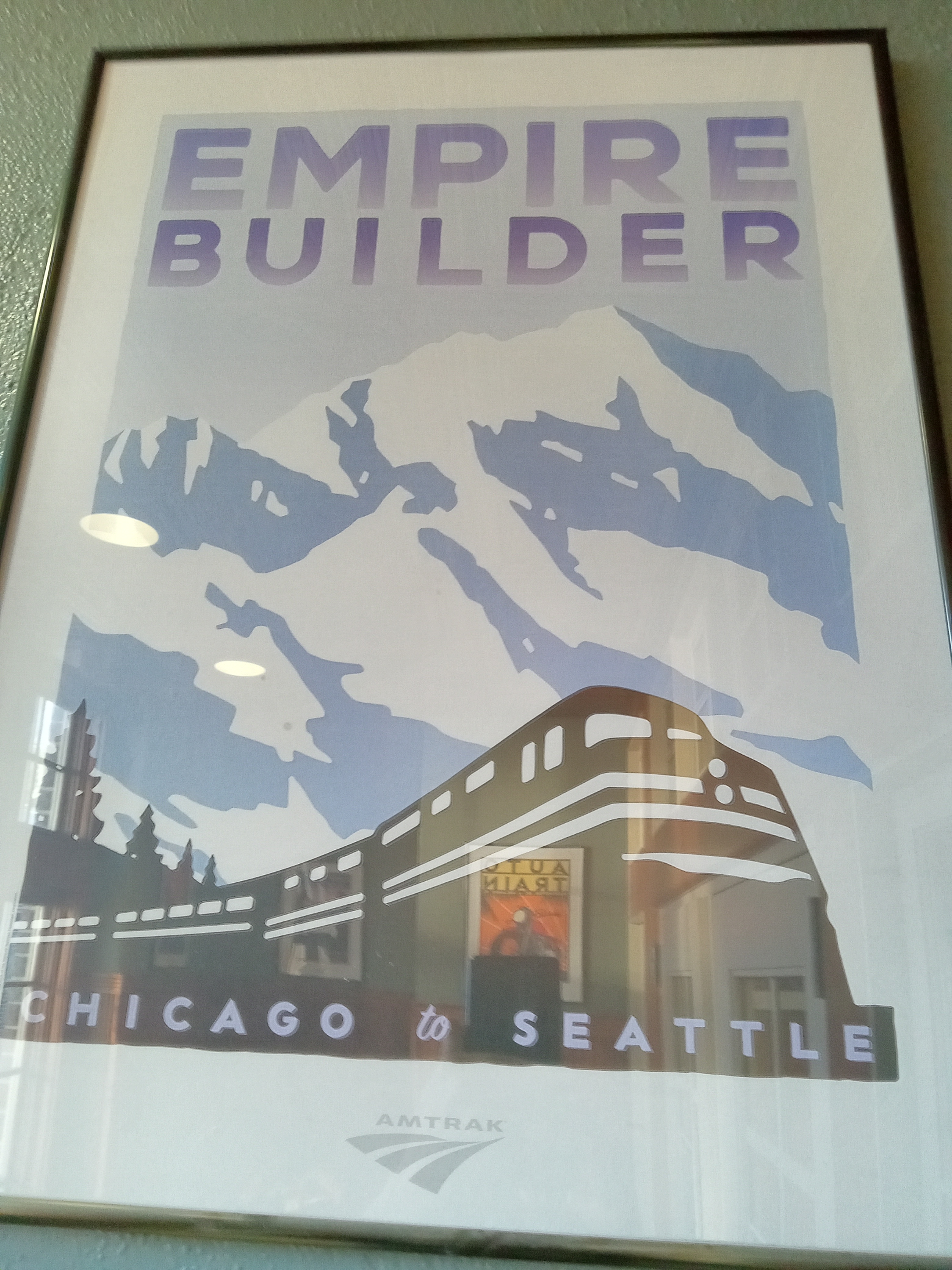
My first thought had been New Orleans, but when I contacted a representative, she informed me that the City of New Orleans was fully booked that night.  What about the Empire Builder to Seattle?  Yes.  There were some openings.  That train left at three.  That would mean I was heading straight back to the West Coast, but that was all right with me.  At least I’d have a place to stay for the next few days.  While I was at it, I went ahead and booked the Coast Starlight down to the Bay Area, the day after I arrived in Seattle, and then the California Zephyr, back to Chicago, the day after that.  What I discovered was that a lot of the trains were filling up fast.  If I wasn’t fast on my feet, I risked getting stranded.

By now, for the first time, I was getting a vision for this trip, which had originally been me just running for my life.  I’d had no intention of spending time in any of the major cities, but now that I’d been in both downtown Los Angeles and Chicago in just a few days, and was on my way towards Seattle and San Francisco, I began to see how I could get an intimate view of some of the other big cities by just showing up on the train like I was doing, and spending one night in a hostel.  If I could also hit up New Orleans, New York City, Washington, DC, and eventually Miami, that would be a lot for a little.  Could it be done?  I didn’t see why not.  Would it be comfortable or fun?  Did it matter?

About fifteen minutes before checkout, I decided to jump in the shower, then hurried to get dressed, pack, and drag my bags down to the front desk on time.  I knew that the hostel was in no way responsible for all the snoring that had gone on the night before, but was grieved when they asked me to pay to store my bags for a few hours, and almost brought it up.  There wasn’t much I planned on doing, now that my train left at three, rather than six.  I figured I’d just walk down to Lake Michigan and back.

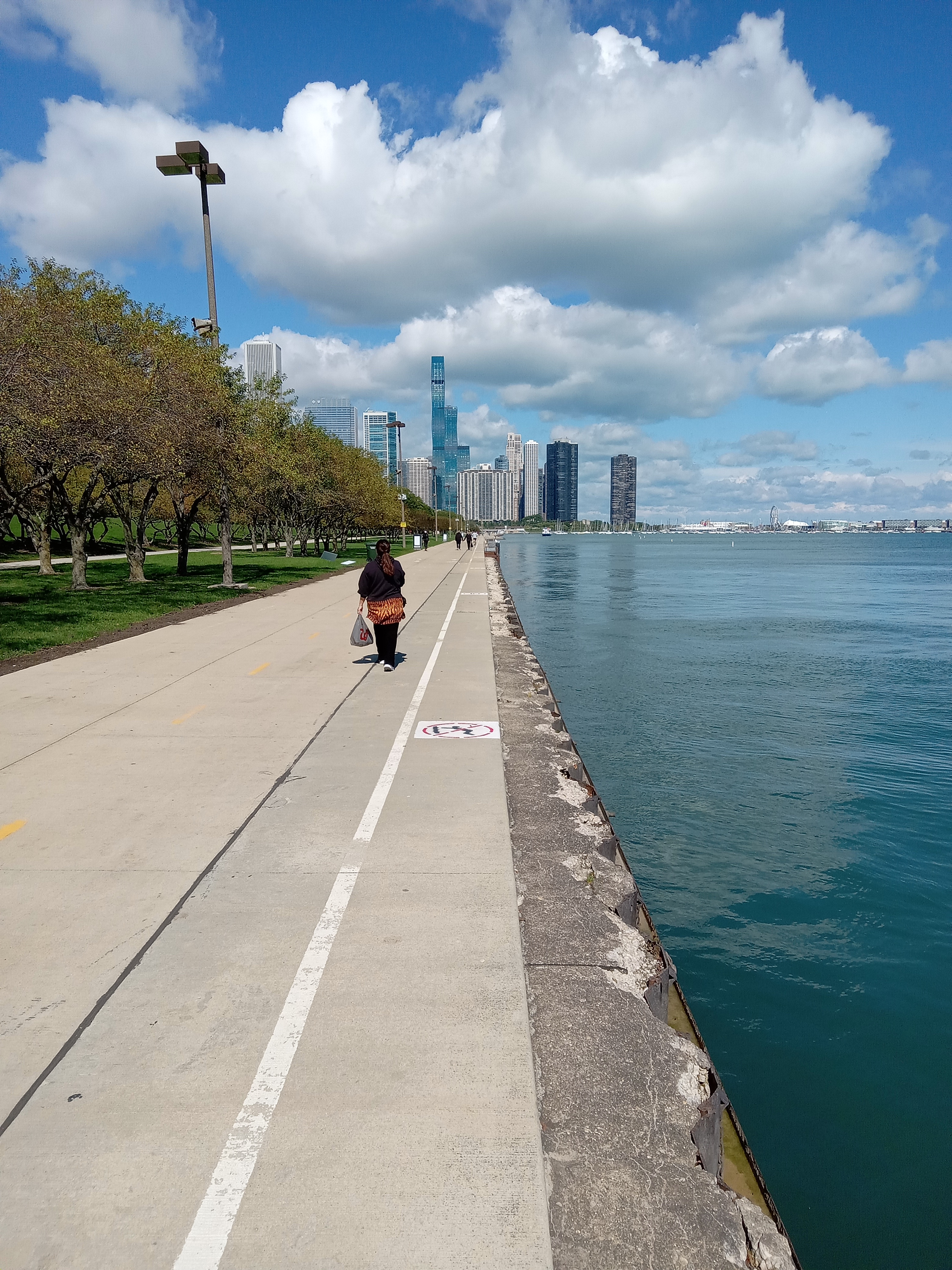
Because of the construction they were doing, I went down to Van Buren Street and headed east, crossing the Chicago River, and then continuing all the way to Grant Park.  Once there I walked towards the two large Indians on horseback that act as sentries to the park, and made my way to Buckingham Fountain.  It was a warm, sunny day, but I wasn’t there for leisure.

I walked as far north as the aquarium, then turned around and followed the trail that ran along the shoreline of the lake back to Jackson Drive.  My feet were badly hurting, but that came as no surprise.  Something was always hurting these days.  If it wasn’t my feet, it was my back.  If it wasn’t my back, then recently it had been my tailbone.  In fact, just before leaving on my trip I’d gone to have my tailbone X-rayed.  The discomfort it was causing me I could live with, but my concern was that there might be something more sinister going on, like a tumor.  I was supposed to be getting a call from the doctor that very afternoon and was hoping that my phone wouldn’t fail me.  It had already cut out a few times on the ride from Los Angeles.  Now would not be a good time to have that happen.

Walking back towards Union Station, in between the enormous skyscrapers that lined both sides of the street, I felt pitifully small and alone, and what struck me about them was that they were designed for gods or supermen to live in, not ordinary people who need to be close to the earth and part of a community.  There were a few homeless people scattered around, in doorways and alleys, but nothing like what I’d just witnessed in Los Angeles.  Perhaps they were being contained in a different section of town.  The winters are brutally cold in Chicago, and I would’ve hated to even be walking down the streets in a few months, let alone living on them.

By the time I’d retrieved my bags and walked over to Union Station, I was dead on my feet.  Passengers were already starting to line up at gate B-19, so I went over and joined them, not wanting to be one of the last ones to board and chance ending up with an aisle seat.  There were a big group of Amish folks ahead of me, and when I got on my car three of the men, in their blue shirts and black vests, had gotten seats close to the door.  There was a garbage can blocking off most of the seats in back and I sat down in front of it.  A few minutes later, the attendant came onboard and angrily accused someone of moving the garbage can.  What could I say?  It wasn’t me.  She still made me move to the front of the coach.

Across from me, some long, tall dude was already stretching out, spreading his limbs and his belongings all over both seats.  If anyone needed a seat, he looked like the last person on earth they’d want to ask to slide over.  He had his phone on speaker phone and was conducting business on it as if he were in his own living room at home.  The tag above his seat showed him going all the way to Seattle, and that pissed me off.  I was already full of resentment and we hadn’t even left the station yet.

We were just pulling out of Chicago when my phone rang and I rushed to answer it.  It was a doctor from the clinic in California, calling with the results of my recent X-rays.  Yes.  The X-rays showed that I had fractured my coccyx, or tailbone.  They also revealed osteoarthritis in one of my hips.  Well, that explained things.  Good thing I was going to be sitting on hard seats and sleeping crunched up in a little ball for the next two or three weeks.  I didn’t ask the doctor what he thought about that plan.

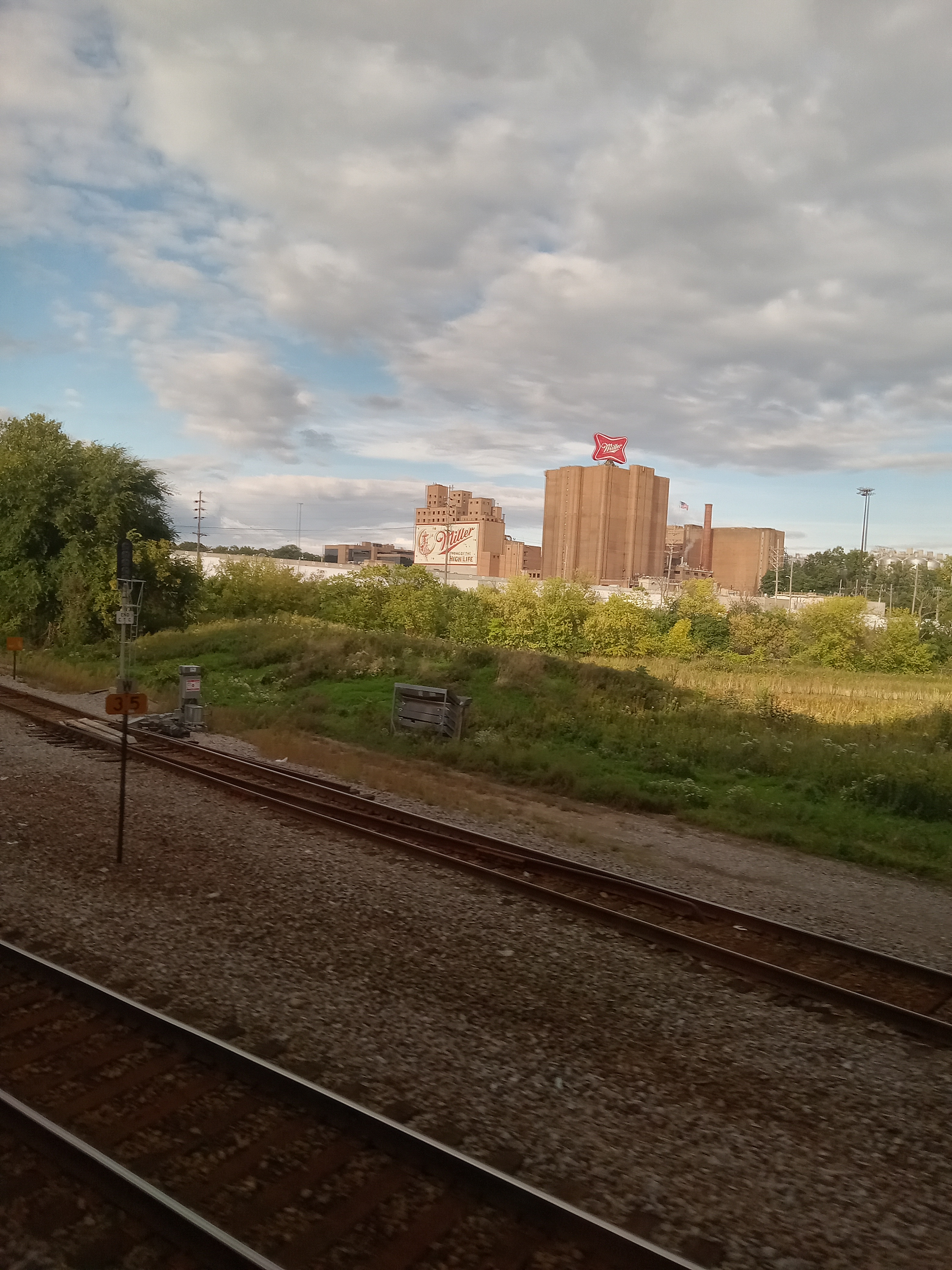
After an hour and a half, we reached Milwaukee, the ultimate beer town, and passed the Miller Brewery, home of the High Life.  On the side of the brewery facing the tracks was a picture of a girl sitting on a crescent moon, raising a toast to the stars.

The train next passed through Columbus and Portage, reaching the Wisconsin Dells around sunset.  The Dells is one of the biggest tourist attractions in the Midwest, as famous for its theme parks as for the dells, which are the unique rock slabs that line the gorge.  Entertainment options include water slides, zip lines, go karts, rollercoasters, and duck boats, amphibious tour buses, capable of floating down river, like something out of a James Bond movie.  Only one side of the train had a view of the dells, while the other one faced the station.  Everyone on the wrong side of the observation car jumped over to try to take pictures, but it was late, and the light had largely faded. 

At a stop in Winona, I got out and talked to the attendant for a few minutes.  She hadn’t come out and accused me of moving the garbage can that had been set in the aisle to reserve seats before we left Chicago, but that had been her implication.  No worries.  It was cold, way too cold for the middle of September, but welcome to life in the Midwest.  Having done most of my schooling there, I wasn’t judging it, but if I do have one claim to fame it’s that I haven’t endured a winter now, going on twenty-seven years.  The attendant told me her son felt the same way.  He’d escaped to California and swore he’d never return, even though the high cost of living there was giving him troubles he’d never dreamed of.  Are things tough all over?  It would be safe to say so.  Are some places worse than others?  Pick your poison.

riding the rails 10

The Empire Builder goes all the way back to 1929, when it was owned and operated by the Great Northern Railway, and later the Burlington Northern Railroad.  It runs from Chicago and then splits in two at Spokane, continuing on to either Seattle or Portland.  Much of the route parallels the Canadian border. 

I’d taken the Empire Builder once before and will never forget it.  We were crossing from Minnesota to North Dakota, out in the wide-open country, and you could see a dust cloud being tossed up on a dirt road as a guy in a pickup truck tried to beat the train across the tracks.  He failed and struck the rear of the engine, disconnecting it and sending it flying down the line solo while the rest of us shuddered to a halt.  It took them seven or eight hours to remedy the situation, and in the meantime no air was circulating and the toilets wouldn’t flush.  Not long after we got moving again, the train once again came to a sudden halt and a crew change took place, way out in the middle of nowhere.  To compensate us for the inconvenience we were all given a six-inch Subway sandwich, a bag of chips, and a soda.

No mishap of that magnitude had occurred on this morning, but the long, tall dude next to me was back on his phone, almost shouting into it from two feet away as he sprawled across both seats.  He didn’t care that everyone could hear his conversation.  No one else existed, as far as he was concerned, even the other person on the phone, who was just a sounding board for his ego.  I had to look around for hidden cameras.  Maybe he was the star of some reality show I didn’t know about.

Now that I’d talked to the doctor and found out that my tailbone was fractured, it did seem to hurt more.  The arthritis in the hip too.  I got up, almost limping, and headed to the café car to get a cup of coffee.  We were passing by Devil’s Lake, an intriguing name which I discovered to be a flimsy translation of a Native American name, which referred to the high salinity of the water and the bad spirits they blamed for it.

The observation car was full of Amish people.  The reason so many of them take the train is that they are not allowed to drive cars, and when forced to travel are required to take the lowest form of transportation. The men were wearing black coats, pants, and boots.  Some wore felt hats while others donned straw ones.  Those who could grow facial hair had beards, but no moustaches.  Their hair looked like the bangs had been cut straight across with a pair of hedge clippers.  The women wore dark dresses, and their bonnets were either black or white.  Sitting in a car full of them made me feel like I’d traveled back in time four hundred years and was in the hull of a wooden ship, sailing across the Atlantic in search of religious freedom.

We had a half-hour layover in Minot and I approached one of the younger Amish men, who was smoking a hand-rolled cigarette and had a sly grin on his face.  I asked if he was Amish and he admitted he was, but didn’t elaborate.  I then wandered from one end of the train to the other, loitering at the edge of Amish conversations, unable to understand one word of the Old-World language they were speaking.

Once we got back on the train it occurred to me that I better track down hostels in Seattle and San Franciso, and was glad I did because there were only a few spaces available.  My first choice in Seattle ended up being sold-out so I went with the Green Tortoise Hostel near Pike Street.  In San Francisco, I booked a bed in a place that said it was also the San Francico Music Hall of Fame.  It was a good thing I made the reservations when I did, because shortly thereafter my phone service dropped off and from then on only worked intermittently until we were just outside Seattle.

There was an old couple I’d seen earlier.  The man had been wearing a Dodgers hat and I’d commented on the team.  Now he was sitting beside me in the observation car, without the hat, but with a head full of memories about his life in the world of baseball, first as a player, then as a coach. He talked about Satchel Paige and Jackie Robinson being some of the first black players in the league, and how Ronnie Lott, who later played football for the 49ers, had been one of the most talented athletes he’d ever had the pleasure of coaching.  His memories were all over the place, something he apologized for, but I had nowhere to go.  He recalled an incident from his wild youth where he’d gone to a bar to hear some music with some buddies, and on a dare at intermission had hidden the accordion player’s accordion.  He wouldn’t do the same thing now.  He’d given his life to Jesus after a close call he’d had a few years ago during a heart valve operation.  He might’ve talked into the night, and that would’ve been OK, if his wife hadn’t come looking for him.  They had reservations in the dining car and it was time for them to eat.

After hearing the old man talk about his satisfying career, successful kids, and how they’d just come from visiting their grandkids, I became overwhelmingly unhappy, thinking about my own life.  I returned to my seat, where the long, tall dude was calling every woman he knew and talking at length about what they could be doing better and who they shouldn’t trust anymore.  I leaned back in my seat and closed my eyes, trying to mediate my way out of a bad depression.  Instead, I was consumed by it.

Late in the afternoon, the train stopped in Havre, Montana for twenty minutes.   Two curiosities they had on display in the yard were an antique steam engine and a statue called Hands Across the Border, featuring a Canadian Mounty and US Border Patrol Agent, shaking hands over their commitment to protecting the border.  A few hours later we stopped again, this time in Shelby, and I wandered into the station and found a book of Louis L’Amour stories in a small library of free books.  Louis L’Amour is the best-selling Western novelist of all time, and the cover featured a man in classic cowboy garb, raising a pistol, and ready to defend the law, however he saw fit.

To distract my tortured mind, I began reading the book as soon as we got back on the train.  The protagonist was the classic drifter, with the mysterious past and growing reputation.  He wandered from town to town, sticking up for those who showed him kindness and gunning down those who didn’t.  He was impervious to the things that would destroy most normal men, long days in the saddle, cold nights in the canyons, rattlesnake bites, treacherous women.  It reminded me of an article I’d once read about the disparity between the myth of the drifter and the reality.  To highlight this, the photo they used beneath the headline was that of a homeless man sleeping on a bench. 

We were going to be passing Glacier National Park right after sunset, which was unfortunate timing.  There was just a little light left when we reached the East Glacier Park Station, but in the few minutes we sat there, the night fell quickly.  As we journeyed on, I could just make out the dark outline of mountains and trees, and couldn’t avoid my own reflection, lit up in the midst of them, that of a true desperado if there ever was one.  Would I shoot up a saloon or rob a stagecoach anytime soon?  Probably not.  What I was about to do with a credit card, however, wasn’t for the faint of heart.

riding the rails 11

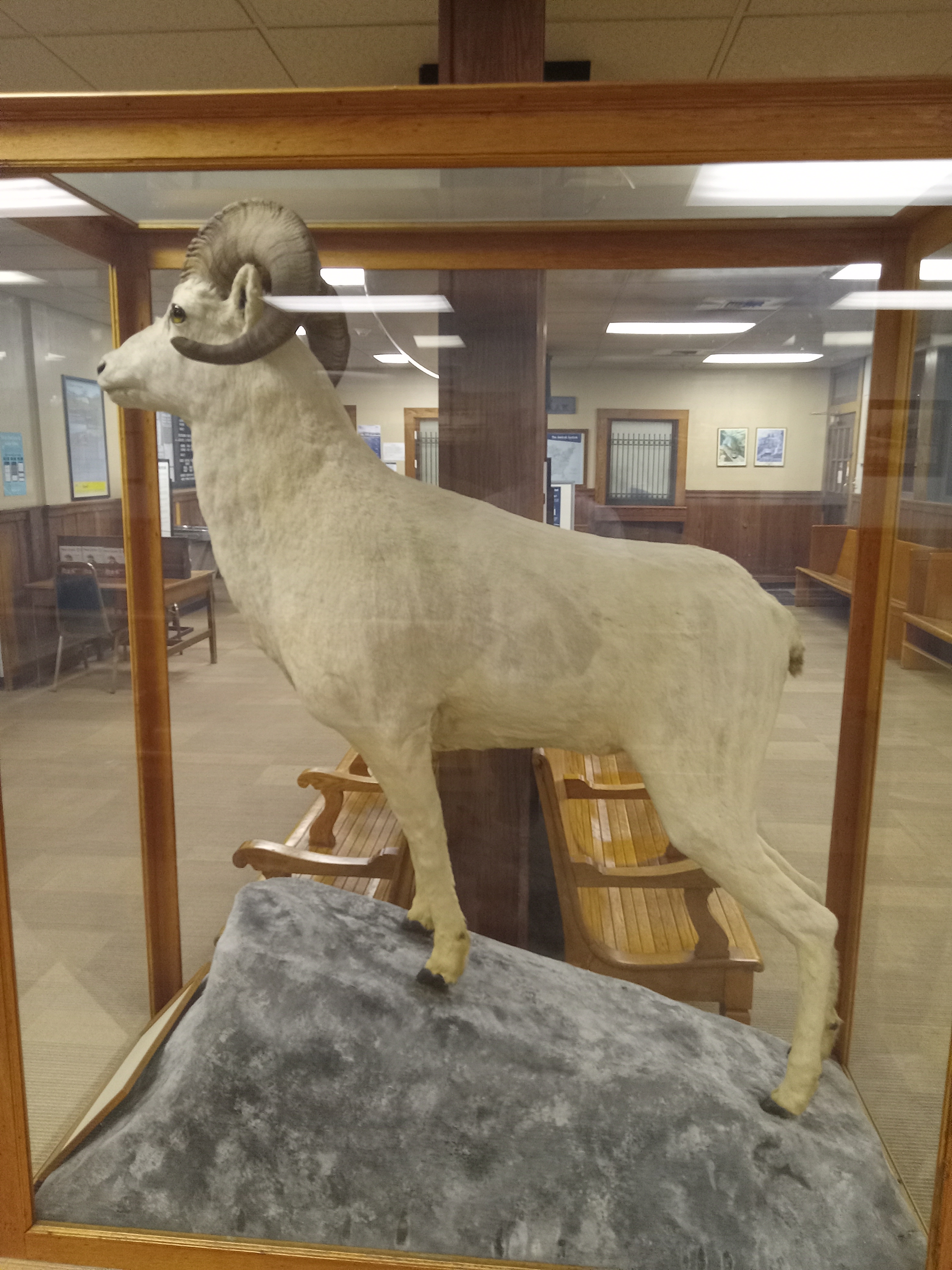
After passing through Glacier National Park in total darkness, the train I was riding on, The Empire Builder, pulled into Whitefish, Montana a little after ten.  We had fifteen minutes to stretch our legs and grab a smoke, if so inclined.  Beside the platform there was a statue of a mountain goat, and inside the station there was a stuffed bighorn sheep in a glass case.  An old upright piano sat in one corner.

Reboarding the train, I was grateful to still have two seats to myself.  The long, tall dude next to me was finally off the phone and out cold.  I lifted both leg-rests and leaned over on my side, drawing my knees up under my chin.  Right away I started to doze off, but then the train began to shake from side to side so violently that I sat up, certain I was back in California in the middle of an earthquake.

At some point I must’ve slept, because when I woke up it was light out.  The long, tall dude was back on the phone and I decided to head straight to the café to get a coffee.  The observation car, which had housed the café, was no longer there.  Now I remembered.  At Spokane the train had been split in two.  The observation car was on its way to Portland, while those of us going to Seattle had to order from the first two tables in the dining car.  I got a coffee and blueberry muffin and sat looking out the window.  It seemed like we were traveling through a haze.

Although I’d been looking forward to this section of the ride, traveling through the mountains and green forests of the Pacific Northwest, the view continued to seem hazy, and I heard someone attribute this to a string of wildfires that were burning in the area.  The pine trees were still there.  The mountains were still there.  A river still ran beside the tracks.  They were all just swathed in smoke.  We passed the little communities I’d once imagined settling in, when I was a young guy traveling around with my guitar.  They too were swathed in smoke, but seemed to be doing fine without me.  

We crossed over the Columbia River and then stopped at Wenatchee, where a new engineer took over.  It was our last chance to get off the train before we reached Seattle.  After Leavenworth it was two hours before our next stop in Everett. From there, we traveled along the shore of the Puget Sound for another hour and a half, until suddenly, almost without notice, we arrived at the King Street Station, and it was time to get off the train.  I let everyone else get off before me, since it was still too early to check into my hostel, and I didn’t even know how to get there yet.

Entering the King Street Station, and passing through the Compass Room, beneath a glass chandelier, I had the sensation, once again, that I’d been transported back to a more glamorous past.  The great clock tower outside the station only added to the effect.  But then I began to trudge up 2nd Avenue with my bags and the illusion quickly fell away.  One of the first things I saw was the long, tall dude from the train coming out of a liquor store, looking over his shoulder, left and right, then cutting across the street and heading uphill.  A homeless guy sat outside the store; his head collapsed onto his lap.  Another one passed with vacant eyes and his backpack flapping open on his back.

The last time I’d been in the Northwest, which was 2019, I’d been taken aback by the aggressive strain of homelessness plaguing Vancouver, Seattle, and Portland, due largely to meth and the legal opioids that have flooded the streets.  Long gone are the days of the harmless old wino, with his hobo stick and harmonica, eating baked beans out of a can before hopping a freight train.  The new breed of homeless drug addict is more akin to a zombie from the Walking Dead, a person who’s been robbed of their soul, who will go so to any length to get at what they crave.  When I got to Pike Street there was a large crowd of them, smoking fentanyl off aluminum foil, not trying to hide it at all.

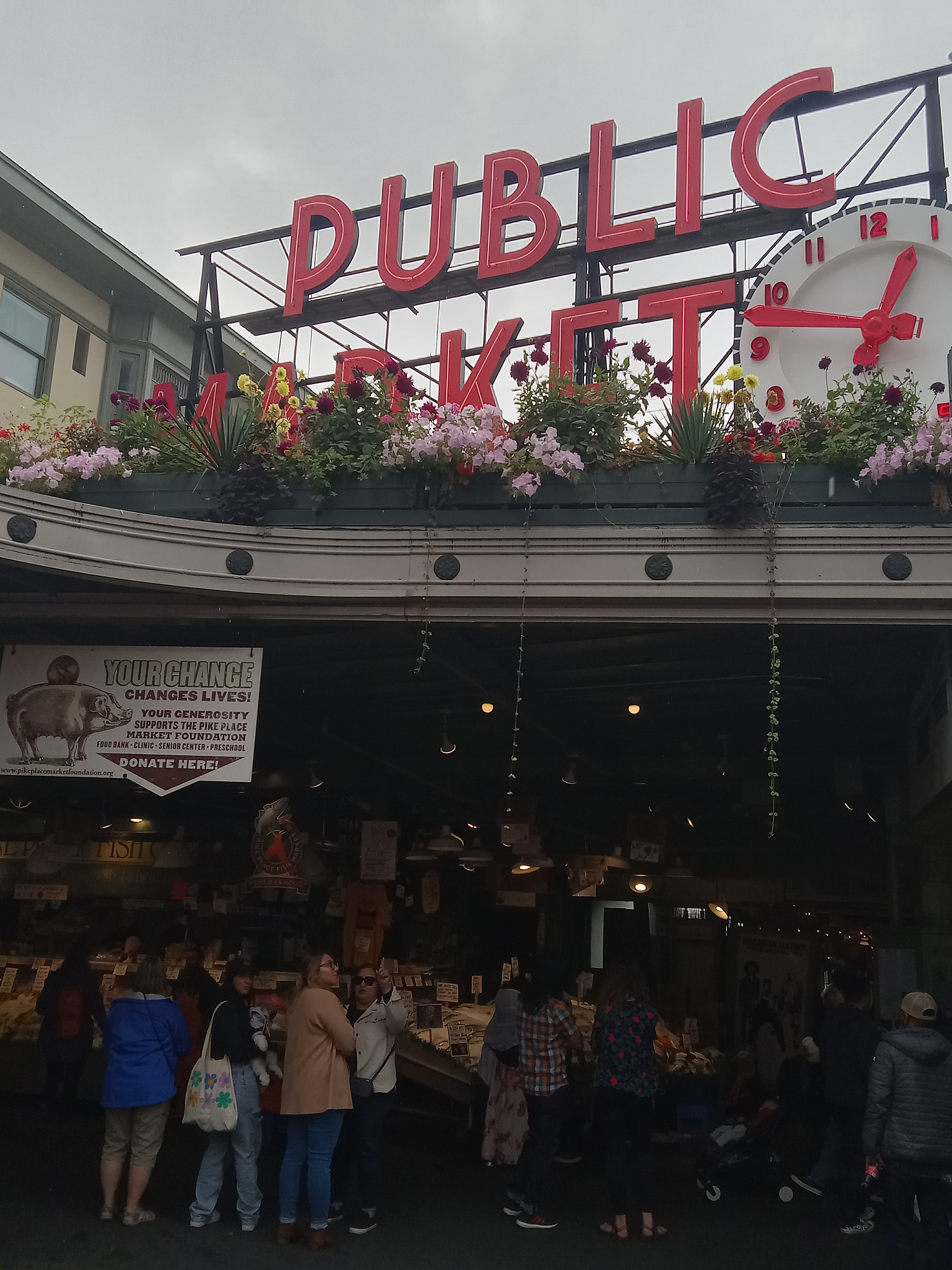
The Green Tortoise Hostel was fine, however, in a perfect location, on the corner of 1st and Pike, right across from the Pike Street Market.  As I already knew, it was too early to check in, but they let me store my bags and I went and sat down in the common room and called my friend, Diaz, letting him know I was in town.  Diaz and I had taught together at two different projects in Saudi Arabia, an oil company and a military base.  He’d been out of the country as long as I had, but had recently returned and was looking to stay in the area.  We made a plan to hook up later that afternoon.

To kill time, I headed across the street and walked through the market.  The last time I’d been in Seattle a bartender had mistaken me for a homeless man and started to shout at me.  I don’t know if that said more about the bartender, more about me, or more about the magnitude of the homeless crisis that they have on their hands, but I’d left there deeply rattled, not really caring if I ever came back to Seattle or not.  Yet, here I was walking around the Pike Street Market, only two days earlier thinking I’d be in Miami.  If you think God works in mysterious ways, you haven’t seen the way I operate.

A few hours later I was standing outside of the Green Tortoise Hostel, waiting for Diaz, who I hadn’t seen in a few years, when a guy who could’ve been Diaz if he’d been smoking crack that entire time, appeared on the opposite side of the street and seemed to be trying to get my attention.  No.  It wasn’t possible.  My mind was playing tricks on me.  A minute later, here came Diaz, looking very much like his normal self, still supporting the Dodgers, judging by the jacket he was wearing.  We walked over to an Irish Pub and talked about the difficulties of trying to adjust to life in the States again.  He was doing better than I was, having already lined up a part-time job with a local school district.  Before he left, I gave him a bobblehead of Big Red, or Dustin May, that I’d gotten at the Dodger’s game.  I’d never heard of him.  Diaz said that was because he’d spent most of his career on injured reserve, but his mom still liked him.  He’d give it to her.

Back at the hostel, my room was ready and I was pleased to see that once again I’d gotten a lower bunk, but this time the bed was more of its own little room, with electric outlets, a light, a fan, and a curtain that could be drawn, as opposed to your standard bunk with the metal ladder and squeaky springs.  I could’ve climbed inside it and slept for two days, but it was still so early I decided to take another walk instead. 

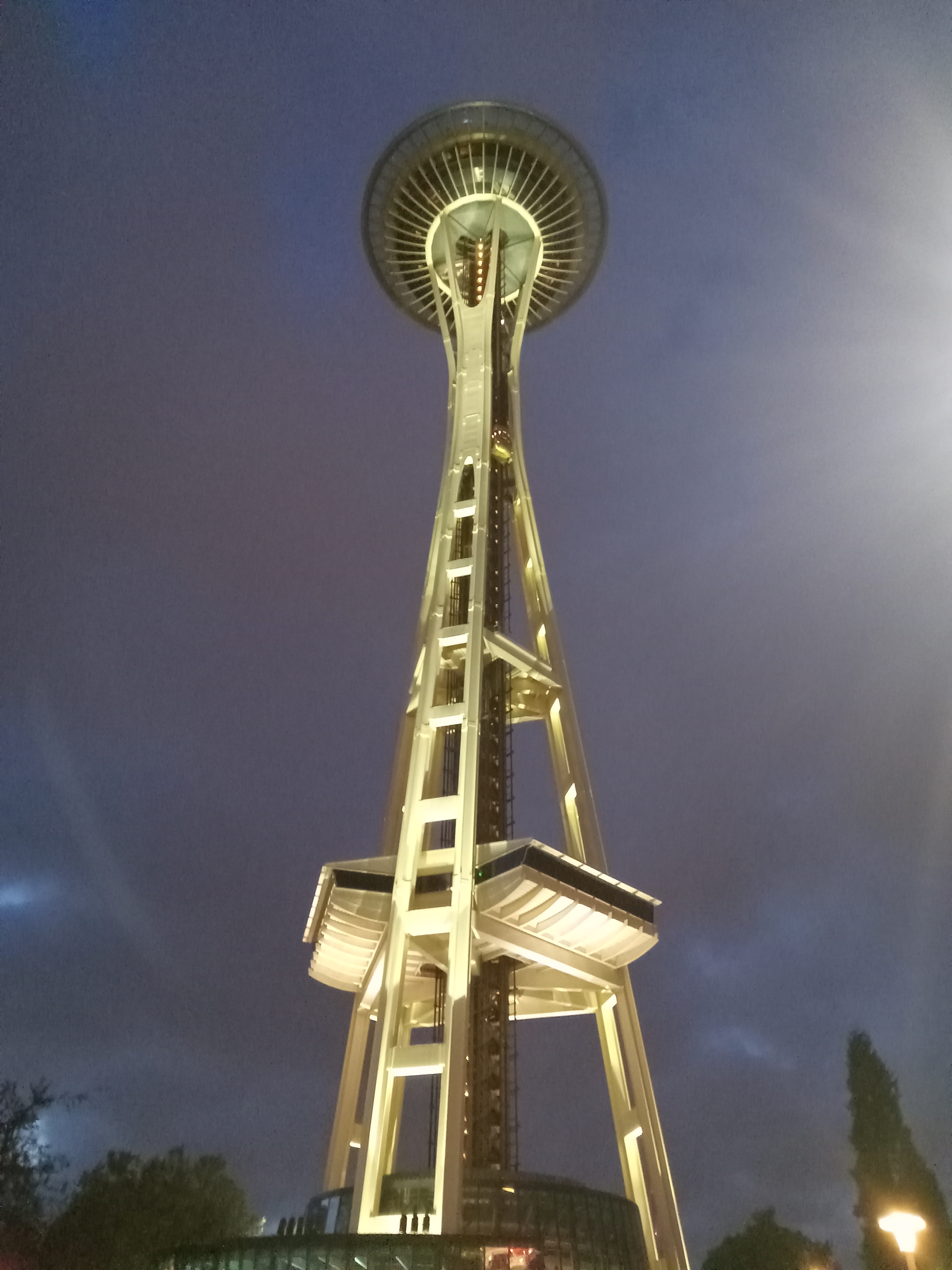
It was only a mile to the Space Needle, but I was dragging so badly it seemed to take a few hours to get there.  On the way back, I passed the same bar where the bartender had shouted at me two years earlier.  By now that was ancient history.  I limped back to Pike Street, passing the same crowd of junkies I’d seen earlier that day, outside of Target on the corner of 2nd Avenue.  When I got to the hostel, they were giving away free beer and the common area was packed with revelers.  They were young and had everything to celebrate.  I went up to the room alone, to enjoy the privacy while it still lasted.