back to the jewel 28

In Hawaiian mythology, a kupua is the son or the daughter of a god, a human blessed with supernatural strength or ability.  One of the most famous of these is Kamapua’a, or the Hog Man, one half hog, one half man, who was born to Hina as a piglet and cast out, only to be later rescued by his grandmother.  As a man he is handsome and tall, with a sparkle in his eyes.  It is said that he has bristles on his back which he hides beneath a cape.  He is a great romancer of women, his most notable paramour being the goddess Pele.  Some of the women he pursues turn into springs of water.  The males who try to stop him get turned into stone.

Kamapua’a is a shapeshifter, meaning he can change from man to animal and back.  In addition to the hog, he can also change into various plants and other animals.  He was able to escape the fires of Pele by turning into a fish.  Some adversaries were overcome by becoming a weed or vine and killing them from within.  Many popular landmarks are named for one of his legendary encounters or skirmishes, such as a point called Huluhulu-nui, or Many Bristles, where he is said to have once lost all the hair from his back.

There were two buses that traveled from Hilo to Kona, up the Saddle Road, past the volcanoes of Mauna Kea and Mauna Loa.  I decided to take the second one at 1:15 in the afternoon, and give myself the chance to sleep in.  Besides, taking the early one would mean I arrived too early to check into my room and would have to wait around.  For a departing gift, I actually got one night where it was quiet.  Ryan slept soundlessly on his side.  A third roommate who was supposed to check in never showed up.

When I went out in the morning, Jolene, the hippy woman living in a tent, was waiting in the lobby to see Joe.  She and another woman who had just arrived were talking.  When I said I was leaving, Jolene said she was sorry she hadn’t had to chance to hear me play my ukelele.  I got it out and played her a song of mine called The Fight.  Both women were very taken with it and suddenly had ideas for what I could do with my music if I stuck around. 

I knew better.  Departure ceremonies always create a sense of nostalgia for good times that never happened.  I’d come back to Hilo later, maybe when I had more money or some solid connections.

Right before I left, Ryan came out and gave me his address and phone number.  That was a bit touching.  I wasn’t sure how much he really knew about me, but he considered me a friend.  I guess we’d been going through hard times together, and after a week of sleeping three feet from someone you either grow fond of them or try to kill them.

I got to the bus station an hour early and bought a tuna sandwich and iced tea.  There were an assortment of sketchy characters sitting around outside with me.  When the first-class bus arrived, there were only ten of us onboard.  One man with a flat-top and rectangular head seemed able to block every view of the black volcanic landscape from his seat ahead of me.  Perhaps he was a kupua and that was his special power.  The guy in the seat across from me sat slumped against the window with his hat over his eyes.

It took about two hours to cross the Saddle Road.  When we reached the leeward side of the sun, resorts, malls, condominium complexes began to spring up.  The sunny vibe of Kona was made for tourism.  When the bus stopped, I needed to walk two miles to get to the hostel.  Now I was passing all of the families, men, women, children, couples, wearing Hawaiian shirts and beachwear.  I walked by the Marriott pulling my suitcase, the ukelele stacked on it, and felt the sweat soaking through my shirt.

The hostel, Kona Beach Huts, was clean and well kept up, but when they showed me the dorm I’d be sleeping in for four nights, I discovered that it was box-like and windowless.  Fortunately, there was a lower bunk open right beside the door.  As soon as I checked in, I headed out to Ali’I Drive to walk along Kailua and Oneo Bays.  The waves were green and blue with white caps.  Green succulents grew amidst black lava and white coral.

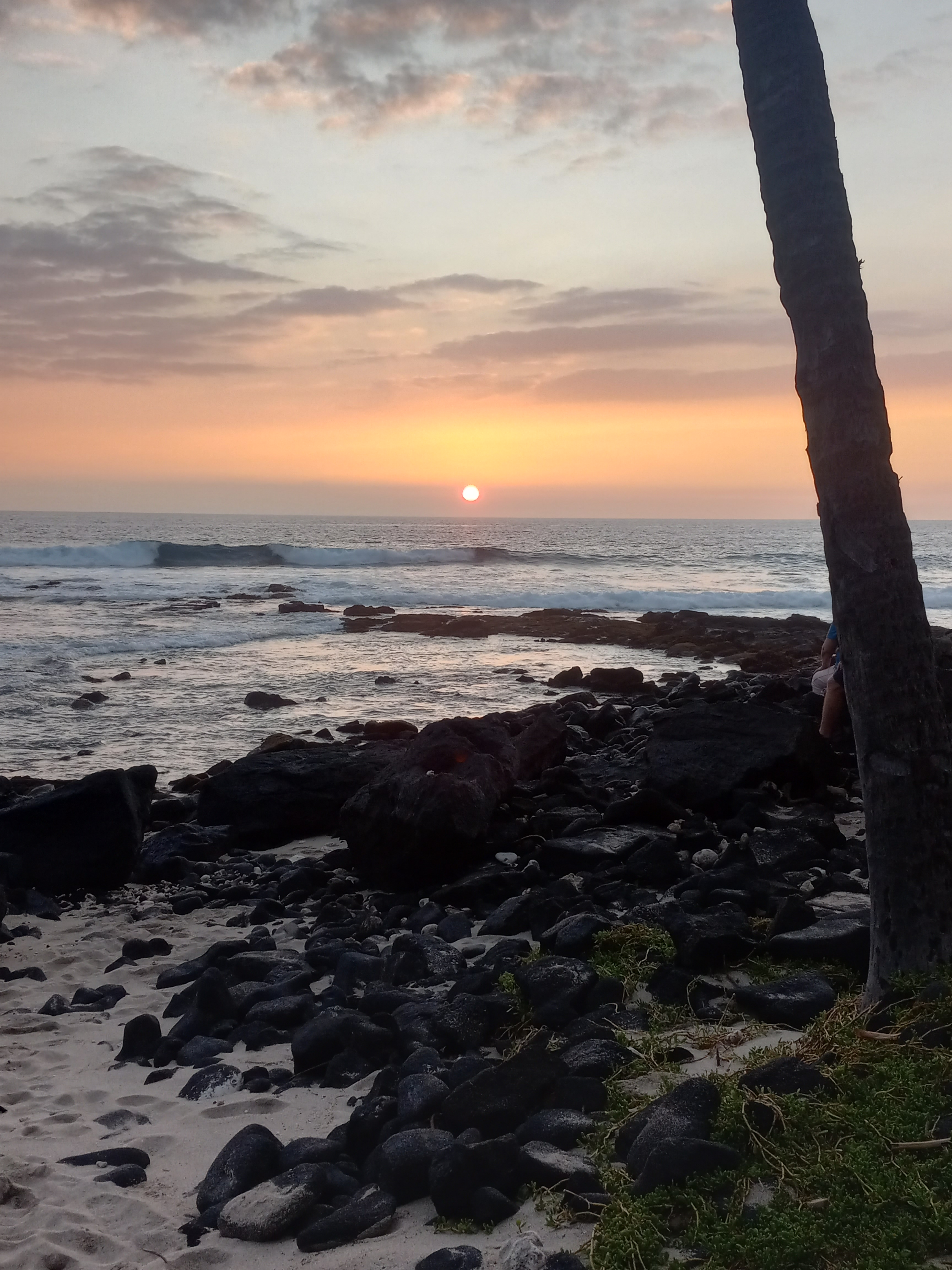
Around sunset, tourists began to descend with their cameras, anticipating a world-class sunset.  A ledge of clouds moved in, just at the last minute.  The sun remained white, sinking down through the clouds and then into the sea.

There were a few open patios at the hostel, and when I got back to it, I took my mythology book to sit outside and study.  Most of the travelers were young, having the vacation of their lives.  A family also occupied a few of the open seats.  The mood was merry and chatty.  Then a shadow darkened the wooden floor, and I saw a guy from the bus, the one who’d been passed out with his hat over his eyes, step across the threshold.  He was looking for something to mix with his drink.  His presence threw off the other travelers.  They didn’t know what to make of him.  He looked more like a homeless tramp than a tourist.

When he left, I saw him stumble across the yard and then go into my room.  I cursed under my breath, just imagining him in there.  It was even worse than I feared.  When I gave up my reading and called it a night, I found he was right above me, flat on his back, his shirt off, his stomach as bloated as a dead whale, a brown and grey beard that looked like roadkill, fanned out over his chest, and a series of impossibly grotesque grunts and snores, pouring from his open mouth.  I looked at a girl in the bed across from me who had her head wrapped up in her pillow in anguish.  My god I hated that man.

Some legends are just stories.  Others are out there running around.  That night I discovered Kamapua’a, the Hog Man, in the bunk above me, not tall, handsome, and charming, but short, sniveling, and conniving.  So repulsed was I by his squeaks, squeals, and phlegm-ridden bellows, that I spent the night spearing the underside of his bed with both feet, hoping to launch him into consciousness and over on to one side.  Right at sunrise, I went down to the beach with my ukelele and waited there until after check-out. 

When I got back, he was gone, thank God, but on the floor all around my bed were beard clippings, scraggly brown and grey hairs that he’d shaved off in one last great act of indecency.  Who he was off to terrorize next I couldn’t say.  If there was a bus to be ridden, he was sure to be passed out on it.  If there was a cheap bed to be found, he’d go on dreaming his terrible dreams.
back to the jewel 29

Maui is one of the most popular characters to come out of Hawaiian folklore, a trickster and hero, rather than a god, who accomplishes great feats that serve to better the condition of humankind.  Some of his exploits are similar to those of Prometheus, Atlas, and Hercules, in Greek mythology.  He is born after the goddess Hina goes searching for seaweed and finds a loincloth that she puts on.  After falling asleep in it she becomes pregnant.  When Maui is born, her husband, Akalana, recognizes the divinity of the child.

These are some of Maui’s most famous deeds.  First, he gets fire for man from the mud hens.  They are roasting bananas, but every time he gets close to them, they put out the fire.  They try to trick him when he demands that they show him the source of fire, but finally show him the right sticks to rub together.  Before leaving them, he smears red on their heads for trying to get the best of him.

Next, he is able to stop the sun from moving so fast across the sky.  He does this by sitting by a tree trunk and lassoing the sun’s rays.  The sun begs him to let it go, and in return makes a bargain to travel slower during the summer, thus insuring longer days.  He also pushes the heavens up from the earth for a woman in exchange for a drink from her gourd.

Once when he is fishing with his brothers, he throws out his magic fish hook and catches a giant ulua fish.  They fight for two days to bring it to the surface, but look back at the last minute and the line breaks.  Instead of one big fish, they wind up with a string of smaller ones.  That’s how the Hawaiian Islands were created.

As far as I was concerned, my ukelele was my magic hook, but I was far from accomplishing great deeds with it.  Mostly I’d spent the trip isolating, facing the waves, facing the jungle, trying to escape from others, escape from myself.  What is the worth of a song if no one hears it?  I’d spent my whole life trying to answer that question.  Does art have any value if there is no one to receive it?  I grabbed my ukelele and trudged down to the shore.

On this trip I suspected that I might be in trouble, so I’d brought along a bottle of anti-depressants that had only kept me up for nights on end a few months earlier.  I couldn’t afford to go down the tubes right now and lose all confidence.  I still had a week and a half to try to figure out some way to stay in Hawaii.  It wouldn’t work to run around frowning and scowling, but that’s where I was at. 

A few nights earlier I’d started taking the pills, but now, walking down Ali’I Drive with my ukelele, I suddenly got so dizzy I thought I was going to pass out.  I stopped at a park and lay on my back on the grass, staring up at the coconut trees swaying above me.   It was like a death scene in a movie, seen through the eyes of the victim.  I was ready to let go and go floating up into the clouds, but it wasn’t my time yet.  Life had more torture in store for me.

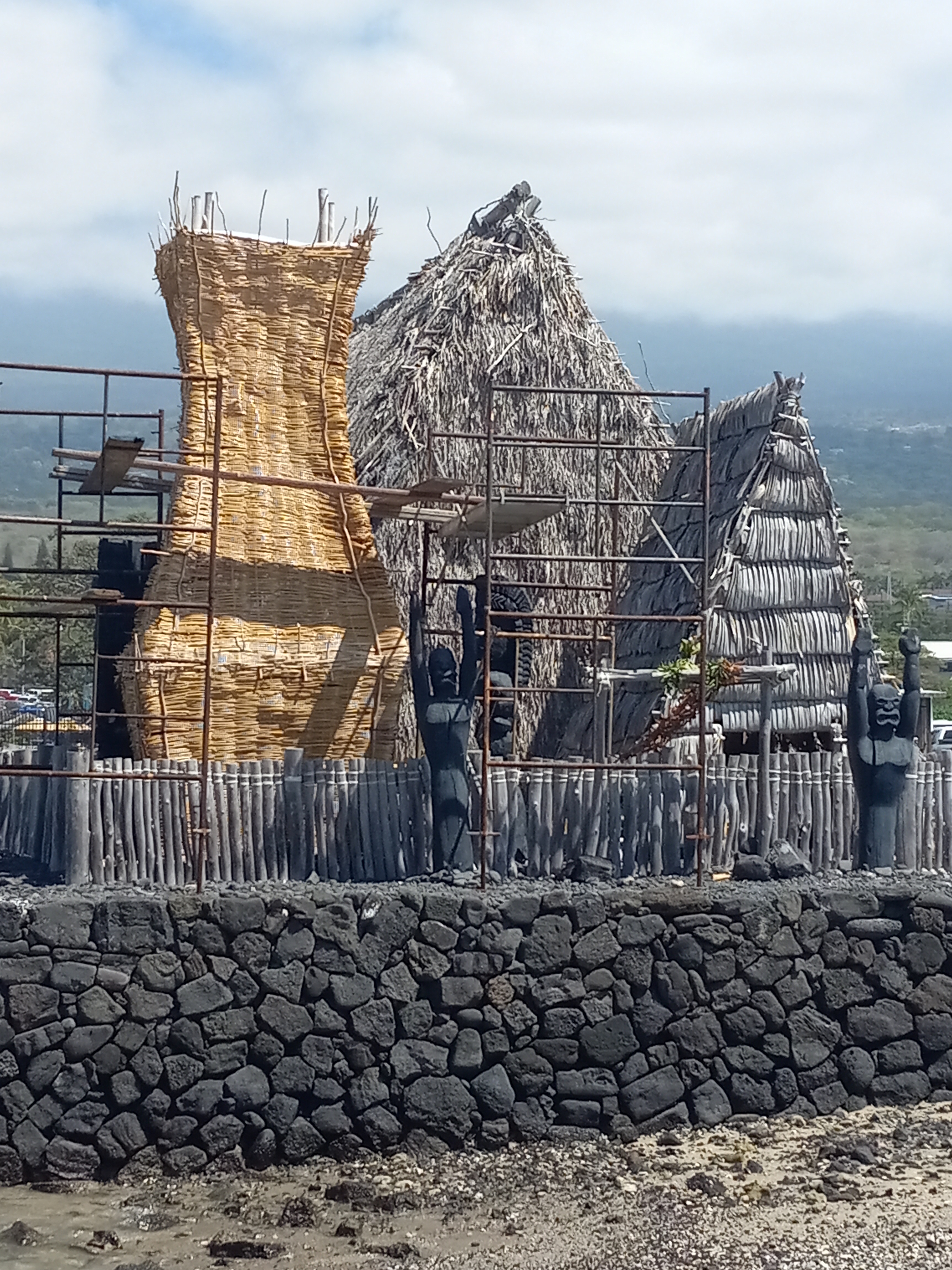
Eventually, I struggled to my feet and continued down to the Kailua Pier, where the first missionaries arrived in 1820.  There, across from the King Kamehameha’s Kona Beach Hotel, was the Ahuena Heiau, a recreation of a temple dedicated to Lono by the king himself.  It was similar to a temple that I’d wanted to revisit at the City of Refuge, but without a car had been unable to.  The temple was closed to foreigners, so I had to stand and look at it from the shore. 

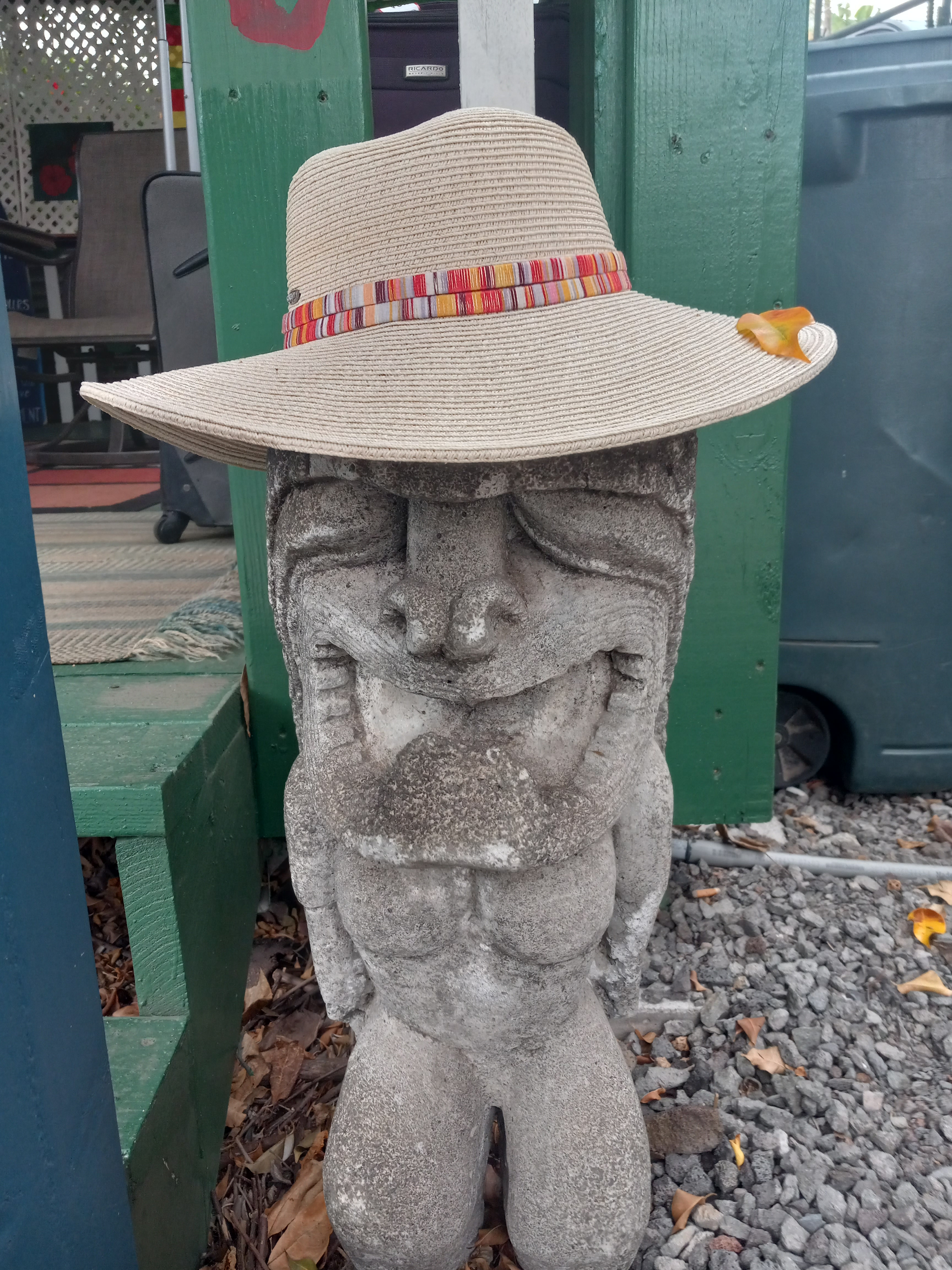
On a stone platform are three structures.  The Hale Mana is where the king met with his advisors.  The Hale Pahu housed the ceremonial drum.  The white tower, ‘A’nu’u was where the priests prayed and received answers from the gods.  There are various tikis outside of the building, the tallest being the god of healing. 

In their early years in Hawaii, my parents worshipped like natives, in that they were moved enough by the spirit to dance and let it all hang out.  They spoke in tongues, cast out demons, prayed for healing, believed in visions.  Then something changed.  Life happened.  The whole tribe had to grow up and get jobs.  We moved back to the mainland, started wearing shoes, enrolled in sports, registered to vote.  After a few years we were just another working-class family, living in the Midwest, barely standing out. 

Hawaii had changed as well.  I watched another cruise ship, backing up into the bay.

back to the jewel

With the addresses for all the places we’d lived at in Hawaii, the one I wouldn’t be able to track down was the one in Kona, since all I had for it was a rural route number.  Although it was a long time ago, I still had many memories of the commune called the House of David.  There were a lot of spaced-out hippies living in that house.  Not all of them knew how to deal with children. 

I remember driving into town and waiting outside of the post-office in the car one day and seeing a guy coming down the street towards me, so bald and strange, with a big, hoop earring, that he seemed to be an alien.  Now a sight like that wouldn’t even phase me, not like looking into a mirror, which would shake me to my core.

We could fit a lot of people into one house back in the day, but nothing like what the Kona Beach Huts hostel was squeezing into one room.  I was glad that Kamapua’a, the Hog Man, had moved on, but another strange old guy had just moved into a bunk across the way.  There were four German women taking up most of the other beds. 

One of them told how it was very strange.  In Europe if you stayed in a hostel. it was mostly young travelers.  In Hawaii, half the bunks would be taken up by old guys lying in bed.  I wasn’t sure if she was confiding in me or complaining about me.  The truth hurts and I was one of them.  What I wanted more than anything is to have my own room for a few days so I could shut the door and just stay inside.

That morning I went out with my ukelele and tried to meditate on a sea wall close to the hostel.  A guy was trying to snare a crab.  I took a deep breath and felt the mana of the sea fill my lungs.  For two and a half weeks I’d managed to play ukelele at least six hours a day and I wasn’t improving at all, just playing the same rhythm over and over, tinkering with a song I’d started on one of the first days.  There was a sound I could hear in my head, a dark, frightening, urban hula, a paradise gone to seed, the good vibes of the innocent days capsized by cruel invaders.

Instead of sitting in the sun, swimming in the sea, taking long nature hikes, I was experiencing the seedy, gritty side of the islands.  Not even knowing what to do with myself, I walked towards the old airport where there was supposed to be a beach park.  I wasn’t even wearing flip-flops.  Sweat was filling both my shoes.  When I got out there, I went to sit down by a baseball field.  As soon as I started playing my ukelele, a hobo crawled out of the dugout and asked me for a smoke.  Then I looked on the backside of the hill behind me and there was a whole tent-city of displaced people.  One of them rode towards me on a bike with a Hawaiian flag streaming behind him. 

That afternoon I got out my book and read about the great flood.  There are many stories from Hawaiian mythology that resemble myths from other countries and cultures, but this particular one, about a man named Nu’u who builds a large boat with a house on top of it to survive a flood, made me think that someone must’ve gotten a hold of a Bible at some point.  In this version, however, Kane, Lono, and Ku send him outside after the rain has stopped, and he finds himself on the summit of Maunakea.  He begins to worship the moon until Kane stops him and informs him who is really due the praise.  He goes on to have three sons and repopulate the land.

Towards sunset, I walked down to the beach, away from the crowds who began to line up on the main strip a half hour beforehand.  The beauty of Hawaii defies imagination.  On this night the sky was purple and pink, and the surf was turquoise with pink highlights.  Pay what you like, you couldn’t witness a finer sunset.  I sat on a chunk of black lava and watched the pinpoint of light that was the sun sink down into the sea.

back to the jewel 31

When my family was living in Palolo, the backyard opened up to jungle growing on the side of a mountain.  There were a few trails through the trees.  Walking through one of them my brother and I discovered a cave that was in the shape of a human skull.  What intrigued us about it, was that someone was keeping it clean, sweeping the floor and piling stones at the entrance.  One day when we walked up to visit it, we saw a vine swinging back and forth.  We figured it was menehune, the invisible little people of Hawaii, who were taking care of the cave and swinging on the vine.

The mu and the menehune are the little people of Hawaii, similar, perhaps to dwarves and elves.  The mu were hairy people, with bushes hair, beards and eyebrows, and round stomachs.  They fed on plant life and bananas and would steal food from campfires by piercing it with a stick.  The menehune were smooth people, about two feet tall, who also fed on plants and lived in caves.  It may be that the stories about them derive from a time when the generations were shorter and stockier.  They may also represent nature spirits, inhabiting the wao, or spiritual side of the mountain.

The menehune are credited with creating the fishponds and many of the early temples, especially the ones in hard-to-reach spaces.  It is possible that the temples, or heiaus were constructed by workers passing the stones along hand to hand.  It could also have been the mythical menehune working by night.

At one point the menehune began to intermarry with too many Hawaiians and were forced to migrate to preserve their blood line.  None of the expert craftsmen were allowed to stay behind.  Offerings are still made on some of the trails they are reported to have traveled on.  Certain rocks are thought to be petrified members of the party and they are considered to have magical powers.

It was another weird night.  I could only wish I was a kid again in the Palolo Valley, sleeping with my back to the mountain so the menehune couldn’t trouble my dreams.  By now I was a middle-aged man, lost in the world, sleeping in a dorm room on the Big Island, filled mostly with German women and one other dislocated crank who suddenly shouted out in agony when someone started snoring.  I’d seen the guy earlier, about my age, wearing Tevas and a floppy little beach hat, a loner among loners.  Left to my own devices, I could pass myself off as another traveler.  Two of us old guys in the same room made a crowd, however.  I wished he would move on.

It had been my idea at one point to visit all of the major islands of Hawaii, but prices were at an all-time high and I wasn’t enjoying myself.  All of my history was on Oahu and the Big Island, and if I decided to live in Hawaii, it would probably be on one of those islands.  My exploration was drawing to a close and things didn’t look good.  I had a little over a week until my flight back to Los Angeles.  Unless something improved dramatically, I would probably fly straight to Central America and hunker down there while I looked for my next job.  In the meantime, I booked a flight back to Oahu and another week at the Waikiki Beach Club, the first two nights in an expensive single, just because that’s all they had available.

I was comfortable in Kapiolani Park in Waikiki, and fit right in in Hilo, but Kona was too touristy, too many cruise ships and package tours going on.  The closest match for me was as one of the homeless residents.  I was just as dislocated, but not sleeping on the street.  Two more days seemed like a long time to kill.

That afternoon I walked up to Honi’s Beach, where the boogie board was invented.  On one day in the 1971, Tom Morey cut a nine-foot piece of foam in half, shaped it, and a new sport was born.  By now it was clear I was staying out of the water and wasn’t sure why.  I was just sticking to the ukelele, sitting by the ocean’s edge, trying to exorcise anxiety and gather some peaceful mana vibes. 

back to the jewel 32

Although cannibalism was practiced in Polynesia at one point in time, it was largely as a revenge in war, or to take on the energy of dead relatives.  Largely, it was outlawed.  Although it wasn’t a part of early Hawaiian culture, there are some tales of famous Man Eaters, usually outsiders who migrated to the islands.  In one such account a chief, Lo the Man Eater, arrives on Kauai with his people.  They are darker than the Hawaiians and have no tapu laws.  It is said that human flesh was devoured at their religious feasts.

Tattooed Lo has a beautiful daughter with hair down to her feet and sparkling teeth.  She gets married to a chief of Kauai and is later put to death for breaking one of the tapus.  In retaliation, the tribe of Lo have a cannibal feast and then flee to Hawaii.  They base themselves in the mountains of Haupu where the chief’s servant builds a house on a high cliff.  From this vantage point it is easy to throw travelers over the edge. 

The wife of the chief witnesses her own brothers eaten by Lo, but the younger one escapes.  He learns wrestling and returns to fight the servant.  Both of them fall to their deaths and Lo and his people are forced to relocate once again.

There was nothing left to do in Kona but walk around some more.  This time I walked south until I came to a bridge where a few locals were surfing in a channel.  I sat and dangled my legs over the edge, absorbing the energy they put into what was once called wave sliding.  It was forbidden for anyone but the royal family to surf back in the early days.  To break this tapu was punishable by death.

I returned to Honi Park for the sundown then started walking towards some music that was coming from the Royal Kona Resort.  They were in the midst of having a luau.  A luau is a Hawaiian tradition that goes back hundreds of years.  It is a feast meant to commemorate either a special occasion or one of the gods.  Women weren’t allowed to eat with the men until 1819, when Kamehameha II invited them to join.  A luau is traditionally eaten sitting on mats or leaves.  Often the food was eaten with the hands.

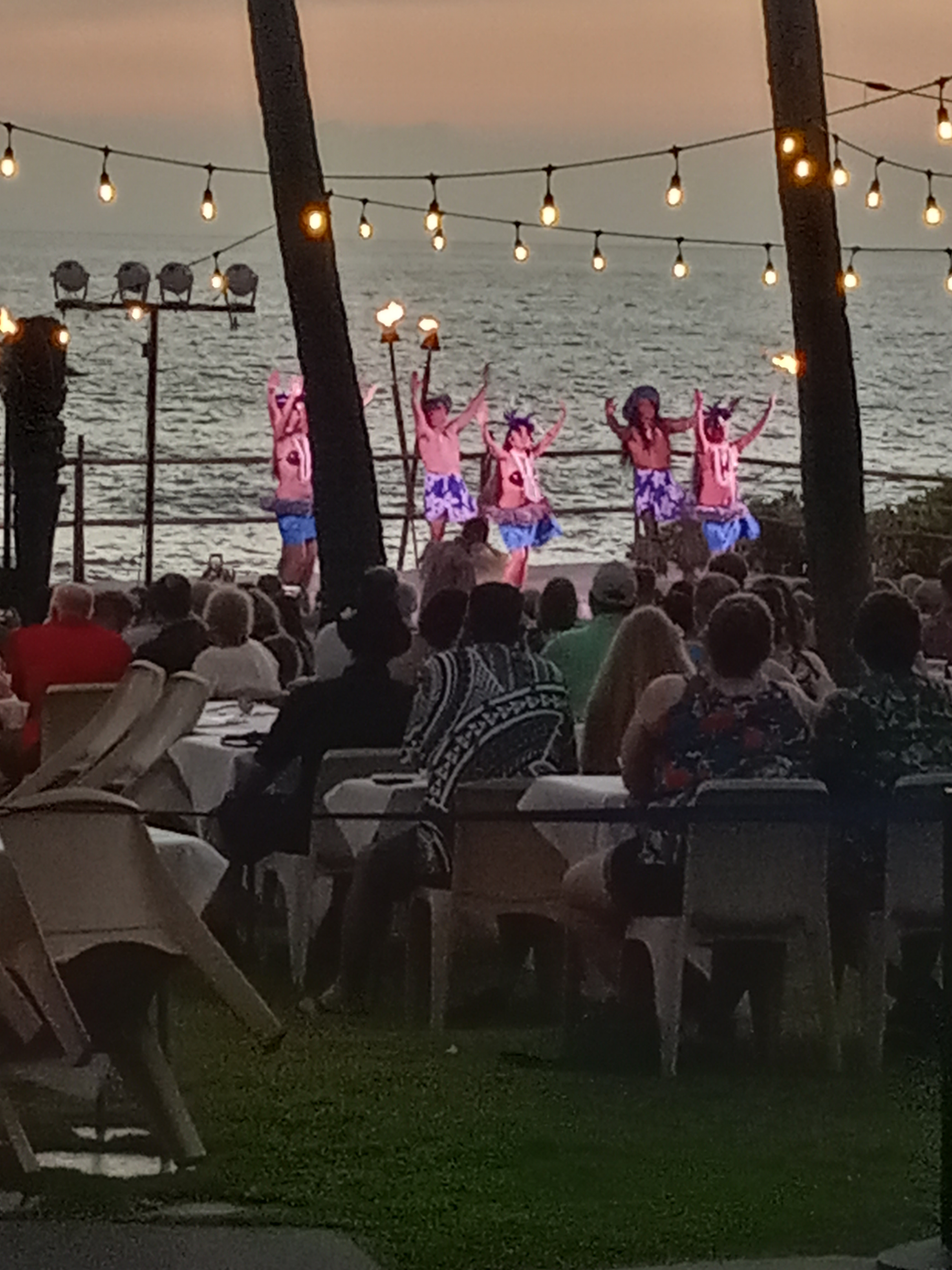
What I was witnessing was a version of a luau, the occasion being just another night at the Royal Kona.  Tourists sat in plastic chairs at plastic tables and ate from a buffet.  A dance troupe performed for them, doing the hula in the stage lights, later dimming the lights to dance with fire.  I had neither the budget nor inclination to join.  Instead, I walked over to an ABC store across the street and got a spam musubi and fruit drink.

That night I went and laid down as soon as it got dark.  I was flying to Honolulu in the morning and glad to be getting away.  There was a new guy in the bed above me who was drinking from a six pack.  An hour later the old crank, with his Tevas and floppy hat, entered the room and got into bed.  Almost as soon as he laid down the guy above me began to snore and the crank began to curse.  Here we go again, I thought.  By now I just wanted to get to Central America.  My only plan was to go where I could get the cheapest ticket, possibly Guatemala.  I wanted to get my own room and just stay inside it for a month. 

An older woman came in during the night with a dozen plastic shopping bags.  When I talked to her in the morning, I learned that she was hoping to relocate to Kona from California.  She’d spent some good years in Hawaii in her early twenties and was hoping to recreate them.  If the shopping bags were full of money, she’d might’ve stood a chance.  If not, I didn’t know what to tell her.

back to the jewel 33

Half of the passengers on the flight back to Oahu were in the military.  They had their own rows assigned to them.  A bossy Russian woman sitting next to me with a large family enlisted a few of the soldiers to help rearrange her bags in the overhead bin.  I was stricken with anxiety.  It was one of my greatest dreams in life to move back to Hawaii, yet I was flailing and floundering, unable to find a power source to plug into.  I’d scouted out Hilo a few times now but had failed to find the right connections or a way to get my foot in the door.  Now I had one last week in Waikiki that I didn’t even want.  It was clear now I was going to need to go to Central America to recuperate.

To get my mind off my troubles I perused my book on Hawaiian mythology.  There were many elaborate stories and multisyllable names that were hard to keep track of.  Still, I was getting some idea about the Native worldview prior to the arrival of the first missionaries in the 1800s.  What I read about now was the dog people.  They were described as being born with wagging tails.  They intermarried and didn’t descend from any chief clan.  The name for them was olohe.

The olohe were hairless dogs and lived in the sand mountains.  They had a mystical power, that of the big war dogs, and often appeared during the processions of spirits known as the marchers in the night.  They look like any other human but have the tails of dogs.  Some of them set themselves apart by tearing out their hair and coating their bodies in oil.  This is because they are esteemed wrestlers and bone-breakers.  Many of them are professional robbers and lie in wait for unsuspecting travelers among the high mountain passes.

A famous dog-like creature that resides in the Moanalua Valley on Oahu is called Poki.  Travelers go out of their way to avoid passing through his territory.  He is considered to be something of a ghost god in that his form sometimes appears in the clouds, accompanied by the wailing of many dogs.  The Hawaiians believed that animal shapes in the clouds, which they called oila, could be used to predict the moves of chiefs who were their kupua descendants.

When we landed in Honolulu, I picked up my bag and called for an Uber.  The price was almost the same as the tourist shuttle.  Pulling up in front of the Waikiki Beach Club was depressing.  All I wanted was to get into my private room and shut the door.  The woman at the reception checked me in then walked me up to the room to make sure that they key code that she’d given me worked. 

There was a tweaker standing outside of it, pulling on the doorknob in vain, one of my new roommates, apparently.  She opened the door, and he came in and started messing around with some bags on a lower bunk in the dorm area.  My room was past the shared bathroom, private, but not worth a hundred dollars a night.  At least I could lock myself in it and not have to deal with the likes of the guy in the dorm, talking and singing to himself.  It was like he was performing a jazz concert in his mind.

For a long time, I just laid down on my bed and stared at the ceiling.  Then I got up and walked down to the ABC store to get a hot dog and 7-Up.  Kalakaua Avenue seemed bleaker than usual.  I walked up to the Duke statue and then turned around and walked back on the beach side.  I was sitting on a bench with my camera when a young homeless guy came up and accused me of filming him.  He had a prediction for me about how the world was going to end, with a big bomb blast, and it wouldn’t be long now.

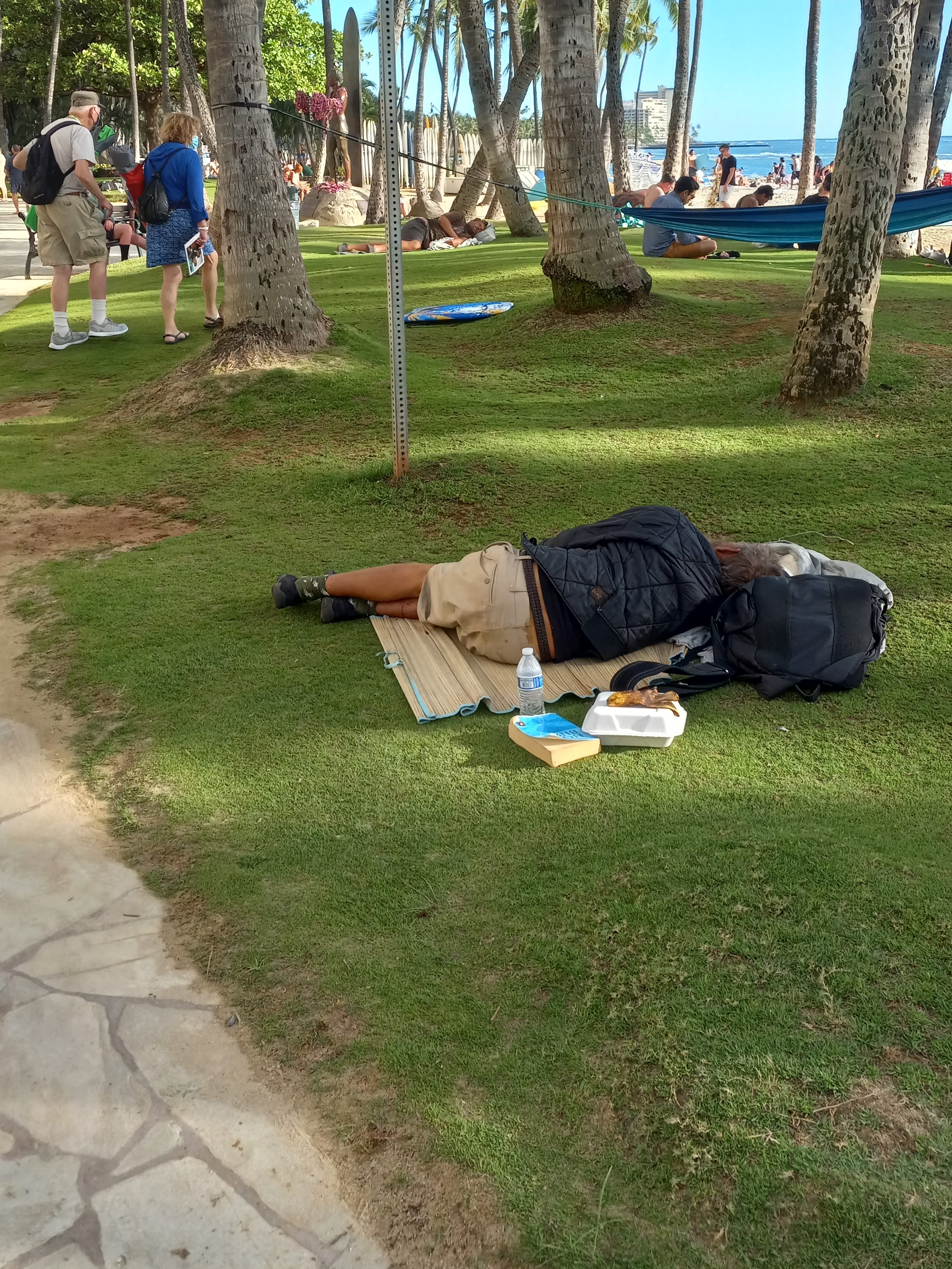
I walked over to the empty hula stage and saw another man lying on the ground who looked like he was suffering from leprosy.  He was filthy and emaciated, with no hair, and scabs all over his body that the flies were buzzing around.  He was hugging himself and begging for cigarettes.  It was impossible to imagine that society would just let him lie on the ground like that.

A little further down the strip was an old shop that a lot of homeless people were squatting around.  A kid was lying on his side in the grass.  Two guys were sharing a beer.  A woman suddenly leaned over and vomited all over the ground.  She tried to change her location when she was done and ended up dragging herself through it.  I went back to my room just happy to have a place to lie down.

back to the jewel 34

For the next two days I just stayed in bed.  I was depressed and full of dread about the future.  At one point I cracked the curtain open and bright sunlight came streaming into the room.  It took my eyes a little while to adjust.  When they did, I saw a bald-headed, shirtless freak making his way towards the hostel.  When I wanted to use the bathroom, someone had locked themselves in.  All I could hear was the crinkling of a plastic bag.  It must’ve been the tweaker from the day before. 

It was time to move into a regular dorm room for the remainder of my trip.  I went down to the lobby after check out time and the woman working at the desk set me up in a room on the top floor.  Someone had just checked out so a bottom bunk was open.  I stashed my things on it and went down to the park with my ukelele.  So far, I had played it on the south side of Oahu and both the east and west coasts of the Big Island.  The next day I would take it up to the North Shore to make sure I got all four directions in.

There was a picnic table beneath a banyan tree close to the zoo that had become my spot.  It was off the beaten track so rarely occupied.  Sometimes people would pass by and flash me a shaka sign, meaning hang loose, or right on.  Though I hadn’t made many connections and considered the trip to be a failure in a lot of ways, almost everyone had been generous when they saw me sitting there playing a ukelele with no ulterior motive.  It was what I was born to do, come hell or high water. 

That evening I was still in the park, when I heard some loud music coming from the sea and walked over to investigate.  It was a hula group, two drums and an electric ukelele, practicing their dance in the diminishing daylight.  There must’ve been fifty dancers, slowly fading from sight in the enveloping darkness.  It felt like I’d stumbled across a procession of night marchers, the ghosts of Hawaiian warriors and ancestors.  According to legend, they begin their march at sunset and continue until sunrise.

You can identify the night marchers by the sound of conch shells and the sight of torches that grow larger as they draw closer.  There is also supposed to be a foul odor that accompanies them, that of death.  To run into them is deadly.  Barriers cannot stop them.  The only way to be saved from a violent death is to prostrate oneself on the ground.  There is a chance too that one of the marchers will recognize you and call out to spare your life. 

I was born in Hawaii and had a ukelele strapped to my back.  Did that mean I was one of them?  No.  I had missed out on too many formative experiences when we’d moved to the mainland.  Would I ever be considered an honored guest, however.  Perhaps, that day would come.  Hawaii might recognize me yet.